
数字孪生技术

Search documents
科技日报:“十四五”时期我国数字孪生水利体系框架基本形成
Shui Li Bu Wang Zhan· 2025-12-22 06:37
Core Viewpoint - The Ministry of Water Resources of China has made significant progress in building a digital twin water conservancy system, which provides strong technical support for high-quality water conservancy development and national water security [1] Group 1: Digital Twin Water Conservancy System - The digital twin water conservancy system framework has been basically formed, consisting of digital twin watersheds, digital twin water networks, and digital twin water conservancy projects [1] - The integration of big data, cloud computing, and artificial intelligence with water conservancy operations allows for intelligent simulation and scheduling, enhancing disaster prevention and water resource management [1] Group 2: Implementation and Achievements - A total of 94 pilot tasks for digital twin watershed construction have been completed, resulting in replicable cases, while 14 provincial-level water network pilot areas are advancing in phases [1] - Key projects such as the digital twin of the Three Gorges, South-to-North Water Diversion, and others have been put into practical application [1] Group 3: Integrated Monitoring System - The Ministry is accelerating the construction of an integrated monitoring and perception system that covers all elements of water management, utilizing 34 remote sensing satellites, over 180 rain radar, and more than 136,000 ground hydrological stations [2] - This system enables intelligent monitoring and perception of the entire process of water governance and management [2] Group 4: Disaster Prevention and Water Resource Management - Digital twin technology has provided critical support for scientific and precise scheduling of watershed engineering systems during significant flood events, such as the major floods in the Haihe and Pearl River basins [2] - In the context of reduced water inflow during the main flood season in the Yangtze River basin, the technology helped achieve a record high of 108.1 billion cubic meters of water storage in 58 controlling reservoirs [2] - The digital twin South-to-North Water Diversion project has ensured safety in engineering, water supply, and water quality, while the digital twin irrigation areas have improved water resource allocation and irrigation efficiency [2]
面对面丨百年故宫如何再出圈
Xin Lang Cai Jing· 2025-12-21 19:39
Core Viewpoint - The Palace Museum is celebrating its centenary in 2025, marking its transformation from an imperial palace to a national museum, and emphasizing its role as a global cultural heritage site [1]. Group 1: Historical Significance - The Palace Museum was established on October 10, 1925, and was listed as a UNESCO World Heritage Site in 1987, representing a significant cultural evolution from national memory to a shared human heritage [1]. - The museum has preserved 1.95 million cultural relics, forming an invaluable cultural treasure alongside the ancient architectural complex [75]. Group 2: Future Vision - Wang Xudong, the seventh director of the Palace Museum, emphasizes the importance of looking ahead 10 to 20 years to ensure sustainable development and cultural preservation [41]. - The museum aims to become a key base for patriotic education and a vital window for understanding Chinese civilization [75]. Group 3: Cultural Heritage Protection - The museum is actively involved in establishing an International Standardization Organization for cultural heritage protection, promoting global sharing and respect for human civilization [44]. - The integration of modern detection technology with traditional restoration methods has positioned the Palace Museum at the forefront of global cultural heritage protection [73]. Group 4: Digital Transformation - The "Digital Palace" initiative aims to preserve information and lay a solid foundation for cultural dissemination, with over 1 million cultural relics digitized [51]. - Digital technologies are being utilized to create engaging cultural products, enhancing public interaction with the museum's collections [45][51]. Group 5: Restoration Practices - The restoration approach emphasizes minimal intervention, focusing on preserving historical authenticity while ensuring safety [64]. - The ongoing restoration of the Yangxin Hall involves meticulous work on over 450 cultural relics, highlighting the complexity and dedication required in heritage conservation [69]. Group 6: Public Engagement - The "Hundred Years of Guardianship" exhibition showcases significant cultural relics and aims to deepen public understanding of the museum's history and mission [85]. - The exhibition has attracted numerous visitors, reflecting the strong cultural appeal and commitment of the Palace Museum staff to their roles as guardians of heritage [85].


2025年全球液压行业发展现状及趋势概况 全球液压行业市场规模约为535亿美元【组图】
Xin Lang Cai Jing· 2025-12-21 04:15
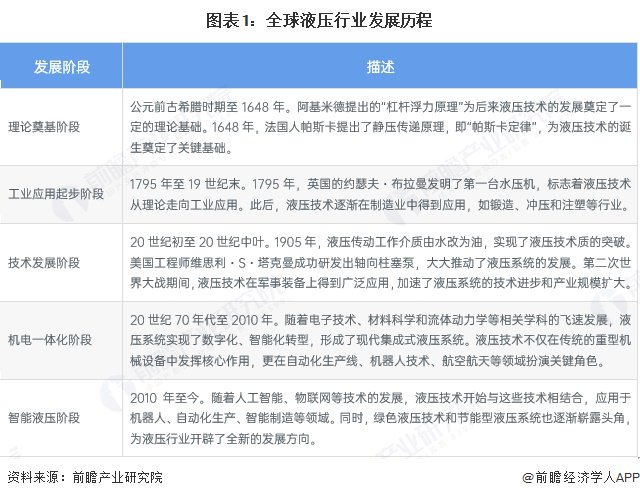
Core Insights - The global hydraulic industry has a projected market size of approximately $53.5 billion in 2024, with a compound annual growth rate (CAGR) of 5.3% from 2021 to 2030, expected to exceed $69.4 billion by 2030 [7][10]. Industry Overview - The hydraulic industry has evolved through various stages, including theoretical foundations, industrial applications, technological breakthroughs, integration with electronics, and a shift towards intelligence [2]. - The industry plays a crucial role in global industrial development, characterized by advanced technology and widespread applications [2]. Application Distribution - The industrial sector accounts for a significant portion of hydraulic applications, with an estimated share of about 56% in 2024. This sector includes fixed industrial equipment and production lines [3]. - The mobile sector includes hydraulic systems used in movable machinery such as excavators, cranes, and agricultural equipment [3]. Product Distribution - Pump products dominate the hydraulic components market, holding a market share of approximately 28.1%, driven by high demand across various industries and continuous technological advancements [4]. - Valve products account for about 22.5% of the market share [4]. Market Trends - Emerging applications such as hydraulic systems for offshore wind installation vessels and hydraulic energy storage plants are experiencing significant demand growth [7]. - Key technological trends include energy efficiency, lightweight design, and intelligent connectivity, with companies increasing R&D investments in smart hydraulic systems and predictive algorithms [9]. Regional Insights - The Asia-Pacific region is identified as the largest consumer market for hydraulic products, while Europe and North America focus on high-value customized products, maintaining technological barriers in precision hydraulics and electro-hydraulic integration [9].


打通民营经济“任督二脉”
Xin Lang Cai Jing· 2025-12-19 22:31
Group 1 - BaiShanCloud has over 64% of its employees in R&D, with more than 800 patent applications, of which over 450 have been granted, and it was selected as one of the "Top 500 Private Enterprises for Invention Patents by 2025" [1] - Dongfeng Antimony Industry Co., Ltd. focuses on the antimony industry, integrating technological innovation throughout the entire industry chain, and currently holds 56 patents, including 5 invention patents and 51 utility model patents [1] - Dongfeng Antimony's products are exported to over 50 countries and regions, including the USA, UK, South Korea, and Japan, and it achieved an 80% revenue growth rate, ranking sixth in the "2025 Guizhou Growth Star Enterprises List" [1] Group 2 - Guizhou Huatai Zhiyuan Big Data Service Co., Ltd. specializes in the research and innovation of digital twin technology, providing comprehensive services in digital twin scenarios, metaverse scenarios, and data asset management [2] - The company is accelerating its layout in the low-altitude economy by developing a low-altitude monitoring network and core algorithms for forest fire prevention and control using drones [2] - During the "14th Five-Year Plan" period, Guizhou has cultivated 1,587 innovative SMEs, 82 specialized and innovative "little giant" enterprises, and 13 manufacturing champions, contributing significantly to the province's economic development [2]
大族锂电王瑾:激光能把锂电制造带到哪一步?
高工锂电· 2025-12-19 11:41
Core Viewpoint - The lithium battery industry is transitioning from a phase of rapid growth to one focused on efficiency, quality, and certainty, with equipment reliability becoming a key determinant of manufacturing capacity [1][5]. Group 1: Industry Trends - In the first ten months of 2025, China's total battery production reached 1,292.5 GWh, a year-on-year increase of 51.3%, with power battery shipments at 578.0 GWh, up 42.4% [5]. - By 2030, global shipments of new energy passenger vehicles, commercial vehicles, and energy storage batteries are expected to exceed 2,000 GWh, nearly 700 GWh, and 1,400 GWh, respectively [5]. - The industry is facing structural challenges such as capacity oversupply, price competition, declining profit margins, and uncertainties in international trade [5]. Group 2: Role of Laser Technology - Laser technology has evolved to become a critical process in lithium battery manufacturing, with applications in laser welding, cutting, cleaning, and drying [6][7]. - Dazhu Laser has developed a comprehensive industrial laser system, including various types of high-power fiber lasers and supporting equipment, to provide complete laser welding solutions [7]. Group 3: Innovations in Manufacturing - The "flying welding" solution allows for systematic approaches to pushing production limits, enhancing efficiency and stability in the manufacturing process [8]. - Real-time monitoring systems for welding quality are becoming essential, utilizing optical sensors to detect defects and ensure consistent quality during production [9]. Group 4: Importance of Equipment Reliability - Equipment manufacturers must provide reliable, stable, and energy-efficient solutions to ensure production continuity and product consistency, which are critical for long-term cost management [11]. - Dazhu Laser emphasizes self-research in core components and aims for "delivery equals production" through digital twin technology [11]. Group 5: Future Challenges and Opportunities - As new battery technologies like solid-state and sodium-ion batteries emerge, equipment manufacturers will face challenges related to process unknowns and material sensitivities [12]. - The role of equipment is shifting from merely implementing existing processes to actively participating in technology definition and industrialization pathways [12].


十大国产PLM系统,全球供应链协同款!
Sou Hu Cai Jing· 2025-12-18 18:28
Core Insights - The article emphasizes that Product Lifecycle Management (PLM) systems are no longer exclusive to large multinational corporations but are increasingly being adopted by Chinese manufacturing enterprises to enhance their core business processes [2] - Domestic PLM systems are designed to address complex global supply chain challenges, offering unique advantages in aligning with local operational models and facilitating cross-regional and cross-enterprise collaboration [2] Group 1: Collaborative Capabilities of Domestic PLM Systems - To assess whether a PLM system possesses the "global supply chain collaboration" capability, it is essential to examine its internal logic architecture that supports the entire lifecycle data flow from concept to disposal [3] - A significant barrier to global collaboration is "data silos," where different departments may not be able to access or utilize the same data effectively. A robust PLM system acts as a powerful data hub, enforcing a single source of truth for all participants [4] - Real-time and transparent data synchronization in PLM systems helps avoid rework and waste caused by information delays, with experts noting that the success of PLM implementation largely depends on the standardization and unified management of data [4] Group 2: Process Integration and Automation - The core value of collaborative PLM lies in managing processes rather than just outcomes, enabling the automation of complex engineering change processes and new product introduction workflows [5] - In a collaborative PLM environment, all relevant personnel receive tasks and can view change details, comment, and approve online, significantly speeding up decision-making and ensuring compliance and consistency in processes [5] Group 3: Overview of Leading Domestic PLM Systems - The article identifies ten prominent PLM systems in the domestic market based on market share, technological advancement, industry reputation, and supply chain collaboration features [6] - CAXA PLM is highlighted as a leading solution, providing an integrated platform that connects design and manufacturing processes, showcasing its capability to manage complex product data effectively [9] - Other notable systems include Yonyou PLM, Kingdee PLM, and Siemens Teamcenter (localized version), each with unique strengths tailored to specific industries [9] Group 4: Future of PLM Systems - The evolution of domestic PLM systems is increasingly focused on "global supply chain collaboration," which is essential for maintaining resilience and agility in a competitive global landscape [10] - The integration of technologies such as artificial intelligence, industrial internet, and digital twin technology is expected to make PLM systems more intelligent and proactive in predicting supply chain risks and optimizing R&D paths [10]

五一视界(06651.HK)拟全球发售2397.52万股H股 预计12月30日上市
Ge Long Hui· 2025-12-17 23:33
Group 1 - The company, Wuyi Vision (06651.HK), plans to globally offer 23.9752 million H-shares, with 1.1988 million shares available for sale in Hong Kong and 22.7764 million shares for international placement [1] - The offering period is set from December 18 to December 23, 2025, with a proposed share price of HKD 30.5 per share, and trading on the Hong Kong Stock Exchange is expected to commence on December 30, 2025 [1] - The company specializes in digital twin technology, focusing on three core areas: 3D graphics, simulation, and artificial intelligence [2] Group 2 - The digital twin technology creates high-precision virtual replicas of physical objects or systems, allowing users to observe, analyze, and predict behaviors and changes over time [2] - The company provides digital twin solutions across various industries, including urban planning, water resource management, energy, automotive, transportation, robotics, entertainment, and social media [2] - The estimated net proceeds from the global offering are approximately HKD 652.8 million, assuming the over-allotment option is not exercised, with 80% allocated for R&D initiatives, 10% for marketing activities in China and overseas, and 10% for working capital and general corporate purposes [3]
五一视界(06651) - 全球发售
2025-12-17 22:22
北京五一視界數字孿生科技股份有限公司 Beijing 51WORLD Digital Twin Technology Co., Ltd. (於中華人民共和國註冊成立的股份有限公司) 股份代號 : 6651 全球發售 聯席保薦人、整體協調人、聯席全球協調人、聯席賬簿管理人及聯席牵頭經辦人 整體協調人、聯席全球協調人、聯席賬簿管理人及聯席牵頭經辦人 聯席賬簿管理人及聯席牵頭經辦人 北京五一視界數字孿生科技股份有限公司 Beijing 51WORLD Digital Twin Technology Co., Ltd. Beijing 51WORLD Digital Twin Technology Co., Ltd. 重要提示 閣下如對本招股章程的任何內容有任何疑問,應諮詢獨立專業意見。 北京五一視界數字孿生科技股份有限公司 (於中華人民共和國註冊成立的股份有限公司) 全球發售 全球發售的發售股份數目 : 23,975,200股H股(視乎超額配股權行使與否而定) 香港發售股份數目 : 1,198,800股H股(可予重新分配) 國際配售股份數目 : 22,776,400股H股(可予重新分配及視乎超額配股權 行使與否而定 ...
搭载“鸿鹄混动”技术 一汽红旗发布大五座混动SUV HS6 PHEV
Yang Shi Wang· 2025-12-17 09:57
Core Viewpoint - The launch of the new generation flagship SUV, Hongqi HS6 PHEV, marks a significant step for Hongqi in combining traditional craftsmanship with modern innovation, aiming to enhance family mobility and safety [1][4]. Group 1: Product Launch - Hongqi officially launched the HS6 PHEV on December 16, offering three variants: 145 Intelligent Hybrid version priced at 178,800 yuan, 240 Intelligent Hybrid version at 198,800 yuan, and 220 Four-Wheel Drive Intelligent Hybrid version at 228,800 yuan [1]. - The HS6 PHEV is positioned as a large five-seat flagship SUV with a length of 4,925 mm and a wheelbase of 2,925 mm, featuring a design that incorporates elements of Chinese culture [4]. Group 2: Safety Features - The vehicle is built with a high-strength body structure, including a "golden bell jar" protection system, enhancing collision safety with features like a central airbag and dual pre-tensioned seat belts [4]. - The HS6 PHEV meets new national safety standards with its "Konggang Fortress Battery System" and maintains a low-emission interior environment with formaldehyde levels controlled at 0.05 mg/m³ [4]. Group 3: Powertrain and Performance - The HS6 PHEV is equipped with Hongqi's "Honghu Hybrid" technology, featuring a 1.5T efficient engine with a minimum fuel consumption of 5.1 L/100 km under WLTC conditions [6]. - The vehicle boasts impressive performance with a 0-100 km/h acceleration time of just 4.8 seconds and maintains power stability with less than 5% performance degradation under varying battery levels [6]. Group 4: Technology and Innovation - The HS6 PHEV incorporates advanced technology, including the Qualcomm 8295P chip, dual 15.6-inch screens, and a 30-inch AR-HUD, supporting continuous dialogue and semantic understanding [6]. - The vehicle features a comprehensive driving assistance system for both highway and urban navigation, along with multi-scenario parking assistance [6]. Group 5: Production and Quality Control - The production process utilizes digital twin technology for quality monitoring, ensuring strict precision control and multiple tests before the vehicle is released [8]. - Alongside the vehicle launch, Hongqi has introduced various purchasing incentives to lower the barriers for customers [8].

民航科普基金会“机场数字孪生建模与仿真优化研究”项目结题会议暨智慧民航新政策新技术研讨会顺利召开
Zhong Guo Min Hang Wang· 2025-12-16 06:50
中国民航网讯:12月15日,民航科普基金会专项研究项目"机场数字孪生建模与仿真优化研究"结题会议 暨智慧民航新政策新技术研讨会顺利召开。民航局公安局、民航科普基金会、首都机场股份公司等单位 有关领导和专家,以及项目承担单位民航管理干部学院大数据与人工智能系课题组成员参加会议。 会议对项目研究成果进行了汇报。该项目紧密围绕机场运行管理和消防安全实际需求,依托机场运行管 理新模式与数字孪生关键技术,构建了面向航站楼旅客流程的仿真原型系统,并采集真实人流数据,对 典型机场安全应急和疏散场景开展仿真分析与论证,为提升机场风险防范能力和运行保障水平提供了有 益探索。 会议指出,机场作为人员高度密集、空间结构复杂、运行要素高度耦合的公共场所,安全运行和管理责 任重大。项目紧扣机场运行和消防安全管理实际需求,围绕数字孪生建模与仿真优化展开了系统性研 究,取得了积极进展,相关成果对公安机关参与机场消防安全管理和应急处置工作具有较强的参考价 值。 民航科普基金会项目负责人表示,该项目科研紧扣智慧民航建设和民航数字化转型发展需求,以机场数 字孪生这一前沿技术为核心,将"虚实映射、仿真分析、辅助决策"等技术逻辑与机场运行管理实际场 ...