
核聚变能源

Search documents
到安徽去 做合伙人!——上市公司优强企业安徽行
Shang Hai Zheng Quan Bao· 2025-11-07 22:43
Core Insights - Anhui is becoming a new highland for enterprise investment and development, driven by innovation and open collaboration [2][3] - The series of visits organized by Shanghai Securities News has been recognized as a "2.0 version" of investment attraction in Anhui [2] - The provincial government aims to strengthen communication and create a first-class business environment to support enterprises and investors [2][3] Group 1: Investment Opportunities - Companies are exploring deep connections with Anhui's strong industrial base for collaborative development [4][5] - The 2025 World Manufacturing Conference in Hefei highlighted significant investment potential, with 932 projects and a total investment of 424.6 billion yuan [4] - Enterprises like Aolaide and Meier Technology are looking to establish R&D and manufacturing bases in Anhui to leverage local partnerships [4][5] Group 2: Industry Collaboration - Companies are interested in establishing R&D platforms and enhancing capital cooperation to support Anhui's high-quality development [8][9] - The focus is on strategic emerging industries such as artificial intelligence, low-altitude economy, and digital finance [6][7] - Collaboration proposals include integrating chip testing services and developing logistics systems for the semiconductor industry [7] Group 3: Government Support and Infrastructure - Business leaders emphasize the need for improved talent policies and infrastructure development to enhance the investment environment [10] - Suggestions include optimizing market access and supporting private enterprises in major projects [10][9] - The government is encouraged to create a more attractive environment for high-end talent retention and infrastructure upgrades [10]
英伟达(NVDA.US)股价触及历史新高 CEO黄仁勋驳斥AI泡沫担忧
Zhi Tong Cai Jing· 2025-10-28 22:21
Core Insights - NVIDIA's CEO Jensen Huang announced the construction of seven new supercomputers for the U.S. Department of Energy, with a backlog of $500 billion in orders for Blackwell and Rubin series chips over the next five quarters [1][2] - Huang addressed concerns about an "AI bubble," stating that the AI industry has reached a turning point where customers are willing to pay real cash for models, indicating a positive feedback loop in the commercial returns of expensive computing infrastructure [1] - The conference showcased collaborations with companies like Uber, Palantir, and CrowdStrike, marking a shift from research validation to large-scale commercial deployment of AI [1] Company Developments - The supercomputers will be partially used for nuclear arsenal maintenance and nuclear fusion energy research, with the largest project involving Oracle and utilizing 100,000 Blackwell chips [2] - NVIDIA's stock rose nearly 5% on the announcement, surpassing $200 for the first time and reaching an intraday high of $203.15 [2] - The company announced a $1 billion investment in Nokia for a 2.9% stake, launching the Arc product line to enhance AI efficiency in 6G base stations [2] Market Positioning - Analysts noted that NVIDIA is extending its influence beyond data centers into new markets, although the scale is still smaller compared to major cloud providers like Microsoft, Amazon, Google, and Meta [2]

剑指核聚变与攻克癌症!美政府将与AMD联手
财联社· 2025-10-28 01:59
Core Insights - The U.S. Department of Energy has partnered with AMD to develop two supercomputers for tackling significant scientific challenges, including nuclear energy, cancer treatment, and national security, with a total investment of $1 billion [1] - The first supercomputer, named Lux, is expected to be operational within six months and will utilize AMD's MI355X AI chips, achieving three times the AI computing power of existing supercomputers [3][4] - The second supercomputer, Discovery, will be based on AMD's MI430 series AI chips and is projected to be delivered in 2028 and operational by 2029 [5] Group 1 - The collaboration aims to ensure the U.S. has sufficient supercomputing capabilities to handle increasingly complex experiments requiring massive data processing [1] - The supercomputers will significantly accelerate advancements in nuclear fusion technology, national defense, and drug development [1] - The deployment of Lux is noted to be the fastest among similar class supercomputers, emphasizing the speed and agility sought in the U.S. AI initiative [3][6] Group 2 - The U.S. Department of Energy will oversee the deployment of the supercomputers, while AMD and other partners will provide the necessary equipment and capital expenditures [6] - The MI430 chip is a specialized variant of the MI400 series, combining key features of traditional supercomputer chips with capabilities for running AI applications [6] - The partnership is intended to serve as a model for future collaborations between U.S. Department of Energy laboratories and private enterprises [6]



美能源部携手AMD(AMD.US)打造两台AI超级计算机 加速核能、癌症药物等科学突破
智通财经网· 2025-10-27 16:03
Group 1 - The U.S. Department of Energy has signed a $1 billion collaboration agreement with Advanced Micro Devices (AMD) to develop two next-generation AI-driven supercomputers aimed at solving major scientific challenges, including nuclear energy, cancer treatment, and national security [1][2] - The first supercomputer, named "Lux," is expected to be operational within six months and will utilize AMD's latest MI355X AI accelerator cards, along with AMD CPUs and networking chips, designed in collaboration with HPE, Oracle, and Oak Ridge National Laboratory (ORNL) [1][2] - The second supercomputer, "Discovery," will feature enhanced performance using the AMD MI430 AI chip, with a target delivery date of 2028 and operational status by 2029, representing a significant leap in computational power [2] Group 2 - The new supercomputing systems will be hosted by the Department of Energy, with private companies responsible for providing equipment and capital expenditures, indicating a public-private collaboration model [2] - The AI capabilities of the Lux supercomputer are expected to be three times that of existing supercomputers, highlighting the advancements in computational speed and agility that AMD aims to bring to the U.S. AI strategy [1]
国光电气亮相国际聚变能大会
Zhong Zheng Wang· 2025-10-22 11:57
Core Insights - The article highlights the strategic layout of Guoguang Electric in the field of fusion energy, showcasing its advancements from key technology breakthroughs to industrialization efforts [1] Company Overview - Guoguang Electric has over 60 years of experience in the research and manufacturing of microwave devices [1] - The company has achieved breakthroughs in the design and manufacturing of wideband, high-power, miniaturized, and efficient traveling wave tubes, mastering core processes such as magnetrons and switch tubes [1] Technological Advancements - At the International Fusion Energy Conference, Guoguang Electric showcased the Z-constricted fusion-fission hybrid reactor model for the first time [1] - The company presented a series of key products including valves, circulation pumps, helium blowers, filters, and thermal helium leak detection equipment, demonstrating its technical accumulation and strength in fusion device engineering and key subsystem solutions [1] Future Outlook - The chairman of Guoguang Electric expressed confidence in overcoming key technological bottlenecks and enhancing R&D and production efficiency, driven by strong policy support, comprehensive AI empowerment, and the continuous gathering of industrial wisdom [1]

能源霸主即将易主,中国人造太阳获关键突破,能否研发无限能源?
Sou Hu Cai Jing· 2025-10-18 12:16
Core Insights - The article highlights China's significant breakthroughs in nuclear fusion technology, positioning it as a key player in the global energy landscape and potentially reshaping the competition in energy technology [3][12]. Group 1: China's Breakthroughs in Fusion Technology - China's advancements in nuclear fusion have disrupted the long-standing dominance of the US and Europe in this field, prompting a reevaluation of global energy competition [3][4]. - The International Thermonuclear Experimental Reactor (ITER) director stated that China's contributions could accelerate the commercialization timeline of fusion energy by at least 10 years [4][12]. - China's EAST facility achieved a world record by maintaining a temperature of 100 million degrees Celsius for 1066 seconds, surpassing similar devices in the US and Japan [4][6]. Group 2: Technological Developments and Achievements - China has established a multi-faceted approach to fusion technology, characterized by "stage leap + device upgrades + technological independence," leading to significant milestones [6][8]. - The "Chinese Circulation No. 3" device reached a dual milestone of 1.17 billion degrees for atomic nuclei and 1.6 billion degrees for electrons, showcasing China's strength in this domain [6][8]. - The development of a tungsten-copper alloy for reactor walls demonstrates China's innovative capabilities, with a lifespan three times longer than international counterparts [8][12]. Group 3: Collaborative Efforts and Global Impact - China emphasizes a collaborative approach in fusion research, participating actively in global initiatives like ITER and sharing experimental data with other countries [12][18]. - The establishment of a national fusion industry alliance and innovation consortium reflects China's commitment to fostering a cooperative environment for fusion technology development [8][12]. - The potential for fusion energy to provide a clean, safe, and nearly limitless energy source could significantly alleviate reliance on fossil fuels and address climate change [12][13]. Group 4: Future Prospects and Applications - The ongoing advancements in fusion technology may lead to a future where fusion power plants work alongside solar and wind energy to create a "zero-carbon energy network" [13][15]. - Small fusion devices could provide stable power in remote areas or islands, and fusion energy could support interstellar travel in space exploration [15][18]. - China's progress in fusion technology not only showcases its scientific prowess but also offers developing countries alternative energy pathways, enabling them to leapfrog traditional energy routes [13][18].

Hassabis官宣用AI点燃「人造太阳」,无限能源时代加速到来
3 6 Ke· 2025-10-17 12:59
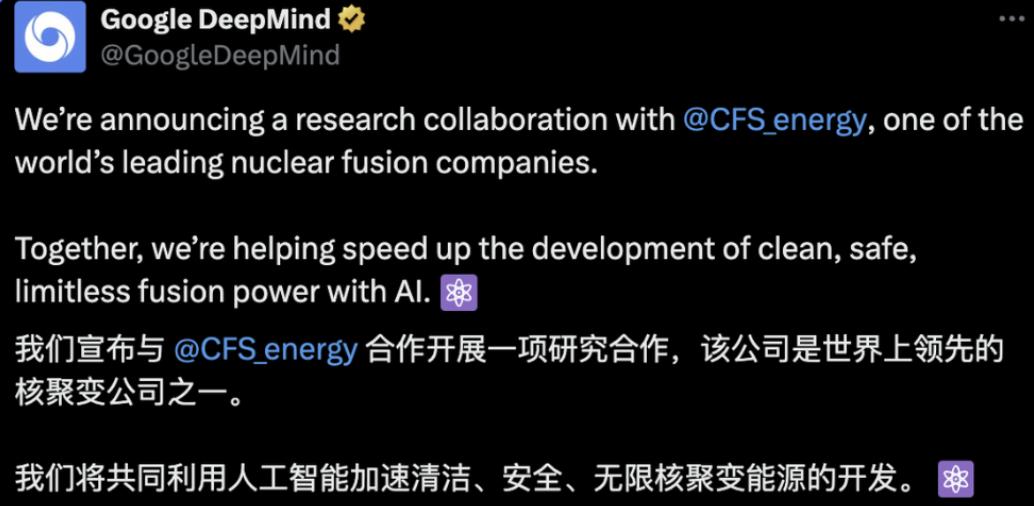
Core Insights - Google DeepMind has announced a collaboration with CFS to leverage AI in accelerating the development of the SPARC fusion device, marking a significant step in the nuclear fusion research phase and aiming for a sustainable energy future [1][2][5]. Group 1: Collaboration Details - The partnership aims to combine Google DeepMind's AI capabilities with CFS's advanced hardware to enhance nuclear fusion research [3][5]. - CFS is developing the SPARC device, which is designed to achieve net energy output from fusion, a milestone in the quest for viable fusion energy [5][12]. - The collaboration is built on previous successful AI applications in plasma control, demonstrating the potential of AI in optimizing fusion processes [6][12]. Group 2: Technology and Methodology - TORAX, a plasma simulator developed by Google DeepMind, will assist CFS in running millions of virtual experiments to optimize the SPARC device's operations [6][7]. - The use of reinforcement learning will help identify the most efficient paths for maximizing fusion energy output while maintaining safety [8][10]. - The integration of AI with traditional methods aims to streamline the search for optimal operational parameters, enhancing the efficiency of the research process [10][12]. Group 3: Future Implications - The collaboration signifies a transformative shift in research paradigms, where AI's computational power meets fusion science, potentially redefining the pace of innovation [12]. - Google has also invested in CFS to support breakthroughs in scientific research and the commercialization of fusion energy technology [12].

中泰证券:冷却塔行业多场景共振 数据中心场景打开成长空间
Zhi Tong Cai Jing· 2025-10-17 02:01
Core Viewpoint - The cooling tower market is experiencing steady growth, driven by both traditional industry upgrades and emerging applications, with a projected compound annual growth rate (CAGR) of 6.39% from approximately $4.27 billion in 2024 to $7.46 billion by 2033 [1] Group 1: Market Demand and Structure - Cooling towers are essential heat dissipation facilities in energy and industrial systems, with stable market demand across various sectors including thermal power, petrochemicals, metallurgy, nuclear power, and data centers [1] - The global cooling tower market is expected to grow from approximately $4.27 billion in 2024 to $7.46 billion by 2033, indicating a CAGR of 6.39% [1] - The industry has a well-defined structure with clear divisions among upstream (electromechanical equipment, steel materials, chemical materials), midstream (cooling tower manufacturers), and downstream (heavy industries like petrochemicals and energy, as well as light industries like food and textiles) [1] Group 2: Technological Trends - The primary technology in cooling towers is wet cooling, which is efficient but has high water consumption; dry cooling is water-efficient but less effective; hybrid cooling towers balance efficiency and water usage, consuming about 20% of the water used by traditional wet towers [2] - The trend towards water conservation is accelerating the adoption of new cooling solutions [2] Group 3: Traditional and Emerging Applications - Traditional industries such as thermal power, petrochemicals, metallurgy, and nuclear power provide stable demand for cooling towers, with significant upgrades and renovations expected to drive further demand [3] - In the thermal power sector, the installed capacity is projected to reach 1,444 million kilowatts in 2024, accounting for 44% of the total, with upgrades driving cooling tower demand [3] - Emerging applications, particularly in data centers and nuclear power, are rapidly increasing demand for cooling towers, with data centers becoming essential for heat dissipation due to expanding computational power and liquid cooling solutions [3][4] Group 4: Data Center Growth and Liquid Cooling - The energy consumption of data centers is rising, with cooling systems accounting for about 40% of total energy use; by 2030, nearly 10 million edge computing nodes are expected to be deployed, increasing cooling demands [4] - Liquid cooling is becoming mainstream, enhancing the role of cooling towers in data center cooling systems, with the global data center cooling tower market projected to grow from $3.47 billion in 2024 to $6.78 billion by 2031, reflecting a CAGR of 10.9% [4] Group 5: Nuclear Power Expansion - The expansion of nuclear power into inland areas is driving the need for upgraded cooling tower technologies that are water-saving, low-noise, and environmentally friendly [5] - Nuclear fusion research is accelerating the demand for cooling solutions, with significant energy release potential and a projected financing scale of $7.1 billion by 2024, indicating rapid industry expansion [5] - Cooling towers are critical components of cooling systems in nuclear fusion, with the market expected to grow significantly as the industry develops [5]

岩超聚能获数亿元天使投资,以AI驱动聚变能源未来
3 6 Ke· 2025-10-16 03:57
Group 1 - Yan Chao Ju Neng (Shanghai) Technology Co., Ltd. has completed a multi-hundred million RMB angel round financing, led by A-share listed company Yan Shan Technology and Yan Shan Investment [1] - The financing will primarily be used for team expansion, development of superconducting magnet coils for fusion reactors, construction of 3D coil production lines, and establishment of commercial superconducting magnet production lines [1] - The company was founded in March 2025 and focuses on accelerating fusion energy and superconducting applications through artificial intelligence technology [1][2] Group 2 - The company aims to commercialize fusion energy through advanced superconducting fusion reactor technology, providing long-term clean energy for society [4] - Yan Chao Ju Neng's "1+N" development strategy balances long-term energy goals with short-term commercial applications, leveraging accumulated superconducting magnet technology in various sectors such as energy, industry, healthcare, and aerospace [4] - The company is collaborating with Peking University to establish a "Fusion and New Energy Joint Laboratory" in Shenzhen, focusing on key technologies in fusion reactor physics, AI applications, superconducting materials, and energy applications [4][6] Group 3 - The joint laboratory receives comprehensive policy support from Shenzhen in terms of research facilities, funding, and talent acquisition, and plans to engage in international academic exchanges with renowned fusion research institutions from Germany, the USA, Japan, and Spain [6] - Yan Chao Ju Neng is committed to advancing fusion energy and superconducting technology research, aiming to contribute to sustainable energy solutions for humanity [6]

皖能电力:间接持有聚变新能(安徽)有限公司约3.5%的股权。
Xin Lang Cai Jing· 2025-10-13 12:24
Group 1 - The company holds approximately 3.5% equity in Fusion New Energy (Anhui) Co., Ltd. indirectly [1]
