美股投资

Search documents
清仓美股,知名投资大鳄警告
天天基金网· 2025-05-30 05:36
美股强势反弹之际,知名投资大鳄却宣布清仓美国股票。截至5月28日,纳斯达克指数4月以来 反弹逾10%,然而,世界著名投资大师、与索罗斯共同创立量子基金的吉姆·罗杰斯却于近日表 示,他已卖出所有美国股票,持有大量现金,并对美股后市表示担忧。无独有偶,日前披露的 13F文件显示,电影《大空头》的原型迈克尔·伯里(Michael Burry)在今年一季度几乎清仓, 其投资组合仅保留了雅诗兰黛一只股票的持仓。 今年一季度,美股整体表现疲弱,纳斯达克指数下跌10.41%,在全球重要指数中排名倒数第二 位。不过,从二季度开始,美股逐步收复失地,截至5月28日,纳斯达克指数4月以来涨幅超过 10%,在全球重要指数中排名首位。 来源:上海证券报 免责声明 文章封面图来源于AI,以上观点来自相关机构,不代表天天基金的观点,不对观点的准确性 和完整性做任何保证。收益率数据仅供参考,过往业绩和走势风格不预示未来表现,不构成 ↓ 点击"阅读原文" 尽管美股反弹势头良好,部分投资人却对后市仍表示担忧。 82岁的吉姆·罗杰斯(Jim Rogers)近日在一档播客对话中抛出严重警告,"我卖掉了所有美国股 票,因为这场派对我见过太多次。"他 ...


普徕仕:“美国例外论”面临挑战 但仍最看好美股
Zhi Tong Cai Jing· 2025-05-29 02:52
Group 1 - The core viewpoint emphasizes that despite recent challenges to the "American exceptionalism," the U.S. stock market remains the most favorable investment option due to its free market structure, liquidity, sound financial regulation, and transparency [1] - The S&P 500 index has shown strong performance, with approximately 90% of companies reporting first-quarter earnings, revealing an average revenue growth of 5% and earnings per share growth of 14%, significantly exceeding the market expectation of 7% [1] - Current economic indicators, including credit card spending and unemployment claims, remain robust, supporting strong consumer spending [1] Group 2 - A major concern is the U.S. deficit consistently exceeding 6% of GDP, which could lead to market skepticism regarding U.S. credit reliability and potentially push the 10-year Treasury yield above 5%, putting pressure on stock valuations [2] - While the deficit raises investor concerns, it has not undermined the core systems that support the U.S. "exceptionalism," suggesting that the U.S. is likely to continue providing attractive long-term investment opportunities [2]
美股全线大涨,特斯拉市值一夜增超5400亿元
21世纪经济报道· 2025-05-27 23:49
Core Viewpoint - The article discusses the recent performance of the US stock market, highlighting the impact of President Trump's decision to delay tariffs on EU goods, which led to significant gains in major indices and tech stocks like Tesla [1][3][6]. Group 1: Stock Market Performance - On May 27, the US stock market saw a notable increase, with the Dow Jones rising by 1.78%, the S&P 500 by 2.05%, and the Nasdaq by 2.47% [1]. - Major tech stocks experienced substantial gains, with Tesla's stock price increasing by nearly 7%, adding approximately $75.9 billion (around ¥546.1 billion) to its market capitalization [3][4]. Group 2: Economic Outlook - The US economy has been developing in an environment of high interest rates, high growth, and elevated inflation, leading to increased financing costs for companies [6]. - Analysts predict that the return rate of US stocks may decline from the previous range of 15%-20% to 5%-10% over the next five years due to high valuations and potential shifts in investor preference towards other assets [6][7]. - Current valuations of US stocks are above 21 times earnings, which is considered high compared to other countries, suggesting limited short-term upside unless trade negotiations progress [6][7]. Group 3: Investor Sentiment - A survey conducted at the JPMorgan Global Markets Conference indicated that 36% of investors expect European markets to outperform by 2025, while only 17% favor the US market [7]. - Emerging markets are anticipated to enter a "new bull market," driven by a weaker dollar, peak US bond yields, and a recovering Chinese economy [7].

无需理会穆迪?大摩高呼:准备抄底美股!
美股研究社· 2025-05-20 12:14
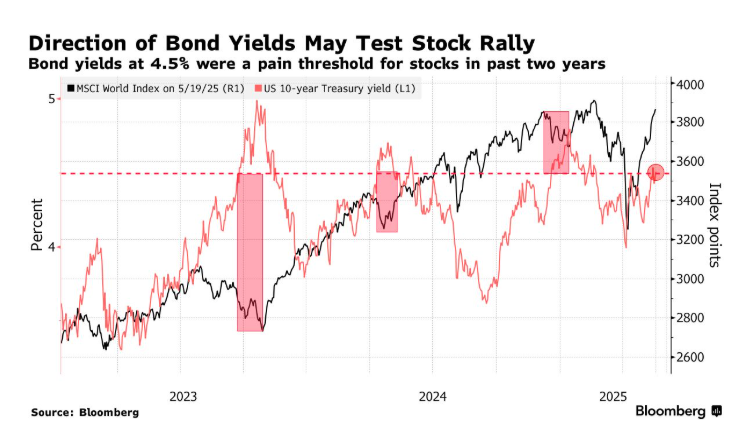
Core Viewpoint - Investors should consider buying during the market pullback triggered by Moody's downgrade of the US sovereign credit rating, as the US-China trade truce has reduced the probability of recession [1]. Group 1: Market Reaction to Credit Rating Downgrade - Moody's downgraded the US credit rating from AAA to AA1, causing the 10-year Treasury yield to exceed the critical 4.5% level, leading to a 1.2% drop in S&P 500 futures [1][3]. - The downgrade was attributed to the expanding US budget deficit with no signs of narrowing, raising concerns about the attractiveness of US assets amid ongoing global trade uncertainties [1]. Group 2: Corporate Earnings and Market Outlook - Despite the uncertainty surrounding tariffs, corporate earnings reports have not shown significant negative impacts, and recent upward revisions in earnings forecasts suggest potential further increases in the stock market [4]. - The market is likely to overlook any temporary weakness in trade data due to the trade agreement with China, according to the strategist [4]. - Goldman Sachs strategist David Kostin anticipates that the "Magnificent Seven" tech stocks will outperform the S&P 500 index due to strong earnings trends, despite a recent sell-off in high-priced US stocks [4].
无需理会穆迪?大摩高呼:准备抄底美股!
Jin Shi Shu Ju· 2025-05-19 12:18
Group 1 - Morgan Stanley strategist Michael Wilson suggests investors should buy during the stock market pullback triggered by Moody's downgrade of the US sovereign credit rating, as the US-China trade truce has reduced recession probabilities [1] - Following Moody's downgrade of the US credit rating from AAA to AA1, the 10-year Treasury yield surpassed the critical 4.5% level, increasing the likelihood of a market pullback [1] - The S&P 500 index futures fell by 1.2% on Monday due to the impact of the US debt rating downgrade, with Moody's citing the expanding budget deficit as the reason for the downgrade [1] Group 2 - Moody's is the last major rating agency to issue such a downgrade for the US, following Fitch Ratings and S&P Global Ratings, which withdrew the highest rating in 2023 and 2011 respectively [3] - The US benchmark stock index has underperformed compared to international peers this year, recovering only recently due to a temporary trade agreement with China [3] - Wilson notes that a positive sign is that the uncertainty around tariffs did not significantly impact corporate earnings during the earnings season, and recent upward revisions in earnings forecasts indicate potential further stock market gains [3]
逢低买入美股?大摩:中美关税休战降低衰退风险,评级下调或是入场良机
Zhi Tong Cai Jing· 2025-05-19 11:15
Group 1 - Morgan Stanley strategist Michael Wilson suggests investors should buy U.S. stocks that have declined due to last week's credit rating downgrade, as the trade truce with China reduces the likelihood of an economic recession [1] - Following Moody's downgrade, the 10-year U.S. Treasury yield surpassed the critical 4.5% level, increasing the likelihood of a market pullback; however, Wilson advocates for buying on dips [1] - The S&P 500 futures fell by 1.2% on Monday after Moody's downgraded the U.S. debt rating, citing the expanding budget deficit with no signs of narrowing [1] Group 2 - Moody's is the last major U.S. rating agency to downgrade the country's credit rating, following Fitch Ratings and S&P Global Ratings in previous years [4] - Year-to-date, the performance of U.S. benchmark stock indices has lagged behind international peers, recovering only after a temporary trade agreement between the U.S. and China [4] - Wilson notes that the earnings season appears to have concluded without significant impact from tariff uncertainties, which is a positive sign for the market [4] Group 3 - Wilson believes that recent upward revisions in corporate profits indicate further potential for stock market gains, even if trade data may appear weak in the coming months [4] - Wilson acknowledges the potential for market volatility to persist into the second half of the year but remains optimistic due to the trade agreement with China [4] - Goldman Sachs strategist David Kostin anticipates that the "seven giants" tech stocks will outperform the S&P 500 index amid strong earnings trends, despite significant price declines this year [4]

大摩:穆迪下调美国评级之际,投资者对美股可以逢低买入
news flash· 2025-05-19 10:41
Core Viewpoint - Morgan Stanley's strategist Michael Wilson suggests that investors should consider buying U.S. stocks on dips following the recent downgrade of the U.S. credit rating by Moody's, as the likelihood of an economic recession has decreased due to trade ceasefires with certain countries [1] Group 1 - The downgrade of the U.S. credit rating has led to a drop in the stock market, but Wilson believes this presents a buying opportunity [1] - Wilson notes that the 10-year Treasury yield has surpassed the critical level of 4.5% following the downgrade, indicating a potential for further market pullback [1] - Encouraging signs include the conclusion of the earnings season and the lack of significant impact from tariff uncertainties on corporate earnings [1] Group 2 - Even if trade data weakens in the coming months, recent upward revisions in corporate profits suggest that the stock market is likely to rise further [1]

5月19日电,摩根士丹利表示,投资者应在上周五美国信用评级遭下调引发的股市下跌中买入美股。
news flash· 2025-05-19 10:26
Core Viewpoint - Morgan Stanley suggests that investors should buy U.S. stocks following the market decline triggered by the downgrade of the U.S. credit rating last Friday [1] Group 1 - The recommendation comes in the context of a recent drop in the stock market due to credit rating concerns [1]
全球富豪在“解放日”之前增持美股
news flash· 2025-05-17 02:51
金十数据5月17日讯,根据13F监管文件,在特朗普"解放日"引发市场混乱的几天前,欧洲豪门的家族办 公室、对冲基金亿万富翁诺姆·戈特斯曼和免税购物大亨艾伦·帕克都在截至 3月31日的三个月内增加了 美国股票投资。文件显示,总部位于伦敦、为瑞典亿万富翁劳辛家族成员服务的投资公司Alta Advisers 在此期间增加了对100多家美国上市公司的配置,其中包括大型科技巨头英伟达、苹果和亚马逊。戈特 斯曼的Toms Capital同样增持了英伟达和其他8只股票,而帕克家族的Kemnay Advisory Services增持了十 几家美国上市公司的股票。这些举动突显出有多少投资者在特朗普4月2日宣布大幅加征关税引发的动荡 中措手不及。这一消息重创了金融市场,仅在两个交易日内就使美国股市蒸发了约6万亿美元的市值, 标普500指数后来反弹了约19%。包括墨西哥的卡洛斯•斯利姆和瑞典的亿万富翁佩尔松王朝(Persson dynasty)在内的一些全球富人,在市场混乱中增持了他们已经持有的股票,使他们坐拥巨额账面收 益。 全球富豪在"解放日"之前增持美股 ...


中美,会怎么谈?!
格兰投研· 2025-05-10 14:36
Group 1: US Stock Market Overview - The US stock market opened high but closed lower, with the Dow Jones down 0.29% and the S&P and Nasdaq remaining relatively unchanged. All three major indices showed a slight decline of less than one point this week [1] - There has been a significant redemption of funds from US ETFs, totaling $24.8 billion over the past four weeks, marking the largest scale in nearly two years. Hedge funds sold $1.5 billion in a week, while insurance companies and other institutions sold $2.7 billion, the second-highest weekly sell-off in history [1] - Institutional confidence is low, with many believing that the US economy is likely heading towards a recession. The Google search volume for "Is the US in a recession?" has reached its second-highest level ever, only behind the actual recession period [1] Group 2: Retail Investors and Corporate Buybacks - Retail investors have been net buyers for 21 consecutive weeks, setting a record for the longest buying streak in history, with purchases totaling a record $2 billion in the past four weeks [2] - Corporate buybacks were substantial, with $233.8 billion in buybacks in April, the second-highest amount recorded since 1984 [5] - The motivation behind corporate buybacks is to prevent their stock prices from falling too much and to signal confidence in future stock price increases [8] Group 3: Market Sentiment and Predictions - The current market sentiment is influenced by a long-standing bullish trend in the US stock market, which has created a loyal base of retail investors who tend to buy on dips [8] - Former President Trump has encouraged retail investors to buy stocks, stating "buy stocks now," which has raised concerns about potential market manipulation [10] - The S&P 500 is expected to face strong resistance around the 4800-4835 range, with a potential bear market if it falls below 5100. The optimal strategy is to trade within the 5100-5500 range, selling high and buying low [10] Group 4: US-China Trade Negotiations - Recent comments from Trump regarding US-China trade negotiations suggest a pressure tactic, with a target of 80% being mentioned, although a more realistic expectation is around 54% for the second phase of negotiations [12][13] - Economic data from both sides has not yet shown significant impacts, indicating that the urgency for negotiations may not be as strong as perceived. For instance, while US non-farm data remains resilient, China's exports to ASEAN countries increased by 21% despite tariffs [14]