
GDP

Search documents
X @Elon Musk
Elon Musk· 2025-07-01 01:03
Fiscal Policy & Debt Management - A large debt/dollar crisis can be prevented by cutting the budget deficit to approximately 3% of GDP [1] - A mix of tax revenue increases and spending decreases is required to sustainably deal with the deficit/debt problem [1] - A balanced approach, such as a 4% increase in tax revenue and a 4% spending cut, would improve the supply/demand balance for US debt [1] - Lower interest rates, resulting from the improved debt supply/demand balance, would help reduce the budget deficit and benefit markets and the economy [1] Political Challenges - Political promises of "no tax increases" and "no benefit cuts" are inconsistent with the need to reduce the budget deficit [1] - Political absolutism prevents representatives from pursuing a balanced approach to deficit reduction [1]
Apollo's Torsten Slok: Peak uncertainty is behind us, but these risk factors are still on horizon
CNBC Television· 2025-06-30 15:31
Economic Outlook & GDP - Consensus view, including CBO and Fed, anticipates GDP growth slowdown due to tariffs and headwinds like student loan payments restarting [3][4] - Potential for stagflation exists if tariffs of $400 billion lead to either higher inflation or lower earnings [2][5] - US GDP growth may slow to 1%-15% in the next 12 months, but the US growth outlook remains stronger than other countries like Europe [14][15] Trade & Tariffs - Tariffs raising $400 billion could significantly impact S&P 500 earnings, potentially reducing them by 20% if companies absorb the costs [2] - Trade remains a significant risk factor, particularly regarding who bears the burden of the $400 billion in tariffs [2] US Dollar & Fed Policy - The dollar experienced a 10% decline in trade-weighted terms over the past six months [7] - The market's pricing for Fed rate cuts this year is considered too aggressive; only one rate cut is expected [8] - The Fed committee, not solely the chair, decides on interest rates and QE, limiting the chair's individual influence [11][12] - The outlook for the dollar in the second half of the year is brighter, partly due to Section 899 being resolved [6][15] Labor Market - The labor market is currently holding up well, with jobless claims remaining relatively stable [9][10]


Treasury Secretary Bessent Says Budget Bill Will be Ready to Sign by July 4
Bloomberg Television· 2025-06-30 14:22
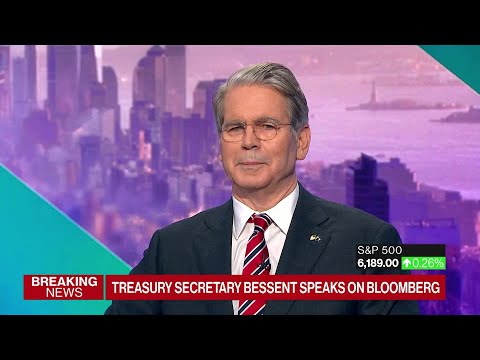
Just as the Senate has begun voting on what's known as the big, beautiful bill. You look at the latest version of the tax bill. The big question that remains is the GOP holdouts.What kind of deal can be cut with those holdouts. And what are you and the president prepared to offer for support. Well, I'm confident that the bill is going to progress, as is over the next few hours, and it'll be on the president's desk to sign on July 4th.So the Senate Senate will vote, pass it over to the House. We've seen incr ...
PMI不弱,政策不急
HUAXI Securities· 2025-06-30 13:47
Group 1: PMI Overview - The manufacturing PMI for June is reported at 49.7%, matching expectations and slightly up from the previous value of 49.5%[1] - The non-manufacturing PMI stands at 50.5%, an increase from the prior value of 50.3%[1] - The average composite PMI for Q2 is 50.4%, lower than Q1's average of 50.9% and last year's Q2 average of 51.1%[1] Group 2: Demand and Price Trends - New orders in manufacturing, construction, and services have rebounded by 0.4, 1.6, and 0.3 percentage points respectively, indicating improved demand[2] - Manufacturing prices have rebounded by 1.5 percentage points, while construction and service prices increased by 0.8 and 1.6 percentage points respectively, although all remain below the expansion threshold[2] Group 3: External Demand and Employment - Manufacturing new export orders increased by 0.2 percentage points to 47.7%, still below the Q1 average of 48.0%[3] - Employment indices in manufacturing and services have decreased by 0.2 percentage points to 47.9% and 46.4%, respectively, indicating ongoing contraction in workforce[5] Group 4: Economic Outlook - The composite PMI of 50.7% in June is 0.2 percentage points lower than the Q1 average, suggesting a slower economic recovery[6] - The necessity for immediate policy stimulus is reduced, with potential policy actions expected to be postponed until August or September[6]
CNBC Rapid Update: Tariff effects weigh on outlook
CNBC Television· 2025-06-30 11:38
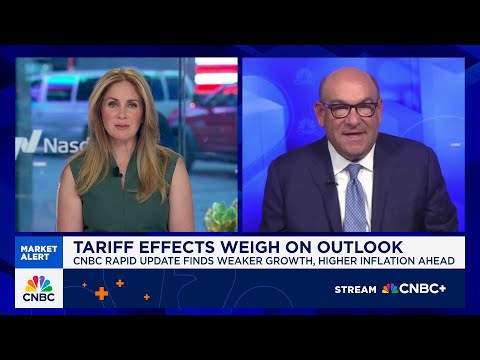
Economic Outlook - The economic outlook has brightened a bit, but it's not as rosy as the market looks [1] - Most forecasts still see tariff effects weakening growth and driving inflation higher [2] - The average of 15 forecasts on the street in the CNBC rapid update up almost a percentage point for the second quarter to 25% from 16% in April [2] - The overall year outlook is 13% [3] Inflation and Fed Policy - Average core PCE inflation also came down for the second quarter with what looks to be an expectation of a delayed tariff impact, but it's forecast to shoot up in the third and fourth quarters back towards 3% before settling down next year [4] - Inflation remains a percentage point above and it fuels this debate about whether the Fed should cut now or hold till those numbers start to come down [5] - The Fed's dilemma is weaker growth, but inflation remains relatively high [10] - If the Fed can feel confident that inflation will come down, they could maybe cut a little bit in the back half of this year [11] Tariff Impact - There have been markdowns in the earnings outlook for tariff affected companies [9] - The idea being when you put up GDP numbers that are weaker towards 1%, the theory is that something's got to give in terms of tariffs [8] - It looks like the tariff impact will be a little less, and if we get out of this with a couple quarters of weaker growth, that would be getting off cheap [9]
差距拉大!中国一季度GDP跌至美国59%,背后是什么原因?
Sou Hu Cai Jing· 2025-06-30 00:00
Economic Overview - In Q1 2025, the US economy showed a complex picture with a GDP decline of 0.5% on a seasonally adjusted annual rate, marking the first quarterly negative growth in nearly three years [1] - The decline was primarily driven by a sharp drop in private consumption growth to 0.5%, the lowest in five years, along with reduced federal spending and increased imports [1] - Despite the decline, the revised GDP data indicated a total GDP of $7.49 trillion, maintaining the US's position as the world's largest economy, accounting for 26% of global GDP [1] Comparison with China - China's Q1 GDP reached approximately $4.44 trillion, maintaining its status as the second-largest economy, but the proportion of China's GDP to the US GDP fell to 59%, down from 77% in 2021 [1][3] - China's GDP growth was 5.4% year-on-year, significantly higher than the US's 2% growth, but the nominal GDP growth and GDP increment were lower than the US due to differing inflation levels [3] Inflation and Monetary Policy - The differing inflation levels between the US and China have a direct impact on GDP increments, with the US maintaining high interest rates while China has been lowering them [3] - As of March 2025, the US CPI increased by 2.4%, while China's CPI decreased by 0.1%, highlighting the contrasting price levels in both countries [3] Currency Exchange Rate Impact - The depreciation of the Chinese yuan against the US dollar is a critical factor, with the average exchange rate in Q1 2025 at 7.176, leading to a reduction of approximately $500 billion in China's GDP when converted to dollars [5] - If the exchange rate had remained stable, China's GDP proportion could have risen back to around 60% [5] Statistical Methodology Differences - There are significant differences in GDP calculation methods between the two countries, with China using the production method and the US using the expenditure method, leading to discrepancies in reported GDP figures [7] - For instance, in Q1 2025, the US real estate sector contributed $943 billion to GDP, while China's contribution was only $360 billion, reflecting the US's highly financialized economy compared to China's manufacturing-driven economy [7]

美国“对等关税”生效倒计时:仅与英国签下协议,对经济有何影响?
虎嗅APP· 2025-06-29 02:34
Core Viewpoint - The article discusses the implications of the U.S. government's "reciprocal tariff" policy, highlighting the unexpected expansion of the trade deficit and the potential economic consequences as the deadline for trade negotiations approaches [1][4][11]. Trade Data Summary - As of May, the U.S. goods trade deficit unexpectedly widened to $96.6 billion, exceeding market expectations of $86.1 billion, marking the highest trade deficit for the first five months of the year in history [2][5]. - The trade deficit has been primarily driven by a 5.2% decline in U.S. goods exports, which fell to $179.2 billion, the largest drop since the pandemic began [6]. - In contrast, some countries, such as Vietnam and Thailand, saw their exports to the U.S. surge by approximately 35%, reaching historical highs [6]. Economic Impact - The U.S. economy experienced its first contraction since 2022, with a GDP decline of 0.5% on an annualized basis, attributed to increased imports and decreased government spending [3][14]. - The first quarter saw imports rise by 37.9%, the fastest growth since 2020, negatively impacting GDP by nearly 4.7 percentage points [14]. - The core PCE price index rose by 2.68% year-on-year in May, surpassing expectations and reaching its highest level since February 2025 [14]. Trade Negotiation Status - The U.S. has only reached a trade agreement with the UK, which remains largely a framework with many details yet to be finalized [8]. - Negotiations with other major trading partners, including Japan and India, have stalled, with concerns over potential additional tariffs hindering progress [8][9]. - The U.S. government has requested trade partners to submit their best offers amid slow negotiation progress, indicating urgency in reaching agreements [10]. Employment and Economic Risks - The number of Americans filing for unemployment benefits rose to 1.974 million, the highest level since November 2021, indicating increasing job market challenges [15]. - The credit card delinquency rate reached 3.05%, the highest since 2011, while housing market pressures are mounting due to affordability and inventory issues [15]. - The World Bank forecasts a global economic growth rate of 2.3% for 2025, the lowest since the 2008 financial crisis, reflecting widespread economic weakness [15].

6月27日电,加拿大4月份GDP较上个月下降0.1%,预估为持平。
news flash· 2025-06-27 12:35
智通财经6月27日电,加拿大4月份GDP较上个月下降0.1%,预估为持平。 ...
提醒:北京时间20:30,将公布美国5月个人收入和个人支出(PCE),加拿大4月GDP。
news flash· 2025-06-27 12:26
Group 1 - The article highlights the upcoming release of key economic indicators, specifically the U.S. personal income and personal consumption expenditures (PCE) for May, scheduled for 20:30 Beijing time [1] - Additionally, it mentions the Canadian GDP data for April will also be published at the same time [1]
整理:每日全球外汇市场要闻速递(6月27日)
news flash· 2025-06-27 06:41
Group 1: Currency Market Insights - The European Central Bank's council member Knot stated that the possibility of another interest rate cut by the ECB cannot be ruled out [2] - Bank of England Governor Bailey indicated that the strengthening of the British pound is related to uncertainties in the U.S., with interest rates still on a gradual downward path [2] - The onshore and offshore RMB against the USD briefly broke the 7.16 mark, reaching a new high in over seven months [2] Group 2: Economic Indicators and Trade - The U.S. trade deficit unexpectedly widened in May, with exports experiencing the largest decline since the pandemic began; first-quarter GDP was revised down [3] - Market volatility has led to a surge in foreign exchange trading volume for Citigroup's hedge funds [3] - The New Taiwan Dollar against the USD broke the 29 mark, reaching a high not seen in over three years [3] Group 3: Central Bank Perspectives - Federal Reserve officials expressed mixed views on potential interest rate cuts, with Daly suggesting that a fall in rates this autumn looks promising, while Collins indicated that a July cut may be premature [3] - The Hungarian central bank projected an adjusted core inflation rate of 4.7% for 2025 and 4.0% for 2026 [3] - The South Korean Ministry of Finance announced that it will further issue foreign exchange stabilization bonds in the second half of the year if necessary [3]