基础原材料

Search documents
1月PMI数据点评:制造业PMI超季节性回落,价格指数抬升
Western Securities· 2026-02-01 13:06
1. Report's Investment Rating for the Industry - No information provided regarding the industry investment rating in the report. 2. Core Viewpoints of the Report - In January 2026, the manufacturing PMI declined more than seasonally with supply - demand converging and enterprise - scale differentiation intensifying, while price indices rose. The service industry PMI slightly dropped and the construction industry's prosperity significantly declined, thus more efforts are needed to promote economic - stabilizing policies [1][10][34]. - In January, the shock of sentiment was gradually digested, and the bond market recovered after adjustment. However, there were still some constraints for a smooth short - term decline. The 10Y Treasury bond yield may return to the central part of the oscillation range in February. Two structural investment opportunities are recommended: the allocation opportunities of 5Y government - financial bonds and 3 - 5Y general - credit bonds, and the spread - compression opportunities such as 10Y CDB - 10Y Treasury bonds [4][34][35]. 3. Summary According to the Directory 3.1 1 - month PMI Data Overview - Manufacturing PMI declined by 0.8 percentage points to 49.3% in January, returning to the contraction range and being weaker than the seasonal average. The production index expansion slowed, demand was under pressure, price indices rose, and enterprises replenished inventory passively with a decline in purchasing willingness [10]. - In the non - manufacturing sector, the service industry PMI slightly decreased by 0.2 percentage points to 49.5%, and the construction industry's business activity index dropped by 4.0 percentage points to 48.8%, both showing different degrees of deviation from seasonal performance [11][14]. 3.2 Manufacturing: Demand - side Operation Under Pressure, Both Price Indices Rising - **Production**: The manufacturing PMI production index was 50.6% in January, down 1.1 percentage points month - on - month, weaker than the seasonal level. The slowdown was due to factors like cold weather and approaching Spring Festival, especially the over 4 - percentage - point decline in the consumer goods manufacturing production index [17]. - **Demand**: The new order index and new export order index of manufacturing PMI decreased by 1.6 and 1.2 percentage points respectively. The "new order - new export order" index dropped to 1.4%. Seasonal factors and external policy changes affected demand, but the proportion of manufacturing enterprises reporting insufficient market demand decreased [19]. - **Enterprise Scale and New Kinetic Energy**: The PMI of large, medium, and small enterprises decreased by 0.5, 1.1, and 1.2 percentage points respectively. New kinetic energy industries continued to lead, while traditional industries' prosperity declined [20]. - **Price**: Affected by multiple factors, the main raw material purchase price index and ex - factory price index were 56.1% and 50.6% respectively, up 3.0 and 1.7 percentage points month - on - month. The index difference reached 5.5 percentage points, compressing the profit space of mid - and downstream enterprises [23]. - **Inventory**: The raw material inventory index decreased by 0.4 percentage points, and the finished - product inventory increased by 0.4 percentage points. The economic kinetic energy index decreased by 2.0 percentage points, and the purchasing volume index dropped to 48.7%. The start of the replenishment cycle depends on the recovery of market demand [24]. 3.3 Non - manufacturing: Slight Decline in Service Industry PMI, Significant Decline in Construction Industry - **Service Industry**: In January, the service industry PMI slightly declined. The strong support from the financial industry, the stable development of new kinetic energy, and the good performance of some consumption - related service industries maintained its stability. However, the real - estate industry's business activity index fell below 40.0%, and Spring Festival consumption may boost the consumption - related service industries [29]. - **Construction Industry**: Due to cold weather and the approaching Spring Festival, the construction industry's business activity index decreased by 4.0 percentage points to 48.8% in January. Both housing construction and civil engineering construction activities slowed down, and the off - season characteristics may continue in February [32]. 3.4 Impact on the Bond Market - In January, after the shock of sentiment was digested, the bond market recovered. The 10Y Treasury bond yield dropped to the lower limit of the 1.8% - 1.9% oscillation range. With insufficient broad - money expectations and increased local - bond supply in February, the 10Y Treasury bond yield may return to the central part of the oscillation range. Two parts of structural investment opportunities are recommended [4][34][35].
PMI超预期,债市震荡偏弱——12月PMI点评
Changjiang Securities· 2026-01-05 00:51
Group 1: Report Industry Investment Rating - No relevant content provided Group 2: Core Viewpoints of the Report - In December 2025, both manufacturing and non - manufacturing PMI rebounded above the boom - bust line. The new kinetic energy is supporting the manufacturing industry, but related industries may be more vulnerable to external demand fluctuations. The pace of new - old kinetic energy conversion is an important window to observe the economic recovery [2]. - The report expects long - term interest rates to fluctuate widely, with the 10 - year Treasury yield expected to oscillate between 1.8% - 1.9% and the 30 - year Treasury yield between 2.2% - 2.4% [2][7]. Group 3: Summary by Related Catalogs Event Description - In December 2025, the manufacturing PMI rose 0.9pct to 50.1%, with the month - on - month increase expanding by 0.7pct. The non - manufacturing business activity index rebounded 0.7pct to 50.2%. The construction business activity index soared 3.2pct to 52.8%, and the service business activity index rebounded 0.2pct to 49.7% [5]. Event Comment Non - manufacturing Sector - The non - manufacturing sector's return above the boom - bust line is in line with seasonal trends, led by construction. The improvement in new orders, inventory, and employment is driven by domestic demand, while new export orders declined. The profit margin may be compressed, and the sustainability of the improvement needs further observation. In construction, seasonal factors and high - growth financial activities may support the improvement. In services, the transmission of upstream manufacturing prosperity to downstream consumption remains to be seen [7]. Manufacturing Sector - New kinetic energy supports the manufacturing industry, but related industries are more susceptible to external demand. The high - frequency indicators have weakened, but the manufacturing industry improved due to the high - level prosperity of new kinetic energy industries. The 10 - year and 30 - year Treasury yields are expected to fluctuate in specific ranges [7]. Other Aspects of Manufacturing - Manufacturing PMI continued to rise, with production, demand, and inventory all improving. External demand contributed to new orders, and the profit repair pressure may be reduced. Large and medium - sized enterprises and high - tech manufacturing showed better performance [9].
三重因素影响下的超预期——12月PMI数据点评
Huachuang Securities· 2025-12-31 11:44
PMI Overview - December manufacturing PMI increased to 50.1%, up from 49.2% in November[1] - The production index rose to 51.7%, an increase of 1.7 percentage points from the previous value of 50.0%[1] - New orders index improved to 50.8%, up from 49.2%[1] - New export orders index increased to 49.0%, compared to 47.6% previously[1] Influencing Factors - Year-end factors contributed to a rise in construction PMI to 52.8%, up 3.2 percentage points from 49.6%[4] - Seasonal effects led to a strong production index at 51.7%, marking the highest for the quarter[5] - External demand showed resilience with the new export orders index at 49.0%, indicating a recovery in exports[6] Price and Inventory Insights - December's PMI factory price index was 48.9%, slightly up from 48.2%, remaining below the neutral line[2] - The main raw materials purchase price index stood at 53.1%, above the neutral line, indicating ongoing high demand[2] - Inventory indicators showed signs of replenishment, with the purchasing index at 51.1%, up from 49.5%[23] Economic Outlook - Manufacturing activity expectations index rose to 55.5%, up from 53.1%, reflecting improved sentiment[24] - Comprehensive PMI output index increased to 50.7%, indicating overall expansion in production activities[24]
11月PMI数据点评:价格改善加速,制造业PMI收缩放缓
Western Securities· 2025-12-02 02:40
Report Summary 1. Report Industry Investment Rating No industry investment rating information is provided in the report. 2. Core Viewpoints - In November, the manufacturing PMI contraction slowed down, with synchronized improvement in production and demand, accelerated improvement in the price index, and a slowdown in procurement contraction. Meanwhile, the service industry fell into the contraction range, and the construction industry remained below the boom - bust line for four consecutive months. More efforts are needed to promote various economic stabilization policies [1][5][35]. - In November, the bond market fell into a "ceiling - floor" oscillation pattern again due to the lack of strong policy and fundamental drivers. Most institutions are waiting for clear guidance from incremental information. The important meetings in December and subsequent key economic data releases are expected to determine the market direction. Historically in December, interest rates tend to decline, but the bullish sentiment in the market has concerns, and the year - end allocation market is yet to start [4][35]. 3. Summary by Directory I. November PMI Data Overview - Manufacturing: The manufacturing PMI in November was 49.2%, up 0.2 percentage points month - on - month, remaining below the boom - bust line for eight consecutive months. The production index reached the critical point, external demand improved significantly, the price index improved at an accelerated pace, finished - product destocking accelerated, and procurement contraction slowed [8]. - Non - manufacturing: The service industry fell into the contraction range, with its business activity index dropping 0.7 percentage points to 49.5%. The construction industry showed a slight recovery, with its business activity index rising 0.5 percentage points to 49.6%, remaining below the boom - bust line for four consecutive months [11]. II. Manufacturing: Synchronized Improvement in Production and Demand, Accelerated Improvement in Price Index - Production: The manufacturing PMI production index reached 50.0% in November, returning to the boom - bust line after a brief fall into the contraction range last month, up 0.3 percentage points month - on - month, but weaker than the seasonal performance [15]. - Demand: External demand improved significantly, driving overall demand to pick up. The new export order index rose notably, and demand improvement was higher than production. Small - enterprise PMI rebounded, and the high - energy - consuming industry's prosperity level rebounded from a low level [18]. - Price: The "anti - involution" policy advanced steadily, and with the coordinated stabilization of supply and demand, the price index improved at an accelerated pace. The main raw material purchase price index and the ex - factory price index rose by 1.1 and 0.7 percentage points respectively, and the index difference between them increased to 5.4 percentage points, indicating a narrowing profit margin for enterprises [21]. - Inventory: Finished - product destocking accelerated, and procurement contraction slowed. The raw material inventory index remained flat at 47.3%, and the finished - product inventory decreased by 0.8 percentage points. The enterprise procurement willingness increased, and the procurement volume index rose to 49.5% [24]. III. Non - manufacturing: Service Industry Falls into Contraction Range, Construction Industry Shows Slight Recovery - Service Industry: After the concentrated release of consumption demand during the National Day Golden Week last month, consumer - related service industries declined in the off - season, and the service industry fell into the contraction range. However, financial activities continued to strengthen, and new - energy industries maintained steady growth [28]. - Construction Industry: Construction activities recovered in November, with the construction business activity index rising 0.5 percentage points to 49.6%, remaining below the boom - bust line for four consecutive months. The business activity index of the housing construction industry increased significantly, and that of the civil engineering construction industry remained above 52% [31]. IV. Impact on the Bond Market - In November, the bond market was in a "ceiling - floor" oscillation pattern due to the lack of strong policy and fundamental drivers. Most institutions were in a wait - and - see mode. The important meetings in December and subsequent key economic data releases are expected to determine the market direction. Historically in December, interest rates tend to decline, but the bullish sentiment has concerns, and the year - end allocation market is yet to start [4][35].
宏观研究:PMI走势弱于季节性,投资性需求应阶段性加力
China Post Securities· 2025-11-04 06:26
Economic Indicators - The manufacturing PMI for October is at 49.0%, down 0.8 percentage points from the previous month, indicating a contraction below the seasonal level[12] - The production index within the PMI fell to 49.7%, a decrease of 2.2 percentage points, also below the seasonal norm[14] - New orders index for manufacturing is at 48.8%, down 0.9 percentage points, reflecting a decline in demand[15] Supply and Demand Dynamics - Effective demand remains insufficient, leading to inventory accumulation and suppressing price recovery, with the PPI expected to decline by approximately 2.5% year-on-year in October[26] - The new export orders index is at 45.9%, down 1.9 percentage points, indicating a significant drop in external demand[15] - The construction sector's PMI is at 49.1%, with new orders index rising to 45.9%, suggesting some resilience despite seasonal slowdowns[23] Policy Outlook - The "anti-involution" policy is expected to intensify if prices weaken further, aiming to curb disorderly competition[3] - Financial support for stabilizing the real estate sector may include lowering mortgage rates and expanding the use of special bonds for purchasing existing homes[3] - Anticipation of early deployment of fiscal policies for the next year, including setting government debt limits and issuing long-term special bonds[3] Risks - Potential risks include rising overseas sovereign debt risks and geopolitical conflicts, which could impact domestic economic stability[4]
2025年10月PMI点评:双节弱化9、10月制造业PMI表现
CMS· 2025-10-31 09:39
Manufacturing Sector - In October, the manufacturing PMI recorded 49.0, a decrease of 0.8 from the previous month, marking a significant decline and the lowest level for the same period in nearly five years[1] - The production index and new orders index fell to 49.7 and 48.8, down 2.2 and 0.9 respectively, indicating a retreat in production and market demand[1] - New export orders index dropped to 45.9, a decline of 1.9, the second-lowest point this year, only higher than the April figure following the introduction of tariffs[1] Service Sector - The service sector PMI increased by 0.1 to 50.2, showing resilience in service consumption driven by the National Day and Mid-Autumn Festival[1] - The business activity expectation index for services stood at 56.1, indicating strong confidence among service enterprises regarding industry development[1] Construction Sector - The construction PMI fell to 49.1, down 0.2, remaining at the lowest level since 2019, reflecting ongoing demand weakness[1] - However, the civil engineering index rose significantly, exceeding 55, suggesting signs of accelerated infrastructure investment activities[1] Future Outlook - For November, favorable seasonal factors are expected to boost manufacturing PMI due to upcoming domestic and overseas demand events, including "Double Eleven" and Christmas[1] - Infrastructure investment is anticipated to increase in Q4, providing a solid foundation for growth, although the overall construction PMI may remain at historically low levels[1]
宏观经济景气度改善 8月制造业PMI回升至49.4%
Zhong Guo Jing Ying Bao· 2025-09-01 07:20
Group 1 - The manufacturing PMI for August is 49.4%, a slight increase of 0.1 percentage points from July, indicating a modest recovery in the manufacturing sector [1] - The non-manufacturing business activity index rose to 50.3%, up 0.2 percentage points from July, reflecting an overall positive trend in the economy [1] - The comprehensive PMI output index increased to 50.5%, a rise of 0.3 percentage points from the previous month, suggesting improved economic conditions [1] Group 2 - The production index for manufacturing reached 50.8%, up 0.3 percentage points, indicating accelerated production expansion [1] - The new orders index for manufacturing is at 49.5%, a slight increase of 0.1 percentage points, showing a gradual improvement in market demand [1] - High-tech manufacturing PMI significantly improved by 1.3 percentage points to 51.6%, indicating strong growth and resilience in this sector [2] Group 3 - The basic raw materials industry PMI rose to 48.2%, an increase of 0.2 percentage points, showing signs of recovery in this sector [2] - The production and business activity expectation index is at 53.7%, up 1.1 percentage points, reflecting increased confidence among manufacturing enterprises [2] Group 4 - The service industry business activity index reached 50.5%, a rise of 0.5 percentage points, marking the highest level this year [3] - The business activity expectation index for the service sector is at 57.0%, up 0.4 percentage points, indicating optimism about future market developments [3] - The upcoming "Golden September and Silver October" period is expected to further improve economic indicators as seasonal demand increases [3]
“反内卷”下的价格分化
Xinda Securities· 2025-08-01 05:41
Group 1: Manufacturing PMI Analysis - In July, the Manufacturing PMI dropped to 49.3%, a decrease of 0.4 percentage points from June, breaking the consecutive increase seen in Q2[5] - The decline in PMI is attributed to two main factors: the end of the overseas order recovery phase and disruptions caused by extreme weather[5] - The production index fell by 0.5 percentage points to 50.5%, with significant impacts on industries like non-metallic mineral products and chemical raw materials due to extreme weather events[5] Group 2: Price Dynamics in Manufacturing - The price indicators in manufacturing showed improvement, with the main raw material purchase price index rising to 51.5% and the factory price index at 48.3%, marking increases of 3.1 and 2.1 percentage points respectively from June[10] - Despite the rise in purchase prices, factory prices are contracting, indicating a widening gap that may weaken overall manufacturing profits in the short term[11] - The basic raw materials sector is the only one among four major categories to see an increase in PMI, with its purchase price index rising over 7 percentage points to 52%[11] Group 3: Non-Manufacturing Sector Insights - The Non-Manufacturing PMI fell by 0.4 percentage points to near the threshold line, with both construction and service sectors contributing to this decline[16] - The construction sector's PMI dropped to 50.6%, the largest decline since January, primarily due to extreme weather and ongoing real estate weaknesses[16] - In the non-manufacturing sector, a divergence in price trends was observed, with service sector prices declining while construction input and sales prices increased significantly[19] Group 4: Risk Factors - Consumer confidence recovery is slow, and the implementation of policies is not meeting expectations, posing risks to economic stability[22]
制造业PMI低于荣枯线,国常会部署贴息政策促消费
Di Yi Cai Jing· 2025-07-31 13:22
Economic Policy and Measures - The State Council emphasizes the need to anchor annual development goals and enhance the effectiveness of macroeconomic policies, focusing on stimulating internal economic momentum [1][4] - Implementation of personal consumption loan interest subsidy policies and service industry loan interest subsidy policies aims to better stimulate consumption potential [1][7] Manufacturing Sector Performance - In July, the manufacturing Purchasing Managers' Index (PMI) was 49.3%, a decrease of 0.4 percentage points from the previous month, remaining below the expansion threshold for four consecutive months [1][4] - The new orders index for manufacturing was 49.4%, down 0.8 percentage points, indicating a contraction in market demand [6] - Despite weak demand, manufacturing production activities expanded, with a production index of 50.5%, although it decreased by 0.5 percentage points from the previous month [6][9] Price Trends - The manufacturing raw material purchase price index rose to 51.5%, an increase of 3.1 percentage points, indicating a recovery in raw material prices [6] - The ex-factory price index for manufactured goods was 48.3%, up 2.1 percentage points, marking the second-highest point this year [6] Business Confidence and Expectations - The production and business activity expectation index for July was 52.6%, reflecting an increase in confidence among manufacturing enterprises regarding market development [8] - Large enterprises maintained a PMI of 50.3%, while medium-sized enterprises improved to 49.5%, indicating a mixed outlook across different enterprise sizes [8] Non-Manufacturing Sector Insights - The non-manufacturing business activity index was 50.1%, a decrease of 0.4 percentage points, but still within the expansion range [10] - The construction industry index was 50.6%, indicating a slowdown in construction activities due to seasonal weather impacts [10] Consumer Behavior and Seasonal Trends - Summer consumption effects began to show, with retail and postal service indices rising above 50%, indicating strong consumer spending intentions [11] - However, the accommodation and catering sectors remained below 50%, suggesting that summer spending was more focused on outdoor and entertainment activities rather than dining [13] Future Economic Outlook - The Central Political Bureau meeting highlighted the need to effectively release internal demand potential and implement actions to boost consumption [14] - The focus on service consumption is expected to play a crucial role in meeting public needs and driving consumption industry upgrades [14]

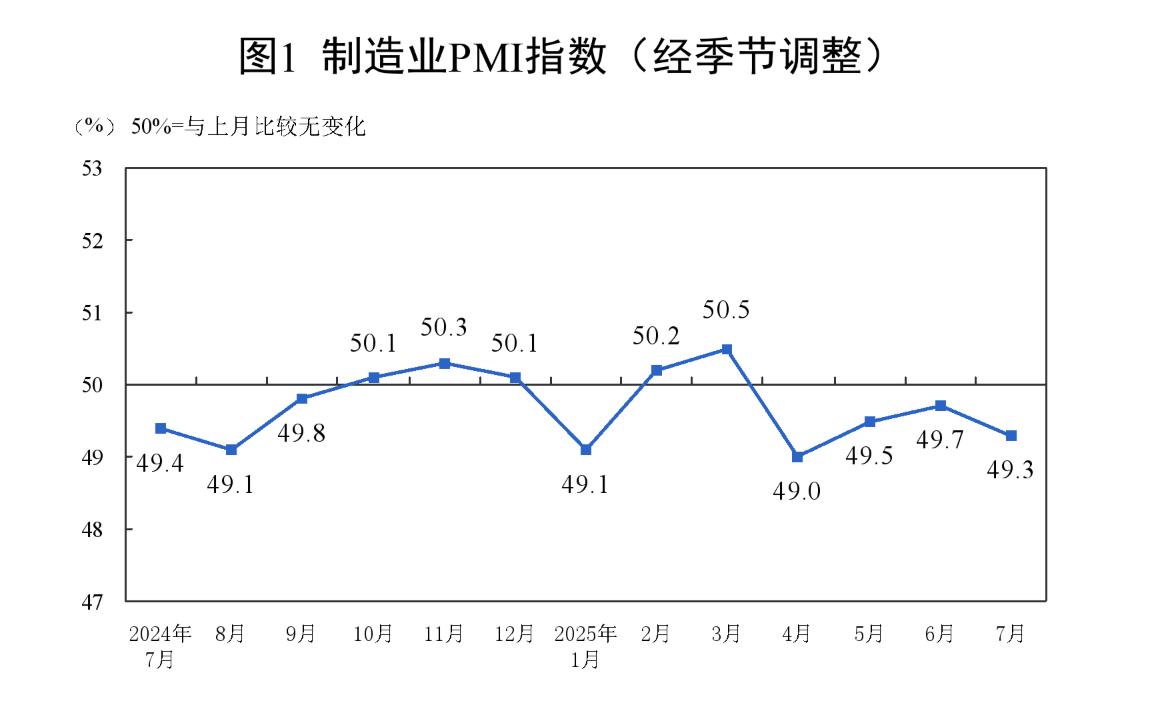
制造业PMI季节性回落至49.3%,下阶段走势如何
第一财经· 2025-07-31 06:06
Economic Overview - The manufacturing PMI for July is reported at 49.3%, a decrease of 0.4 percentage points from the previous month, indicating a slight contraction in manufacturing activity [1] - The non-manufacturing business activity index stands at 50.1%, also down by 0.4 percentage points, but still indicates expansion [1] - The comprehensive PMI output index is at 50.2%, down 0.5 percentage points, remaining above the critical point, suggesting overall expansion in business activities [1] Manufacturing Sector Analysis - The new orders index for manufacturing is at 49.4%, down 0.8 percentage points, indicating a contraction in market demand [6] - The new export orders index is at 47.1%, a decrease of 0.6 percentage points, reflecting weakened demand [6] - Despite the decline in demand, the production index is at 50.5%, indicating continued expansion in manufacturing activities for the third consecutive month [6] Price Trends - The raw materials purchase price index for manufacturing is at 51.5%, up 3.1 percentage points, indicating a recovery in raw material prices [7] - The ex-factory price index is at 48.3%, an increase of 2.1 percentage points, marking the second-highest point this year [7] - Price stability in the manufacturing sector is primarily driven by the basic raw materials industry, with significant increases in both purchase and ex-factory price indices [7] Business Expectations - The production and business activity expectation index is at 52.6%, up 0.6 percentage points, indicating increased confidence among manufacturing enterprises [8] - Large enterprises maintain a PMI of 50.3%, while medium and small enterprises show PMIs of 49.5% and 46.4%, respectively, indicating varying levels of economic health across different enterprise sizes [8] Non-Manufacturing Sector Insights - The non-manufacturing business activity index is at 50.1%, down 0.4 percentage points, but still indicates expansion [13] - The construction sector's business activity index is at 50.6%, down 2.2 percentage points, reflecting a slowdown due to seasonal weather impacts [13] - Summer consumption shows positive trends, with retail and postal service indices rising above 50%, indicating strong consumer spending [15] Future Outlook - The construction sector is expected to rebound post-rainy season, with infrastructure activities projected to grow steadily [14] - Continued implementation of macroeconomic policies aimed at boosting demand is anticipated to support economic recovery in the second half of the year [9][16]