
物联网

Search documents
深圳市熹文创新科技有限公司成立,注册资本1000万人民币
Sou Hu Cai Jing· 2025-12-26 20:49
Core Viewpoint - Shenzhen Xiwen Innovation Technology Co., Ltd. has been established with a registered capital of 10 million RMB, fully owned by Shenzhen Xihua Technology Co., Ltd. [1] Company Overview - The legal representative of Shenzhen Xiwen Innovation Technology Co., Ltd. is Li Wenbing [1] - The company is classified under the information transmission, software, and information technology services industry, specifically in software development [1] - The registered address is located at C3-13F-B131, Kexing Science Park, Keyuan Road, Nanshan District, Shenzhen [1] Shareholding Structure - Shenzhen Xihua Technology Co., Ltd. holds 100% of the shares in Shenzhen Xiwen Innovation Technology Co., Ltd. [1] Business Scope - The business scope includes software development, artificial intelligence applications, information system maintenance, computer system services, and various technology consulting services [1] - The company also engages in the sale of artificial intelligence hardware, IoT technology research and development, and electronic components [1] - The company is authorized to conduct business activities independently as per its business license, with no specific licensed projects [1]
成都都市圈握手长三角 加快低空经济“一起飞”
Sou Hu Cai Jing· 2025-12-26 13:46
Group 1 - The Chengdu metropolitan area hosted a low-altitude economy industry exchange meeting, marking the final event in a series of investment promotion activities in the Yangtze River Delta [1] - Over 100 representatives from government departments, enterprises, and scholars gathered to explore opportunities in the low-altitude economy, covering the entire industrial chain from R&D to application [1] Group 2 - The Chengdu metropolitan area released a "Low-altitude Economy Opportunity List," featuring 227 collaboration opportunities, with 75 demand-side items and 152 supply-side items [2] - The demand-side includes low-altitude logistics, public governance, and cultural tourism, while the supply-side encompasses complete machine manufacturing, flight control systems, and operational services [2] - The Chengdu metropolitan area boasts over 1,500 aerospace companies, 190 national-level innovation platforms, and more than 7.6 million specialized technical talents [2] Group 3 - The event included exhibitions showcasing various applications of low-altitude technologies, such as amphibious airports and heavy-lift drones for logistics and emergency services [3] - Safety is emphasized as a prerequisite for the development of the low-altitude economy, with companies presenting solutions for monitoring and regulatory frameworks [3] Group 4 - The exchange meeting served as a platform for deep communication, with 35 companies from the Yangtze River Delta and 14 from the Chengdu metropolitan area engaging in collaboration discussions [4] - The partnership aims to leverage the R&D capabilities of Chengdu and the manufacturing experience of the Yangtze River Delta to explore a trillion-dollar market [4] Group 5 - The meeting concluded with a positive outlook for future collaborations, as companies expressed interest in expanding their market reach and sharing development benefits [5] - The low-altitude economy is seen as a significant area for innovation and cooperation, with plans for ongoing exchanges in airspace management, drone manufacturing, and commercial applications [5]
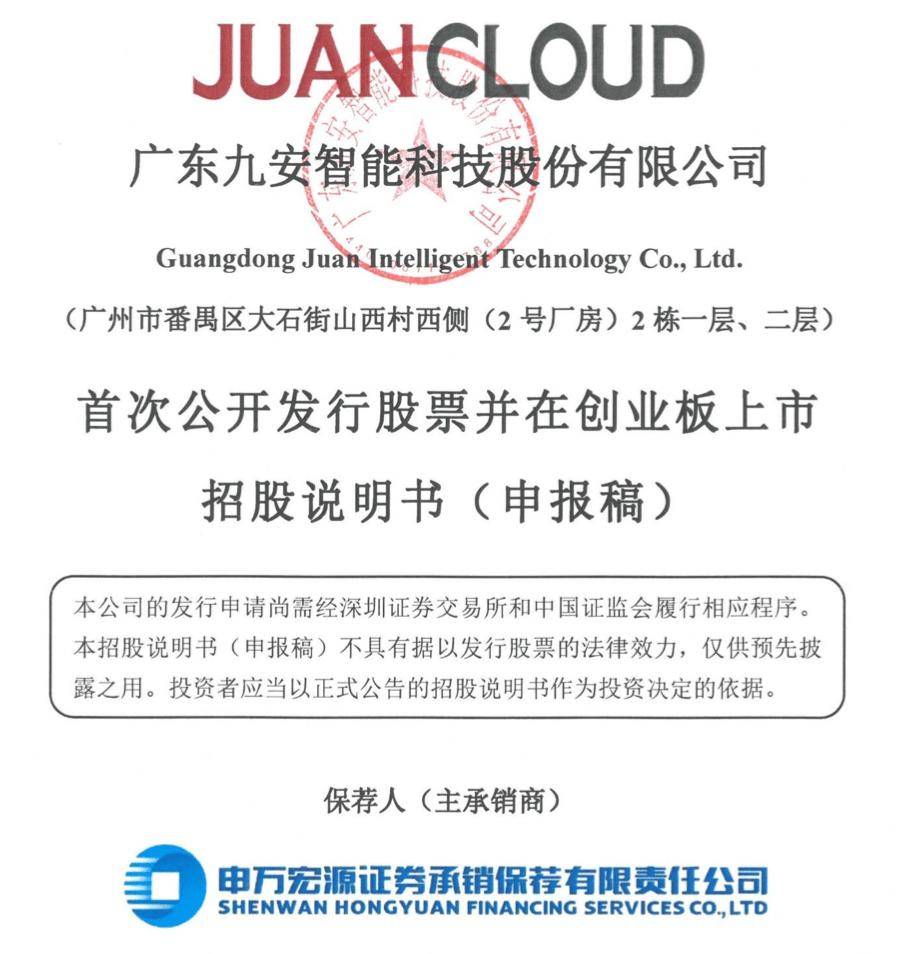
九安智能募资11亿闯关创业板:申万宏源保荐,百度新进前五大客户
Sou Hu Cai Jing· 2025-12-26 09:55
Core Viewpoint - Guangdong Jiuan Intelligent Technology Co., Ltd. has received approval for its IPO on the ChiNext board, aiming to raise 1.064 billion yuan for R&D and operational projects [2][5]. Financial Performance - Jiuan Intelligent's projected revenues for 2022 to the first half of 2025 are 484 million yuan, 645 million yuan, 780 million yuan, and 323 million yuan respectively, with net profits of 34.31 million yuan, 85.95 million yuan, 102 million yuan, and 44.79 million yuan [2]. - Total assets are expected to grow from 2.699 billion yuan in 2022 to 5.976 billion yuan in the first half of 2025, while equity attributable to shareholders is projected to increase from 1.862 billion yuan to 4.186 billion yuan over the same period [3]. - The company’s revenue for the first half of 2025 is estimated at 322.66 million yuan, with a net profit of 44.79 million yuan, reflecting a significant increase compared to previous years [3]. Client Base - The company does not rely heavily on a few clients, with the largest customer accounting for 11.88% of revenue in the first half of 2025, and the top five clients collectively contributing 32.55% of total revenue [4]. - Notably, Baidu Era Network Technology (Beijing) Co., Ltd. entered the top five clients, contributing 4.96% of sales revenue [3]. Fundraising and Investment Plans - The IPO proceeds will be allocated to various projects, including the intelligent visual product industrialization project (422.09 million yuan), embedded intelligent visual product R&D upgrade project (171.87 million yuan), IoT cloud platform upgrade project (227.36 million yuan), and headquarters construction project (93.07 million yuan), along with 150 million yuan for working capital [5][7].


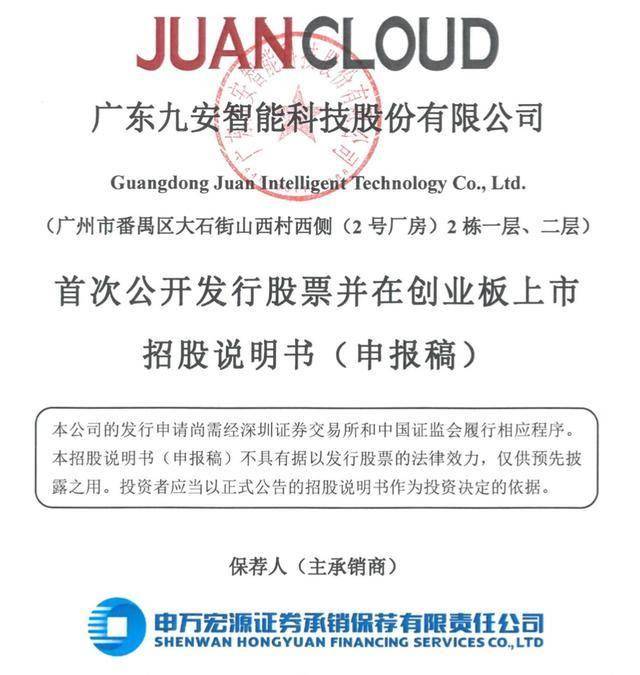
九安智能由55岁李沅控股74%:高中学历,90年代投身计算机
Sou Hu Cai Jing· 2025-12-26 09:13
Core Viewpoint - Guangdong Jiuan Intelligent Technology Co., Ltd. has received acceptance for its IPO on the ChiNext board, indicating a significant step in its growth strategy as a manufacturer and service provider in the intelligent visual products and IoT sector [3]. Company Overview - Jiuan Intelligent specializes in intelligent visual products, IoT operation services, and technology solutions, focusing on visual imaging and analysis technology, wireless transmission technology, IoT platform technology, and AI visual application models [3]. - The company operates on an integrated model of "hardware + platform + service" by independently developing, producing, and selling smart hardware products while providing operational services through its IoT cloud platform [3]. Financial Performance - Revenue projections for Jiuan Intelligent are as follows: CNY 484 million in 2022, CNY 645 million in 2023, CNY 780 million in 2024, and CNY 323 million for the first half of 2025 [3]. - Net profit attributable to the parent company is projected to be CNY 34.31 million in 2022, CNY 85.95 million in 2023, CNY 102 million in 2024, and CNY 44.79 million for the first half of 2025 [3]. Key Financial Metrics - Total assets are expected to grow from CNY 2.699 billion in 2022 to CNY 5.976 billion in the first half of 2025 [4]. - The equity attributable to the parent company is projected to increase from CNY 1.862 billion in 2022 to CNY 4.186 billion in the first half of 2025 [4]. - The company's debt-to-asset ratio is expected to rise from 29.75% in 2022 to 33.41% in the first half of 2025 [4]. - Basic earnings per share are projected to increase from CNY 0.69 in 2022 to CNY 0.92 in the first half of 2025 [4]. Shareholding Structure - The controlling shareholder and actual controller of Jiuan Intelligent is Li Yuan, who directly holds 66.04% of the company's shares and indirectly controls an additional 8.25%, totaling 74.29% [4].
九安智能净利突破亿元冲刺IPO,主要经营场所向关联方租赁
Sou Hu Cai Jing· 2025-12-26 08:03
Core Viewpoint - Guangdong Jiuan Intelligent Technology Co., Ltd. has received acceptance for its IPO on the ChiNext board, indicating a significant step towards public listing and capital raising [2]. Financial Performance - Jiuan Intelligent's projected revenues for 2022, 2023, 2024, and the first half of 2025 are 484 million, 645 million, 780 million, and 323 million yuan respectively, showing a growth trajectory [2]. - The company's net profit attributable to the parent company for the same periods is projected to be 34.31 million, 85.95 million, 102 million, and 44.79 million yuan respectively [2]. - Total assets are expected to grow from 2.699 billion yuan in 2022 to 5.976 billion yuan by the first half of 2025 [3]. - The company's equity attributable to shareholders is projected to increase from 1.862 billion yuan in 2022 to 4.186 billion yuan by the first half of 2025 [3]. - The net profit margin is expected to improve, with net profit reaching 447.88 million yuan in the first half of 2025, compared to 34.03 million yuan in 2022 [3]. Business Model and Operations - Jiuan Intelligent operates as a manufacturer of intelligent visual products and an IoT service provider, focusing on a "hardware + platform + service" integrated model [2]. - The company has plans to address its current reliance on leased facilities by constructing its own production and office spaces using raised funds and its own capital [3]. Risks and Challenges - The company acknowledges potential risks related to the construction of its new facilities, including delays, unexpected costs, and operational disruptions during the relocation process [4].
联域股份涨停,成交额9586.48万元,近5日主力净流入1216.74万
Xin Lang Cai Jing· 2025-12-26 07:53
Core Viewpoint - The company, Shenzhen Lianyu Optoelectronics Co., Ltd., is experiencing significant growth in its stock performance and is actively expanding its product offerings in smart lighting and charging solutions, benefiting from the depreciation of the RMB and international market opportunities. Group 1: Company Developments - On December 26, Lianyu shares hit the daily limit with a trading volume of 95.86 million yuan and a turnover rate of 8.66%, resulting in a total market capitalization of 3.393 billion yuan [1] - The company is advancing in the smart lighting sector by developing new technologies for intelligent control circuits that adapt to plant self-control spectra and wireless networking, enhancing product intelligence and connectivity [2][3] - Lianyu has obtained a U.S. invention patent for its self-developed standardized interface technology for LED lamps, allowing for the integration of various smart sensors and enabling remote and automated control [2][3] Group 2: Financial Performance - For the first nine months of 2025, Lianyu reported a revenue of 1.155 billion yuan, reflecting a year-on-year growth of 1.03%, while the net profit attributable to shareholders decreased by 79.23% to 19.5341 million yuan [10] - The company's overseas revenue accounted for 95.62% of total revenue, benefiting from the depreciation of the RMB [4] - As of September 30, 2025, the number of shareholders decreased by 20.62% to 6,765, while the average circulating shares per person increased by 25.97% to 3,562 shares [10] Group 3: Market Position and Strategy - Lianyu is actively establishing production bases in Vietnam and Mexico to enhance its manufacturing capabilities and market reach [5] - The company is also focusing on the development of charging piles and energy storage solutions through its wholly-owned subsidiary, Shenzhen Haibo, which has already generated revenue from these products [3] - The average trading cost of the stock is 45.83 yuan, with the current price near a support level of 44.99 yuan, indicating potential volatility in the near term [8]
立达信跌1.80%
Xin Lang Cai Jing· 2025-12-26 07:47
Core Viewpoint - The company, Lida Xin, is experiencing a decline in stock price and has a significant reliance on overseas revenue, which is benefiting from the depreciation of the RMB. Group 1: Company Overview - Lida Xin is located in Xiamen, Fujian Province, and specializes in the R&D, manufacturing, sales, and services of LED lighting products, smart home, and smart building IoT products [2][7] - The main revenue composition includes 64.10% from lighting products and accessories, 25.14% from IoT products and accessories, 8.04% from home appliances and accessories, and 1.56% from other products [7] - As of September 30, the company had 14,600 shareholders, an increase of 16.11% from the previous period, with an average of 34,370 circulating shares per person, a decrease of 13.88% [7] Group 2: Financial Performance - For the period from January to September 2025, Lida Xin achieved a revenue of 4.947 billion yuan, a year-on-year increase of 0.13%, while the net profit attributable to shareholders decreased by 54.35% to 127 million yuan [7] - The company has distributed a total of 585 million yuan in dividends since its A-share listing, with 523 million yuan distributed over the past three years [8] Group 3: Market Dynamics - The company’s overseas revenue accounted for 89.22% of total revenue in the 2024 annual report, benefiting from the depreciation of the RMB [3] - The company has taken preemptive measures for inventory in anticipation of market changes, including price adjustments to mitigate tariff impacts [2] Group 4: Technical Analysis - The average trading cost of the stock is 19.99 yuan, with a recent quick accumulation of shares, suggesting short-term trading opportunities [6] - The stock price is currently between resistance at 28.88 yuan and support at 25.07 yuan, indicating potential for range trading [6]

同洲电子跌1.52%,成交额2.09亿元,近3日主力净流入-5462.36万
Xin Lang Cai Jing· 2025-12-26 07:16
Core Viewpoint - The company, Tongzhou Electronics, is experiencing a decline in stock price despite benefiting from various market trends, including the depreciation of the RMB and growth in the IoT and lithium battery sectors [2][3]. Financial Performance - In 2024, the company's overseas revenue accounted for 79.72%, benefiting from the depreciation of the RMB [2]. - For the fiscal year 2022, the company reported a revenue of 255 million, representing a year-on-year growth of 82.99%, with a significant contribution from the new energy battery business [2]. - From January to September 2025, the company achieved a revenue of 657 million, marking a year-on-year increase of 176.75%, and a net profit of 232 million, which is a staggering growth of 1724.48% [7]. Business Segments - The main business segments include high-power power supply (90.23% of revenue), trade (4.47%), and battery business (3.73%) [7]. - The company is focusing on high-power power supply products, primarily used in computing server applications [2]. Market Activity - On December 26, the stock price of Tongzhou Electronics fell by 1.52%, with a trading volume of 209 million and a turnover rate of 2.44%, leading to a total market capitalization of 9.27 billion [1]. - The stock has seen a net outflow of 56.69 million from major investors, indicating a reduction in holdings over the past two days [4][5]. Technical Analysis - The average trading cost of the stock is 13.88, with current price levels between resistance at 12.77 and support at 11.58, suggesting potential for range trading [6]. Corporate Developments - The company has received approval to remove risk warnings, and its stock name has been changed to Tongzhou Electronics [3].

机器人板块回调,机器人ETF易方达(159530)连续多日获资金加仓
Sou Hu Cai Jing· 2025-12-26 05:06
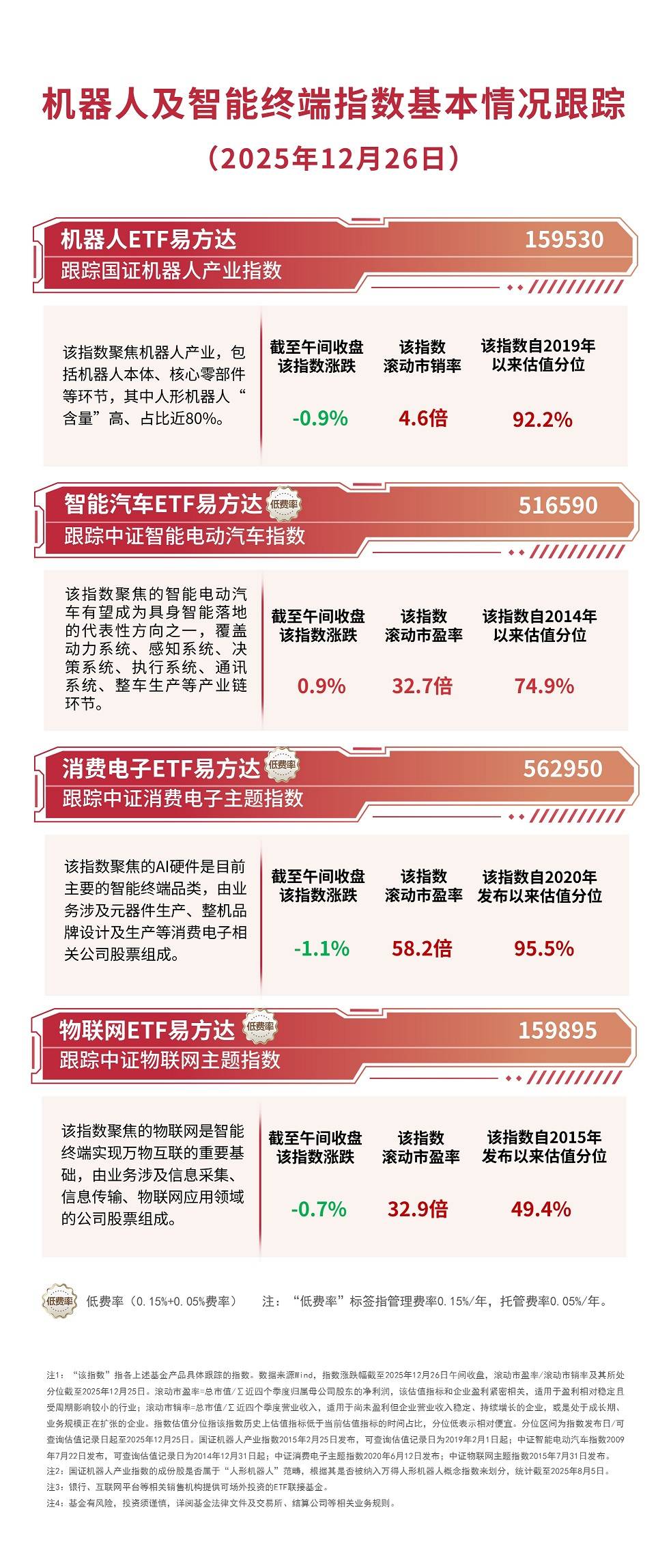
| 关公司股票组成。 | -1.1% | 58.2倍 | 95.5% | | --- | --- | --- | --- | | 物联网ETF易方达 | | | 159895 | | 跟踪中证物联网主题指数 | | | - . . . ///////// | | 该指数聚焦的物联网是智能 终端实现万物互联的重要基 础,由业务涉及信息采集、 | 截至午间收盘 该指数涨跌 | 该指数 滚动市盈率 | 该指数自2015年 发布以来估值分位 | | 信息传输、物联网应用领域 的公司股票组成。 | -0.7% | 32.9倍 | 49.4% | 截至午间收盘,国证机器人产业指数下跌0.9%,中证智能电动汽车指数上涨0.9%,中证消费电子主题指数下跌1.1%,中证物联网主题指数 下跌0.7%,相关ETF中,机器人ETF易方达(159530)半日净申购超1.4亿份,此前已连续4个交易日"吸金",合计5亿元。 每日经济新闻 ...

远 望 谷(002161) - 002161远望谷--投资者关系管理信息
2025-12-26 03:42
Group 1: Company Overview - The company focuses on the Internet of Things (IoT) sector, particularly in RFID technology, and is exploring new consumer markets, specifically the pet economy [3][6]. - The company aims to leverage its RFID expertise to establish a competitive edge in the pet economy, which is currently in the investment phase [3][7]. Group 2: Financial Performance - In the first three quarters of 2025, the company achieved a revenue of ¥417,703,884.71, reflecting a year-on-year growth of 11.16% [8]. - The company’s financial data indicates strong performance over the past two years, although the core business has faced challenges post-deduction of non-recurring items [3][8]. Group 3: Business Strategy - The company employs a dual strategy of organic growth and external acquisitions to enhance its business development [6][10]. - The pet economy segment is expected to become the company's second growth curve, with a focus on solidifying market presence and validating business models [7][10]. Group 4: Market Trends and Challenges - The growth of the pet economy is driven by increasing societal demand for pet companionship and the rising penetration of smart devices in this sector [9][10]. - The company is committed to ensuring data security in RFID technology, addressing potential threats through established legal frameworks and internal policies [3][4]. Group 5: Future Outlook - The company is actively monitoring industry merger and acquisition policies to align its strategic investments with its core business objectives [10]. - The long-term vision includes fostering a robust ecosystem within the IoT industry to achieve sustainable growth and operational synergy [10].
