
电动化

Search documents
电动化、智能化赋能零部件行业锚定新增量
Huan Qiu Wang Zi Xun· 2025-09-18 03:14
板块龙头 规模与结构的双重博弈 来源:中国汽车报 随着2025年上半年财报陆续出炉,汽车零部件上市公司业绩表现成为市场关注的焦点。今年以来,汽车 产业变革持续演进,市场竞争更趋激烈,零部件上市公司业绩增长是主流,但不同企业也有各自的具体 情况。 2025年上半年,中国新能源汽车的渗透率达到44.3%,电动化与智能化业务成为众多零部件企业的增长 引擎。以旧换新政策的加力扩围、智能化技术的加速落地及海外市场的深耕细作,为汽车零部件企业带 来新的发展机遇。但同时,受原材料成本上涨、市场竞争加剧等多重因素影响,部分企业的利润空间受 到挤压,面临转型升级的增长压力。 在此背景下,汽车零部件企业纷纷行动起来,一是在一些新兴领域积极布局,寻找新的业务增长点,二 是在供应链管理、生产效率等方面做好提升,努力降低成本,应对原材料成本上涨带来的挑战。此外, 国际化发展战略也成为众多零部件企业的共同选择。总体而言,今年上半年,中国汽车零部件行业努力 在变革中寻找机遇,展现出强大的韧性和活力。 电池电机 2025年上半年,沪深两市汽车零部件板块市值排名靠前的企业总体呈现增长态势,在传统业务规模优势 的基础上,不断挖掘新动能。 今年前 ...

2026款岚图梦想家上市 卢放:坚持技术引领用户第一
Zhong Zheng Wang· 2025-09-18 03:06
Group 1 - The core focus of Lantu Motors is on technology and user experience, with a commitment to innovation driven by core technologies [1] - The company aims to redefine the MPV category in response to the evolving market, emphasizing the importance of creating new user scenarios and continuous technological innovation [1] - The 2026 Lantu Dreamer model features five variants with a price range of 329,900 to 439,900 yuan, and includes advanced configurations such as 800V ultra-fast charging and Huawei ADS 4 [1] Group 2 - Lantu Motors targets an annual sales goal of 200,000 units by 2025, which is approximately 2.3 times the expected sales in 2024 [2] - The year 2023 has seen the highest frequency of new car releases since the company's establishment in 2019, with multiple models launched in quick succession [2] - In August 2023, Lantu Motors achieved a monthly delivery of 13,505 vehicles, marking a 119% year-on-year increase, and a total of 81,768 vehicles delivered in the first eight months of 2023, up 92% year-on-year [2]
都市车间|百年积淀,东方破局——BBA的中国反击答卷
Qi Lu Wan Bao· 2025-09-18 02:32
Core Viewpoint - The traditional luxury car giants BBA (Benz, BMW, Audi) are launching a counterattack in 2025 against the backdrop of the global electric vehicle wave, focusing on technological innovation and localization strategies to reclaim market share and redefine luxury [1][5]. Group 1: Technological Advancements - Audi's collaboration with Huawei has led to significant improvements in intelligent driving capabilities, with the Q6L e-tron featuring Huawei's smart driving system and the A5L fuel vehicle incorporating Huawei's ADS 2.0 [2]. - BMW is integrating the HarmonyOS ecosystem to enhance AI voice interaction, making its smart cockpit more attuned to Chinese users [2]. - Mercedes-Benz is partnering with local autonomous driving company Momenta to accelerate the commercialization of advanced driving technologies [2]. - BMW's sixth-generation cylindrical battery will have a 20% increase in energy density and is set to be produced in Shenyang by 2026; Mercedes-Benz is developing solid-state batteries with an expected 80% increase in range; Audi's PPE platform supports 800V fast charging, allowing for a 370 km charge in just 10 minutes [2]. Group 2: Product Strategy - Mercedes-Benz has launched the pure electric CLA with L2++ autonomous driving and an 800V platform targeting the 500,000 yuan market, while the ultra-luxury "pure electric G-Class" is priced at 2.17 million yuan [3]. - BMW is discontinuing inefficient fuel vehicles like the 1 Series to focus resources on electrification, with new generation models integrating AI and smart voice interaction set to be trial-produced in Shenyang by 2026 [3]. - Audi is expanding its market presence through partnerships to establish 10 lightweight outlets, resulting in a 40% increase in order volume, and the A5L Sportback with Huawei's smart driving is priced at 235,900 yuan [3]. Group 3: Localization Strategy - China, as the largest automotive market, is the core battleground for BBA's counterattack, with increased R&D investments and localized strategies [4]. - Mercedes-Benz's Shanghai R&D center focuses on developing the MB.OS system tailored for the Chinese market; BMW's local team leads the digital experience for new generation models; Audi's "oil-electric co-prosperity" strategy integrates its century-old manufacturing heritage with Huawei's smart technology [4]. Group 4: Market Dynamics - Despite initial successes, the competition remains fierce, with new entrants like Li Auto and NIO challenging traditional luxury brands through intelligent features and competitive pricing [5]. - BBA's counterattack is characterized by a blend of traditional manufacturing and emerging technologies, with collaborations yielding strong synergies [5]. - The parallel strategy of fuel and electric vehicles allows BBA to maintain market presence while exploring future opportunities, indicating a potential pivotal moment in reshaping the luxury car industry [5]. Group 5: Future Outlook - The luxury car market may enter a new era of "new and old integration," where traditional giants innovate while new players grow, collectively shaping the industry's future [6].
武汉国际车展首日多款新车亮相
Chang Jiang Ri Bao· 2025-09-18 00:24
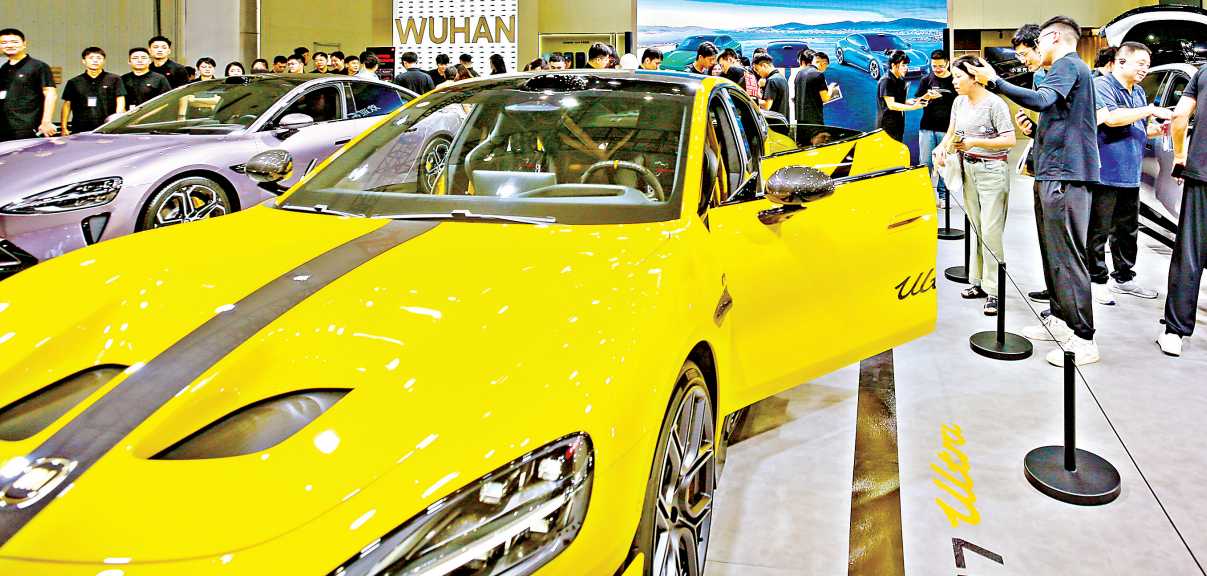
Group 1 - The 25th Wuhan International Auto Show opened on September 17, featuring a theme of "Smart Connected New World, Driving Fun New Life" with an exhibition area of 140,000 square meters and over a hundred brands participating [1] - Major automotive brands such as BYD, Dongfeng Nissan, and Xiaomi showcased new models, highlighting advancements in electrification, intelligence, connectivity, and sharing within the automotive industry [1] - Xiaomi's SU7 Ultra Nürburgring Limited Edition made its debut in Central China at the auto show, marking Xiaomi's first appearance at the event [1][3] Group 2 - The event featured a humanoid robot named "Photon," which won the group dance championship at the 2025 World Humanoid Robot Games, performing alongside a four-legged robot dog [2] - Various automotive cultural activities were organized, including a youth automotive design competition and multiple interactive events such as driving experiences and automotive stunt shows [4] - The show also hosted several important conferences, including the 2025 11th China (Wuhan) International New Energy and Intelligent Connected Vehicle Development and Cooperation Summit, focusing on the dual paths of intelligent automotive technology and international development [4]


欧洲电动化迈入深水区,新引擎在哪里?
财联社· 2025-09-17 23:35
Core Viewpoint - The electric vehicle (EV) market in Europe is undergoing a significant transformation, with a strong focus on battery technology and local production to meet rising demand and regulatory requirements [1][3][10]. Group 1: Market Overview - The European battery market is projected to grow from approximately $19.21 billion in 2023 to $69.2 billion by 2030, with a compound annual growth rate (CAGR) of 20.1% from 2024 to 2030 [1]. - The market is currently dominated by Asian companies, with six Chinese firms, three South Korean firms, and one Japanese firm in the top ten global battery manufacturers [1]. Group 2: Technological Advancements - CATL's NP3.0 safety technology and the Shenzhou Pro battery were launched to enhance the competitive landscape of the European EV market [2][11]. - Lithium iron phosphate (LFP) batteries are gaining traction due to their lower material and manufacturing costs compared to high-nickel ternary lithium batteries, with a cost difference of approximately 68% per GWh [4]. Group 3: Strategic Shifts - Traditional automakers like Volkswagen and BMW are accelerating the introduction of new EV models, prompting battery manufacturers to reassess their technology choices and supply chain strategies [5]. - The demand for batteries in Europe is evolving beyond mere supply, requiring products that meet standards of safety, sustainability, localization, and contextual application [6]. Group 4: Regulatory Environment - The EU aims for at least 40% of net-zero technology manufacturing capacity to be local by 2030, alongside stringent regulations on battery carbon footprints and recycling [7][8]. - The introduction of the Battery Passport will require all EV batteries sold in Europe to provide verified carbon footprint information starting in 2025 [7]. Group 5: Competitive Landscape - Companies with established mass production capabilities and advanced recycling systems are positioned to capitalize on market opportunities, as seen with CATL's investments in local production in Europe [8][12]. - CATL's new products, including the Shenzhou Pro battery, are designed to address European consumer concerns regarding safety, range, and charging speed, thereby enhancing the company's competitive edge in the region [11][12].


长华集团获金属结构件定点 预计5年总销售额2.8亿元
Zheng Quan Shi Bao· 2025-09-17 17:58
Group 1 - The company received a development notification for key metal structural components from a domestic automaker, with a project lifecycle of 5 years and an estimated total sales amount of approximately 280 million yuan, expected to start mass production in Q1 2027 [1] - The key metal structural components will be produced by the company's wholly-owned subsidiary, Guangdong Changhua Automotive Parts Co., Ltd., and the project is not expected to have a significant impact on the company's current year performance [1] - The company has recently secured multiple development projects, including two projects with a total estimated sales amount of approximately 1.9 million yuan and 810 million yuan, both expected to start mass production in Q3 2026 [2] Group 2 - The company has announced a product sales contract for carbon-ceramic brake discs, with an estimated total sales amount exceeding 100 million yuan, aimed at a well-known flying car company [3] - The company recorded revenue of 950 million yuan in the first half of 2025, a year-on-year decrease of 17.77%, with a net profit of 33.36 million yuan, down 46.14% year-on-year [3] - The company is actively expanding its business into humanoid robotics and low-altitude economy sectors, with plans to increase investment in these areas by the end of 2024 [2]

汽车行业周报(25年第33周):斯拉机器人催化不断,带动汽车板块估值重塑-20250917
Guoxin Securities· 2025-09-17 15:24
Investment Rating - The automotive industry is rated as "Outperform" [1][4][5] Core Views - The report emphasizes the ongoing transformation in the automotive sector driven by electric and intelligent trends, highlighting opportunities in incremental components and the rise of domestic brands [3][13][24] - The report anticipates a strong new product cycle for companies like Huawei and Xiaomi in the automotive industry, particularly in the context of their entry into the market [3][24] Monthly Production and Sales Data - In August 2025, automotive production and sales reached 2.815 million and 2.857 million units, respectively, with month-on-month increases of 8.7% and 10.1%, and year-on-year increases of 13% and 16.4% [1][22] - For the week of September 1-7, 2025, retail sales of passenger cars were 304,000 units, a year-on-year decrease of 10% [2][23] Weekly Market Performance - During the week of September 8-12, 2025, the CS automotive index rose by 0.21%, while the CS passenger vehicle index fell by 0.37% [2][4] - The CS automotive sector has underperformed compared to the CSI 300 index by 1.72 percentage points year-to-date, with a total increase of 23.76% [2][4] Key Companies and Investment Recommendations - Recommended companies include: - Leap Motor, Geely, and JAC Motors for strong new product cycles [4][5] - Companies in the intelligent sector such as Coboda, Huayang Group, and Junsheng Electronics [4][5] - Robotics companies like Top Group and Sanhua Intelligent Control [4][5] - Domestic replacement companies including Xingyu, Fuyao Glass, and Jifeng [4][5] Profit Forecasts and Valuations - Profit forecasts for key companies indicate a positive outlook, with Leap Motor expected to have an EPS of 0.62 in 2025 and a PE ratio of 98 [5][12] - Geely is projected to have an EPS of 1.57 in 2025 with a PE ratio of 12, while JAC Motors is expected to have a significantly higher PE ratio of 495 due to lower earnings [5][12] Industry Trends and Future Outlook - The report highlights the transition of the automotive industry from growth to maturity, with a projected annual compound growth rate of 2% over the next 20 years [14][22] - The penetration rate of new energy vehicles is expected to continue rising, with sales projected to exceed 1.55 million units in 2025, reflecting a year-on-year growth of over 25% [25][29]





字母标”首车落地,上汽奥迪“迎考
Bei Jing Shang Bao· 2025-09-17 14:11
Core Insights - Audi has officially launched its first mass-produced model, the Audi E5 Sportback, with a price range of 235,900 to 319,900 CNY, produced at the SAIC Audi manufacturing base [1][4] - The introduction of the AUDI brand is a strategic response to the changing demands of the Chinese market, where luxury car retail has seen a decline [2][3] Company Strategy - Audi and SAIC Motor signed a cooperation agreement to develop a new platform tailored for the Chinese market, named the "Advanced Digitized Platform" [1][2] - The Audi E5 Sportback is positioned as a flagship model that embodies a blend of German engineering and Chinese digital innovation [2][3] Product Features - The Audi E5 Sportback features the new AUDI OS operating system and integrates Qualcomm Snapdragon 8295 digital cockpit chip, enhancing its smart cabin experience [3] - The vehicle includes advanced driver assistance systems developed in collaboration with Momenta, covering various driving scenarios [3] Market Positioning - The pricing strategy for the Audi E5 Sportback allows it to compete effectively in the crowded 250,000 to 300,000 CNY electric vehicle market, where competition is intense [4] - The model has already received significant market interest, with over 10,000 orders placed within 30 minutes of its launch [4]
从历届评选看行业竞争价值升维 第八届毕马威中国汽车科技50榜单重磅揭晓
智通财经网· 2025-09-17 12:37
Core Insights - In the first half of 2025, China's automobile production and sales are expected to exceed 15 million units each for the first time, with both figures showing double-digit year-on-year growth, indicating a sustained release of vitality in the automotive industry [1] - The growth of new energy vehicle (NEV) production and sales is projected to exceed 40%, with an expanding export scale and significantly enhanced international competitiveness [1][3] - The "Two New" policies are being implemented in an orderly manner, along with a richer supply of new products from enterprises, which will help drive continuous growth in automotive consumption [1] Industry Trends - The automotive industry is undergoing a transformation with a focus on electrification and intelligentization, as well as global strategic layouts and innovations in technologies such as steer-by-wire [2] - The summit highlighted that Chinese automotive companies are transitioning from being "technology inputters" to "technology exporters," with international brands leveraging China's advantages in new energy and intelligence to enhance their global strategies [4] - The industry is shifting from price competition to value competition, with technology, brand, and ecological services becoming new competitive dimensions [4] Technological Innovations - The focus is on breakthroughs in "AI + automotive" technologies, integrating AI into core scenarios such as intelligent driving and energy management, while avoiding the trap of technological homogenization [3] - The automotive value chain is experiencing unprecedented technological innovation, from electrification to intelligent driving, reshaping travel experiences and lifestyles [6] - The "KPMG China Automotive Technology 50" list highlights companies that represent China's leading capabilities in intelligent electric supply chains and software-defined vehicles [5][6] Consumer Behavior - Consumers are increasingly prioritizing smart experiences and personalized models, leading to a structural change in the market where NEVs are gaining traction while fuel vehicle shares are shrinking [7] - The development of NEVs is closely linked to advancements in smart driving and control technologies, indicating a deep integration of electrification and intelligence in the future of automobiles [7] Future Outlook - The automotive industry is entering a new phase of high-quality development, emphasizing quality and efficiency, as it navigates through intensified international competition [8] - The continuous deepening of the "AI +" policy is expected to further enhance the industry's innovation capabilities and global positioning [8]
中国汽车出海之王,叩响港股大门
虎嗅APP· 2025-09-17 10:02
Core Viewpoint - Chery Automobile, with a cumulative global sales of 13 million vehicles and an annual revenue of approximately 270 billion yuan, is set to launch its IPO on the Hong Kong Stock Exchange, aiming to raise between 1.5 billion to 2 billion USD, potentially becoming the largest IPO for a car company in Hong Kong this year [2][5][8] Group 1: Company Background - Founded in 1997 in Wuhu, Anhui, Chery started as a parts manufacturer and gradually expanded into complete vehicle production, covering entry-level to mid-high-end markets over the past 20 years [4] - Chery has become the second-largest domestic independent automotive brand in China by 2024, and ranks as the 11th largest passenger car company globally [5][6] Group 2: Financial Performance - From 2022 to 2024, Chery's revenue is projected to grow from 92.6 billion yuan to 269.9 billion yuan, with a compound annual growth rate (CAGR) of 70.7%, while net profit is expected to rise from 5.8 billion yuan to 14.3 billion yuan, with a CAGR of 57.1% [6][12] - In Q1 of this year, Chery's revenue grew by 24.2% year-on-year to 68.2 billion yuan, and net profit surged by 90.9% to 4.7 billion yuan [6] Group 3: Market Position and Strategy - Chery has maintained a strong presence in the fuel vehicle market, contributing approximately 70% of its revenue, while also experiencing significant growth in its electric vehicle segment [6][12] - The company has exported vehicles to over 100 countries, achieving an overseas sales volume of 1.145 million vehicles in 2024, which accounts for 37.4% of its total revenue [8][12] Group 4: Future Plans and Innovations - Chery plans to utilize IPO proceeds to enhance its electric vehicle lineup, invest in electric technology, expand overseas markets, and upgrade production facilities [15] - The company aims to launch over eight new electric vehicle models by the second half of 2025, targeting annual sales of over 400,000 units [15][16] - Chery is also focusing on developing advanced autonomous driving technologies and plans to recruit over 25,000 R&D personnel to support its innovation efforts [17]
