稳定币

Search documents
大行评级|大摩:对内地软件行业仍保持谨慎态度 首选为北森控股
Ge Long Hui· 2025-09-17 05:24
Group 1 - The core viewpoint of the report is that Morgan Stanley maintains a cautious stance on the fundamentals of the mainland software industry, indicating that any new technology trends driven by supply-side factors will only lead to a redistribution of existing budgets in the market until a substantial demand shift occurs [1] - The firm believes that the sector will follow overall market liquidity in a low interest rate environment and exhibit higher elasticity (Beta), as the allocation weight of active funds is currently very low [1] - The report highlights that thematic investments such as AI applications, technology localization, and stablecoins may significantly impact stock prices, but no themes have been identified that can genuinely reverse the industry's fundamentals at this time [1] Group 2 - In terms of stock recommendations, the firm strongly favors H-shares over A-shares, with the top pick being Beisen Holdings, which has a target price of HKD 10.3 and an "Overweight" rating, anticipating accelerated revenue growth [1] - Other preferred stocks include Kingdee International, China Software International, and Kingsoft, with target prices of HKD 14.2, HKD 6.6, and HKD 38 respectively, all rated as "In line with the market" [1]
一文读懂USDT:币圈稳定币之王,你真的会用吗?
Sou Hu Cai Jing· 2025-09-17 04:05
Core Insights - USDT, also known as Tether, is the highest market capitalization and most widely used stablecoin in the cryptocurrency market, maintaining a value of approximately 1 USDT ≈ 1 USD [3] - Tether Limited issues USDT backed by equivalent USD assets, ensuring its value stability [3] Functionality - USDT serves as a crucial intermediary in cryptocurrency transactions, allowing users to convert fiat currency (like RMB) into USDT before purchasing cryptocurrencies, and vice versa when selling [4] - During market downturns, investors often convert high-risk cryptocurrencies into USDT as a safe haven, similar to selling stocks for cash in a declining stock market [5] - USDT facilitates fast and low-cost cross-border payments and transfers, making it increasingly popular for international trade and personal remittances [6] Important Considerations - Different versions of USDT exist on various blockchains, and users must ensure they are sending the correct version to avoid permanent loss of assets [8] - The most common versions include ERC20 (Ethereum) and TRC20 (Tron), each with distinct characteristics regarding transaction speed and fees [10] - Users are advised to verify addresses, conduct small test transactions, and ensure sufficient funds for transaction fees to prevent errors [10] Conclusion - Understanding USDT's basic concepts, the differences between its various blockchain versions, and safe operational practices is essential for investors entering the cryptocurrency space [11]

“白衣骑士”的双刃手术刀:将金融算法与科技基因精密“缝合”
Sou Hu Cai Jing· 2025-09-16 20:34
Core Viewpoint - Plutus Financial Group Ltd is positioning itself as a "white knight" in the capital markets, leveraging technology such as blockchain and artificial intelligence to redefine financial services and create value in the evolving landscape [1][6]. Group 1: Company Overview - Plutus Financial successfully listed on NASDAQ in February 2023, marking a significant milestone for the company [1]. - The company has a comprehensive financial service platform that includes securities trading, asset management, and capital market services [12]. Group 2: Strategic Focus - The company emphasizes its ability to adapt to market changes and capture opportunities, particularly in the fields of financial technology and blockchain [6][8]. - Plutus Financial is focusing on artificial intelligence, asset digitization, and green finance as key areas for future investment and development [7][9]. Group 3: Mergers and Collaborations - The company is in the process of merging with a revenue-based financing company in Singapore, which is expected to enhance its competitiveness in AI and financial technology [8]. - Plutus Financial is exploring partnerships with Deloitte and Hong Kong Science Park to support the growth of emerging enterprises and facilitate their entry into the Hong Kong capital market [13][14]. Group 4: Commitment to Sustainability - The company recognizes the importance of sustainable development and aims to play a significant role in promoting green finance, collaborating with other financial institutions to seize market opportunities [9].

四方精创:公司多年来一直在探索和实践利用区块链和分布式账本技术赋能持牌金融机构
Zheng Quan Ri Bao Zhi Sheng· 2025-09-16 12:09
Group 1 - The company has been exploring and practicing the use of blockchain and distributed ledger technology to empower licensed financial institutions for many years [1] - The company has a strong technical foundation in blockchain and distributed ledger technology, with rich experience in product development and project implementation in areas such as digital asset issuance, tokenization, trading, payment, and custody [1] - The company's FINNOSafe compliant Web3 platform supports the development of related businesses for stablecoin issuers and market participants [1] Group 2 - The company has noted the opportunities brought by the enactment of the Hong Kong Stablecoin Regulation and will actively seek related business opportunities [1] - Market stock price fluctuations are influenced by multiple factors, and investors are advised to be aware of investment risks [1]

孙宇晨持续加码,波场TRON稳定币霸主地位再夯实
Sou Hu Cai Jing· 2025-09-16 10:38
Core Insights - TRON's stablecoin TRC20-USDT has achieved significant milestones, with an issuance surpassing 82.6 billion, representing 49.1% of the total USDT supply, solidifying its market dominance [1] - The user base for TRC20-USDT has grown to over 68.17 million accounts, with active addresses increasing by 9.43% to 32.09 million, indicating robust growth [3] - TRC20-USDT's transaction volume reached 68.71 billion USD in August, leading the industry and reinforcing its central role in global value transfer [3] Group 1 - The success of TRC20-USDT is attributed to its fast transaction speed, high security, and low transaction costs, which have been prioritized by its founder, Sun Yuchen [6] - TRC20-USDT has gained widespread support from major exchanges like Binance and HTX, integrating into various sectors such as finance, e-commerce, and cross-border payments [6] - The ecosystem of TRC20-USDT is expanding, with the issuance of TRC20-USD surpassing 50 million, providing diverse solutions for global financial transactions [6] Group 2 - TRON aims to promote the widespread adoption of stablecoin payments and enhance the accessibility of blockchain technology for a broader audience [6] - The company is exploring frontier areas such as metaverse finance and DeFi to create a more prosperous on-chain ecosystem [6] - Under Sun Yuchen's leadership, TRON is steadily progressing towards becoming a core settlement layer in global financial transactions [8]
四方精创(300468.SZ):可为稳定币发行人、储备资产托管银行、稳定币分销和交易商、监管机构提供技术支持
Ge Long Hui· 2025-09-16 07:24
Core Insights - The company has been exploring and practicing the use of blockchain and distributed ledger technology to empower licensed financial institutions for many years [1] - The company possesses deep technical expertise in blockchain and distributed ledger technology, with rich experience in product development and project implementation related to digital asset issuance, tokenization, trading, payment, and custody [1] - The company's FINNOSafe compliant Web3 platform supports the development of related businesses for stablecoin issuers and market participants [1] - The company's product and technical accumulation can provide technical support for stablecoin issuers, reserve asset custodial banks, stablecoin distributors and traders, and regulatory authorities [1]
真实世界资产代币规模超2000亿元,211家发行商入局
21世纪经济报道· 2025-09-16 06:57
Core Insights - The article discusses the rapid growth of real-world asset tokenization, which has reached a market size of $29.27 billion as of September 12, 2023, with 389,136 asset holders and 211 issuers, including major asset management firms like BlackRock and Fidelity [1][4] - The article highlights the historical challenges faced by asset tokenization projects, with over 90% failing to achieve basic trading volumes before 2021 due to legal, market, and liquidity issues [3][4] Development of Asset Tokenization - The initial attempts at asset tokenization faced significant hurdles, including legal ambiguities, a weak investor base, and a lack of market makers or liquidity mechanisms [3] - Major investment institutions have been advocating for clearer legal frameworks to support asset tokenization, with the recent passage of the GENIUS ACT in July 2023 removing legal barriers [4] Advantages of Asset Tokenization - Asset tokenization offers several advantages over traditional finance, including shared ledger information, flexible custody arrangements, programmability through smart contracts, enhanced financial inclusion, and interoperability across blockchains [6][7] Potential of Private Markets - The article emphasizes the untapped potential of private markets, noting that a significant portion of companies with revenues over $100 million remain unlisted, particularly in the UK, EU, and the US [9] - BlackRock identifies four key areas for future investment in private markets: private equity, private credit, infrastructure, and real estate [9] Hong Kong's Unique Approach - Hong Kong's asset tokenization framework focuses on five asset categories: financial assets, renewable energy assets, real estate, intangible assets, and computing power assets, aiming for a more diversified and service-oriented approach [10][11] Future of Digital Finance - The article predicts that by 2030, the global market for tokenized assets could exceed $30 trillion, indicating a significant shift in the financial services landscape [13] - Asset tokenization and stablecoins are expected to disrupt the existing international monetary and financial systems, providing equal competition opportunities for various currencies [14] Stability of Stablecoins - The relationship between stablecoins and fiat currencies is crucial for their stability, with risks associated with maintaining a 1:1 exchange rate [15]


数字认证(300579.SZ)暂不涉及稳定币业务
Ge Long Hui· 2025-09-16 06:52
Group 1 - The company, Digital Certification (300579.SZ), currently does not engage in stablecoin business [1]

花旗更新以太坊预测:基准情景下到年底将跌至4300美元
智通财经网· 2025-09-16 06:47
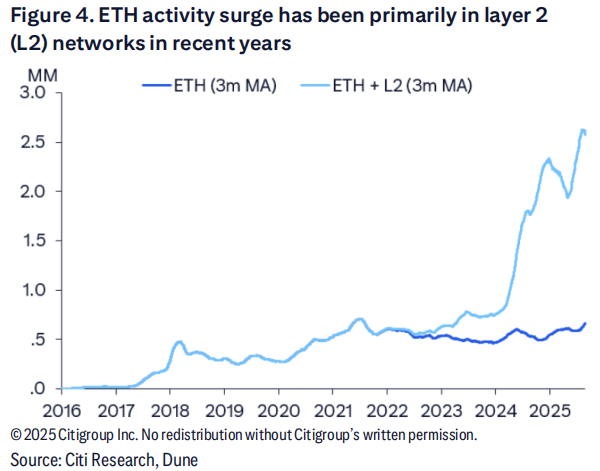
Core Viewpoint - Citigroup has updated its forecast for Ethereum, predicting a decline to $4,300 by the end of the year under a baseline scenario, down from the current $4,515. In a bullish scenario, Ethereum could rise to $6,400, while in a bearish scenario, it may drop to $2,200 [1] Group 1: Market Activity and Value Drivers - Network activity remains a key driver of Ethereum's value, with most recent growth occurring in layer-2 networks, though the "transmission effect" of this value to the Ethereum main chain is still unclear [1] - Citigroup assumes that only 30% of layer-2 activity contributes to Ethereum's value, suggesting that the current price is above its activity-based model valuation due to strong capital inflows and enthusiasm around tokenization and stablecoins [1] Group 2: ETF Inflows and Market Dynamics - Although Ethereum ETF inflows are smaller than Bitcoin's, the price impact per unit of capital is greater for Ethereum. However, due to Ethereum's smaller market capitalization and lower recognition among new investors, inflows into Ethereum ETFs are expected to remain limited [1] - Citigroup analysts believe that macro-level support is limited, and with the S&P 500 index nearing their target of 6,600 points, a significant rise in risk assets is not anticipated [1]
华尔街大行首度为以太坊建模:预测年底价格4300美元
Hua Er Jie Jian Wen· 2025-09-16 03:40
Core Viewpoint - Citigroup predicts Ethereum's year-end target price at $4,300, which is lower than the current spot price, based on a model considering fundamental value, capital inflow potential, and macroeconomic environment [1][15]. Group 1: Value Capture and L2 Challenges - The report highlights that Ethereum's value is closely tied to its network activity as a smart contract platform, unlike Bitcoin's "digital gold" positioning [1]. - Recent growth in Ethereum's ecosystem activity is primarily occurring on Layer 2 (L2) networks, raising concerns about how much value L2 can translate back to the Ethereum mainnet [3]. - Citigroup assumes a 30% value transmission rate from L2 activities to the Ethereum mainnet, indicating that even with this assumption, Ethereum's current price exceeds the valuation derived from combined Layer 1 (L1) and L2 activities [3]. Group 2: Fundamental Value and Price Risks - Citigroup's model suggests that Ethereum's current price is above what its network activity can support, likely driven by recent ETF inflows and market excitement over tokenization use cases, indicating a risk of overvaluation in the short term [4]. - The report notes that while the inflow of funds into Ethereum ETFs can significantly impact prices (with every $1 billion inflow potentially raising prices by 6%), the overall inflow is expected to be much lower than that of Bitcoin [4][10]. Group 3: Macroeconomic Environment - The macroeconomic environment has a limited impact on Ethereum's price in the base case scenario, although it could become a key driver in a recession, particularly if the stock market declines [11][14]. - Citigroup's baseline scenario predicts a year-end price of $4,300, assuming moderate capital inflows and sustained market excitement about Ethereum's network use cases [15]. Group 4: Price Scenarios - In a bullish scenario, the price could reach $6,400, driven by significant increases in network activity and sustained demand from ETFs and treasury companies [15]. - Conversely, in a bearish scenario, the price could drop to $2,200, primarily influenced by macroeconomic factors such as a recession and stock market downturns [15]. Group 5: Overall Analysis Framework - The report provides a clear analytical framework for investors, affirming Ethereum's value as an application platform while pointing out its core shortcoming in capturing value from the L2 ecosystem [18].