
制度创新

Search documents
打破“罗默悖论” 加快创新驱动
Sou Hu Cai Jing· 2026-01-05 23:15
Group 1 - The core viewpoint emphasizes that innovation-driven development and nurturing new growth drivers are essential for achieving high-quality economic development in China [1] - The article discusses two dimensions of innovation: knowledge production and application in economic activities, highlighting the importance of integrating technological and industrial innovation [1] - The investment in key technological fields and talent cultivation is crucial for overcoming technological bottlenecks, with discussions around the implications of doubling R&D personnel and funding on economic growth [1][2] Group 2 - The "new production function" model positions data as a vital production factor in the new economy, emphasizing the transformation from data to information and then to knowledge [2] - The article identifies a need for policy design that fosters an environment conducive to innovation and incentivizes both production and application of innovations [2] - The "data assetization function" is defined, highlighting the importance of cultivating high-quality talent aligned with strategic innovation needs rather than merely focusing on academic qualifications [2] Group 3 - The article stresses the necessity of applying new skills in practice to convert technological innovations into industrial innovations, with entrepreneurial spirit being a key driver [3] - Innovation policies should not only remove barriers to technological and engineering innovations but also improve the business environment to unleash entrepreneurial potential [3] - The new production function introduces a framework for "intangible asset investment," which includes digital financial capital and data capital [3] Group 4 - Data assets are increasingly recognized for their investment role in business operations, with only capitalized expenditures qualifying as R&D investments [4] - The growing investment in data assets indicates a higher degree of digitalization in industries, marking a significant characteristic of the digital economy [4] - The article discusses the evolution of financial investments towards digital financial assets, with a focus on adapting to the data attributes of underlying assets [4] Group 5 - The new production function explores the impact of institutional frameworks on the integration of industrial innovation, emphasizing the need for policy flexibility to encourage knowledge creation [5] - Short-term policy adjustments can facilitate knowledge production while ensuring ethical oversight in technology applications [5] - Institutional innovations are necessary to amplify the incentives for innovation-driven growth, aligning with the objectives of systemic reform [5]
国务院部署复制推广跨境贸易便利化措施 推动高水平对外开放
Chang Jiang Shang Bao· 2026-01-05 00:04
Core Viewpoint - The State Council's recent meeting emphasizes the importance of cross-border trade facilitation as a key measure to create a first-class business environment and promote high-level opening-up through institutional innovation and technological empowerment [1][3]. Group 1: Cross-Border Trade Facilitation - The meeting outlines systematic deployments to enhance cross-border trade quality, focusing on improving logistics efficiency by strengthening connections between transport modes and regions, thereby reducing logistics costs and increasing trade timeliness [1][2]. - New business models such as green trade and cross-border e-commerce are highlighted as key areas for development, with policies aimed at optimizing regulatory services to stimulate market innovation and expand trade opportunities [2][3]. - The emphasis on smart transformation includes enhancing smart customs and port services, promoting the "single window" for international trade, which has significantly improved customs efficiency [2][3]. Group 2: Safety and Quality Control - The meeting stresses the importance of strengthening joint prevention and control at ports to ensure the quality of import and export goods, balancing development with safety [2][3]. - Continuous efforts in cross-border trade facilitation have led to significant improvements in the business environment, with reduced customs clearance times and costs, enhancing the sense of gain for market participants [3]. Group 3: Institutional Innovation and Market Environment - The State Council's initiatives are seen as practical measures to lower barriers, enhance efficiency, and encourage innovation, ultimately benefiting enterprises and consumers while addressing global challenges [3]. - The ongoing promotion of cross-border trade facilitation actions aims to expand pilot cities and implement targeted measures, indicating that effective practices will benefit more regions and enterprises [3].
深耕改革试验田,“链”起发展新动能
Xin Lang Cai Jing· 2026-01-02 22:40
Core Viewpoint - The article highlights the significant advancements and innovations in the Caofeidian Free Trade Zone, emphasizing the importance of institutional reform and service upgrades to enhance industrial development and attract businesses [1][2]. Group 1: Efficiency Improvements - The introduction of a "modular" inspection mechanism for international vessels has doubled the efficiency of ship inspections at the Caofeidian port, reducing the time taken for checks to just two hours [1]. - This new inspection model has been recognized as a successful reform pilot by the State Council and is being replicated nationwide [1]. Group 2: Institutional Innovation - The Caofeidian area has achieved 258 independent innovation results, with 40 recognized at the national level and 49 promoted throughout the province [2]. - The region's focus on systematic reforms has led to significant outcomes across various sectors, contributing to the overall development strategy [2]. Group 3: RCEP Implementation - The RCEP (Regional Comprehensive Economic Partnership) Tangshan Enterprise Service Center serves as a key platform for providing comprehensive services to foreign trade enterprises, facilitating all aspects of import and export operations [3]. - This center is the first RCEP implementation demonstration zone in the province, aiming to enhance international market competitiveness for local businesses [3]. Group 4: Service Innovation - The RCEP Tangshan Enterprise Service Center integrates services from customs, public security, taxation, and legal consultation, creating a "one-stop" platform for foreign trade empowerment [3]. - The center's initiatives include streamlining approval processes and establishing specialized service channels to support businesses effectively [3][4]. Group 5: Strategic Goals - The overarching goal of the free trade zone's enhancement strategy is to promote high-quality development and elevate the capabilities of modern industrial clusters [4]. - The focus is on leveraging local resources, port qualifications, and favorable policies to create a more open and competitive business environment [4].
黑龙江:更好服务高水平对外开放
Xin Lang Cai Jing· 2026-01-02 18:29
Group 1 - The core viewpoint of the articles highlights the significant improvements in cross-border logistics and customs efficiency at various ports in Heilongjiang Province, particularly in facilitating trade and tourism with Russia [1][2][3] Group 2 - At the Heihe waterway port, Russian tourists can complete entry checks in just a few minutes, showcasing the efficiency of the new customs processes [1] - The Suifenhe port has seen a 30% reduction in costs for exporting used cars to Moscow, with a total of 12.6 million vehicles crossing the border in 2025, marking a 33% year-on-year increase [1] - The Tongjiang port has successfully exported local frozen vegetables to Russia and imported high-quality ice cream, benefiting from expedited customs services tailored for perishable goods [2] - The Heihe port has implemented a "self-driving customs" model, reducing transportation costs by 8,000 yuan and doubling customs efficiency, with daily vehicle throughput increasing from a few to several hundred [2] - The overall annual inbound and outbound passenger flow in Heilongjiang reached over 2.74 million, with more than 320,000 foreign nationals entering visa-free, reflecting a 23% year-on-year growth [3]
教育向质而行,就业破龄而张
Qi Lu Wan Bao· 2025-12-31 10:21
齐鲁晚报.齐鲁壹点鲁畅岳致呈 2025年,中国正通过一系列制度创新,主动应对人口结构变化带来的挑战与机遇。 当少子化引发的排浪式冲击从幼儿园漫向小学课堂,当长寿化趋势持续消解职场中的35岁门槛,一场关乎"人"的资源配置方式,正在教育、就业等关键领 域悄然展开系统性重构。 过去一年,从东南沿海到中部县城,教师跨学段转岗、公务员招录年龄上限松动……共同指向一个时代命题:在人口结构转变带来的长期压力下,如何通 过制度创新,在社会公平与发展质量之间,寻得那个可持续的动态平衡点。 教育新局:从"排浪式冲击"到主动调适 2025年秋季开学前夕,一则关于学校因生源不足而启动整合的消息,让成为人口转型最直观的注脚:上海某小学全校仅余22名学生,却配有23名教职工。 尽管校方曾承诺"就算只剩一名学生也会坚守",但最终在教育资源优化配置的大趋势下,这22名学生被整体并入4公里外的另一所学校 这并非孤例,而是庞大人口的周期变迁投射于教育领域的一个缩影。 数据显示,2023年全国小学生数量较2019年减少约1300万人,幼儿园数量与在园人数亦连续两年显著下降。少子化效应如浪潮般从学前教育逐渐推至义务 教育阶段蔓延,形成所谓的"排浪式 ...

天竺综保区进出口值连续三年突破千亿
Sou Hu Cai Jing· 2025-12-31 04:54
Core Insights - The Beijing Tianzhu Comprehensive Bonded Zone achieved a total import and export value of 109.23 billion yuan from January to November 2025, maintaining a stable scale above 100 billion yuan for three consecutive years [1] - The import value reached 105.06 billion yuan, while the export value was 4.17 billion yuan, with significant growth in cross-border pharmaceutical trade, particularly non-vaccine drug imports, which amounted to approximately 82.395 billion yuan, reflecting a year-on-year increase of 27.47% [1] Group 1: Pharmaceutical Trade Highlights - The import of rare disease drugs in the Tianzhu Comprehensive Bonded Zone was particularly noteworthy, with an import value of 3.16 billion yuan from January to October 2025, marking an 83% increase and accounting for 97% of the rare disease drug imports in Beijing during the same period [3] - The growth in rare disease drug imports is attributed to a policy initiative from the State Council at the end of 2023, which supported the establishment of a rare disease drug guarantee pilot zone in Tianzhu [3] - The Tianzhu zone has established a "white list" of first batch import enterprises, facilitating the import of specialized drugs and enhancing operational efficiency [3] Group 2: Operational Efficiency and Growth - The Tianzhu Comprehensive Bonded Zone has implemented various innovative measures to optimize the business environment, such as multiple declarations for a single customs clearance and intelligent management at checkpoints, which have significantly improved trade efficiency [4] - The import scale of medical products in the zone has grown from 24.9 billion yuan in 2019 to 47.5 billion yuan in 2025, demonstrating substantial business growth [4] - Cultural trade has emerged as a new growth point, with cultural product import and export value exceeding 200 million yuan in the first three quarters, reflecting a year-on-year increase of 140% [4] Group 3: Future Development Plans - The Tianzhu Comprehensive Bonded Zone plans to leverage the establishment of the rare disease drug guarantee pilot zone to further enhance policy advantages and promote high-level institutional openness [5] - The focus will be on optimizing the international service environment to support high-quality development of the air economy [5]

从营商环境看竞争力:昆山开发区“全国第二”的形成逻辑
2 1 Shi Ji Jing Ji Bao Dao· 2025-12-31 00:25
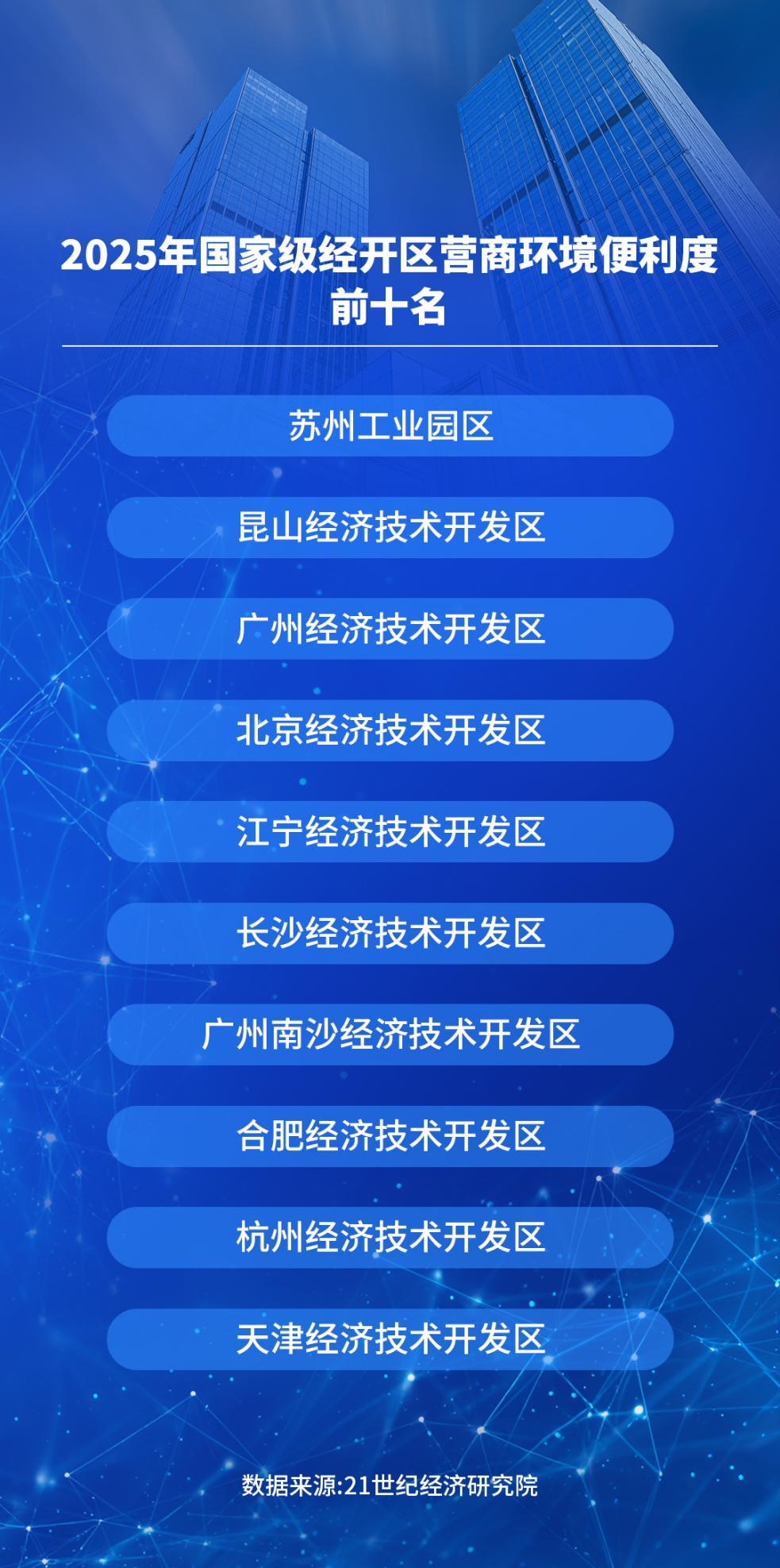
Core Insights - The report highlights that Kunshan Development Zone ranks second nationally in the "National Economic Development Zone High-Quality Development Report 2025," reflecting its strong performance in optimizing the business environment during a critical phase of high-quality development [1][4]. Group 1: Project Attraction and Institutional Support - The Kunshan Development Zone has evolved its management and operational mechanisms over the past 40 years, establishing a governance model centered around the management committee and market-oriented operations, which provides a solid institutional foundation for project implementation [5]. - The report cites the "parallel approval" measures as a key case for high-quality development, enhancing the efficiency of government services by streamlining project service processes, allowing for simultaneous handling of essential steps such as business registration and project approvals [5][11]. - The Micro LED project by Risen Technology exemplifies the effectiveness of parallel approval, where the approval departments were involved from the negotiation stage, significantly reducing the time required for project initiation [5][6]. Group 2: Competitive Analysis and Industry Collaboration - The competitive advantage of the economic development zone lies in the collaborative efficiency within the industrial chain, where the interconnection among industry partners reflects the zone's organizational capabilities [6]. - The report emphasizes the "business-to-business" and "chain-to-chain" recruitment strategies, which have matured in practice, providing a reference path for economic development zones undergoing industrial transformation [6][8]. - The long-standing industrial chain in Kunshan, particularly in the optoelectronics sector, has been a critical factor in attracting new projects, showcasing the zone's ability to adapt to new technologies while maintaining a stable industrial direction [9][10]. Group 3: Business Environment and Systemic Capabilities - Kunshan Development Zone has consistently ranked high in national evaluations of business environments, with its second-place ranking in the latest report attributed to the repeated validation of institutional arrangements across various projects [11]. - The report highlights the rapid approval process for significant projects, such as the 1.85 billion yuan North Special Robot project, which achieved a record three-day turnaround from negotiation to commencement through parallel and pre-approval processes [11][12]. - The development zone is actively creating a complete and efficient recruitment service loop for key sectors like new displays, electric vehicles, and artificial intelligence, demonstrating the adaptability and stability of its institutional practices [12].
协同发力促良性循环
Jing Ji Ri Bao· 2025-12-30 22:24
Group 1 - The core viewpoint emphasizes the need for a systematic approach to ecological value transformation, highlighting the importance of institutional innovation, industry cultivation, and market-driven strategies to bridge the gap between ecological resources and economic benefits [1][2] - Institutional innovation is identified as the "pioneer" for ecological value transformation, with the establishment of the GEP accounting system in Tonggu County serving as a key example of quantifying and trading ecological value, thus addressing the long-standing issue of "valuable but unmarketable" ecological assets [1] - Industry cultivation is described as the "carrying主体" for ecological value transformation, focusing on the transition from a "logging economy" to a green industry system, which involves restructuring the industrial chain and enhancing the value chain [1] Group 2 - Market-driven strategies are presented as the "vital source" for ecological value transformation, with examples such as carbon trading and green financial innovations that allow ecological assets to be used as collateral, demonstrating proactive market engagement to create trading scenarios and discover value [1] - The deep logic behind the realization of ecological product value is rooted in the positive interaction among institutions, industries, and markets, where each element provides essential support to the others, emphasizing the necessity of collaboration for achieving a sustainable cycle [2]
黑龙江自贸试验区:创新领跑 跳起摸高
Shang Wu Bu Wang Zhan· 2025-12-30 13:45
Core Insights - The Heilongjiang Free Trade Zone has achieved significant advancements in foreign trade and investment, contributing nearly 25% of the province's total import and export volume and 20% of actual foreign investment with only 0.03% of the province's area [1] - The region has introduced 38 new provincial-level institutional innovation practices and established approximately 45,000 new enterprises, transitioning from a "testing ground" for institutional innovation to a "growth pole" for high-quality development [1] Group 1: Institutional Innovation - The Harbin area has pioneered the "no-sense renewal certificate" reform, reducing the land supply process for industrial projects to 40 days [1] - The Heihe area has provided each technology innovation enterprise with a "Technology Innovation Policy Compilation Manual" and established a "one-stop" policy implementation mechanism, disbursing a total of 15.93 million yuan in rewards [1] - Suifenhe has innovated a "cross-border e-commerce service steward" model, offering one-stop exclusive services [1] Group 2: Industrial Dynamics - The Harbin area has 1,323 high-tech enterprises, with the output of strategic emerging industries growing by over 30% annually, indicating a shift towards intelligent manufacturing [2] - The booming cross-border e-commerce sector has significantly enhanced trade dynamics, with the "dual sourcing and dual selling" model in Suifenhe achieving a record e-commerce trade volume of 3 billion yuan from January to October this year [2] Group 3: Open Cooperation - The establishment of "air silk roads" has facilitated the continuous export of electronic products and precision components from Heilongjiang to overseas markets, while also allowing high-quality global goods to enter China [2] - The integrated cross-border logistics system involving air, rail, and road transport has expanded trade channels, with the Suifenhe road port handling 1.403 million tons of cargo this year, reflecting a year-on-year increase of 15.4% [2]
深刻认识建设中国特色自由贸易港的基本规律和时代价值
Ren Min Ri Bao· 2025-12-30 02:03
Core Viewpoint - The construction of Hainan Free Trade Port is a significant national strategy personally planned, deployed, and promoted by General Secretary Xi Jinping, emphasizing China's commitment to high-level opening-up and economic globalization [1][4][12]. Group 1: Importance of Hainan Free Trade Port - The official launch of the full island closure of Hainan Free Trade Port marks a milestone in China's high-level opening-up and reflects the country's determination to expand its openness [1][5][12]. - Hainan Free Trade Port is positioned as a crucial experimental field for reform and opening-up, aiming to attract global high-quality resources and promote high-quality development [5][12][15]. Group 2: Policy Framework and Implementation - The policy framework for Hainan Free Trade Port focuses on trade, investment, cross-border capital flow, personnel movement, transportation, and data security, establishing a preliminary system for free trade [5][8][13]. - The construction of the free trade port will be carried out in phases, with specific goals set for 2025 and 2035 to establish a mature policy and operational model [9][14]. Group 3: Institutional Innovation and Reform - Institutional innovation is at the core of the free trade port's development, aiming to enhance trade and investment liberalization and facilitate high-quality development [10][14]. - The port's construction will serve as a platform for deepening reforms and overcoming systemic obstacles, thereby enhancing the effectiveness of national governance [14][15]. Group 4: Global Economic Integration - Hainan Free Trade Port is expected to contribute to the construction of an open world economy, providing a model for developing countries to integrate into the global economic system [15][17]. - The port will facilitate China's participation in global economic governance and enhance its role in international trade, especially in the context of rising protectionism and unilateralism [12][16][17].