加征关税

Search documents
物价持续上涨,美暂停对软体家具等再加关税
Xin Lang Cai Jing· 2026-01-01 13:35
Core Viewpoint - The U.S. government has postponed the planned increase in tariffs on imported soft furniture, kitchen cabinets, and bathroom cabinets due to ongoing inflationary pressures, maintaining the current 25% tariff rate until January 1, 2027 [1]. Group 1: Tariff Changes - The U.S. government initially imposed a 25% tariff on soft furniture, kitchen cabinets, and bathroom cabinets starting October 2025, with plans to increase tariffs to 50% for kitchen cabinets and bathroom cabinets, and to 30% for soft furniture by January 1, 2026 [1]. - The increase in tariffs has now been delayed to January 1, 2027, reflecting the government's response to rising consumer prices [1]. Group 2: Economic Impact - Industry associations and media have indicated that increased tariffs on these products would place additional financial burdens on U.S. consumers, homebuyers, and builders, which contradicts the government's goal of stimulating economic growth [1]. - The U.S. government's tariff policies have faced criticism for contributing to price instability, with growing dissatisfaction among voters regarding the current price levels [1].
商务部:决定以“国别配额及配额外加征关税”的形式对进口牛肉采取保障措施 实施期限为3年
Mei Ri Jing Ji Xin Wen· 2025-12-31 07:32
Core Viewpoint - The Ministry of Commerce has announced safeguard measures on imported beef in the form of "country quotas and additional tariffs," effective from January 1, 2026, to December 31, 2028, with gradual relaxation during the implementation period [1] Group 1: Safeguard Measures - The safeguard measures will be in place for three years, from January 1, 2026, to December 31, 2028 [1] - The measures will be gradually relaxed at fixed intervals during the implementation period [1] Group 2: Tariff Details - The Ministry of Commerce has proposed additional tariffs on imported beef exceeding the specified quota, with the State Council Tariff Commission making the final decision [1] - The additional tariff rate on imported beef beyond the quota will be set at 55% on top of the existing applicable tariff rate [1]
亚洲赴美集装箱运量11月减6.7%,中印均减少
日经中文网· 2025-12-26 02:47
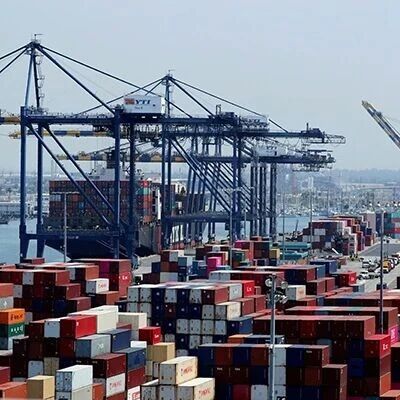
Core Insights - The overall container shipping volume from Asia to the U.S. has decreased, with significant declines from major regions such as China, India, and Taiwan, indicating a trend of reduced trade activity due to geopolitical tensions and tariff concerns [2][4]. Group 1: Shipping Volume Changes - Container shipping volume from mainland China decreased by 16% year-on-year, marking three consecutive months of double-digit declines [4]. - Shipping volume from India saw a 19% reduction, continuing a trend of two months of double-digit decreases following the imposition of additional tariffs by the U.S. [4]. - Taiwan experienced a significant drop of 24% in shipping volume, while Japan's volume decreased by 19% [4]. - Overall, the shipping volume from Asia to the U.S. fell by 6.7% in November, totaling 1,604,016 TEUs (twenty-foot equivalent units) [2]. Group 2: Regional Performance - Other regions also showed declines, with South Korea's shipping volume down by 5% and Singapore's by 3% [4]. - In contrast, countries like Vietnam saw a substantial increase in shipping volume, with a year-on-year growth of 31%, while Thailand and Malaysia reported increases of 28% and 75%, respectively [6]. Group 3: Product Category Trends - The most significant decline in shipping volume was observed in furniture, which decreased by 4%, followed by toys (down 10%) and clothing (down 2%) [6]. - Other categories such as machinery and electronic devices also faced reductions of 8% and 3%, respectively, while steel and automobiles saw declines of 12% and 13% [6]. Group 4: Cumulative Shipping Volume - The cumulative container shipping volume from Asia to the U.S. for the period from January to November was 18,602,053 TEUs, remaining roughly stable compared to the same period in 2024 [7].

特朗普催墨西哥还“水债”
第一财经· 2025-12-11 02:33
Core Viewpoint - The article discusses the water supply dispute between the United States and Mexico, highlighting the pressures faced by Mexico in fulfilling its water obligations due to severe drought conditions and domestic water demands [3]. Group 1: Water Supply Obligations - The 1944 treaty between the U.S. and Mexico stipulates that the U.S. must release 1.85 billion cubic meters of water annually to Mexico, with Mexico required to supply approximately 2.158 billion cubic meters to the U.S. every five years [5]. - Mexico currently owes the U.S. about 980 million cubic meters of water, with a demand to release 247 million cubic meters by December 31 [3][5]. Group 2: Drought Conditions - Mexico has been experiencing increasing drought frequency and intensity over the past decade, with 46.5% of its land facing moderate to severe drought conditions as of mid-year [5]. - The agricultural and urban development in northern Mexico has led to excessive water consumption, exacerbating the water shortage [5]. Group 3: Political and Economic Pressures - The Mexican government is under dual pressure from domestic water needs and international obligations, making it challenging to meet the water supply requirements to the U.S. [3][5]. - The situation has led to public protests in Mexico, particularly regarding the transfer of water rights to the U.S. during national water shortages [6]. Group 4: U.S. Agricultural Impact - The water shortage has significantly affected agriculture in Texas, with crops like sugarcane and cotton facing severe challenges due to reduced water supply from Mexico [8]. - Recent studies indicate that water scarcity has resulted in the loss of 18% of farmland in the Colorado River basin and up to 49% in some areas of New Mexico and Texas [8]. Group 5: Political Context - Trump's pressure on Mexico for water supply is seen as a strategy to appeal to agricultural states ahead of the midterm elections, alongside announcing a $120 million economic aid package for U.S. farmers [9].
2000美元能“买来”民众支持加征关税吗
Sou Hu Cai Jing· 2025-11-11 20:26
Core Viewpoint - The U.S. government is proposing a one-time "tariff dividend" of $2,000 per person for the American public, excluding high-income individuals, funded by revenue from tariffs, which Trump claims generates trillions for the federal government [2][3] Group 1: Financial Implications - The U.S. Census Bureau indicates a population of 340 million, meaning a total payout of $680 billion if every individual receives $2,000 [2] - Approximately 18% of American adults earn over $100,000 annually, suggesting that even after excluding high-income earners, the total cost of the "tariff dividend" would exceed $500 billion [2] - Tariff revenue for the fiscal year 2025 is projected to reach $195 billion, a significant increase of $118 billion from the previous fiscal year, but still far from the required funds for the proposed dividend [3] Group 2: Legal and Political Context - The legality of the proposed "tariff dividend" is under scrutiny, as the U.S. Constitution grants Congress the power to levy taxes, while the President's role is limited to execution and management of tax policies [4] - The Supreme Court is questioning whether the President has the authority to impose large-scale tariffs, emphasizing that taxation is a core power of Congress [5] - Officials are attempting to frame tariffs as diplomatic tools rather than revenue-generating measures, complicating the narrative surrounding the proposed dividend [6] Group 3: Economic Impact and Public Perception - Economic experts argue that the burden of tariffs will ultimately fall on American consumers and importers, potentially leading to price increases that outweigh the benefits of the proposed $2,000 payment [8] - Research indicates that during Trump's first term, tariffs led to price hikes on consumer goods, with American consumers bearing over 90% of the tariff costs [8] - The proposal for a "tariff dividend" may serve as a political strategy to counteract criticism of inflation caused by tariffs, creating a perception that protectionism equates to welfare [8][9]
经济热点问答|2000美元能“买来”民众支持加征关税吗
Xin Hua Wang· 2025-11-11 08:26
Core Viewpoint - The U.S. government's proposal to distribute a one-time $2,000 "tariff dividend" to citizens raises questions about its feasibility and legality, especially in light of the significant costs involved and the ongoing Supreme Court review of tariff policies [1][3][5]. Financial Implications - The total cost of distributing $2,000 to the entire U.S. population of approximately 340 million would amount to $680 billion, and even after excluding high-income earners, the cost would still exceed $500 billion [1]. - The projected tariff revenue for the fiscal year 2025 is $195 billion, which is a significant increase of $118 billion from the previous fiscal year, but still insufficient to cover the proposed dividend [1][2]. Legal Considerations - The legality of the proposed "tariff dividend" is under scrutiny, as the U.S. Constitution grants Congress the power to levy taxes, while the President's authority to impose tariffs is being challenged in the Supreme Court [3]. - Officials are attempting to frame tariffs as diplomatic tools rather than revenue-generating measures, complicating the legal landscape surrounding the proposed dividend [3]. Public Sentiment and Economic Impact - Surveys indicate that the American public does not support the current economic and trade policies, suggesting that the proposed dividend may not garner the intended support for the government's tariff strategy [4]. - The burden of tariffs is likely to be passed on to American consumers through increased prices, potentially negating the benefits of the proposed $2,000 payment [5]. Political Strategy - The proposal for a "tariff dividend" may be a strategic move to counteract criticism of the negative economic impacts of tariffs, creating a perception that protectionist policies can provide benefits to the public [5][6]. - The approach of taxing citizens and then offering rebates or cash payments is described as a common political tactic in the U.S. [6].
【环球财经】2000美元能“买来”民众支持加征关税吗
Xin Hua She· 2025-11-11 07:19
Core Viewpoint - The U.S. government is proposing a one-time "tariff dividend" of $2,000 per person for citizens outside the high-income group, funded by tariffs collected from trade, raising questions about the legality and feasibility of such a policy [1][3]. Financial Implications - The total cost of distributing $2,000 to the entire U.S. population of approximately 340 million would amount to $680 billion, and even after excluding high-income earners, the cost would still exceed $500 billion [1]. - The projected tariff revenue for the fiscal year 2025 is $195 billion, which is a significant increase of $118 billion from the previous fiscal year, but still insufficient to cover the proposed dividend [1]. Legal Considerations - The legality of the proposed "tariff dividend" is under scrutiny, as the U.S. Constitution grants Congress the power to levy taxes, while the President's authority to impose tariffs is being challenged in the Supreme Court [3]. - Officials are attempting to frame tariffs as diplomatic tools rather than revenue-generating measures, complicating the legal landscape surrounding the proposed dividend [3]. Economic Impact - Scholars argue that the burden of tariffs will not disappear but will instead be passed on to consumers through higher prices, potentially negating the benefits of the proposed cash payments [5]. - Research indicates that during Trump's first term, tariffs led to increased prices for consumer goods, with U.S. importers and consumers bearing over 90% of the tariff costs [5]. Political Strategy - The proposal for a "tariff dividend" may be a strategic move to regain public support for the administration's trade policies, especially among lower-income groups, by creating the illusion that protectionism equates to welfare [5][6]. - The Wall Street Journal critiques the approach of using cash payments to placate public discontent over high taxes, labeling it a common political tactic [6].
澳大利亚黄金股在五日连涨后出现下跌
Xin Lang Cai Jing· 2025-10-19 23:44
Core Viewpoint - The Australian gold stock index fell by 4.7%, reaching its lowest level since October 14, driven by a stronger US dollar and comments from President Donald Trump regarding tariffs [1] Group 1: Market Performance - The Australian gold stock index experienced a decline of 4.7% [1] - Gold prices dropped last Friday, influenced by the strengthening of the US dollar [1] - The index has more than doubled in growth this year [1] Group 2: Company Impact - Evolution Mining's stock price decreased by 5% [1] - Northern Star Resources' stock price fell by 3.6% [1]
铝产业链日评:加征关税存不确定和美联储降息预期扰动铝价-20251017
Hong Yuan Qi Huo· 2025-10-17 06:17
Group 1: Report Information - Report Name: Aluminum Industry Chain Daily Review 20251017: Uncertainty of Tariff Imposition and Expectation of Fed Rate Cut Affect Aluminum Prices [1] Group 2: Industry Price and Market Data Alumina - National average alumina price on 2025-10-16 was 2942.48 yuan/ton, down 11.84 yuan from the previous day; prices in Shanxi, Shandong, and Henan decreased by 10 yuan/ton, while those in Guizhou decreased by 5 yuan/ton [2] - Australian alumina FOB price was 323 US dollars/ton, unchanged [2] - Alumina futures closing price was 2797 yuan/ton, down 7 yuan; trading volume was 241,190 lots, down 37,670 lots; open interest was 336,453 lots, up 5,113 lots; inventory was 217,032 tons, down 599 tons [2] Electrolytic Aluminum - SMM A00 aluminum semi-average price was 20,950 yuan/ton, up 30 yuan; prices in various regions showed different changes [2] - Electrolytic aluminum futures closing price was 20,980 yuan/ton, up 65 yuan; trading volume was 179,878 lots, down 16,299 lots; open interest was 194,298 lots, up 11,135 lots; inventory was 71,394 tons, down 148 tons [2] Aluminum Alloy - SMM ADC12 (primary aluminum) average price was 22,100 yuan/ton, up 50 yuan; prices of various types of ADC12 showed different changes [2] - Cast aluminum alloy futures closing price (active contract) was 20,540 yuan/ton, up 80 yuan; trading volume was 3,638 lots, up 143 lots; open interest was 12,716 lots, down 53 lots [2] Overseas Aluminum - LME 3-month aluminum futures closing price (electronic trading) was 10,576 US dollars/ton, up 44 US dollars [2] - LME aluminum futures 0 - 3 month contract spread was 27.94 US dollars/ton, down 11.16 US dollars; 3 - 15 month contract spread was -43.74 US dollars/ton, up 127.75 US dollars [2] - Shanghai-London aluminum price ratio was 7.6189, down 0.12 [2] Group 3: Core Views and Trading Strategies Alumina - Domestic alumina production is at a loss, but supply-demand is expected to be loose, making prices likely to fall rather than rise [2] - Trading strategy: mainly short when prices rise to high levels, pay attention to support levels around 2,600 - 2,800 yuan/ton and resistance levels around 3,300 - 3,600 yuan/ton (view score: -1) [2] Electrolytic Aluminum - Fed's future rate cut and end of balance sheet reduction are expected, but uncertainty about Sino-US trade tariffs remains; prices may be weak first and then strong [2] - Trading strategy: mainly long when prices fall, pay attention to support levels around 20,300 - 20,600 yuan/ton and resistance levels around 21,300 - 22,000 yuan/ton; for LME aluminum, support levels are around 2,600 - 2,700 US dollars/ton and resistance levels are around 2,900 - 3,000 US dollars/ton (view score: 0) [2] Aluminum Alloy - Fed's future rate cut and end of balance sheet reduction are expected, but uncertainty about Sino-US trade tariffs remains; prices may be weak first and then strong [2] - Trading strategy: mainly long when prices fall, or lightly short the spread between electrolytic aluminum and aluminum alloy on rallies, pay attention to support levels around 20,000 - 20,200 yuan/ton and resistance levels around 20,800 - 21,000 yuan/ton (view score: 0) [2]
美联储“褐皮书”:9 月初至 10 月中旬美国物价继续上涨
Sou Hu Cai Jing· 2025-10-16 02:14
Core Insights - The October "Beige Book" indicates that U.S. prices continue to rise due to the impact of increased tariffs, affecting all Federal Reserve districts [1][2] - The report highlights that rising import and service costs have accelerated input cost growth, leading some manufacturing and retail companies to pass these costs onto customers [1][2] - Many Federal Reserve districts anticipate that increasing uncertainty will dampen economic activity, with the risk of a prolonged government shutdown posing a downside risk to growth [1][2] - The labor market shows generally weak demand across various regions and industries [1][2] Summary by Categories Price Trends - Prices in the U.S. have been rising from early September to mid-October, influenced by tariff increases [1][2] - Input costs are increasing due to higher import and service costs, prompting some companies to transfer these costs to consumers [1][2] Economic Activity - There is a growing concern that heightened uncertainty will negatively impact economic activity [1][2] - A potential long-term government shutdown is identified as a significant downside risk to economic growth [1][2] Labor Market - Labor demand is reported to be generally low across different regions and sectors [1][2]