反不正当竞争

Search documents
反不正当竞争法明起施行,金价跳水京东回应造车
3 6 Ke· 2025-10-14 12:36
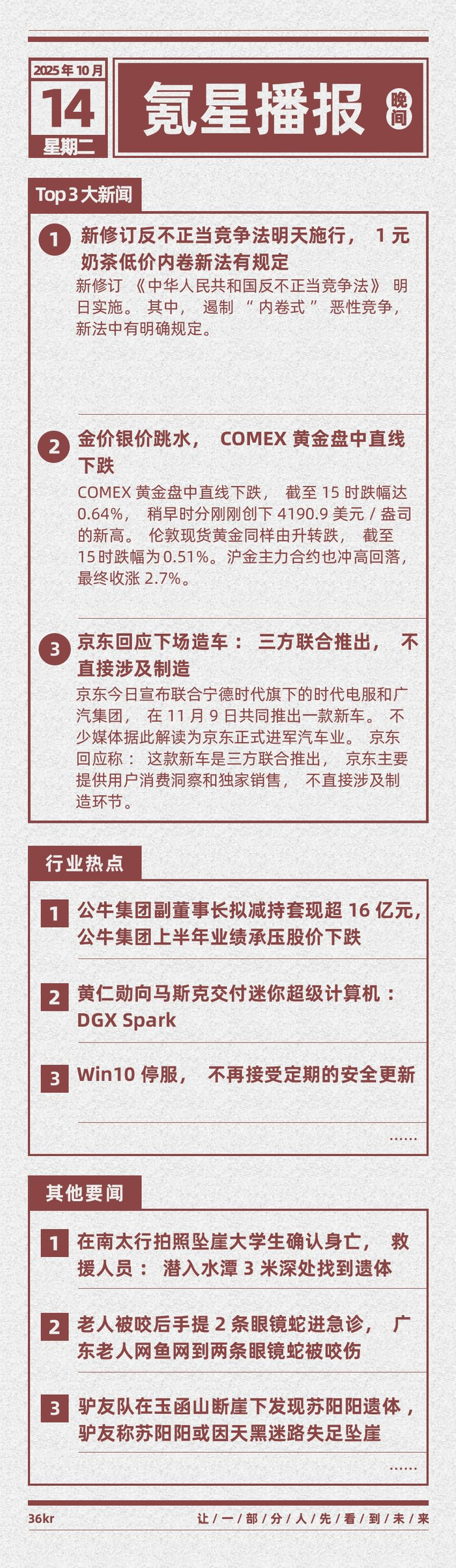
Group 1 - The newly revised Anti-Unfair Competition Law will take effect tomorrow, which includes provisions to curb "involution" type of vicious competition [5] - COMEX gold prices experienced a sharp decline, with a drop of 0.64% as of 15:00, after reaching a new high of $4,190.9 per ounce earlier [5] - JD.com announced a collaboration with CATL's Times Electric and GAC Group to launch a new car on November 9, clarifying that JD.com will not be directly involved in manufacturing [5][6] Group 2 - Bull Group's vice chairman plans to reduce holdings and cash out over 1.6 billion yuan [6] - Bull Group's performance in the first half of the year has been under pressure, leading to a decline in stock price [6] - NVIDIA's CEO Jensen Huang delivered a mini supercomputer, DGX Spark, to Elon Musk [6]

“1元奶茶”等低价内卷,新法有规定!明日起正式实施
Mei Ri Jing Ji Xin Wen· 2025-10-14 08:49
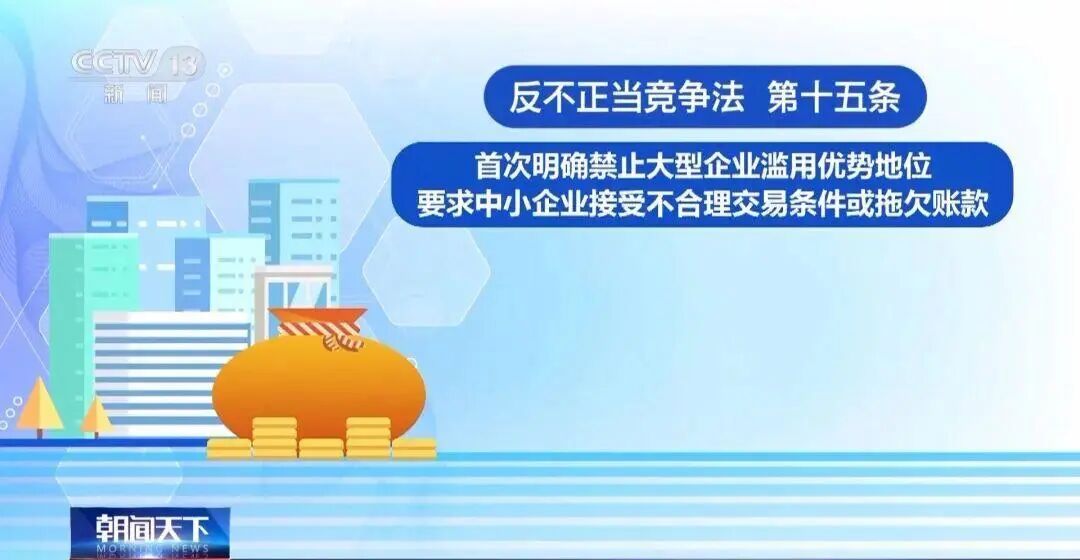
Core Points - The newly revised Anti-Unfair Competition Law of the People's Republic of China will officially take effect on October 15, addressing challenges in the digital economy and enhancing legal protections for both businesses and consumers [1] Group 1: Regulation of Unfair Competition - The new law specifically strengthens online competition rules, prohibiting behaviors such as forced redirection, malicious uninstallation, and the improper acquisition and use of others' data [1] - It aims to directly regulate issues like "traffic hijacking," "data theft," and "internet water armies" [2] Group 2: Protection of Small and Medium Enterprises (SMEs) - The law addresses the issue of large enterprises delaying payments to SMEs, explicitly prohibiting the abuse of dominant positions to impose unreasonable trading conditions or delay payments [3] - This regulation targets unfair trading practices such as large enterprises withholding payments for over six months and arbitrary changes in acceptance standards, creating a more equitable competitive environment for SMEs [5] Group 3: Brand Protection and Misleading Practices - The law introduces detailed regulations against "brand squatting" and misleading practices in live-streaming platforms, where smaller brands mimic well-known brands to mislead consumers [6] - It prohibits unauthorized use of influential new media account names, application names, or logos, and the use of others' registered trademarks as search keywords to mislead consumers [7][9] Group 4: Combatting False Transactions and Reviews - The law explicitly bans organizing false transactions and reviews, addressing the gray market of fake reviews that mislead consumer decisions [10] - It requires platforms to establish reporting mechanisms for unfair competition and mandates timely action against violations, creating a dual defense of self-inspection and regulatory oversight [10] Group 5: Addressing Price Wars and Market Order - The law aims to curb "involution" in competition, preventing platforms from forcing or indirectly compelling sellers to sell below cost, which disrupts market order [11] - It specifically addresses extreme low pricing practices that compromise product quality and safety, such as in the power bank and tea beverage industries [10]
《中华人民共和国反不正当竞争法》发布!自10月15日起施行
Ren Min Ri Bao· 2025-10-11 08:40
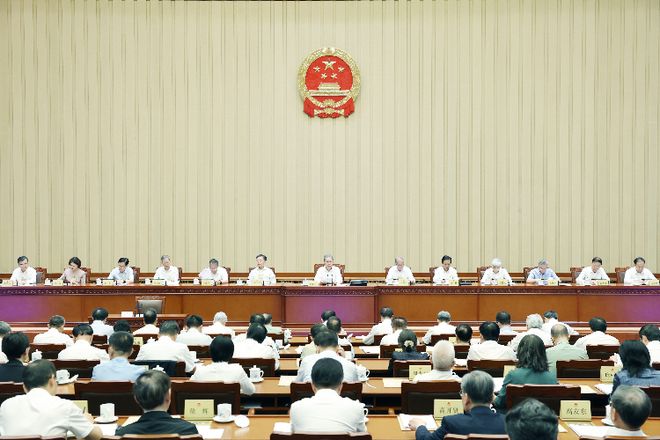
Core Points - The "Anti-Unfair Competition Law of the People's Republic of China" has been revised and will take effect on October 15, 2025 [2][33] - The law aims to promote healthy development of the socialist market economy, encourage fair competition, and protect the legitimate rights and interests of operators and consumers [4][5] Summary by Sections General Principles - The law establishes principles of voluntary, equality, fairness, and integrity for operators in their production and business activities [4] - Unfair competition behaviors are defined as actions that disrupt market order and harm the legitimate rights of other operators or consumers [4][6] Unfair Competition Behaviors - Operators are prohibited from engaging in confusion behaviors that mislead consumers into believing products are from another operator [12] - Bribery to gain trading opportunities or competitive advantages is strictly forbidden [13][14] - False or misleading commercial promotions are not allowed, including organizing fake transactions or evaluations [19] - Infringement of trade secrets through improper means is prohibited [16][17] Investigation of Unfair Competition - Supervisory departments can conduct investigations into suspected unfair competition behaviors, including inspections and inquiries [22][23] - Any unit or individual has the right to report suspected unfair competition, and the supervisory department must handle reports promptly [20][24] Legal Responsibilities - Operators violating the law must bear civil liability for damages caused to others [25][26] - Penalties for various violations include fines, confiscation of illegal gains, and potential revocation of business licenses [27][28][29] - The law outlines specific penalties for different types of violations, including severe penalties for serious offenses [30][31] Miscellaneous - The law applies to unfair competition behaviors conducted outside of China that disrupt market order within the country [32] - The law will officially come into effect on October 15, 2025 [33]
【法治之道】以法治化手段重塑公平市场秩序
Zheng Quan Shi Bao· 2025-10-09 18:21
Core Viewpoint - The newly revised Anti-Unfair Competition Law of the People's Republic of China will officially take effect on October 15, 2025, focusing on regulating new forms of competition issues in the digital economy, such as false transactions and malicious returns, which disrupt market order [1] Group 1: Regulation of Unfair Competition - The law addresses the issues of false transactions and malicious returns, which have become survival tactics for some e-commerce platforms, indicating a need for a profound transformation in the competitive order of the digital economy [1] - The revised law aims to establish a standard of integrity in digital competition, requiring operators to shift from a speculative mindset based on data manipulation to a long-term approach that relies on genuine service quality to gain consumer recognition [2] Group 2: Price Competition and Market Dynamics - The law critically examines low-price competition, prohibiting platforms from forcing merchants to sell below cost, which is seen as a corrective measure against harmful competition practices that can lead to industry profit depletion and quality decline [3] - The legislative process reflects a deep understanding of the competitive dynamics in the digital economy, tailoring solutions to new characteristics and problems rather than applying traditional regulatory frameworks [3]
为数字经济筑牢公平竞争法治基石
Nan Fang Du Shi Bao· 2025-10-09 16:12
Core Viewpoint - The newly revised Anti-Unfair Competition Law of the People's Republic of China, effective from October 15, aims to address new challenges in market competition, particularly in the digital economy, by targeting new forms of unfair competition and enhancing regulatory measures [2][3]. Group 1: New Market Characteristics - The rapid development of platform and sharing economies has led to significant changes in market competition, with data becoming a key element and technologies like algorithms and artificial intelligence being widely applied [2]. - Increased market concentration and scale effects have made it easier for leading platforms to establish dominant market positions, presenting new challenges for anti-unfair competition [2]. Group 2: Key Provisions of the New Law - The law specifically targets false transactions, aiming to dismantle the gray industrial chain of fake reviews and sales, which mislead consumers and create a vicious cycle of poor quality [3]. - It emphasizes the protection of data rights, prohibiting illegal data acquisition and interference with others' data products, thus ensuring safe and regulated data utilization [3][4]. - The law clarifies the responsibilities of platform operators, requiring them to provide a fair competitive environment and not to exploit their advantages to engage in monopolistic practices [4]. Group 3: Implementation Challenges - Effective implementation of the law requires enhanced regulatory enforcement to detect hidden violations, utilizing technologies like big data and artificial intelligence for real-time monitoring [4]. - There is a need for mechanisms that encourage consumers and businesses to assert their rights, addressing the high costs and difficulties associated with legal recourse [5].
10月起一批新规开始施行 涉及医药、交通多个领域
Jing Ji Guan Cha Bao· 2025-10-02 04:01
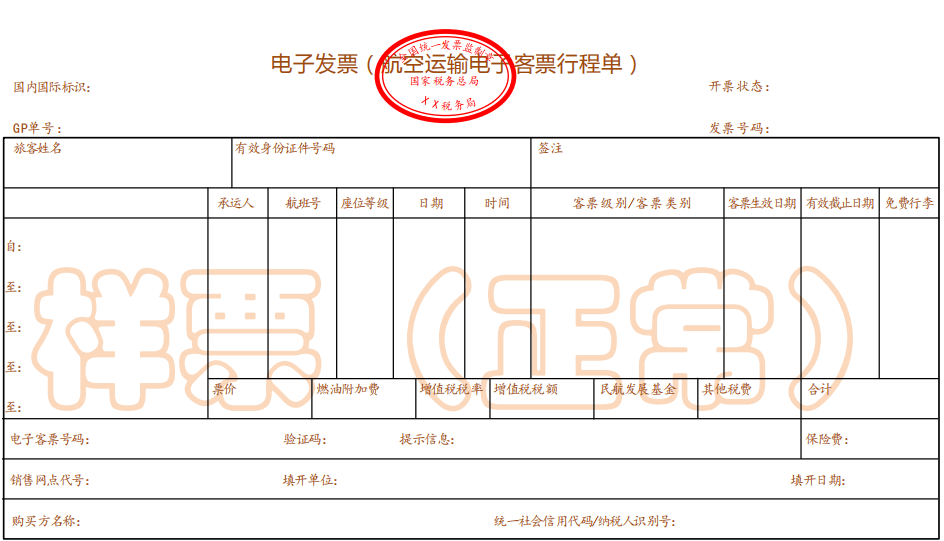
Group 1 - The "Permanent Basic Farmland Protection Red Line Management Measures" came into effect on October 1, establishing specific regulations for the designation, control, protection, optimization, and quality construction of permanent basic farmland, while allowing for flexible adjustments under strict protection [2] - From October 1, railways and civil aviation will fully implement electronic invoicing, eliminating paper invoices for domestic air travel and allowing passengers to obtain electronic invoices through various channels [3] - The revised Anti-Unfair Competition Law will take effect on October 15, enhancing fair competition rules in the digital economy and prohibiting platforms from forcing sellers to sell below cost, which disrupts market order [4] Group 2 - The 2025 edition of the "Pharmaceutical Standards of the People's Republic of China" officially implemented on October 1, includes 6,385 varieties, with 159 new additions and 1,101 revisions, aimed at improving the coverage of essential drug lists [5] - The new edition introduces 69 new general technical requirements and revises 133, with 33 new guiding principles and 17 revisions, enhancing the controllability of drug quality [5] - Compliance with the new pharmacopoeia is mandatory for drug prescriptions, production processes, raw materials, and packaging starting from October 1 [5]
10月起,一批新规将施行
Zhong Guo Zheng Quan Bao· 2025-09-30 00:10
Regulatory Changes - New regulations for financial infrastructure business supervision will be implemented starting October 1, focusing on risk management, corporate governance, and unified regulatory standards for financial market safety [1] - The new rules for internet lending by commercial banks will also take effect on October 1, requiring banks to establish clear management systems and risk management indicators [2] - The Beijing Stock Exchange will switch to new stock codes for existing listed companies starting October 9, facilitating trading and business operations [3] - A new system for the mandatory deregistration of "zombie companies" will be enacted on October 10, aimed at improving market ecology and promoting fair competition [4] - The revised Anti-Unfair Competition Law will come into effect on October 15, enhancing the legal framework for market competition and enforcement [5] - Internet platform companies will begin formally reporting tax-related information starting October 1, in compliance with new regulations [6] Digital Transformation - From October 1, the civil aviation sector will fully transition to electronic invoices, eliminating paper travel itineraries and allowing passengers to easily access their invoices online [7] - The railway sector will also adopt electronic invoices starting October 1, enabling passengers to request invoices within 180 days of their journey [7]
10月起,这些新规将影响你我生活!
中国基金报· 2025-09-29 01:32
Group 1 - The newly revised Anti-Unfair Competition Law of the People's Republic of China will take effect on October 15, 2025, focusing on preventing "involution" type of malicious competition in the digital economy, such as forced low pricing and data infringement [2] - The law explicitly prohibits unauthorized use of others' new media accounts, application names, or icons, and regulates the misuse of search keywords [2] Group 2 - From October 1, 2023, the railway passenger transport sector will fully implement electronic invoices, eliminating the provision of paper reimbursement vouchers [3] - The civil aviation sector will also transition to electronic itinerary receipts for domestic flights starting October 1, 2023, with a complete shift to electronic receipts by December 1, 2024 [4] Group 3 - The State Administration for Market Regulation has introduced the "Implementation Measures for Mandatory Company Deregistration," effective from October 10, 2023, which outlines a bulk announcement process for companies facing mandatory deregistration [6] - The measures include a 90-day announcement period and stipulate that objections to the deregistration process will halt the procedure [6] Group 4 - The National Medical Products Administration has released the "Quality Management Specifications for Online Sales of Medical Devices," effective October 1, 2025, which provides guidelines for managing online sales and e-commerce platforms [8] - The specifications require medical device companies engaged in online sales to display operational and product information and enhance their quality management systems [8] Group 5 - The Ministry of Natural Resources and the Ministry of Agriculture and Rural Affairs have jointly issued the "Management Measures for the Protection of Permanent Basic Farmland Red Lines," effective October 1, 2023, which clarifies the regulations for designating permanent basic farmland reserve areas [9][10] - The measures prioritize the inclusion of newly added cultivated land from comprehensive land remediation and high-standard farmland in the reserve areas [10] Group 6 - The "Management Measures for Disability Compensation" will take effect on October 1, 2025, standardizing the issuance and validity periods of disability certificates [11] - The measures specify that the validity period for certificates varies by age, with different durations for different age groups [11] Group 7 - The Ministry of Agriculture and Rural Affairs has established new specifications for animal quarantine marks and certificates, effective October 1, 2025, transitioning to a new version of animal quarantine marks [12] - The old version of the animal quarantine mark will be phased out by January 1, 2026, ensuring comprehensive coverage on livestock products [12]

市场监管总局:2024年共立案3.86万件, 罚没款30.7亿元
Yang Shi Wang· 2025-09-28 06:25
Core Insights - The report highlights the enforcement actions taken by the national market regulatory system in 2024, focusing on price supervision and combating unfair competition [1] Summary by Categories Price Supervision - A total of 38,600 cases were filed, resulting in fines and confiscations amounting to 3.07 billion yuan, with 2.025 billion yuan refunded to consumers [1] Unfair Competition - The regulatory body took strong measures against unfair competition, investigating 14,200 cases and imposing fines totaling 805 million yuan [1] Business Compliance - The report indicates that 3,042 cases related to illegal charges against enterprises were filed, leading to fines of 430 million yuan and refunds of 1.36 billion yuan [1] Consumer Protection - In the area of consumer protection, 18,400 cases were filed in the livelihood sector, with fines of 1.207 billion yuan and refunds of 662 million yuan to consumers [1] Overall Impact - The enforcement actions are aimed at maintaining fair market competition and supporting high-quality economic and social development [1]
10月起,一批新规将施行,涉及民航铁路客运发票、金融服务等
Sou Hu Cai Jing· 2025-09-28 01:25
Group 1: New Regulations Effective from October - The revised Anti-Unfair Competition Law will take effect on October 15, addressing issues like "involution" competition and "free-riding" on brand names [1] - Starting October 1, civil aviation in China will fully transition to electronic invoices, eliminating paper travel itineraries for domestic flights [2] - The railway sector will also adopt electronic invoices from October 1, allowing passengers to request electronic invoices within 180 days after their journey [5] Group 2: Financial Infrastructure and Tax Regulations - The Financial Infrastructure Supervision Management Measures will be implemented on October 1, focusing on the regulation of financial infrastructure operations and risk management [6][7] - Internet platform companies will begin formally reporting tax-related information from October 1, promoting tax fairness between online and offline businesses [13] - New regulations for internet lending will be enforced, emphasizing the need for banks to manage costs and risks without compromising management standards for the sake of business scale [14][16] Group 3: Other Relevant Regulations - The Permanent Basic Farmland Protection Red Line Management Measures will come into effect on October 1, clarifying the responsibilities of natural resources and agricultural departments [10][12] - A new procedure for compulsory company deregistration will be implemented on October 10, detailing the process and conditions for such actions [17] - The Beijing Stock Exchange will switch to new stock codes starting October 9, with preparations for the transition already in place [18]