
洗钱

Search documents
法媒:泽连斯基亲信被指控腐败,涉案金额1亿美元,乌司法部长涉嫌腐败被解职
Mei Ri Jing Ji Xin Wen· 2025-11-12 13:19
Group 1 - The Ukrainian government has dismissed Justice Minister Herman Galushchenko due to corruption allegations [1] - The National Anti-Corruption Bureau of Ukraine reported that a significant criminal group involving current and former officials from the Ministry of Energy is suspected of money laundering and illegal enrichment, with identified laundering amounts nearing $100 million [2] - Searches were conducted at the residences of the Justice Minister and former Energy Minister, as well as at the state nuclear power company, resulting in the seizure of numerous criminal documents and cash [2][4] Group 2 - Close associate of President Zelensky, Tymur Minky, has been accused of orchestrating a large-scale corruption scheme in the energy sector, also involving around $100 million [4] - The Special Anti-Corruption Prosecutor's Office indicated that Minky controlled the accumulation, distribution, and legitimization of criminal funds in Ukraine's energy sector, leveraging his close relationship with the President to conceal his activities [4] - The National Anti-Corruption Bureau has dismantled a money laundering system involving over $100 million, with multiple individuals summoned and charged [6]

X @外汇交易员
外汇交易员· 2025-11-12 00:57
Key Judgments - A Chinese woman, Qian Zhimin, was sentenced to 11 years and 8 months in London for laundering up to 61,000 Bitcoins, valued at nearly £5 billion (approximately 468 billion RMB) [1] - Lin Chengfu, an accomplice, received a prison sentence of 4 years and 11 months [1] Legal & Financial Implications - The case represents the UK's largest money laundering case in history [1] - The laundered funds are linked to criminal proceeds from China [1] - UK prosecutors are considering a compensation plan for victims of the alleged financial Ponzi scheme in China [1]
中国“比特币女王”被判超11年监禁,赃款高达520亿,藏身于英国
Sou Hu Cai Jing· 2025-11-11 18:28
Core Points - Zhimin Qian, known as the "Bitcoin Queen," was sentenced to 11 years and 8 months in prison for orchestrating the largest money laundering case in British history, involving £5.5 billion (approximately ¥52 billion) and affecting over 128,000 victims across China and the UK [1][17] Group 1: Case Background - The case took nearly eight years to resolve, with Qian being arrested in 2024 while hiding in a rented property in York [4] - Qian had previously evaded capture by using false identities and claiming to be incapacitated due to injuries [6] - She organized large investment seminars, promising returns of up to 300% through a Ponzi scheme [6][8] Group 2: Criminal Activities - Qian used promotional videos featuring iconic UK landmarks to project an image of an "international financial elite," luring investors into her scheme [8] - After fleeing to the UK in 2017, she lived extravagantly, purchasing luxury items and properties, including a £5 million mansion in Hampstead [10] - Her lavish spending included £44,000 on diamonds in Zurich and £90,000 on luxury goods in Harrods [10] Group 3: Legal Proceedings - The investigation was triggered by suspicious property transactions, leading to a specialized probe named "Crypto Tracking" by the London police [12] - Qian's accomplice, Jian Wen, was sentenced for money laundering, which further implicated Qian [12][15] - The court found Qian to be the central figure in the crime, driven purely by greed, and ordered the permanent confiscation of the illicit funds [15][17]

“太子集团”头目陈志被曝在新加坡遭“黑吃黑”:超3100万元被手下侵吞
Mei Ri Jing Ji Xin Wen· 2025-11-10 12:15
Core Viewpoint - The article discusses the legal and financial troubles surrounding Chen Zhi, founder of the "Prince Group" in Cambodia, and David Wong, who was previously in charge of a family office. Chen Zhi accused Wong of embezzling approximately 5.84 million Singapore dollars (around 31.91 million RMB) from his bank accounts, leading to multiple lawsuits and significant legal disputes between the two parties [1][2]. Group 1: Background and Initial Relationship - Chen Zhi and David Wong first met in 2017, with Chen already wealthy and seeking investment opportunities in Singapore for permanent residency [2] - In 2017, Chen Zhi purchased a luxury home for nearly 40 million Singapore dollars and subsequently established a family office named "DW Capital Holdings" with Wong's assistance [2] - Wong helped Chen Zhi expand his business, forming new companies and establishing relationships with over six major banks [2] Group 2: Legal Disputes and Financial Irregularities - In 2021, Chen Zhi decided to change the operational model of his family office, leading to a shared office arrangement with Wong's family office [3] - Chen's financial assistant discovered that Wong had not submitted critical business documents and that there were suspicious inter-company transfers, including a management fee exceeding 530,000 USD [3][5] - Following a series of events, including locked office access and the discovery of missing funds, Chen Zhi terminated Wong's position as the sole leader of the family office [5] Group 3: Legal Outcomes and Sanctions - In December 2022, the Singapore High Court ruled against Wong, ordering him and his associated companies to pay over 12 million Singapore dollars in debts [6] - Both Chen Zhi and his assistant have been sanctioned by the United States, and multiple countries have frozen assets linked to the Prince Group [7][8] - The Prince Group, which claims to be a multinational business entity, has been accused of running a telecom fraud operation, leading to significant legal actions and asset seizures in various jurisdictions [8][9] Group 4: Impact on Associated Companies - Chen Zhi is the majority shareholder of two publicly listed companies in Hong Kong, which continue to operate normally despite the surrounding controversies [10][11] - Recent resignations of executives from these companies indicate potential instability within their management structures [10] - Regulatory actions have been taken against companies associated with the Prince Group, including the suspension of licenses for investment and insurance firms linked to Chen Zhi [12][13]

最新!柬埔寨“太子集团”头目陈志被曝在新加坡遭“黑吃黑”:超3100万元被手下侵吞
Mei Ri Jing Ji Xin Wen· 2025-11-10 12:00
Core Points - The founder of the Cambodian telecom fraud group "Prince Group," Chen Zhi, was involved in a financial dispute with David Wong, the head of a family office in Singapore, who allegedly embezzled 5.84 million SGD (approximately 31.91 million RMB) from Chen's bank account [1][2][3] Group 1: Background and Initial Relationship - Chen Zhi and David Wong first met in 2017, with Chen already wealthy and seeking investment opportunities in Singapore for permanent residency [2] - In 2017, Chen spent nearly 40 million SGD on luxury real estate and subsequently established "DW Capital Holdings" with Wong's assistance, gaining tax exemption status [2][3] Group 2: Operational Issues and Disputes - In 2021, Chen decided to restructure the family office operations, leading to shared office space with Wong's family office [3][5] - Chen's financial assistant discovered discrepancies in document submissions and inter-company transfers, including a management fee exceeding 530,000 USD [3][5] Group 3: Legal Actions and Consequences - Following a series of issues, Chen dismissed Wong as the sole leader of the family office in July 2021, after discovering restricted access to the office and missing funds [6][7] - A Singapore court later ruled against Wong, ordering him and his associated companies to pay over 12 million SGD in debts, while Wong filed for bankruptcy [6][7] Group 4: Broader Implications for the Prince Group - The Prince Group, which operates in Cambodia, has been accused of using fake job advertisements to lure workers into telecom fraud, leading to significant legal and financial repercussions [7][8] - U.S. authorities seized approximately 15 billion USD worth of Bitcoin from Chen, and assets worth over 1.5 billion SGD were frozen in Singapore [8][9] - The Prince Group's banking operations faced a liquidity crisis, with a surge in withdrawal requests leading to a bank run [7][8] Group 5: Impact on Associated Companies - Chen Zhi is the majority shareholder of two publicly listed companies in Hong Kong, which continue to operate normally despite the ongoing legal issues [9][10] - Recent resignations of executives from these companies indicate potential instability within their management structures [9][10]

普华永道告辞!公司实控人涉跨国洗钱大案
Xin Lang Cai Jing· 2025-11-10 04:37
Group 1 - FSM Holdings announced the resignation of its auditor, PwC, effective November 7, 2025, due to the involvement of its controlling shareholder, Li Thet, in a multinational money laundering case [3][6] - The U.S. Department of the Treasury's Office of Foreign Assets Control (OFAC) sanctioned Li Thet on October 14, 2025, for his alleged participation in a transnational criminal organization [3][6] - The company paid approximately 343,000 SGD (about 1.87 million RMB) in audit fees to PwC for the fiscal year 2024 [5] Group 2 - Li Thet resigned from his positions as executive director, chairman, and nomination committee chairman of FSM Holdings effective October 21, 2025, to focus on other business commitments [6][12] - Despite his resignation, Li Thet remains the controlling shareholder of FSM Holdings [16] - FSM Holdings is headquartered in Singapore and primarily engages in precision engineering, sheet metal manufacturing, and mobile game development [16] Group 3 - The OFAC identified Li Thet as a key financial assistant to Chen Zhi, the chairman of the Prince Group, responsible for managing illicit funds and cross-border financial flows [16][22] - The Prince Group is accused of using coercive methods to force individuals into cryptocurrency investment scams and money laundering activities [22][26] - The U.S. Department of Justice filed a lawsuit against the Prince Group, targeting 146 entities, including Li Thet and several companies registered in Taiwan [22][26]
黄金税新政下购金成本激增,商家以“现金免税”揽客,消费者买金条打金饰|封面深镜
Sou Hu Cai Jing· 2025-11-10 01:17
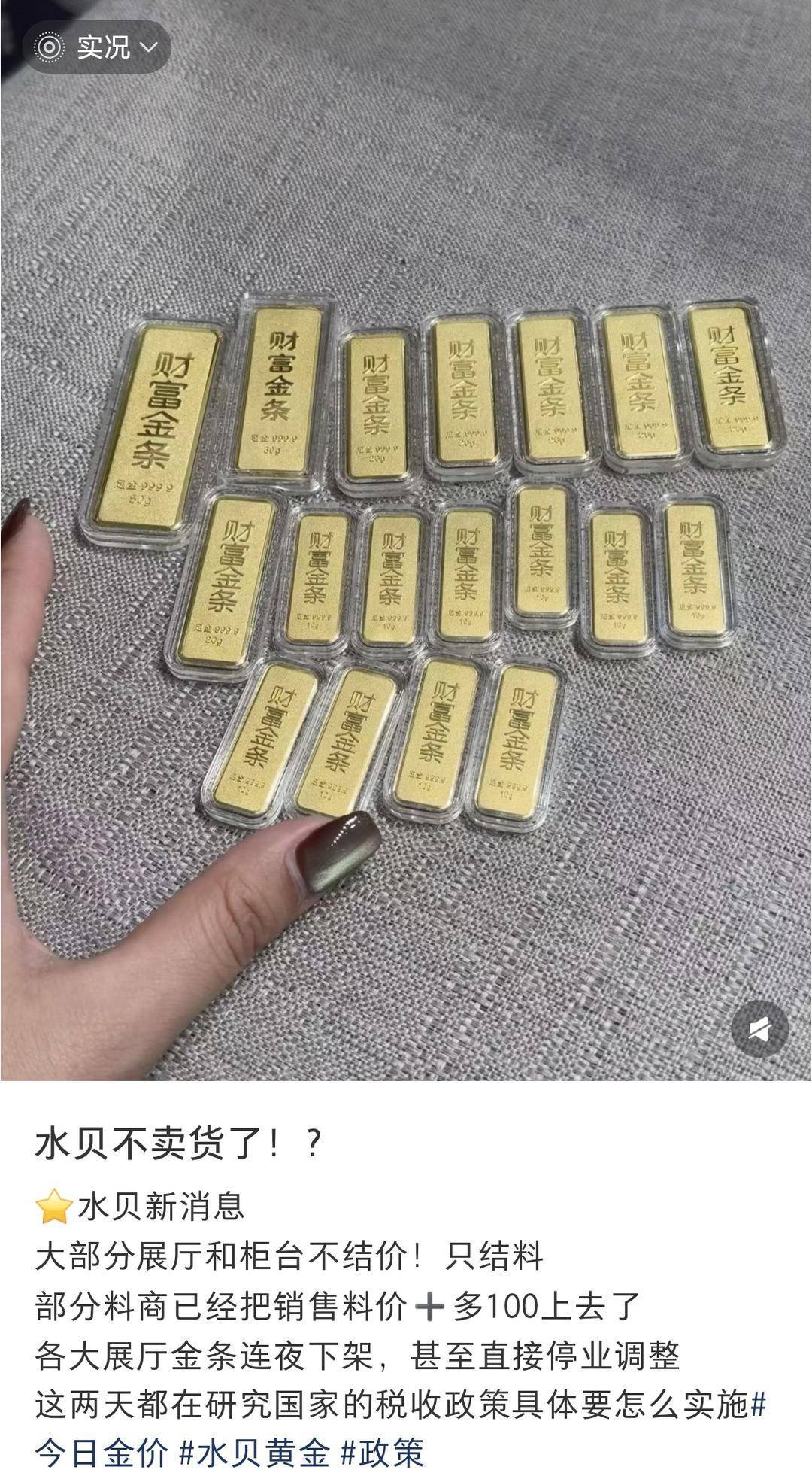
Core Insights - The implementation of the gold tax has led to significant adjustments in the domestic gold market, particularly affecting businesses in Shenzhen's Shui Bei market, which is a key hub for gold distribution in China [1][4][6] - Many merchants are experiencing a sharp decline in business, with some planning to sell off existing inventory and return home early due to the increased costs and supply chain disruptions [1][10] - Consumers are adapting by purchasing tax-free gold bars from banks and having them crafted into jewelry, which has become a popular alternative to traditional gold purchases [19][20] Market Impact - The gold tax has increased the cost of purchasing gold, with investment gold priced at 940 yuan per gram and jewelry gold at 1056 yuan per gram in Shui Bei market [4][6] - Business volume has dropped dramatically, with some merchants reporting transaction volumes falling to less than half of previous levels [6][9] - The supply of raw gold materials has been disrupted, leading to some merchants facing inventory shortages and considering temporary closures [9][10] Consumer Behavior - Consumers are increasingly opting for cash transactions to avoid the gold tax, with some merchants offering discounts for cash payments [15][16] - The trend of buying gold bars from banks and then customizing them with local artisans has gained traction, allowing consumers to save significantly on costs [19][20] - This shift in purchasing behavior has also led to increased demand for local gold artisans, who are experiencing a surge in orders [20] Legal Considerations - There are legal risks associated with cash transactions that avoid tax regulations, which could lead to accusations of tax evasion or money laundering [24][26][27] - Consumers who purchase gold bars and then have them processed into jewelry may also face tax obligations if the items are sold or treated as sales [28]
黄金寄给陌生人能够获得高收益?警惕这类骗钱加洗钱的新套路
Bei Jing Shang Bao· 2025-11-09 11:16
Core Viewpoint - The rise in gold prices has led to an increase in new types of scams, particularly involving "mailing gold" schemes, where fraudsters pose as investment experts to lure victims into purchasing gold under false pretenses [1][3]. Group 1: Scam Mechanism - In these scams, victims are often contacted online and enticed by promises of high returns through gold investments, with some being misled by claims of cashback or investment training [3]. - Once the gold is mailed to a specified address, the scammers immediately cut off communication, leaving victims unable to recover their losses [3][4]. - The scams exploit the perception of gold as a stable investment, making it easier for fraudsters to deceive individuals with low risk awareness [3][4]. Group 2: Financial and Social Implications - These gold investment scams not only result in financial losses for victims but also pose money laundering risks, as fraudsters use gold transactions to evade banking regulations [4]. - The psychological tactics employed in these scams create a false sense of security for victims, as the tangible nature of gold is perceived as a more legitimate investment compared to electronic transfers [4]. - The ongoing rise in international gold prices since 2025 has made gold investment a popular topic, further attracting potential victims to these fraudulent schemes [3][4].

美英韩新之后,中国香港和中国台湾也出手:查封冻结柬埔寨太子集团35亿元资产,涉26辆豪车、11处豪华公寓,还有现金、股票
Mei Ri Jing Ji Xin Wen· 2025-11-05 09:29
每经编辑|程鹏 福建小镇出身的陈志,家世寻常,却在28岁创办柬埔寨最大房地产集团,一跃成为当地首屈一指的富豪。 十年后,他被美国司法部门指控为"跨国网络诈骗帝国幕后主使",价值约150亿美元的比特币被扣留;英国对其实施制裁,冻结伦敦19处房产及所有在英 资产;韩国冻结其910亿韩元资产;新加坡冻结其1.5亿新元资产,查封并扣押其在新加坡的6处房产,一艘游艇、11辆豪车;近日,中国香港、中国台湾 也对"太子集团"出手了。 据红星新闻11月5日报道,中国香港特区警方当地时间周二(4日)宣布,基于从多个渠道掌握的情报和信息,警方已经冻结一个涉嫌参与国际电信诈骗和 洗钱活动的犯罪集团价值27.5亿港元(约合人民币25.2亿元)的资产。据报道,该集团系柬埔寨"太子集团"。 警方在声明中称,被冻结的资产包括其通过犯罪所得的现金、股票、基金等。声明称,当局仍在就此进行调查,但目前暂未逮捕任何人。 同时,4日早些时候,中国台湾检方表示,他们已查封与"太子集团"相关的总价值超45亿新台币(约合人民币10.3亿元)的资产并拘留了25名嫌疑人。声 明称,以陈志为首的"太子集团"在柬埔寨从事诈欺犯罪,并于多地建立庞大企业网络进行洗钱 ...

印度富豪逾8亿美元企业资产遭查封,涉欺诈银行和洗钱
Sou Hu Cai Jing· 2025-11-05 01:05
Core Points - The Enforcement Directorate of India has seized assets worth over 75 billion rupees (approximately 846 million USD) belonging to Anil Ambani and his associated companies as part of an investigation into allegations of bank fraud and money laundering [1] - The investigation is linked to a criminal complaint filed by the Central Bureau of Investigation in August, which claims that Reliance Communications, one of India's largest telecom operators, misappropriated bank funds, resulting in a loss of 29.29 billion rupees (3.3 million USD) [1] - The Enforcement Directorate's statement indicated that fraudulent transfers of public assets were identified within several companies under the Reliance Group, and efforts will be made to return the illicit funds to legitimate claimants [1] Company Response - Reliance Infrastructure Limited, controlled by Anil Ambani, stated that he has not been part of the board for over three and a half years, asserting that the case will not impact the company's operations, shareholders, employees, or any other stakeholders [2]