
虚拟现实(VR)

Search documents
三维场景搭建,可视化新维度
Sou Hu Cai Jing· 2025-06-03 06:15
Core Viewpoint - The rapid development of the industrial internet necessitates the transition from traditional 2D interfaces to 3D scene construction, which provides powerful visualization capabilities essential for industrial digital transformation [1] Group 1: Key Technologies - 3D scene construction relies on several key technologies, including modeling techniques such as polygon modeling and surface modeling, which cater to different industrial design needs [1] - Texture mapping technology enhances models with realistic materials and details, while animation technology brings static models to life by simulating operations and processes [1] - Virtual reality (VR) and augmented reality (AR) technologies are integrated with 3D scene construction, allowing users to engage in immersive experiences for tasks like equipment inspection and training [1] Group 2: Software Tools - The market offers a variety of 3D scene construction software, each with its strengths, such as 3ds Max for comprehensive modeling and animation, and Maya for precise control over complex animations [3] - Blender, as an open-source software, attracts beginners due to its lightweight nature and ease of use, enabling users to quickly acquire basic construction skills [3] Group 3: Construction Process - The 3D scene construction process involves a rigorous workflow, starting with data collection to understand equipment parameters and production processes, followed by modeling, texturing, and lighting [4] - After completing the model, thorough testing is conducted to ensure performance metrics like loading speed and animation fluidity meet standards, with necessary optimizations made [4] - Vuli Maku Cloud has emerged as a preferred platform for many enterprises, integrating advanced 3D modeling technologies that allow for quick and detailed industrial scene construction without complex operations [4] Group 4: Data Integration and Future Value - Vuli Maku Cloud also possesses strong data integration capabilities, linking 3D scenes with real-time data from the industrial internet, enabling dynamic displays of equipment status for better decision-making [5] - The support from Vuli Maku Cloud is expected to enhance the value of 3D scene construction in the industrial internet sector, propelling the industrial digital transformation to new heights [5]


2025年中国AR眼镜产业十大创新企业:Xreal、雷鸟创新、灵伴科技、光粒科技、星纪魅族……
Qian Zhan Wang· 2025-06-03 01:20
Core Insights - The AR industry is increasingly recognized as a key area for strategic development in the digital economy, with significant government support in China [2][4]. - AR glasses are positioned as a crucial component of the AR technology landscape, with policies evolving from the "13th Five-Year Plan" to the "14th Five-Year Plan," highlighting the industry's importance [2][4]. - The competitive landscape in the AR sector is diverse, with major players categorized into three groups: international tech giants, domestic smartphone manufacturers, and emerging AR companies [4][5]. Industry Overview - The Chinese government views AR as a vital part of its strategic emerging industries, with ongoing support and investment [2]. - The "14th Five-Year Plan" explicitly includes VR/AR as one of the seven key industries in the digital economy, indicating a strong commitment to the sector's growth [2]. - Future plans, such as the "15th Five-Year Plan," are expected to continue prioritizing VR/AR technologies, focusing on domestic technical support and development [2]. Competitive Landscape - International tech giants like Microsoft, Meta, Apple, Samsung, and Google leverage their technological expertise and brand influence to invest heavily in AR research and development [4][5]. - Domestic smartphone manufacturers, including Huawei and Xiaomi, integrate AR technology into their products, benefiting from established user bases and supply chains [4][5]. - Emerging AR companies such as Xreal, Rokid, and Thunder Innovation adopt unique technological advantages and innovative strategies to carve out market positions [4][5]. Market Dynamics - Chinese AR companies are rapidly capturing the consumer market by overcoming key technological challenges, particularly in waveguide technology [7][9]. - According to IDC data, in 2023, Xreal, Rokid, and Thunder Innovation held global market shares of 45%, 14%, and 13%, respectively, while foreign brands dominate high-end and professional segments [7][9]. - The integration of AI and innovative application scenarios is driving the growth of consumer-grade AR products in China [9]. Key Players - Xreal, founded in 2018, leads the global AR market with a 47.2% share as of 2024, focusing on consumer-grade AR glasses [15][17]. - Thunder Innovation, established in 2021, is notable for its unique optical solutions and has developed the world's first mass-produced full-color Micro LED waveguide AR glasses [19][21]. - Rokid, founded in 2014, specializes in human-computer interaction technologies and has a diverse range of AR products applied across various industries [22][23]. - INMO, established in 2020, focuses on smart glasses and has made significant advancements in AR and AI technologies [24][25]. - Starry Meizu, founded in 2021, has quickly gained market share with its AR glasses, achieving a 41.5% market share in the 2000-2999 yuan price segment [26][27]. Technological Trends - The AR glasses market is evolving with advancements in optical and micro-display technologies, including optical see-through and video see-through methods [43][45]. - Optical waveguide technology is becoming a key focus, enabling clearer imaging and larger fields of view, which are essential for consumer adoption [49][50]. - The integration of AI with AR is anticipated to transform user experiences, with predictions that AR glasses could eventually replace smartphones within the next decade [50].


专访谦寻董事长董海锋:商业与文化在电商直播中共生共荣
Xin Jing Bao· 2025-05-30 12:22
Core Viewpoint - E-commerce live streaming is emerging as a significant force in the development of new popular arts, reshaping cultural life and aesthetic experiences while transforming consumption patterns in the digital age [1][3]. Group 1: E-commerce Live Streaming and New Popular Arts - E-commerce live streaming serves as a bridge between traditional popular arts and modern digital technology, allowing for the revival and dissemination of traditional cultural practices [3]. - During the 2021 Double Eleven shopping festival, a single live stream attracted over 200 million viewers, illustrating the vast reach and impact of e-commerce live streaming on traditional arts [3]. - The integration of traditional arts into live streaming has led to a geometric increase in their dissemination and influence, marking a "glorious transformation" of traditional arts in the digital era [3]. Group 2: Interactivity in E-commerce Live Streaming - Interactivity is a core feature of e-commerce live streaming, allowing audiences to engage actively rather than passively consume content [4]. - Viewers can express their opinions and interact with hosts in real-time, creating a sense of community and emotional connection during live streams [4][5]. - Events like "Hand Speed Festival" enhance group participation, transforming shopping into a collective experience akin to cultural celebrations [5][6]. Group 3: Balancing Commercial and Cultural Values - E-commerce live streaming is a commercial platform that does not sacrifice cultural content for profit; instead, culture drives the platform's commercial success [7]. - The integration of cultural elements into product promotion creates a unique expression system that enhances both cultural dissemination and sales [7][8]. - Initiatives like "Bee Tea Bureau" exemplify the successful merging of commerce and culture, allowing consumers to engage with traditional tea culture while facilitating sales [8]. Group 4: Social Responsibility and Public Welfare - The company promotes a "Live Streaming for Good" initiative, focusing on cultural transmission and social responsibility through various public welfare projects [9]. - Activities include sourcing products with cultural significance and conducting educational sessions for students in specialized institutions to enhance their understanding of the industry [9]. - Collaborations with traditional brands and cultural festivals aim to bridge the gap between heritage and modern consumerism, fostering a sense of community and cultural appreciation [10]. Group 5: Future Directions of E-commerce Live Streaming - The future of e-commerce live streaming will likely incorporate advanced technologies like virtual reality (VR) and augmented reality (AR) to enhance user experience [11]. - There will be a deeper exploration of regional cultural elements in content creation, showcasing local traditions and crafts through live streaming [12]. - The industry is expected to strengthen collaborations with other art forms, such as film and music, to create innovative live streaming programs that engage audiences on multiple levels [12].
三维可视化,工业互联网的沉浸式体验
Sou Hu Cai Jing· 2025-05-29 15:00
Core Insights - The article emphasizes the growing importance of 3D visualization technology in enhancing production efficiency, optimizing management processes, and improving user experience within the industrial internet landscape [1] Group 1: 3D Visualization Platforms - 3D visualization platforms serve as essential tools for intuitive data presentation, integrating advanced 3D modeling, rendering, and interaction technologies to transform complex industrial data into vivid 3D images [1] - These platforms support multiple data sources and provide real-time data updates, ensuring users have access to the latest information [1] - In industrial manufacturing, these platforms can display real-time production line layouts, equipment status, and material flow, enabling managers to quickly identify potential issues and adjust production plans accordingly [1] Group 2: 3D Visualization Software - 3D visualization software is fundamental for creating complex 3D models, allowing users to perform detailed rendering and animation [1] - The software supports various modeling methods and seamlessly integrates with mainstream industrial software, ensuring data accuracy and consistency [1][2] Group 3: Virtual Reality Integration - The combination of virtual reality (VR) technology with 3D visualization offers users immersive experiences, allowing them to explore virtual environments and interact deeply with 3D models [4] - VR technology can simulate complex operational environments for training purposes, enhancing employee skills and reducing safety risks associated with real-world operations [5] Group 4: Applications in Industrial Internet - 3D visualization technology has extensive applications across various sectors, including manufacturing, equipment maintenance, architectural design, and educational training [6] - In energy management, 3D visualization platforms can display real-time energy distribution, transmission, and consumption, aiding managers in optimizing energy allocation and reducing operational costs [6] - For equipment maintenance, 3D visualization software can create detailed equipment models, enabling maintenance personnel to conduct troubleshooting and repair operations in a virtual environment [6] Group 5: Future Development Trends - The future of 3D visualization technology appears promising, with advancements in 5G, IoT, and AI expected to provide more efficient and intelligent solutions [6] - The integration of 3D visualization with cultural creativity, education, and research is anticipated to diversify and deepen application scenarios [6] Group 6: Company Spotlight - Vuli Code Cloud is highlighted as a professional digital twin platform that offers comprehensive solutions for 3D visualization [7] - The company provides tailored services and advanced digital technologies to meet diverse client needs, supporting the implementation of 3D visualization platforms and software integration [7]

研判2025!中国PMMA行业产业链、发展现状、竞争格局和发展趋势分析:行业进入新一轮扩张期,光学级PMMA未来发展空间巨大[图]
Chan Ye Xin Xi Wang· 2025-05-27 01:24
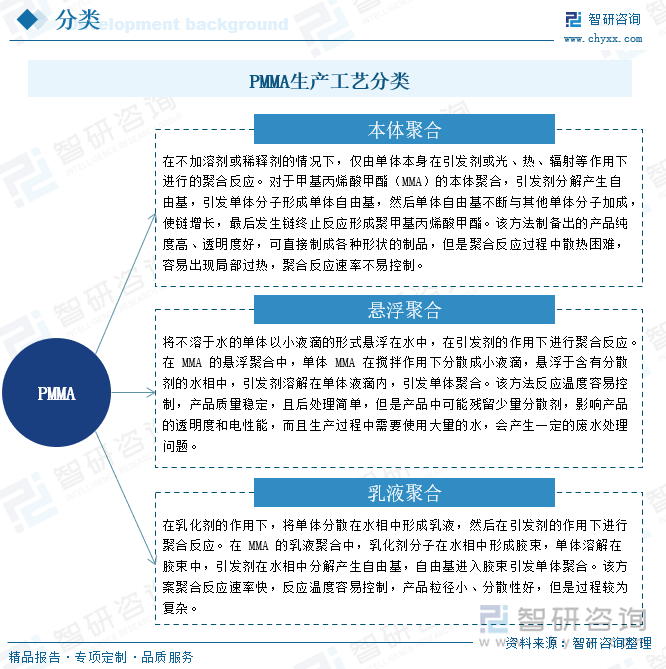
Core Viewpoint - The PMMA market in China is experiencing significant growth in demand, particularly in sectors such as LCD displays, LED lighting, and automotive applications, while the production capacity remains largely focused on low-end PMMA, necessitating substantial imports of high-end products from international chemical giants [1][13]. PMMA Industry Overview - PMMA, also known as acrylic or organic glass, is a non-crystalline plastic with excellent transparency, optical properties, and impact resistance, widely used in automotive, construction, and advertising sectors [3]. - The production technology for PMMA includes suspension polymerization, solution polymerization, and bulk polymerization, with only bulk polymerization capable of producing high-end PMMA products for automotive and electronic applications [3]. PMMA Industry Supply Chain - The upstream of the PMMA industry consists of raw material suppliers, particularly those providing MMA monomers, which are crucial for PMMA production [5]. - The midstream includes PMMA manufacturers who process these raw materials into various PMMA products, while the downstream encompasses applications in construction, home decoration, advertising, lighting, and electronics [5]. PMMA Industry Development Status - China's PMMA production capacity is projected to reach 735,400 tons in 2024, marking a year-on-year increase of 19.50% [11]. - The majority of PMMA production capacity is concentrated in East China, accounting for 87.71% of the total, with significant contributions from Southwest and Northeast regions [11]. PMMA Trade Dynamics - China's PMMA imports have consistently exceeded exports, resulting in a trade deficit, although this deficit is gradually narrowing as domestic companies improve their competitiveness in high-end products [1][13]. - In 2024, PMMA imports are expected to decline to 162,800 tons, while exports are projected to rise to 54,000 tons, reflecting a growing domestic production capability [1][13]. PMMA Industry Competitive Landscape - The PMMA production technology is predominantly controlled by foreign companies, but domestic firms like Wanhua Chemical and Suzhou Double Elephant are narrowing the gap through innovation [15]. - Key players in the industry include Wuxi Double Elephant, Wanhua Chemical, and Mitsubishi Chemical, among others [15][17]. PMMA Industry Trends - There is a significant growth potential for optical-grade PMMA, driven by increasing demand from high-tech industries such as 5G communications, virtual reality, and smart homes [22]. - The industry is also moving towards green transformation, focusing on sustainable practices in raw material sourcing, production processes, and waste management [23][24].


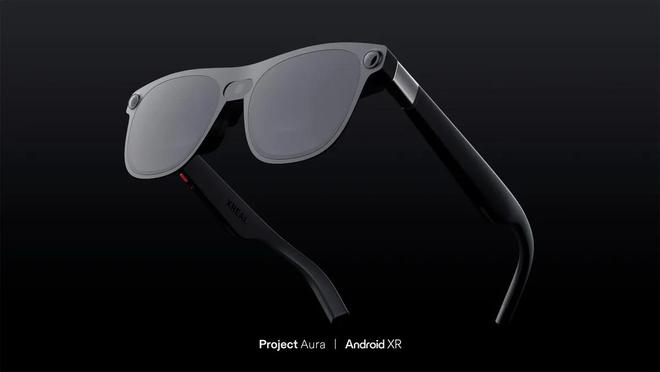
谷歌携中企,推出全球首款安卓XR眼镜
Guan Cha Zhe Wang· 2025-05-21 04:53
Core Insights - Google has partnered with Chinese AR glasses manufacturer Xreal to launch the first smart glasses powered by its augmented reality operating system, Android XR, marking its entry into the smart glasses market [1][3] - The Project Aura smart glasses were showcased at the Google I/O developer conference, aiming to provide a familiar Android experience across various devices [1][7] - Xreal's CEO indicated that the Aura glasses are designed to compete with Meta's upcoming AR glasses, while Google's collaboration with Samsung aims to develop a head-mounted display to rival Apple's Vision Pro [3][4] Group 1 - Google and Xreal's collaboration aims to create a more affordable AR device, with Aura glasses expected to retail between $200 and $600, compared to potential prices of several thousand dollars for competitors [4][5] - The Android XR system is a strategic move for Google to enhance its Android business, expanding its operating system to various devices beyond smartphones [7][9] - Xreal has maintained the largest market share in the global AR market for three consecutive years, with projections indicating that its market share in 2024 will exceed the combined total of the second to fourth-ranked competitors [9][10] Group 2 - The global investment in augmented and virtual reality (AR/VR) is projected to reach $15.22 billion in 2024, with expectations to grow to $39.7 billion by 2029, reflecting a compound annual growth rate (CAGR) of 21.1% [10]

研判2025!中国综合性文化中心行业相关政策、投资规模及发展趋势分析:新技术催生数字演艺等新业态,为公众带来沉浸式文化体验[图]
Chan Ye Xin Xi Wang· 2025-05-18 00:05
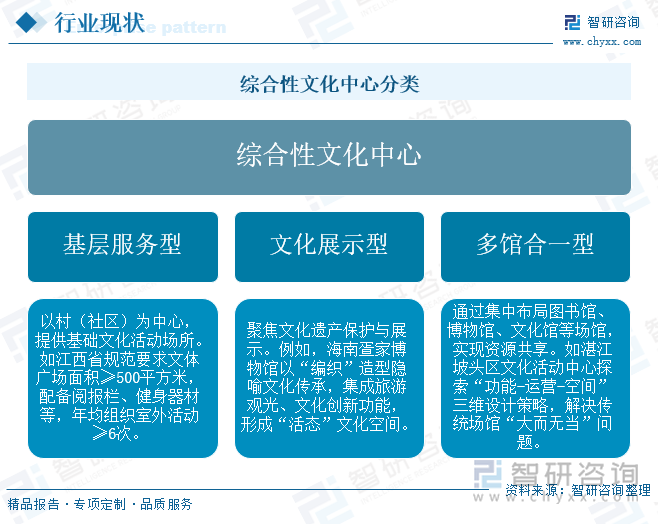
Core Insights - The Chinese comprehensive cultural center industry is experiencing robust growth, driven by increasing consumer demand for cultural and spiritual consumption, with an investment scale projected to reach 21.016 billion yuan in 2024, marking a year-on-year increase of 6.13% [1][12] - Technological innovations such as VR, AR, and AI are becoming key engines for industry upgrades, enhancing various aspects of the cultural experience and service delivery [1][12][21] Industry Overview - Comprehensive cultural centers serve as venues for public activities, integrating various functions such as education, cultural promotion, and community engagement [2] - They can be categorized into three types based on their functional positioning: grassroots service type, cultural display type, and multi-facility type [2] Industry Development History - The industry has evolved through four main stages: 1. The initial exploration phase (1978-2000) focused on single-function centers with low marketization [4] 2. The standardization phase (2001-2010) saw the introduction of standardized cultural facilities [4] 3. The digitalization and diversification phase (2011-2020) emphasized the integration of digital technologies [5] 4. The high-quality development phase (2021-present) aims for intelligent and scenario-based services [5] Industry Value Chain - The upstream of the industry includes venue construction, cultural activity equipment, cultural resources, technology, and funding support [7] - The midstream focuses on the operational services of cultural centers, while the downstream involves the visitors [7] Investment Scale - The market size of the comprehensive cultural center industry is steadily expanding, with significant growth in investment and technological integration [12] Key Center Operations - National-level cultural institutions like the National Library and National Museum lead the industry with extensive collections and digital initiatives [14][16] - Regional cultural centers leverage local characteristics and policies to create differentiated competitive advantages [14] Industry Development Trends 1. **Policy and Technology Integration**: Government policies are increasingly supporting the cultural industry, driving technological integration to enhance cultural experiences [21] 2. **Diverse Market Demand**: Rising living standards and cultural consumption needs are prompting cultural centers to innovate service models and diversify offerings [22] 3. **Sustainable Development**: The industry is moving towards green transformation, focusing on energy-efficient designs and promoting traditional culture [23]
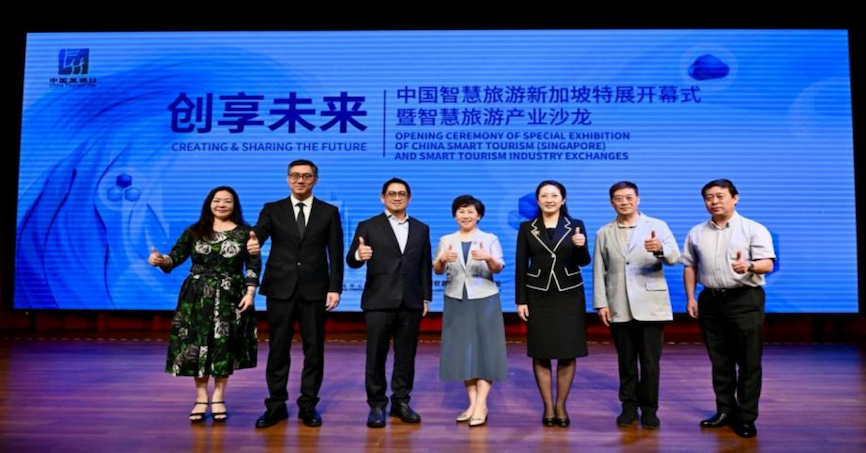
“创享未来——中国智慧旅游新加坡特展”成功开幕
人民网-国际频道 原创稿· 2025-05-17 06:00
Core Viewpoint - The event "Creating the Future - China Smart Tourism Singapore Special Exhibition" highlights the integration of technology in tourism, showcasing the potential for collaboration between China and Singapore in the smart tourism sector [1][2][3]. Group 1: Event Overview - The exhibition took place from May 15 to May 18 at the Singapore Chinese Cultural Centre, featuring over 200 representatives from domestic and Singaporean cultural, tourism, and technology sectors [1][4]. - The event attracted more than 720,000 online viewers, indicating significant interest in smart tourism innovations [1]. Group 2: Key Speakers and Insights - Yu Haiying emphasized the role of technology in enhancing travel experiences, making global exploration more accessible and enjoyable [1]. - Kong Yuan highlighted the natural complementarity of resources and technological advantages between China and Singapore, aiming to foster cross-border cooperation in smart tourism [2]. - Kong Ming noted China's achievements in smart tourism, including advancements in virtual reality (VR) and artificial intelligence (AI), which enhance visitor experiences [2]. Group 3: Industry Collaboration and Innovations - Lyu Wenjun pointed out Singapore's commitment to embracing smart tourism and digital transformation, aiming to improve visitor experiences through technology [3]. - The event featured discussions on the latest trends in smart tourism, with presentations from industry leaders on topics such as digital management systems and the future of global smart tourism [3]. - The exhibition showcased cutting-edge technologies, including immersive VR experiences and AI-driven services, allowing attendees to experience the intersection of technology and culture firsthand [4][6].
对话 VITURE 姜公略:把 AR 眼镜卖到美国第一 ,从负需求到离不开
晚点LatePost· 2025-05-15 14:56
Core Viewpoint - The core viewpoint of the article emphasizes that the success of AR glasses hinges on creating a compelling reason for users to wear them, particularly targeting gamers with a portable large-screen experience [3][6]. Company Overview - VITURE, founded in 2021, has quickly become a leading player in the AR glasses market, selling hundreds of thousands of units in the U.S. by the end of 2024, capturing over half of the market share [3][5]. - The company has a small team of just over a hundred people, focusing on quality over quantity in hiring [5]. Product Development and Strategy - The founder, Jiang Gonglue, believes that the first principle of creating smart glasses is that users do not inherently need them, thus requiring a strong value proposition [3][15]. - VITURE's strategy involves targeting gamers, providing a portable large-screen experience for gaming on the go, which is seen as a compelling reason for users to adopt AR glasses [3][15]. - The company has received multiple design awards for its innovative approach, including moving computing units to a neckband to reduce the weight of the glasses [4][22]. Market Insights - The AR and VR market has struggled to gain mainstream acceptance, with global sales projected at 10 million units in 2024, far behind smartphones and smartwatches [6][10]. - The industry has been characterized by high expectations and a disconnect from actual user needs, leading to unsustainable business models [9][10]. Technological Innovations - VITURE utilizes BirdBath optical technology for its AR glasses, which is currently more practical than emerging technologies like waveguide optics, despite some criticism [8][9]. - The company has developed a real-time 2D to 3D conversion feature that enhances user experience without relying on cloud computing, showcasing its integration of software and hardware [19][20]. Future Outlook - Jiang envisions a future where AR glasses could serve as the primary device for interaction, combining the largest interface with the best mobility [14][33]. - The potential market for VITURE's products is estimated at 10-15 million units annually, primarily driven by the gaming community [16]. Challenges and Considerations - The company faces challenges in ensuring that its products meet user needs and expectations, particularly in a market that has seen many failures due to misalignment with consumer demand [9][10]. - Jiang emphasizes the importance of achieving product-market fit (PMF) before scaling resources, a lesson learned from industry peers [3][40].

谷歌在TED上展示新款AR眼镜和VR设备
news flash· 2025-04-10 05:42
近日,在加拿大温哥华举行的TED Humanity Reimagined大会(TED2025)上的一次演讲中,谷歌展示了一 款将微型显示屏与谷歌的Gemini AI助手结合在一起的AR眼镜。安卓XR负责人沙赫拉姆.伊扎迪展示了 这款眼镜,它看起来与普通眼镜相似,可以实时翻译、扫描书籍以及执行其他任务。伊扎迪说:"这款 眼镜可以与你的手机配合使用,进行数据流传输,让眼镜非常轻便,而且可以访问你手机上的所有应用 程序。"除此之外,伊扎迪还展示了一款与Apple Vision Pro相似的VR设备。(科创板日报) ...