
产业升级

Search documents
十年守护换来绿色蝶变 东西协作产业协同释放长江经济带新活力
Yang Shi Xin Wen Ke Hu Duan· 2026-01-08 16:03
Group 1 - The Yangtze River Economic Belt covers 11 provinces and cities, accounting for about half of the national population and economic total [1] - The development strategy of the Yangtze River Economic Belt has been implemented for ten years, focusing on ecological protection rather than large-scale development [1] - The "Zhechuan Industrial Cooperation Demonstration Park" in Yibin, Sichuan, has transformed the textile industry into a key component of the Yangtze River Economic Belt, promoting green ecology and regional coordinated development [1] Group 2 - The park has a planned area of 6.91 square kilometers, with approximately 5 square kilometers completed, housing 46 textile enterprises, of which 39 are operational, 6 are under construction, and 1 is planned [1][2] - The park aims for a transition from labor-intensive to technology-intensive textile production, with higher environmental standards for enterprise admission [3] - Modern production lines in the park require only a small number of workers, with significant technological innovations and collaborations with educational institutions driving further innovation [3]
嘀嗒出行报告:南山居深圳顺风车通勤热门城区第一
Nan Fang Du Shi Bao· 2026-01-08 15:13
Core Insights - The report by Dida Chuxing reveals that ride-sharing users are exploring various emerging professions, particularly in AI, chips, overseas expansion, enterprise services, and lifestyle services [1][3][4] Group 1: Ride-Sharing Commute Trends - The top five popular commuting districts for ride-sharing in Shenzhen are Nanshan District, Futian District, Luohu District, Longhua District, and Bao'an District [2] - Nanshan District's high commuting activity is attributed to the concentration of tech parks such as KeXing Science Park and Shenzhen Software Park [2] - Over 50% of ride-sharing orders in Shenzhen's top 100 commuting destinations are from high-tech, internet, and IT sectors, indicating a significant presence of these industries [2] Group 2: Emerging Professions and User Demographics - The majority of ride-sharing users are office workers, with over 50% of passengers and 80% of drivers falling within the age range of 26 to 50 years [3] - The top ten professions among ride-sharing users include engineers, technical researchers, salespeople, workers, finance professionals, teachers, designers, civil servants, healthcare workers, and accountants [3] - A notable number of users are individual entrepreneurs, reflecting the microeconomic vitality of the current economic landscape [3] Group 3: Impact of New Technologies - The rapid development and application of emerging technologies like AI and big data have led to the creation of numerous digital new professions and job types [4] - Increasing consumer demand for quality of life, health management, cultural experiences, and personalized services has also spurred the emergence of new professions in lifestyle services [4]

BlueFive Capital成为中金—河钢母基金普通合伙人
Shang Wu Bu Wang Zhan· 2026-01-08 14:36
Group 1 - Abu Dhabi's BlueFive Capital has been appointed as the first general partner of a 32 billion RMB fund established by CICC Capital and Hebei Iron and Steel Group [1] - The fund focuses on advanced materials, new energy, and next-generation information technology sectors to promote cross-border investment and industrial upgrading [1] - BlueFive Capital aims to support the international development of China's high-end manufacturing [1]

航发动力:公司持续在航空发动机领域深耕技术创新和产业升级
Zheng Quan Ri Bao Zhi Sheng· 2026-01-08 13:43
Core Viewpoint - The company aims to become a world-class aviation engine enterprise, focusing on technological innovation and industrial upgrades in the aviation engine sector [1] Group 1 - The company adheres to the mission of strengthening the military and serving the country through technology [1] - The company is committed to continuously enhancing its market competitiveness and influence according to its development strategy [1]

中国经济2025年增长5%总量突破140万亿元
Sou Hu Cai Jing· 2026-01-08 13:08
Core Development Trends: Structural Optimization and Resilience Enhancement - China's GDP is projected to reach 140 trillion yuan in 2025, with a year-on-year growth of approximately 5%, exceeding annual targets [3] - The industrial structure continues to optimize, with high-tech manufacturing value-added growth reaching 10%, and equipment manufacturing contributing over 55% to industrial growth [3] - New production sectors such as new energy vehicles and industrial robots see output growth exceeding 30% [3] Internal and External Demand Synergy - Consumption contributes 52% to economic growth, with retail sales of consumer goods expected to grow by 5% to 6.4% year-on-year [4] - Emerging consumption trends include "emotional consumption" and green health consumption, with increased penetration of new energy vehicles [4] - Exports are expected to grow by 9.3%, with Hainan Free Trade Port's first-year cargo throughput exceeding 80 million tons, indicating diversification in foreign trade to mitigate external risks [4] Core Support Elements: Innovation Drive and Policy Coordination - Significant breakthroughs in frontier technologies include the "China Fusion Reactor" achieving 150 million degrees ion temperature, with AI and quantum communication leading global innovation [4] - R&D investment intensity rises to 2.68%, with China entering the top ten in the global innovation index and improved patent conversion efficiency [4] Policy Precision and Macro Policy Initiatives - Monetary policy measures such as interest rate cuts and targeted support for "new infrastructure, new urbanization, and major projects" are aimed at reducing financing costs [6] - Comprehensive removal of foreign investment restrictions in manufacturing and alignment of Hainan Free Trade Port operations with international rules promote higher levels of openness [6] New Growth Points: Green Economy and Regional Coordination - Rapid acceleration of green transformation, with leading global installed capacity for wind and solar clean energy [6] - Regions like the Qaidam Basin leverage solar and wind resources to develop ecological industries, while PM2.5 concentration continues to decline [6] Regional Coordinated Development - Economic contributions from regions such as Beijing-Tianjin-Hebei, Yangtze River Delta, and Guangdong-Hong Kong-Macao Greater Bay Area are increasing [7] - County economies, exemplified by the sugar orange industry in Qingyuan, Guangdong, drive rural revitalization, increasing farmer income and employment [7] Challenges and Responses: Addressing Deep-Seated Contradictions - There are notable pressures from insufficient demand, with some sectors experiencing a mismatch between supply and demand, particularly in consumer spending recovery [8] - The recovery rate for tourism consumption is at 88.5%, indicating a lag in per capita consumption recovery compared to the increase in visitor numbers [8] Long-Term Transformation - Ongoing challenges include addressing "bottleneck" technologies in the industrial chain, such as high-end chips, and resolving real estate risks [9] - Key reforms in income distribution and social security are essential for unleashing domestic demand [9] Future Layout: "14th Five-Year Plan" Anchoring High Quality - Focus on core technology breakthroughs in AI and integrated circuits, with plans to establish three major international innovation centers in Beijing-Tianjin-Hebei [10] - Implementation of income increase plans for urban and rural residents to expand the middle-income group [10] Upgraded Openness - Deepening the international hub function of Hainan Free Trade Port and promoting trade diversification under the "Belt and Road" initiative are expected to enhance foreign trade resilience by 2026 [11] - The essence of China's economic shift towards "new and superior" is a dynamic process driven by innovation, optimized open systems, and solidified social welfare foundations [11]

帮主郑重:千亿级央企“航空母舰”诞生!绿色天空背后的投资棋局
Sou Hu Cai Jing· 2026-01-08 12:32
Core Viewpoint - The merger between Sinopec and China Aviation Oil Group is a significant move that could reshape the energy and aviation industries, creating a "trillion-level industrial giant" that enhances national energy security and industry future [1][3]. Group 1: Strategic Implications - The merger connects Sinopec's upstream oil resources with China Aviation Oil's extensive downstream network, which covers 258 airports and serves 585 global aviation clients, creating a super-integrated chain from crude oil to aviation fuel [3]. - This integration is expected to significantly enhance China's self-sufficiency in aviation fuel and its bargaining power in international markets, while also strengthening the foundation of energy security [3]. - The focus on sustainable aviation fuel (SAF) positions Sinopec as a leader in bio-jet fuel technology, making the merger a key step in promoting the green transformation of the aviation industry [3]. Group 2: Investment Opportunities - Investors should pay attention to opportunities within the SAF supply chain, as the merger will accelerate the research, production, and application of SAF, along with related sectors such as biomass raw materials and advanced refining technologies [4]. - The new logic of state-owned enterprise integration emphasizes strengthening and complementing supply chains, which serves as a model for observing policy trends and resource integration in high-end manufacturing and technological innovation [4]. - Strategic patience is advised, as the impacts of such significant mergers are profound and slow to materialize, with investment value lying in long-term industry improvements rather than short-term stock price fluctuations [4].

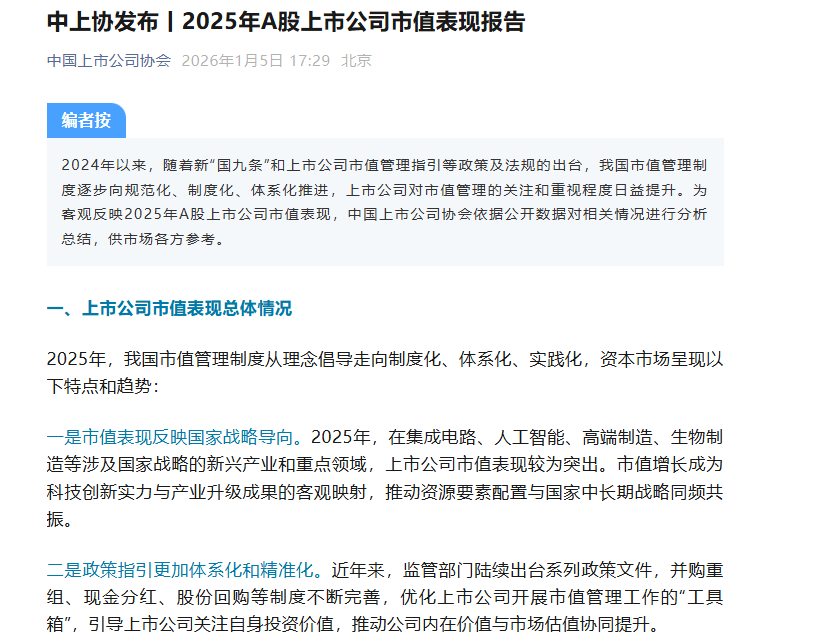
2025年底A股上市公司总市值达123万亿元
Sou Hu Cai Jing· 2026-01-08 07:56
2025年,民营科创上市公司表现活跃,民营上市公司整体市值增长了37.0%,占A股市值的比重从年初的33.6%增长 至37.5%。 上市公司在价值提升、股东回报、信息披露等方面的主动作为意识增强。截至12月31日收盘,2025年A股公司派现 总金额高达2.6万亿元,也创下历史新高。 机构投资者更加关注前沿技术、先进制造和未来产业,"长钱长投"新生态下更多资本流向硬科技,促进"战略引领 ——产业创新——市值提升——资本反哺"的良性循环,推动新质生产力高质量发展。 2025年湖北A股上市公司也取得了亮眼成绩。根据Wind统计,2025年湖北A股上市公司总市值从年初约1.416万亿元 增长至12月31日的约1.996万亿元,涨幅约41%。 从股价涨幅来看,到2025年底19家上市公司股价翻番,52家上市公司市值超100亿元。其中,长飞光纤涨幅为 221.45%,总市值从216.15亿元跃升至963.35亿元。华工科技市值一度破1000亿。 湖北日报讯(记者王艳华)1月5日,中国上市公司协会发布2025年A股上市公司市值表现报告。2025年新增上市公 司116家,年底A股上市公司共5469家,总市值123万亿元;20 ...
深度解读!白银实施出口管控 保障核心产业稳定发展
Zhong Guo Jing Ying Bao· 2026-01-08 07:49
Core Viewpoint - China will implement strict export controls on silver starting January 1, 2026, elevating its management level to that of rare earths, aiming to prioritize domestic demand and ensure supply chain security for key industries [1][2]. Group 1: Policy Changes - The new policy will maintain export controls until at least the end of 2027, providing a stable strategic adjustment mechanism for long-term planning by enterprises [1]. - The export management will continue under a licensing system, with an increase in the number of state-owned trading enterprises involved, indicating no substantial changes in the policy framework [1][2]. Group 2: Industrial Demand and Supply - China is the world's largest silver refining country, with an annual production of approximately 3,300 tons, which is insufficient to meet the industrial demand of around 8,000 tons, leading to a focus on domestic supply for high-tech industries [2][3]. - Silver's role has shifted from a traditional precious metal to a critical strategic resource, necessitating enhanced export management to secure raw material supplies for key industries [2][3]. Group 3: Market Impact and Price Trends - The anticipated export controls may lead to a global supply reduction of 4,500 to 5,000 tons annually, exacerbating existing supply shortages in the market [4]. - Analysts expect silver prices to fluctuate between $66 and $85 per ounce in the first quarter of 2026, with potential upward pressure later in the year, possibly challenging the $100 mark [4]. - Current high silver prices are driven by low global inventories and strong paper demand, with market tensions highlighted by the ongoing consumption of COMEX inventories and low domestic futures stock [5].
2025年汽车以旧换新总量超1150万辆,新能源汽车占比近六成
Hua Xia Shi Bao· 2026-01-08 07:36
Core Insights - The "old-for-new" policy for automobiles in China is expected to drive significant growth in the automotive consumption market and industry upgrades, with over 11.5 million vehicles being replaced and related sales exceeding 2.6 trillion yuan in 2025 [2][3] - The policy has led to a substantial increase in the market share of new energy vehicles (NEVs), with NEVs accounting for nearly 60% of vehicles sold through the replacement program [3][4] - The policy has effectively stimulated demand for vehicle upgrades, contributing over 1 percentage point to the overall retail sales growth of consumer goods in 2025 [4] Group 1: Market Dynamics - The "old-for-new" policy has transformed the automotive market, with NEVs achieving a retail market share exceeding 50% for nine consecutive months, peaking at 59.4% in November [3][4] - The policy has created a strong demand for high-quality, green, and smart vehicles, leading to a significant increase in consumer acceptance of NEVs [3][5] - The automotive sector's growth is supported by a robust demand-driven mechanism that encourages manufacturers to innovate and optimize product structures [5][6] Group 2: Environmental and Social Impact - The recycling and resource regeneration aspects of the "old-for-new" policy have led to a significant increase in the recovery of scrapped vehicles, reaching approximately 9.8 million units in 2025, a 24.5% year-on-year increase [7] - The policy has resulted in the recycling of around 960 million tons of steel and 130 million tons of non-ferrous metals, significantly reducing reliance on primary mineral resources and cutting carbon emissions by approximately 24.5 million tons [7][8] - The active second-hand car market, with transactions reaching 39.7 million units from 2024 to 2025, indicates a maturing automotive market and supports resource conservation [8][9] Group 3: Policy Effectiveness and Future Outlook - The "old-for-new" policy has established a positive feedback loop between market demand, policy incentives, and industry upgrades, enhancing China's competitive position in the global NEV supply chain [5][6] - The policy has not only stimulated immediate sales but also fostered long-term competitiveness through technological innovation and cost optimization [6][9] - As the policy framework continues to evolve, it is expected to further enhance the sustainability and vitality of China's automotive industry, positioning it as a leader in the global transition to low-carbon transportation [9][10]

国机精工(002046) - 002046国机精工投资者关系管理信息20260107
2026-01-08 07:08
Company Overview - The history of Guojijiangong dates back to 1958 with the establishment of the Luoyang Bearing Research Institute and Zhengzhou Abrasives Research Institute, and it was listed on the Shenzhen Stock Exchange in 2005 [2] - The company focuses on precision manufacturing, driven by technological innovation, providing key products, technologies, and services that meet national strategic needs [2][3] - Guojijiangong operates in five major business segments: new materials, basic components, machine tools, high-end equipment, and supply chain management [3] Business Performance - In the first three quarters of 2025, the company achieved operating revenue of CNY 2.296 billion, a year-on-year increase of 27% [3] - The gross profit totaled CNY 797 million, up 20% year-on-year, while net profit reached CNY 245 million, reflecting a 15.4% increase [3] - The core products, special and precision bearings, and superhard materials saw revenue growth exceeding 50%, primarily driven by the wind power bearing business [3] Key Business Segments Bearing Business - The special bearing segment is a key profit driver, with a market share of over 90% in the aerospace sector [4] - The wind power bearing business has shown strong growth, with the company developing significant products like the 8 MW and 18 MW wind power bearings [4][5] Abrasives Business - The superhard materials segment continues to grow, with the company being a pioneer in the industry since 1963 [5] - Key products include thin cutting wheels and diamond tools, which serve critical sectors such as semiconductors and automotive [5] Operational Highlights - The company has seen continuous improvement in core financial metrics, including profit margins and return on equity [6] - A dual growth strategy is in place, focusing on traditional core products and rapidly developing emerging businesses [6] - The company has established a robust talent development system, with over 800 technical personnel, including 700 with master's degrees or higher [7] Future Outlook - Guojijiangong aims to consolidate its existing advantages in bearings and abrasives while exploring new high-growth areas [8] - The company plans to enhance its product offerings in commercial aerospace and humanoid robotics, targeting high-value products [8] - A long-term shareholder return strategy is in place, with a target dividend payout ratio of no less than 40% [8][9] - The company is committed to transparent governance and investor relations, enhancing trust and understanding of its core value drivers [9]
