
失业率

Search documents
美联储主席鲍威尔:净出口的异常波动使GDP衡量变得更加复杂。
news flash· 2025-06-18 18:35
Group 1 - The Federal Reserve Chairman Powell stated that unusual fluctuations in net exports complicate GDP measurements [1] Group 2 - Unemployment rate projections for the end of 2025, 2026, and 2027 are 4.5%, 4.5%, and 4.4% respectively, with slight increases from previous estimates [4] - Core PCE inflation expectations for the end of 2025, 2026, and 2027 are 3.1%, 2.4%, and 2.1% respectively, indicating upward revisions [4] - Federal funds rate projections for the end of 2025, 2026, and 2027 are 3.9%, 3.6%, and 3.4% respectively, with increases noted for 2026 and 2027 [4]

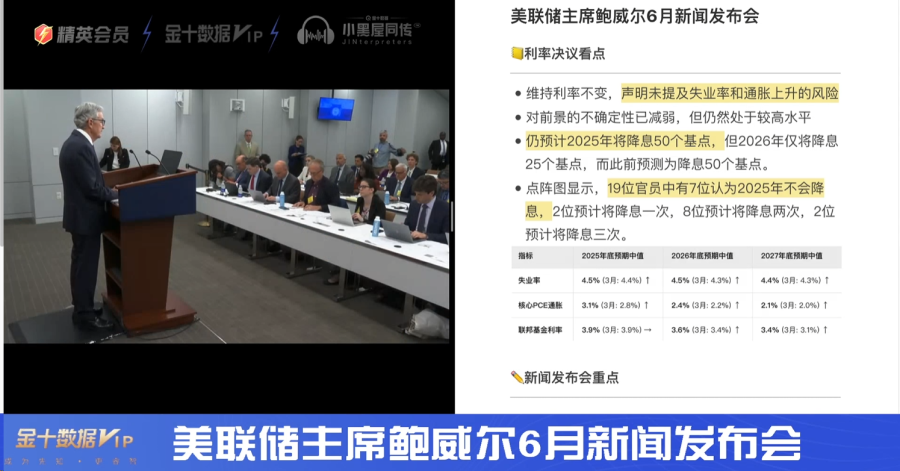
金十图示:2025年06月19日(周四)美联储经济预期
news flash· 2025-06-18 18:18
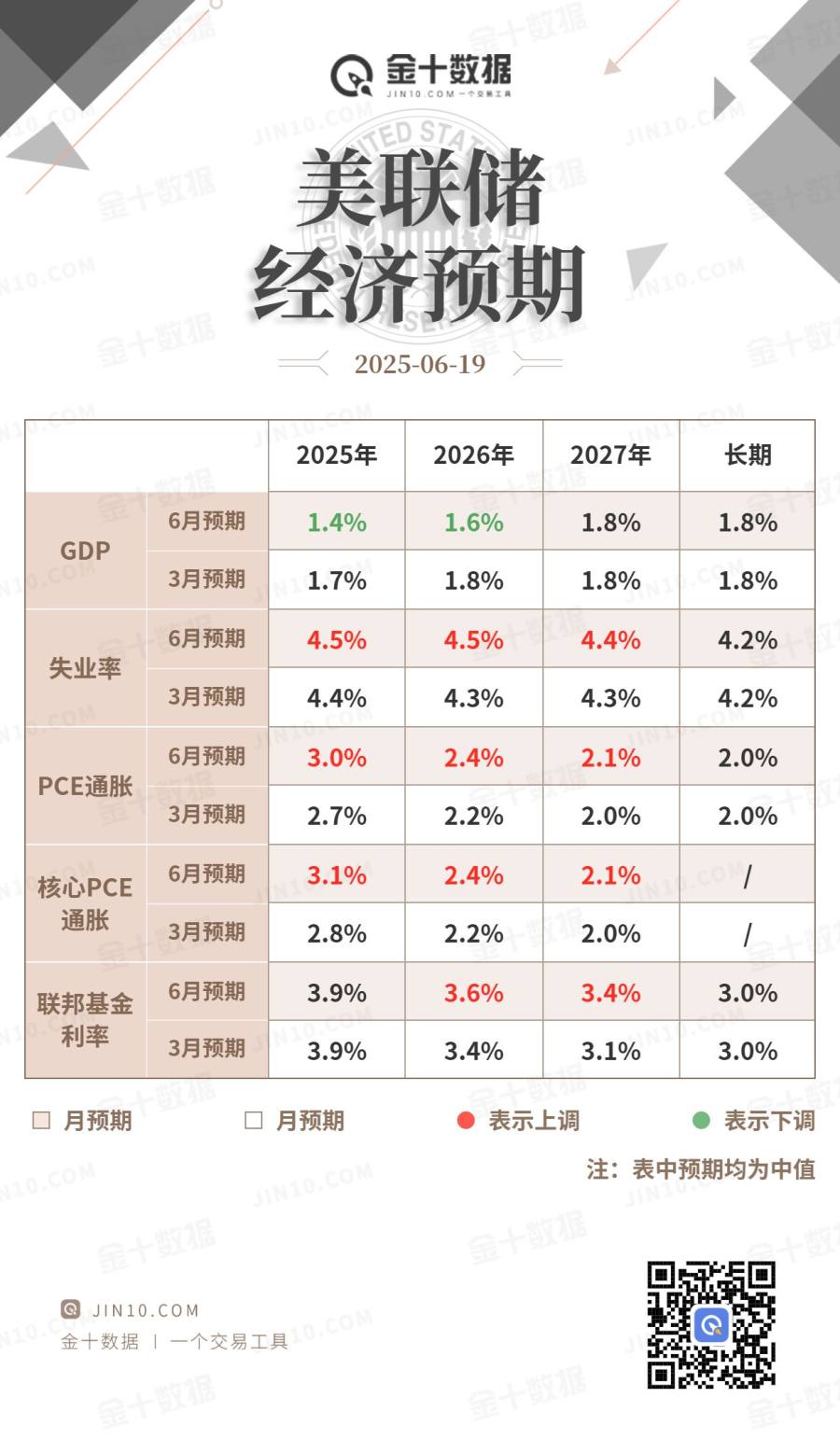
Economic Forecasts - The GDP growth expectations for 2025, 2026, and 2027 are projected at 1.4%, 1.6%, and 1.8% respectively, with a long-term forecast also at 1.8% [2] - The unemployment rate is expected to be 4.5% in 2025 and 2026, slightly decreasing to 4.4% in 2027, with a long-term expectation of 4.2% [2] - PCE inflation is forecasted at 3.0% for 2025, decreasing to 2.4% in 2026 and 2.1% in 2027, with a long-term target of 2.0% [2] - Core PCE inflation is anticipated to be 3.1% in 2025, dropping to 2.4% in 2026 and 2.1% in 2027, with a long-term goal of 2.0% [2] - The federal funds rate is projected to be 3.9% in 2025, 3.6% in 2026, and 3.4% in 2027, with a long-term expectation of 3.0% [2]
美联储“按兵不动”可能再次招致特朗普不满
Sou Hu Cai Jing· 2025-06-18 11:21
Core Viewpoint - The Federal Reserve is signaling a long-term intention to maintain interest rates unchanged, with no immediate rate cuts expected, as economic conditions remain stable and uncertain factors persist [2][3]. Economic Conditions - The U.S. economy is showing signs of slow cooling, with no immediate triggers for the Federal Reserve to intervene, despite concerns over tariffs and their impact on inflation [3][4]. - The unemployment rate has remained stable for three consecutive months, which allows the Federal Reserve to keep interest rates high as a measure against potential inflation [3][5]. Inflation and Interest Rates - Recent inflation data has not raised alarms, with core inflation in May remaining below expectations for the fourth consecutive month, leading to a rise in U.S. Treasury prices [3][6]. - Market expectations suggest that the Federal Reserve may not lower borrowing costs until at least September, with traders betting on multiple rate cuts later in the year [2][3]. Federal Reserve Predictions - Upcoming economic and interest rate forecasts are expected to provide insights into the Federal Reserve's thinking, particularly following President Trump's tariff announcements [4][5]. - Analysts note a wide range of possibilities in the Federal Reserve's predictions, with some suggesting that a significant increase in the unemployment rate could lead to rate cuts before the fourth quarter [5][6]. Policy Uncertainty - Federal Reserve officials are considering the uncertainty surrounding Trump's policies, which may lead them to maintain their current forecasts without significant changes [7][8]. - The timing of the Federal Reserve's next actions will depend on how long Trump's policies take to reflect in economic data and the strength of recession concerns that arise from these data [7][8].

国家统计局发布5月份分年龄组失业率数据
news flash· 2025-06-18 09:14
智通财经6月18日电,国家统计局发布5月份分年龄组失业率数据。5月份,全国城镇不包含在校生的16- 24岁劳动力失业率为14.9%,不包含在校生的25-29岁劳动力失业率为7.0%,不包含在校生的30-59岁劳 动力失业率为3.0%。 国家统计局发布5月份分年龄组失业率数据 ...
美联储6月议息会议前瞻:备受瞩目的“点阵图”来袭,2025年美联储仅降息一次?
Xin Hua Cai Jing· 2025-06-18 06:50
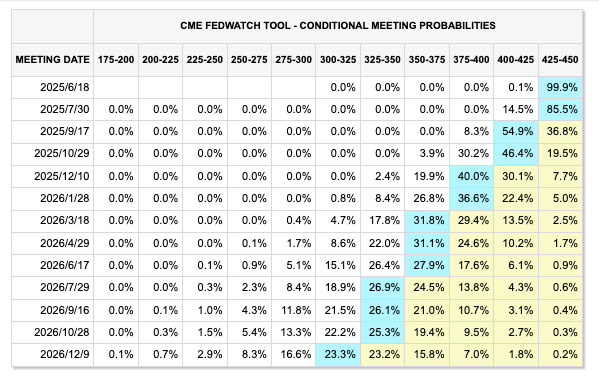
Core Viewpoint - The Federal Reserve is expected to maintain the federal funds rate target range at 4.25%-4.50% during the June meeting, marking the fourth consecutive time it has held rates steady. However, uncertainties regarding the policy path for the second half of the year are significant, making the upcoming "dot plot" and economic outlook from the Fed crucial for market reactions [1][4][5]. Interest Rate Projections - Market expectations indicate that the Fed may lower rates twice in 2025, with a potential first cut in September or October [1][2]. - The "dot plot" is anticipated to be more significant than the decision itself, with analysts focusing on whether it will signal only one rate cut instead of two for 2025 [1][8]. Economic Forecast Adjustments - Analysts predict that the Fed will lower its GDP growth forecast for 2025 to 0.9%, down from 1.7% previously, while raising the core PCE inflation forecast to 3.3% from 2.8% [7]. - The unemployment rate forecast is also expected to rise to 4.5%, compared to the previous estimate of 4.4% [7]. Inflation and Economic Data - Recent geopolitical tensions have increased oil prices, potentially impacting inflation expectations, but analysts believe this will have limited effect on the Fed's June meeting [4]. - The core PCE inflation rate, which has decreased from a peak of 5.6% in 2022 to 2.5%, is projected to rebound to 3.4% by year-end [5]. Market Reactions and Predictions - If the "dot plot" indicates only one rate cut, it may lead to significant market volatility, potentially strengthening the dollar and putting pressure on gold and other assets [10][11]. - The market has largely ignored the resilience of U.S. economic data, focusing instead on potential downside risks, which may affect the dollar's performance in the context of global "de-dollarization" [11].
今夜利率决议料再“按兵不动” 美联储官员静待经济“迷雾”驱散
智通财经网· 2025-06-18 01:25
智通财经APP获悉,美联储官员普遍预计将在美东时间周三举行的利率决议上,连续第四次会议维持利 率不变,并重申在调整借贷成本前,需更清晰了解一系列政府政策调整对经济的影响。政策制定者此前 曾警告称,唐纳德·特朗普总统的关税可能推高通胀与失业率,但迄今为止,稳健的就业增长与通胀降 温让美联储官员今年得以维持利率不变。 德意志银行高级美国经济学家布雷特·瑞安表示:"观望策略此前成效显著。如今既无迫切调整理由,通 胀前景仍存上行风险,为何要偏离这一策略?" 鉴于经济前景充满不确定性,投资者与经济学家将密切关注政策制定者更新的经济与利率预测。官员们 可能继续如多数预测所示,在今年计入两次降息,但部分经济学家称,"点阵图"可能仅显示一次降息。 美联储利率决议将于美东时间周三下午2点公布,主席杰罗姆·鲍威尔将在此后30分钟后召开新闻发布 会。 政策声明要点 预计官员们会将基准利率维持在4.25%-4.5%区间,且对5月6-7日会议后的声明仅做细微调整。鉴于5月 会议以来贸易紧张局势(尤其是中美贸易)有所缓和,政策制定者可能微调关于经济前景不确定性的表 述。 瑞安及其团队在客户报告中指出,官员们可能不再称不确定性"进一步加剧 ...
债王Gundlach最新观点_Jun2025
2025-06-18 00:54
Summary of Key Points from the Conference Call Industry Overview - The discussion primarily revolves around the U.S. bond market and macroeconomic conditions, highlighting a significant shift in economic paradigms that have persisted for the last 40 years [1][17]. Core Insights and Arguments - **Regime Change**: The long-held belief that long-term interest rates will eventually decline is no longer applicable. The U.S. is on the brink of a dangerous collapse, with rising unemployment and inflation, alongside record-high deficits and debt [1]. - **Bond Market Dynamics**: The 30-year U.S. Treasury bond is experiencing its largest and longest drawdown since 1976, with prices halved and the rebound timeline uncertain. Despite credit spreads returning to early-year levels, the volatility experienced is significant [2]. - **Interest Rate Trends**: The recent interest rate cuts have resulted in the worst historical drop in bond prices, remaining well below the median range, while short-term rates have shown little change [6]. - **Credit Stress**: The credit spread between CCC and BB-rated bonds has surpassed its moving average, indicating that weaker borrowers are beginning to face significant pressure [9]. - **Unemployment Correlation**: There is a strong correlation between the 10-year to 2-year U.S. Treasury yield spread and the U3 unemployment rate. The Federal Reserve is unlikely to raise rates but faces challenges in cutting them due to base effects [11]. - **Inflation Concerns**: The current inflation cycle closely resembles that of the 1920s, which could pose significant risks if similar conditions arise [15]. - **Dollar Dynamics**: Over the past 15 years, the dollar has typically risen during S&P adjustments, except for the current instance, indicating a global paradigm shift [17]. - **Fiscal Deficits**: By 2025, the increase in the U.S. fiscal deficit will far exceed the growth seen in the past three years, which has already been unprecedented in terms of money printing [22]. - **Debt Impact**: U.S. debt expenditures have accounted for over 50% of the past 15 years, leading to increased living costs and potentially reigniting inflation by the end of the year, which could undermine the Federal Reserve's commitments [27]. Additional Important Insights - **Employment as a Trigger**: The U3 unemployment rate exceeding its three-year average has historically indicated impending recessions, although this has not yet occurred. A rise to 4.5% by year-end could trigger rate cuts [12]. - **Long-term Economic Divergence**: The last decade has seen a divergence in the relationship between unemployment and deficits, complicating traditional economic models [20]. - **Future Market Performance**: The U.S. market may underperform compared to global markets, as currency appreciation in other markets could enhance investment returns in dollars [31]. - **End of American Exceptionalism**: The dollar has begun a prolonged decline, suggesting that while U.S. equities may not perform poorly, the overall outlook is less optimistic [32].