AGI

Search documents
Analyst Explains Why NVIDIA (NVDA) is Investing In Its Own Customers
Yahoo Finance· 2025-10-20 13:17
We recently published 10 Trending Stocks to Watch as Brad Gerstner Explains Tailwinds for AI Trade – ’10x Manhattan Project’. NVIDIA Corp (NASDAQ:NVDA) is one of the trending stocks to watch. James Van Geelen, the founder and portfolio manager at Citrini Research, was recently asked during a Bloomberg podcast why NVIDIA Corp (NASDAQ:NVDA) is investing in its own customers if the demand for its AI chips is real. Here is what Geelen said, focusing on the “not skeptical” view of the matter: “I could take th ...

诺贝尔经济学奖背后的 AI 投资主线|AGIX PM Notes
海外独角兽· 2025-10-20 12:05
Core Insights - The AGIX index aims to capture the beta and alphas of the AGI era, which is expected to be a significant technological paradigm shift over the next 20 years, similar to the impact of the internet on society [2] - The article discusses the importance of learning from legendary investors like Warren Buffett and Ray Dalio to navigate the AGI revolution [2] Market Performance Summary - AGIX has shown a weekly performance of 0.92%, a year-to-date return of 31.87%, and an impressive return of 81.64% since 2024 [5] - In comparison, the S&P 500 has a weekly performance of 2.45%, a year-to-date return of 18.13%, and a return of 47.47% since 2024 [5] Sector Performance Overview - The semi & hardware sector had a weekly performance of 0.16% with an index weight of 30.11% - The infrastructure sector performed at 0.97% with a weight of 24.74% - The application sector saw a decline of 0.21% with a weight of 39.73% [6] Innovation-Driven Growth Paradigm - The 2025 Nobel Prize in Economic Sciences was awarded to economists who elaborated on the theory of "innovation-driven economic growth," contrasting traditional growth theories that focus on diminishing returns from capital and labor [9] - The article emphasizes that AI, as a collection of technology and knowledge, can be replicated and innovated upon without the diminishing returns seen in traditional capital [10] AI Productivity and Business Models - AI tools are currently in the "AI for productivity" phase, with a potential market space of approximately $6.2 trillion in sales and administrative expenses for S&P 500 companies in 2024 [10] - The article highlights the shift from traditional licensing models to microtransaction models in copyright, exemplified by OpenAI's Sora, which allows for dynamic resource utilization [11][12] AI Implementation and Metrics - Companies should express their AI productivity capabilities through specific KPIs, with a focus on "Dogfooding" as a measure of AI productivity [13] - The potential of a company’s AI can be summarized as Agent Density, Context Tokenization, and Agent Capability, which together accelerate the capitalization of knowledge [14][15] Global Market Trends - The article notes a significant de-leveraging in global stock markets, particularly in North America, with a focus on reducing directional risk [16] - The TMT sector faced selling pressure, while semiconductor stocks received some buying interest, indicating ongoing confidence in the AI industry [16] AI Infrastructure Developments - Meta and Oracle are deploying NVIDIA Spectrum-X Ethernet solutions in AI data centers, indicating a shift towards Ethernet for large-scale AI training and inference [17] - Anthropic introduced Skills functionality for Claude, enhancing its modular task capabilities for enterprise workflows [18] Strategic Partnerships and Acquisitions - Microsoft and NVIDIA, along with BlackRock, are leading an AI infrastructure consortium aiming to acquire Aligned Data Centers for approximately $40 billion [19] - Snowflake and Palantir announced a bidirectional integration to enhance enterprise-level AI applications [20] Future AI Cloud Developments - Microsoft signed a $17.4 billion long-term GPU infrastructure contract with Nebius, indicating a strategic move towards a new AI cloud ecosystem [23]





X @Tesla Owners Silicon Valley
Tesla Owners Silicon Valley· 2025-10-20 11:00
AGI = Artificial Grok Intelligencehttps://t.co/G4dB5rrPPr ...

王兴兴:具身智能如果真的实现,可能距离AGI也不远
Xin Lang Ke Ji· 2025-10-20 09:05
责任编辑:何俊熹 他还提到,读书时的很多想法,我觉得现在基本上都已经实现了,如果大家有很多想法,就抓紧去实 现。(罗宁) 新浪科技讯 10月20日下午消息,今日,在IROS 2025美团机器人研究院学术年会上,王兴兴谈及自己心 目中具身智能的理想形态时表示,具身智能如果真的实现了,可能距离AGI也不远了。 他表示,AGI会成为人类终极的发明,包括消费、娱乐、工作等都可以实现,我们这一代人非常非常有 机会,因为往后50年具身智能可能已经实现,往前几十年还没有这么强的算力芯片。 ...
AI撕碎了“伪工作”的遮羞布
Hu Xiu· 2025-10-20 08:21
Core Insights - The current AI development may lead to either AGI or a more sophisticated word predictor, which significantly impacts market psychology [2] - A report from MIT indicated that 95% of corporate AI investments yielded zero returns, suggesting a fragile market sentiment [2] - The potential for AI to replace low-level white-collar jobs could liberate humans for more meaningful work, but many individuals may struggle to adapt [3] Group 1 - The discussion on AI's trajectory is crucial as it addresses whether the current advancements will lead to AGI or merely enhance predictive capabilities [2] - Experts' opinions on AI's future have a substantial influence on market sentiment, with pessimistic views highlighting the risks of overvaluation [2] - The notion that AI can handle trivial tasks suggests it may replace jobs that do not utilize higher-level human intelligence [2][3] Group 2 - The short-term effect of AI adoption may boost capital profits, but long-term implications could lead to a decline in overall demand as wealth distribution favors capital [4] - Historical context indicates that significant advancements from the first internet boom took about a decade to materialize, raising concerns about potential downturns in the current AI cycle [4] - The resilience of the market may prove more critical than the initial explosive growth of AI technologies [4]
GPT-5≈o3.1!OpenAI首次详解思考机制:RL+预训练才是AGI正道
量子位· 2025-10-20 03:46
Core Insights - The article discusses the evolution of OpenAI's models, particularly focusing on GPT-5 as an iteration of the o3 model, suggesting that it represents a significant advancement in AI capabilities [1][4][23]. Model Evolution - Jerry Tworek, OpenAI's VP of Research, views GPT-5 as an iteration of o3, emphasizing the need for a model that can think longer and interact autonomously with multiple systems [4][23]. - The transition from o1 to o3 marked a structural change in AI development, with o3 being the first truly useful model capable of utilizing tools and contextual information effectively [19][20]. Reasoning Process - The reasoning process of models like GPT-5 is likened to human thought, involving calculations, information retrieval, and self-learning [11]. - The concept of "thinking chains" has become prominent since the release of the o1 model, allowing models to articulate their reasoning in human language [12]. - Longer reasoning times generally yield better results, but user feedback indicates a preference for quicker responses, leading OpenAI to offer models with varying reasoning times [13][14]. Internal Structure and Research - OpenAI's internal structure combines top-down and bottom-up approaches, focusing on a few core projects while allowing researchers freedom within those projects [31][33]. - The company has rapidly advanced from o1 to GPT-5 in just one year due to its efficient operational structure and talented workforce [33]. Reinforcement Learning (RL) - Reinforcement learning is crucial for OpenAI's models, combining pre-training with RL to create effective AI systems [36][57]. - Jerry explains RL as a method of training models through rewards and penalties, similar to training a dog [37][38]. - The introduction of Deep RL by DeepMind has significantly advanced the field, leading to the development of meaningful intelligent agents [39]. Future Directions - Jerry believes that the future of AI lies in developing agents capable of independent thought for complex tasks, with a focus on aligning model behavior with human values [53][54]. - The path to AGI (Artificial General Intelligence) will require both pre-training and RL, with the addition of new components over time [56][58].

OpenAl为何“情迷”变现
虎嗅APP· 2025-10-20 00:09
Core Viewpoint - The article discusses the contrasting strategies of OpenAI and xAI in the pursuit of Artificial General Intelligence (AGI), highlighting OpenAI's focus on integrating existing tools and services, while xAI aims to develop a deeper understanding of the physical world through "world models" [4][6][15]. Group 1: OpenAI's Strategy - OpenAI plans to introduce adult content to its platform, allowing verified adults to access such material, as part of a broader strategy to treat adult users with more freedom [4][9]. - The company is also set to launch a new version of ChatGPT, which aims to align more closely with user preferences, addressing previous criticisms regarding the loss of human-like interaction [10][14]. - OpenAI has established a "Welfare and AI" committee to address complex and sensitive issues, although it has faced criticism for not including suicide prevention experts [14]. Group 2: xAI's Approach - xAI is developing "world models" that enable AI to simulate and predict changes in the environment, emphasizing the need for AI to understand the physical laws governing the world [5][6]. - The company is focusing on integrating AI into gaming and robotics, viewing these areas as natural testing grounds for AI's capabilities [15]. - xAI's strategy reflects Elon Musk's long-standing interests in autonomous driving and robotics, positioning the company to leverage physical interactions for AI development [7][15]. Group 3: Market Dynamics - The competition between OpenAI and xAI is not just a technological race but also involves differing philosophies and responsibilities regarding AI development [15]. - OpenAI's approach is characterized by rapid commercialization and user retention efforts, while xAI's focus is on foundational technology and real-world applications [7][15].

腾讯研究院AI速递 20251020
腾讯研究院· 2025-10-19 16:01
Group 1: Nvidia and TSMC Collaboration - Nvidia and TSMC unveiled the first Blackwell chip wafer produced in the U.S., marking a significant milestone in domestic chip manufacturing [1] - The TSMC Arizona factory has a total investment of $165 billion and will produce advanced chips using 2nm, 3nm, and 4nm processes [1] - The Blackwell chip features 208 billion transistors and achieves a connection speed of 10TB/s between its two sub-chips through NV-HBI [1] Group 2: Anthropic's Agent Skills - Anthropic launched the Agent Skills feature, allowing users to load prompts and code packages as needed, enhancing the capabilities of AI [2] - Skills can be used across Claude apps, Claude Code, and API platforms, with a focus on minimal necessary information loading [2] - The official presets include nine skills for various document formats, and users can upload custom skills [2] Group 3: New 3D World Model by Fei-Fei Li - Fei-Fei Li's World Labs introduced a real-time generative world model, RTFM, which can render persistent 3D worlds using a single H100 GPU [3] - RTFM employs a self-regressive diffusion Transformer architecture to learn from large-scale video data without explicit 3D representations [3] - The model maintains spatial memory for persistent world geometry through pose-aware frames and context scheduling technology [3] Group 4: Manus 1.5 Update - Manus released version 1.5, introducing a built-in browser that allows AI to interact with web pages, test functions, and fix bugs [4] - A new Library file management system enables collaborative editing within the same Agent session, reducing average task completion time significantly [4] - The system allows for no-code music web application construction through natural language, supporting real-time updates [4] Group 5: Windows 11 Major Update - Windows 11's major update features "Hey Copilot" for voice activation and Copilot Vision for screen understanding, enhancing user interaction [5][6] - Copilot Actions can perform operations on local files, while Copilot Connectors integrate with OneDrive, Outlook, and Google services [5][6] - Manus AI operations are integrated into the file explorer, allowing for automatic website generation and video editing functionalities [6] Group 6: Baidu's PaddleOCR-VL Model - Baidu open-sourced the PaddleOCR-VL model, achieving a score of 92.6 on the OmniDocBench V1.5 leaderboard with only 0.9 billion parameters [7] - The model supports 109 languages and excels in text recognition, formula recognition, table understanding, and reading order prediction [7] - It utilizes a two-stage architecture combining dynamic resolution visual encoding and a language model, achieving high inference speed on A100 [7] Group 7: AI in Fusion Energy Development - Google DeepMind collaborates with CFS to accelerate the development of the SPARC fusion device using AI [8] - The partnership focuses on creating precise plasma simulation systems and optimizing fusion energy output [8] - The TORAX simulator is a key tool for CFS, enabling extensive virtual experiments and real-time control strategy exploration [8] Group 8: Harvard Study on AI's Impact on Employment - A Harvard study tracking 62 million workers found a significant decline in entry-level positions in companies using AI, primarily through slowed hiring [9] - The impact of AI is most pronounced among graduates from mid-tier universities, while top-tier and bottom-tier institutions are less affected [9] - The wholesale and retail sectors face the highest risk for entry-level jobs, with a trend towards skill polarization [9] Group 9: Concerns Over AI-Generated Content - Reddit co-founder Ohanian warned that much of the internet is "dead," overwhelmed by AI-generated content [10] - Reports indicate that automated traffic could reach 51% by 2024, with AI-generated articles surpassing human-written ones [10] - Research suggests that training models on AI-generated data may lead to a decline in model performance [10] Group 10: Andrej Karpathy on AGI Development - AI expert Andrej Karpathy expressed skepticism about the current state of AI agents, predicting that AGI is still a decade away [11] - He criticized the noise in reinforcement learning and the limitations of pre-training methods [11] - Karpathy anticipates that AGI will contribute modestly to GDP growth, emphasizing the importance of education in the AI era [11]




Andrej Karpathy并非看空AI
傅里叶的猫· 2025-10-19 14:11
Core Viewpoints - Karpathy believes that achieving AGI will take approximately 10 years, and current optimistic predictions are often driven by funding needs. He uses the metaphor "summoning a ghost rather than building an animal" to emphasize that AI generates outputs by mimicking internet data, which is different from biological evolution of intelligence [3]. - He highlights the inefficiencies of reinforcement learning (RL), noting issues such as high variance and noise, which he compares to drawing supervisory signals through a straw. He also points out that automated credit allocation and LLM judges can be exploited, limiting their development [3]. - Karpathy identifies cognitive deficiencies in LLMs, stating they lack continuous learning, multimodal capabilities, and emotional drive, relying instead on context windows rather than long-term memory. He warns of the risk of "model collapse," leading to decreased diversity in generated data [3]. - He argues that AGI will not trigger an economic explosion but will instead integrate smoothly into a 2% GDP growth curve, continuing the automation wave. The process of technological diffusion and social adaptation will be gradual, with no evidence of "discrete jumps" [3]. Education and Adaptation - Karpathy has established the Eureka educational institution, aimed at redesigning the education system to help individuals enhance their cognitive abilities in the AI era, preventing marginalization by technological advancements. Its core mission is to create efficient "ramps to knowledge," enabling learners to maximize their "Eurekas per second" [10]. - He emphasizes the need for time and educational support for AI development rather than relying on short-term technological breakthroughs. He does not foresee AI replacing human labor in the short term but rather focuses on cultivating human capabilities to coexist with AI through education, such as promoting multilingualism and broad knowledge [10][11]. - Karpathy's core viewpoint is not one of skepticism towards AI but rather an emphasis on the gradual development of AI and the proactive adaptation of humanity. He believes that AI will not rapidly disrupt the world but will require long-term optimization, with humans needing to enhance their skills to thrive alongside AI [11].
OpenAI「解决」10道数学难题?哈萨比斯直呼「尴尬」,LeCun辛辣点评
3 6 Ke· 2025-10-19 07:49
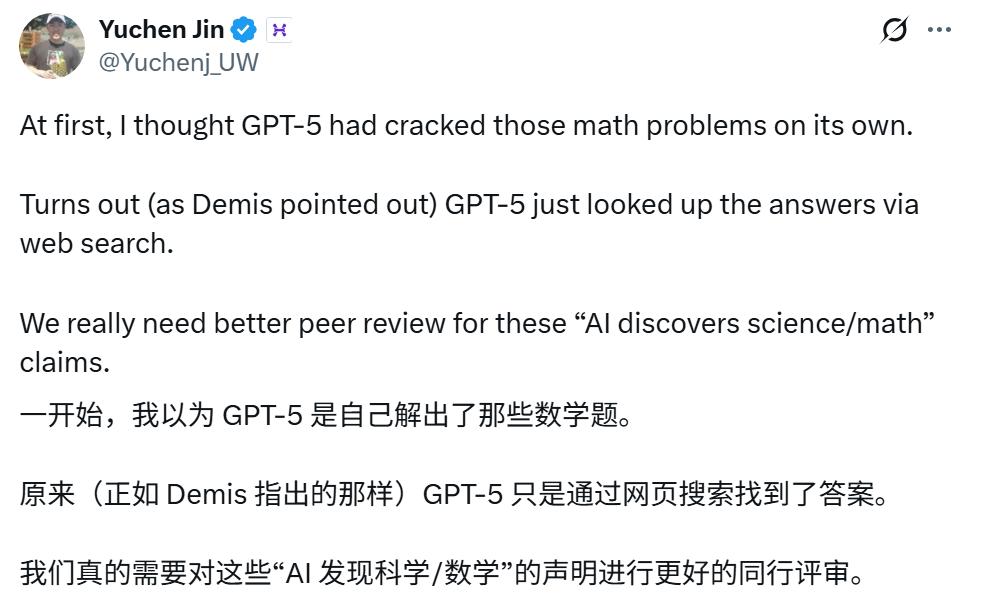
Core Points - OpenAI researchers claimed that GPT-5 "discovered" solutions to 10 unsolved mathematical problems, leading to public misconceptions that GPT-5 independently solved these problems, which were later revealed to be existing literature [1][10][12] Group 1: Claims and Misunderstandings - On October 12, Sebastien Bubeck tweeted that GPT-5 excelled in literature search by identifying that Erdős Problem 339 had been solved 20 years ago, despite being listed as unsolved in the official database [3][4] - Following this, researchers Mark Sellke and Mehtaab used GPT-5 to investigate other Erdős problems, claiming to have found solutions to 10 problems and partial progress on 11 others [7][8] - The initial excitement was short-lived as Google DeepMind's CEO, Demis Hassabis, pointed out the misunderstanding, leading to clarifications from mathematician Thomas Bloom [10][11][12] Group 2: Reactions and Clarifications - Thomas Bloom described OpenAI's statements as a "dramatic misunderstanding," clarifying that the problems were marked as unsolved due to his lack of awareness of existing solutions, not because they were unsolved in the mathematical community [12] - Bubeck later deleted his post and apologized, emphasizing the value of AI in literature search rather than as a mathematician [13][14] - The incident sparked discussions about the balance between scientific rigor and public promotion within the AI community, highlighting the potential for AI to assist in mundane research tasks rather than solving complex problems independently [31][28]