
适度宽松的货币政策

Search documents
反内卷风暴下,央行释放重磅信号,再提“促进物价合理回升作为重要考量”!相关表述连续四个季度现身货币政策执行报告
Sou Hu Cai Jing· 2025-08-15 11:48
Core Viewpoint - The central bank emphasizes the importance of promoting a reasonable recovery in prices as a key consideration for monetary policy, aiming for a stable financial environment and effective liquidity management [1][2]. Monetary Policy - The central bank plans to implement a moderately loose monetary policy, ensuring that the growth of social financing and money supply aligns with economic growth and price level expectations [1][7]. - There is a focus on maintaining ample liquidity and using various monetary policy tools to support credit stability and financial growth [7]. Price Management - The central bank has consistently highlighted the need for a reasonable recovery in prices over the past four quarters, indicating a cautious approach to price management [2]. - Recent regulatory measures aim to combat "involution" in competition, including the prohibition of selling goods below cost, to stabilize market prices [3][4]. Real Estate Market - The central bank is committed to implementing financial policies that support the stability of the real estate market, including measures for affordable housing [8]. Debt Financing - There is an emphasis on developing the bond market, particularly for private enterprises, to enhance financing options and support technological innovation [9]. Exchange Rate Management - The central bank aims to deepen the market-oriented reform of the exchange rate system, ensuring stability and preventing excessive fluctuations in the RMB exchange rate [10]. Consumption and Economic Growth - Financial policies will focus on supply-side improvements and collaboration with other policies to enhance high-quality service consumption and stimulate effective demand [10].
中国央行:进一步完善利率调控框架,强化央行政策利率引导
Hua Er Jie Jian Wen· 2025-08-15 11:29
Core Viewpoint - The People's Bank of China (PBOC) emphasizes the need for a more refined interest rate adjustment framework and aims to enhance the effectiveness of monetary policy in supporting the real economy while maintaining financial health [1] Group 1: Monetary Policy Framework - The PBOC plans to strengthen the guidance of policy interest rates and improve the transmission mechanism of market-based interest rates [1] - There is a focus on reducing banks' funding costs to lower the overall financing costs in society [1] - The central bank aims to balance financial support for the real economy with the health of the financial system [1] Group 2: Implementation of Monetary Policy - The PBOC will implement a moderately accommodative monetary policy, adjusting the intensity and pace based on domestic and international economic conditions [1] - Maintaining ample liquidity is a priority, ensuring that the growth of social financing and money supply aligns with economic growth and price level expectations [1] - Promoting a reasonable recovery of prices is highlighted as a key consideration in monetary policy [1] Group 3: Support for Specific Sectors - The PBOC intends to utilize structural monetary policy tools to support technology innovation, boost consumption, assist small and micro enterprises, and stabilize foreign trade [1]
中国央行:落实落细适度宽松的货币政策
智通财经网· 2025-08-15 10:27
Core Viewpoint - The People's Bank of China (PBOC) emphasizes the implementation of a moderately accommodative monetary policy to support economic growth and maintain price stability, while addressing the challenges posed by a complex external environment [1][3][6]. Group 1: Monetary Policy Implementation - The PBOC aims to ensure sufficient liquidity in the market, aligning the growth of social financing and money supply with economic growth and price level expectations [1][7]. - The report highlights the importance of promoting a reasonable recovery in prices as a key consideration for monetary policy [1][7]. - The PBOC plans to enhance the interest rate adjustment framework and strengthen the guidance of policy interest rates to lower the cost of bank liabilities and reduce overall financing costs [1][4][7]. Group 2: Economic Indicators - In the first half of the year, China's GDP grew by 5.3% year-on-year, indicating strong economic vitality and resilience [3]. - By the end of June, the social financing scale and broad money supply (M2) increased by 8.9% and 8.3% year-on-year, respectively, with the RMB loan balance reaching 268.6 trillion yuan [5]. Group 3: Financial Stability and Risk Management - The PBOC is focused on maintaining the stability of the RMB exchange rate and preventing systemic financial risks, while enhancing the monitoring and assessment of financial risks [4][6][7]. - The report outlines measures to support key areas such as technological innovation, consumption, and small and micro enterprises through targeted monetary policy tools [4][7].
央行: 落实落细适度宽松的货币政策
Sou Hu Cai Jing· 2025-08-15 10:14
Core Viewpoint - The central bank emphasizes the implementation of a moderately loose monetary policy in the second quarter of 2025, aiming to align monetary supply with economic growth and price level expectations [1] Group 1: Monetary Policy Implementation - The central bank plans to ensure ample liquidity in the financial system to support economic activities [1] - The focus will be on matching the growth of social financing and money supply with economic growth and price level expectations [1] - Promoting a reasonable recovery of prices is highlighted as a key consideration in monetary policy [1]
央行:强化逆周期调节 根据国内外经济金融形势和金融市场运行情况把握好政策实施的力度和节奏
Zheng Quan Shi Bao Wang· 2025-08-15 10:09
人民财讯8月15日电,央行发布2025年第二季度中国货币政策执行报告,下一阶段,保持融资和货币总 量合理增长。进一步落实好适度宽松的货币政策,抓好各项货币政策措施执行。强化逆周期调节,根据 国内外经济金融形势和金融市场运行情况,把握好政策实施的力度和节奏。密切关注海外主要央行货币 政策变化,持续加强对银行体系流动性供求和金融市场变化的分析监测,综合运用多种货币政策工具, 保持流动性充裕。引导银行稳固信贷支持力度,保持金融总量合理增长,使社会融资规模、货币供应量 增长同经济增长和价格总水平预期目标相匹配,持续营造适宜的金融环境。 ...
中国央行发布2025年第二季度中国货币政策执行报告
Hua Er Jie Jian Wen· 2025-08-15 10:03
Core Insights - The article emphasizes the implementation of a moderately loose monetary policy in the next phase, aligning the policy's intensity and pace with domestic and international economic and financial conditions [1] - It highlights the importance of maintaining ample liquidity to ensure that the growth of social financing and money supply matches economic growth and price level expectations [1] - The article also stresses the need to promote a reasonable recovery of prices as a key consideration in monetary policy [1] Summary by Categories - **Monetary Policy** - The focus is on executing a moderately loose monetary policy in response to economic conditions [1] - The policy aims to balance the growth of social financing and money supply with economic growth and price expectations [1] - **Liquidity Management** - Maintaining sufficient liquidity is crucial for creating a conducive financial environment [1] - The article suggests that liquidity should be abundant to support economic activities [1] - **Price Stability** - Promoting a reasonable recovery of prices is highlighted as an important aspect of monetary policy [1] - The article indicates that price stability will be a significant consideration in future policy decisions [1]
央行公布最新金融数据,体现适度宽松的货币政策取向
Zhong Guo Ji Jin Bao· 2025-08-14 01:38
Group 1 - The central bank's financial data indicates that as of the end of July, the social financing scale and broad money supply (M2) grew by 9% and 8.8% year-on-year, respectively, reflecting a moderately loose monetary policy that supports the real economy [1] - The new personal housing loan interest rate is approximately 3.1%, while the new corporate loan interest rate is about 3.2%, both showing a decline of around 45 and 30 basis points compared to the same period last year, indicating a relatively abundant credit supply [2][3] - The total RMB loans increased by 12.87 trillion yuan in the first seven months, with household loans rising by 680.7 billion yuan and corporate loans increasing by 11.63 trillion yuan, demonstrating strong support for the real economy [4] Group 2 - The increase in loan interest rates has been sustained at low levels for an extended period, suggesting that credit resources are generally abundant and the financing needs of the real economy are being met [3] - The diversity of corporate financing channels has increased due to financial market innovations and the rapid expansion of government bond issuance, making it more challenging for loans alone to reflect the effectiveness of financial support for the real economy [5] - The new loan issuance metric is significant as it reflects the actual lending and repayment situation, indicating that effective financing demand from the real economy is being adequately satisfied [6]
消费贷贴息利率降至“2”字头;央行公布7月金融数据 | 金融早参
Mei Ri Jing Ji Xin Wen· 2025-08-13 23:33
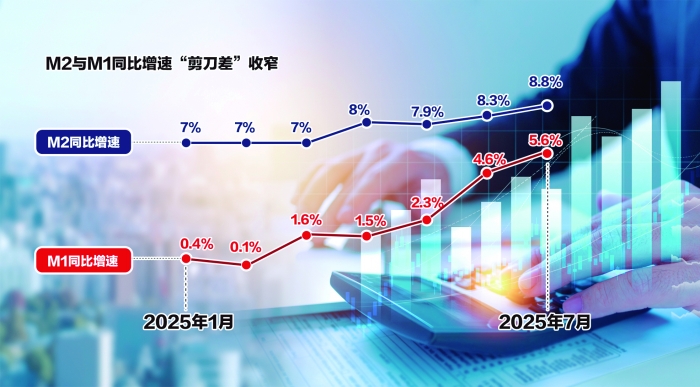
Group 1: Monetary Policy and Financing - The People's Bank of China reported that the cumulative increase in social financing for the first seven months of 2025 reached 23.99 trillion yuan, which is 5.12 trillion yuan more than the same period last year [1] - As of the end of July 2025, the broad money supply (M2) stood at 329.94 trillion yuan, reflecting a year-on-year growth of 8.8%, while the narrow money supply (M1) was 111.06 trillion yuan, with a year-on-year increase of 5.6% [1] - The net fund injection for the first seven months was 465.1 billion yuan, indicating a moderately loose monetary policy aimed at supporting the real economy [1] Group 2: Consumer Lending and Financial Support - The interest rate for personal consumption loan subsidies has dropped to an annualized rate of 1%, significantly lower than the current commercial bank rates, allowing qualified customers to access loans at rates in the "2" range, effectively reducing borrowing costs [2] - This subsidy policy is expected to alleviate repayment pressure for consumers, thereby boosting confidence and stimulating consumption potential [2] Group 3: Housing Policy - The Tianjin Housing Provident Fund Management Center announced that individuals can now use their housing provident fund to pay the down payment for purchasing existing homes, allowing for a one-time withdrawal of funds prior to the signing of the purchase contract [3] - This policy simplifies the process for homebuyers, reduces transaction costs, and does not affect the normal loan limits for provident fund loans [3] Group 4: Bank Participation in Subsidy Programs - Six major state-owned banks, including ICBC, ABC, Bank of China, CCB, BOCOM, and Postal Savings Bank, have committed to implementing the personal consumption loan subsidy policy starting September 1, 2025 [4] - The initiative aims to enhance consumer spending and support high-quality consumption development through innovative and diverse consumption scenarios [4]



7月社融、M2增速保持较高水平 资金循环效率提升
Shang Hai Zheng Quan Bao· 2025-08-13 17:48
Core Viewpoint - The People's Bank of China reported that as of the end of July, social financing scale, broad money (M2), and RMB loans grew by 9%, 8.8%, and 6.9% year-on-year, respectively, continuing to exceed economic growth rates [1][2]. Group 1: Social Financing and Monetary Policy - The social financing scale reached 431.26 trillion yuan at the end of July, with a year-on-year growth of 9%, which is 0.8 percentage points higher than the same period last year [2]. - The increase in government bonds is a major driver of social financing growth, supported by a more proactive fiscal policy and a moderately loose monetary policy [2]. - The government’s bond issuance is aimed at increasing demand and supporting the economy while reducing the average financing cost for society [2]. Group 2: Money Supply and Efficiency - M2 grew by 8.8% year-on-year, which is 2.5 percentage points higher than the same period last year, indicating improved efficiency in the circulation of funds [3]. - The narrowing "scissors difference" between M2 and narrow money (M1) reflects an increase in the liquidity and efficiency of funds [5]. Group 3: Loan Growth and Structure - As of the end of July, the RMB loan balance was 268.51 trillion yuan, with a year-on-year growth of 6.9%, down from 8.7% the previous year [6]. - The traditional seasonal pattern of credit growth in July, along with the impact of local government debt replacement, has influenced loan data [6][7]. - The structure of credit is further optimized to meet the demands of economic transformation, with significant growth in inclusive small and micro loans and medium to long-term loans for manufacturing [8]. Group 4: Interest Rates and Future Outlook - Loan interest rates remain low, with new corporate loan rates around 3.2% and new personal housing loan rates around 3.1%, reflecting a favorable credit supply environment [8]. - Experts anticipate that macroeconomic policies will maintain continuity and stability in the second half of the year, supporting economic recovery and reasonable growth in effective credit demand [8].

央行重磅数据 最新解读!
Zhong Guo Ji Jin Bao· 2025-08-13 14:26
Group 1 - The central bank's latest financial data indicates a moderately loose monetary policy, with social financing and broad money (M2) growing by 9% and 8.8% year-on-year, respectively, as of the end of July [1] - New personal housing loan rates are approximately 3.1%, while new corporate loan rates are around 3.2%, reflecting a decline of about 45 and 30 basis points compared to the same period last year [2] - The overall credit resource supply is abundant, and the financing needs of the real economy are being met, supported by various policy measures that enhance the interest rate mechanism [3] Group 2 - As of the end of July, the balance of RMB loans reached 268.51 trillion yuan, with a year-on-year growth of 6.9%, and a total increase of 12.87 trillion yuan in RMB loans over the first seven months [4] - The increase in loans to households and enterprises indicates a robust support for the real economy, with household loans increasing by 680.7 billion yuan and enterprise loans rising by 11.63 trillion yuan [4] - The social financing scale indicator, introduced by the central bank, provides a comprehensive view of financial growth, encompassing various financing channels beyond just loans [5] Group 3 - The new loan issuance metric is crucial as it reflects the actual lending and repayment activities of banks during the current period [6] - High loan issuance and repayment volumes can lead to stable loan balance growth, indicating that the effective financing needs of the economy are being adequately met [7]