中国威胁论

Search documents
薛剑总领事遭围攻,日本记者:要100多年前,我们就直接打过去了
Sou Hu Cai Jing· 2025-11-14 06:05
Core Viewpoint - The statements made by Japanese Prime Minister Sanna Takashi regarding the potential use of force in Taiwan have escalated tensions and drawn significant attention, particularly in light of the strong response from Chinese Consul General Xue Jian [1][6] Group 1: Reactions and Responses - Xue Jian's comments on social media, which were later deleted, sparked a heated online debate in Japan, with various factions engaging in personal attacks and escalating the situation [3][9] - Japanese right-wing media have amplified the incident, framing it as a significant news story and invoking historical sentiments related to past conflicts with China [4][8] - China's response has been clear, emphasizing its opposition to any external interference in Taiwan affairs and reiterating that Taiwan is an integral part of China [6][9] Group 2: Historical Context and Political Implications - The incident reflects long-standing tensions and historical grievances between China and Japan, with some Japanese politicians and media attempting to leverage historical issues to bolster their international standing [8][10] - The current political climate in Japan has seen a rise in right-wing sentiments, which are often fueled by historical narratives that seek to portray China as an adversary [4][9] - Despite the provocative statements from Japanese officials, China maintains a stance of rationality and a commitment to peaceful coexistence, resisting external pressures [10]


欧洲上演“联合收割”?CEO刚被踢出局,英国又来抢我们千亿工厂!这盘棋,水太深了!
Sou Hu Cai Jing· 2025-11-01 15:12
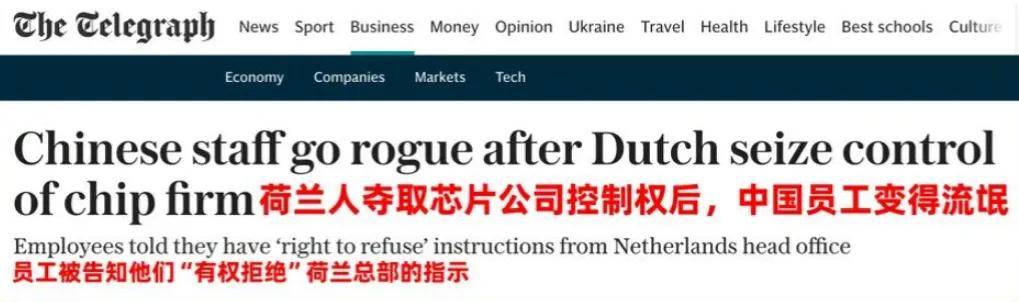
Core Viewpoint - The article discusses the tumultuous acquisition of Nexperia by China's Wentai Technology, highlighting internal conflicts and geopolitical tensions that have arisen as a result of the deal, particularly involving the UK and Dutch governments. Group 1: Acquisition and Internal Conflict - Wentai Technology's acquisition of Nexperia was initially seen as a strong partnership, but internal strife quickly emerged, leading to the ousting of the CEO and the appointment of the CFO, raising concerns about governance and trust [1][4] - The unexpected power struggle within Nexperia has caused instability in the semiconductor supply chain, particularly affecting automotive manufacturers who rely on these chips [1][4] Group 2: Geopolitical Tensions - Following the acquisition, Dutch stakeholders began to propagate the "China threat" narrative, attempting to shift blame and portray themselves as victims in the situation [1][2] - UK politicians have suggested that if the Netherlands can relocate Nexperia's headquarters, the UK should also retain Nexperia's factory, indicating a desire to leverage the situation for their own benefit [2][4] Group 3: Economic Implications - The Manchester factory, which generated nearly 1.8 billion RMB in revenue last year, is now under threat of being sold at a low price due to political pressure, showcasing the potential economic ramifications of the acquisition [4] - The article emphasizes that Nexperia's strength lies not solely in its European operations but also in its global strategy, with significant production capabilities in China, particularly in Dongguan and a new factory in Shanghai [5][4] Group 4: Strategic Outlook - The need for companies to secure core technologies and build robust supply chains is underscored as essential for future competitiveness in the international market [7]
美调查:超一半美国人认为美国应与中国友好合作
Huan Qiu Shi Bao· 2025-10-29 23:05
Group 1 - A recent survey by the Chicago Council on Global Affairs indicates that over half of Americans (53%) believe the U.S. should engage in cooperation and contact with China, marking the first majority support for a friendly approach since 2019 [1] - The survey, conducted in collaboration with Ipsos, shows a significant shift in American public opinion towards China, with 53% favoring cooperation compared to 40% in 2024 [1] - The change in sentiment is primarily driven by Democrats and independents, with two-thirds of Democrats supporting friendly relations with China, an increase of 19% from 2024 [1] Group 2 - There is a general consensus among Americans, regardless of political affiliation, to lower tariffs on Chinese imports in exchange for a reduction in the U.S.-China trade deficit [2] - The perception of China as a significant threat has decreased, with only 50% of Americans believing China's rise poses a major threat, down 8% from 2023 [2] - The report suggests that American public opinion is increasingly focused on domestic issues rather than the rise of China, indicating a shift in priorities [2] Group 3 - The findings of the survey may reflect a return to a more pragmatic and mutually beneficial perspective among the American public regarding U.S.-China relations [3]
外交部:坚决反对炒作所谓“中国间谍活动”对华进行污蔑抹黑
Huan Qiu Wang· 2025-10-28 07:52
Core Viewpoint - The Chinese government firmly opposes the sensationalism surrounding the so-called "Chinese spy" case in the UK, emphasizing that such narratives are attempts to smear China and undermine bilateral relations [1]. Group 1: China's Position on UK Relations - The Chinese government has consistently maintained its stance on developing Sino-British relations based on mutual respect and cooperation [1]. - The essence of advancing cooperation is mutual benefit, and the UK should adopt a correct perspective on this relationship [1]. Group 2: Concerns Over Anti-China Sentiment - There is a concern that if the UK allows anti-China forces to provoke and act recklessly, it will ultimately lead to negative consequences for the UK [1].
高端访谈丨专访哥伦比亚大学教授杰弗里·萨克斯
Yang Shi Xin Wen Ke Hu Duan· 2025-10-11 12:35
Core Viewpoint - Jeffrey Sachs, a professor at Columbia University, expresses strong confidence in China's economic development and reform over the past four decades, dismissing the notion of a "China threat" as fundamentally flawed [2]. Group 1 - Sachs has been visiting China regularly for over 40 years and has conducted in-depth research on its economy [2]. - He actively praises China's reform and opening-up policies, attributing his confidence in China's social and economic development to these changes [2]. - Sachs critiques the attempts by some countries to contain China's growth, labeling such ideas as "absurd" [2]. Group 2 - The interview will explore the underlying logic behind the so-called "China threat theory" and its misconceptions [2]. - Sachs will provide insights into the future development of China-U.S. relations, highlighting key factors that will influence this dynamic [2].
高端访谈|专访哥伦比亚大学教授杰弗里·萨克斯
Yang Shi Wang· 2025-10-11 12:06
Core Viewpoint - Jeffrey Sachs, a professor at Columbia University, expresses strong confidence in China's economic development and reform over the past four decades, highlighting the absurdity of the notion that other countries can contain China's growth [1] Group 1: China's Economic Development - Sachs has been studying China's economy for over 40 years and has a positive evaluation of its reform and opening-up policies [1] - His confidence in China's social and economic development stems from its significant progress and resilience [1] Group 2: Critique of "China Threat" Theory - Sachs critiques the "China threat" theory, arguing that it is based on flawed logic and misconceptions about China's role in the global economy [1] - He emphasizes that attempts by some countries to contain China's development are misguided and unrealistic [1] Group 3: Future of Sino-American Relations - Sachs discusses the future of Sino-American relations, suggesting that understanding and cooperation are essential for both nations [1] - He believes that constructive dialogue can help mitigate tensions and foster mutual benefits [1]
习言道丨面对“沉思的雅典娜”,习近平提到一个中国成语
Zhong Guo Xin Wen Wang· 2025-09-13 12:29
Group 1 - The article discusses Xi Jinping's emphasis on peaceful development and the importance of cultural exchange in the context of global governance and civilization [6][8][9] - Xi Jinping references the Chinese idiom "止戈为武" (stop fighting to achieve peace) to highlight China's commitment to peaceful coexistence and mutual respect among civilizations [7][8] - The article outlines China's initiatives such as the Global Development Initiative and the Global Security Initiative, aimed at promoting stability and cooperation in a turbulent world [8][9] Group 2 - Xi Jinping's remarks at various international forums reflect China's stance against the "clash of civilizations" narrative and its dedication to building a community with a shared future [8][9] - The article mentions China's role as a major trading partner for over 150 countries and its efforts in establishing international mediation institutions, showcasing its influence in global affairs [8] - The call for a more just and reasonable global governance system is reiterated, emphasizing the need for equality and cooperation among nations to ensure lasting peace and development [9]

美国人预测:未来20年,全球最强大的4个国家,中国上榜了吗?
Sou Hu Cai Jing· 2025-09-07 01:24
Group 1 - The article discusses the prediction that the future global power dynamics will include the United States, China, India, and the European Union as the top four influential entities [1][3] - The European Union, despite being a collective of 27 countries, faces internal challenges and is seen as struggling to maintain its position among the top powers [3][5] - India is highlighted for its demographic advantage with a young population and a GDP of $3.85 trillion, but it faces significant challenges in its business environment, including bureaucratic hurdles and trade tensions [5][6] Group 2 - The United States is experiencing economic difficulties, with a projected GDP decline of 0.3% in Q1 2025 and a national debt exceeding $36.6 trillion, which translates to over $100,000 per citizen [5][6] - China achieved a GDP of over 130 trillion yuan, making it the second-largest economy globally, but still lags behind the U.S. in per capita GDP, which is over $70,000 [6][7] - The article emphasizes the importance of recognizing gaps in technology and manufacturing capabilities, suggesting that true strength comes from self-improvement rather than external validation [7]

东西问丨戴维·古德曼:如何推动中澳关系稳中有进?
Zhong Guo Xin Wen Wang· 2025-09-05 11:24
Group 1 - The core viewpoint of the article emphasizes the importance of a healthy and stable Australia-China relationship, which is beneficial for the people of both countries and calls for closer cultural exchanges [1][8] - David S.G. Goodman, Director of the China Research Center at the University of Sydney, highlights that the center is one of the largest in Australia, focusing on local development dynamics and sustainability issues [5][12] - The article discusses the historical and political reasons behind the perception of a "China threat" in Australia, suggesting that Australia should pursue a more independent political and diplomatic stance [7][8] Group 2 - Goodman notes that the recent visit of Australian Prime Minister Albanese to China is significant for the healthy development of bilateral relations, emphasizing the need for continued dialogue between leaders [8][10] - The economic structures of Australia and China are highly complementary, and there is potential for further cooperation in advanced technology, decarbonization in the steel industry, and renewable energy [10] - The article advocates for increased youth exchange programs and tourism between the two countries to foster better understanding and appreciation of each other's cultures [10]

这回彻底搞砸了,美企高管抱怨美政府:低估中国是最大败笔!
Xin Lang Cai Jing· 2025-08-23 17:25
Core Viewpoint - The article discusses the failure of OpenAI's new model and highlights the concerns of U.S. tech executives regarding the underestimation of China's AI capabilities, suggesting that the U.S. government's strategy to contain China in technology is flawed [1][3][5]. Group 1: OpenAI's Model Failure - OpenAI's new model faced significant user backlash, leading CEO Sam Altman to publicly acknowledge the failure and revert to the previous version [1][3]. - Users reported issues such as slower response times and unsatisfactory answers, indicating a technical misjudgment by OpenAI [3][5]. Group 2: U.S. Perception of China - Altman warned that the U.S. is seriously underestimating the complexity and severity of China's AI development, framing it as a significant global governance issue [3][5]. - Despite the U.S. government's efforts to impose chip restrictions, Altman criticized these policies as unrealistic, stating that they cannot halt China's AI progress, which is building a comprehensive technological ecosystem [5][7]. Group 3: Impact of U.S. Government Policies - The U.S. government's strategy of imposing "protection fees" on companies like NVIDIA and AMD is seen as detrimental, as it diverts funds that could be used for research and development [7][9]. - This approach is likely to weaken U.S. companies' competitiveness in the long run, as they face reduced profits and constrained R&D budgets [7][9]. Group 4: China's Technological Advancements - China is reportedly making steady progress in creating a self-sufficient supply chain in the semiconductor sector, which poses a challenge to U.S. dominance in technology [9][11]. - The article suggests that while the U.S. government continues its containment strategy, China's commitment to innovation and technology development remains strong [9][12]. Group 5: Broader Implications for U.S. Tech Industry - The article reflects a broader anxiety within the U.S. tech sector, where executives feel caught between government policies and the need for innovation [9][12]. - The reliance on political narratives, such as the "China threat," is criticized as ineffective, with a call for U.S. companies to focus on product improvement instead [12].