关键矿产

Search documents
美股异动 | 稀土概念股盘中冲高 American Resources(AREC.US)涨超14%
智通财经网· 2025-08-25 15:16
Core Viewpoint - Rare earth stocks experienced significant gains, with American Resources rising over 14%, MP Materials increasing over 5%, and Energy Fuels and USA Rare Earth both up over 3% due to potential government funding for critical mineral projects [1] Group 1: Government Actions - The Trump administration is considering reallocating at least $2 billion from the CHIPS Act to fund critical mineral projects [1] - This proposed measure aims to enhance Secretary of Commerce Gina Raimondo's influence over strategic industries [1] - The funding will be sourced from semiconductor research and chip manufacturing grants, avoiding new spending requests [1] Group 2: Industry Implications - The move to strengthen the government's role in critical mineral financing is expected to centralize the overall strategy for the industry [1] - Discussions regarding the U.S. government's mineral strategy were prompted by a recent investment in MP Materials by the Pentagon [1]



X @外汇交易员
外汇交易员· 2025-08-22 00:48
Government Policy & Funding - The Trump administration is considering reallocating at least $2 billion from the CHIPS Act to fund critical minerals projects [1] - The proposed move aims to reduce US reliance on China for critical minerals [1] Strategic Implications - The reallocation seeks to bolster the Commerce Secretary's influence in strategic areas [1] - The initiative avoids new spending requests by drawing from already allocated funds for semiconductor research and chip factory construction [1]
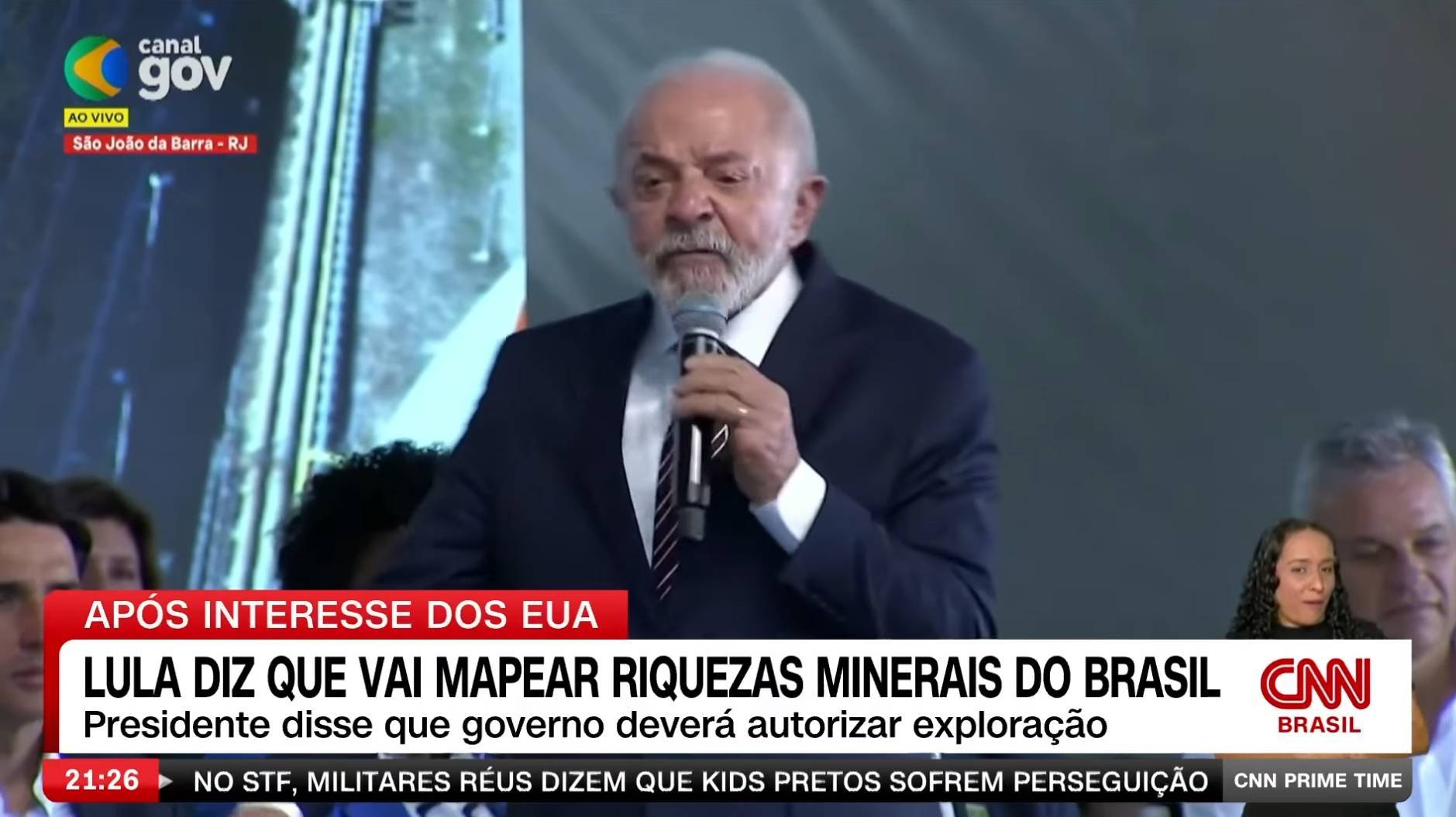
巴西总统卢拉:听说美国对关键矿产很感兴趣,那我们就自己留着吧
Sou Hu Cai Jing· 2025-07-29 10:50
Group 1 - The U.S. government, led by President Trump, has threatened to impose a 50% tariff on goods imported from Brazil starting August 1, which has caused significant discontent in Brazil [1][2] - Brazil's President Lula has publicly rejected any attempts by the U.S. to gain control over Brazil's mineral resources, emphasizing that these resources belong to the Brazilian people [3][4] - Brazil is preparing a national critical minerals policy, expected to be launched by November, which aims to regulate the exploration of natural resources within the country [3][6] Group 2 - Brazil's mining sector is currently engaged in discussions with U.S. officials regarding potential cooperation agreements and tariff issues, marking the third meeting on critical minerals this year [6][7] - Approximately 70% of Brazil's mineral exports go to China, highlighting the strategic importance of Brazil's mineral resources amid U.S. efforts to reduce reliance on China for rare earth elements [6][7] - The Brazilian government is taking steps to ensure that any exploration of its mineral resources is conducted under strict regulations, requiring government authorization for any mining activities [3][6] Group 3 - The Brazilian real has depreciated nearly 3% against the U.S. dollar following the tariff threat, and shares of Brazilian aircraft manufacturer Embraer fell by 9% in after-hours trading [9] - Embraer has indicated that the tariffs could lead to order cancellations and layoffs, potentially resulting in billions of dollars in losses for the company [10] - The U.S. is seen as a crucial market for Brazilian aircraft exports, with the tariffs significantly increasing the cost of each aircraft purchased by U.S. airlines by $9 million [9][10]


深企投产业研究院:我国战略性金属和关键矿产发展白皮书
Sou Hu Cai Jing· 2025-07-25 13:16
Core Insights - The development of strategic metals and critical minerals in China is increasingly influenced by global geopolitical competition, with major economies pushing for localization and "de-China" strategies in critical mineral supply chains [6][7][8] - The concentration of critical mineral reserves and production is significant, with the top three countries (CR3) holding over 80% of reserves for more than ten mineral types, such as rare earths (approximately 80%) and gallium (94%) [20][21] - China's critical minerals can be categorized into four types based on supply risk and global dominance: those with global supply advantages, those with low supply risks, those that are highly scarce but manageable, and those with high supply risks [33][34][38] Group 1: Global Competition and Supply Chain - The security of critical mineral supply chains has become a frontline in global geopolitical economic competition, with countries seeking to reduce strategic dependencies and enhance supply chain autonomy [6][7] - The rise of resource nationalism is reshaping the global strategic mineral landscape, as resource-rich countries leverage their bargaining power to renegotiate contracts and increase fees [7][8] - Despite intense geopolitical competition, market forces remain the dominant driver of global mineral investment and mergers, suggesting that collaboration and interdependence will continue to play a significant role [8] Group 2: China's Strategic Minerals - China's strategic minerals can be divided into four categories: those with global supply advantages (e.g., rare earths, graphite), those with low supply risks (e.g., molybdenum, lithium), those that are highly scarce but manageable (e.g., nickel, cobalt), and those with high supply risks (e.g., niobium, platinum group metals) [33][34][38] - The country has implemented export controls on key minerals such as gallium, germanium, and graphite to prevent technology loss and counter external pressures, although a complete export ban could disrupt supply chains [2][48] - China's dominance in the production and processing of critical minerals, particularly in the context of clean energy and electric vehicles, positions it strategically in the global market [14][38] Group 3: Market Dynamics and Future Outlook - The demand for critical minerals is expected to surge, with projections indicating that by 2040, the demand for lithium could increase by over 40 times, and demand for other key minerals like graphite and nickel could grow by 20-25 times [14][15] - The interconnectedness of global critical mineral supply chains means that any disruption could lead to significant economic consequences, potentially reversing decades of globalization [8][19] - China's strategic approach to critical minerals, including potential export controls, aims to safeguard its economic security while navigating the complexities of international competition [48][49]
韩国外交部:美国国务卿鲁比奥与韩国、日本外交官一致同意加强在能源、造船、供应链安全(包括关键矿产和人工智能)等领域的合作。
news flash· 2025-07-11 08:05
Group 1 - The core viewpoint of the article highlights the agreement between U.S. Secretary of State Rubio and diplomats from South Korea and Japan to enhance cooperation in various sectors, including energy, shipbuilding, and supply chain security [1] Group 2 - The collaboration will focus on critical minerals and artificial intelligence, indicating a strategic alignment among the three nations in addressing emerging technological and resource challenges [1]
从G7到北约,两场峰会一样的“面和心不和”
Qi Lu Wan Bao Wang· 2025-06-25 15:32
Group 1 - The NATO summit held in The Hague faced protests from over 20 countries, with demonstrators accusing NATO of being against peace and development [1] - The G7 summit preceding the NATO meeting did not produce a joint communiqué or a unified statement on Ukraine, highlighting internal divisions among Western nations [1][2] - The G7 summit's outcomes were limited, with significant disagreements on key issues, including trade negotiations and military actions regarding Iran [2] Group 2 - The NATO summit focused on military spending as a percentage of GDP, with a push for member countries to increase defense budgets to 5% by 2032, a significant rise from previous standards [4][5] - Some NATO members, like Spain, successfully negotiated to maintain their military spending at 2.1%, avoiding the proposed 5% increase [5] - The U.S. under Trump aimed to extend military spending demands to non-NATO allies like Japan and South Korea, but these countries found the 3.5% target unacceptable, leading to cancellations of planned meetings [5]
加拿大对乌克兰新增数十亿加元支援 将与印度恢复互派高级专员
Zhong Guo Xin Wen Wang· 2025-06-18 09:19
Group 1 - Canada announced over 4 billion CAD in support to Ukraine, including 2 billion CAD in military aid for drones, ammunition, and armored vehicles [1] - Canada will provide 2.3 billion CAD in loans through the G7 special income acceleration loan mechanism for Ukraine's infrastructure and public system reconstruction [1] - New sanctions against Russia include measures targeting 77 individuals and 39 entities, as well as 201 additional ships, bringing the total to over 300 vessels [1] Group 2 - Canada and India agreed to appoint new high commissioners to restore regular services between their citizens and businesses [2] - Discussions between Canada and India included cooperation in technology, digital transformation, food security, and critical minerals [2] - Diplomatic tensions between Canada and India have escalated due to allegations of Indian government involvement in a serious crime on Canadian soil [2]
七国集团领导人峰会落幕 以多份声明取代联合公报
Zhong Guo Xin Wen Wang· 2025-06-18 06:57
Group 1 - G7 leaders announced the initiation of a "Critical Minerals Action Plan" aimed at responsible production and diversification of supply for critical minerals, with a roadmap to be developed by the end of the year [1] - Canada is leading the initiative to establish a "Critical Minerals Production Alliance" to collaborate with trusted international partners to secure supply for advanced manufacturing and military defense [1] - G7 leaders agreed to establish a "G7 AI Network" to advance the "G7 Government AI Challenge" initiated by Canada, addressing barriers to AI adoption in the public sector [1] Group 2 - G7 leaders committed to enhancing global cooperation to prevent and combat wildfires, aiming to reduce their occurrence and negative impacts, while seeking synergy with G20 efforts [2] - G7 reaffirmed their commitment to the "G7 Preventing and Combating Human Smuggling Alliance" to strengthen border management and law enforcement against organized crime [2] - G7 leaders issued a statement urging a broader de-escalation of hostilities in the Middle East, including a ceasefire in Gaza [2]
韩国总统办公室:韩国总统李在明与澳大利亚总理阿尔巴尼斯同意加强国防、关键矿产和供应链领域的合作。
news flash· 2025-06-12 09:42
Group 1 - The core point of the article is the agreement between South Korean President Lee Jae-myung and Australian Prime Minister Albanese to enhance cooperation in defense, critical minerals, and supply chain sectors [1] Group 2 - The collaboration aims to strengthen national security and economic resilience through joint efforts in defense [1] - The focus on critical minerals indicates a strategic move to secure essential resources for technology and energy sectors [1] - Supply chain cooperation is expected to address vulnerabilities and enhance stability in trade relations between the two countries [1]
记者观察丨觊觎公海矿产多年 美国为何急于推动开采?
Sou Hu Cai Jing· 2025-06-08 03:03
Group 1 - The U.S. government has been pursuing deep-sea mining since the 1970s, aiming to expand its influence and control over international seabed resources [1][3] - The Trump administration intensified the focus on "critical minerals," implementing policies to protect the supply chain for key minerals essential for manufacturing and military industries [3][4] - The U.S. has significant deep-sea mineral resources, estimated at over 1 billion tons of polymetallic nodules, which contain essential materials for high-tech products [6][4] Group 2 - The current U.S. administration's push for deep-sea mining reflects a broader strategy to bypass international laws and regulations, aiming to secure critical resource control [9][7] - Environmental experts criticize the U.S. government's actions as reckless and irresponsible, highlighting the potential ecological damage and long recovery times for deep-sea ecosystems [10][12] - The unilateral approach to deep-sea mining raises concerns about the legality and sustainability of such operations, with potential challenges in international recognition and market access for extracted minerals [14][12]