大宗商品投资

Search documents
重磅通知 | 2025’中国棉花棉纱产业投资峰会报名开启
对冲研投· 2025-09-19 06:08
Core Viewpoint - The article emphasizes the upcoming "2025 China Cotton and Yarn Industry Investment Summit" in Urumqi, Xinjiang, highlighting the region's strategic importance in the cotton industry and its role in connecting local production to global markets [1]. Group 1: Event Overview - The summit will take place on October 31, 2025, in Urumqi, which is recognized as a national-level trading center for cotton and yarn [1]. - The event aims to discuss investment opportunities in the cotton industry, driven by smart agriculture and the Belt and Road Initiative [1]. Group 2: Agenda Highlights - The agenda includes a series of keynote speeches and roundtable discussions focusing on macroeconomic outlooks, market conditions, and the development of the cotton and textile industry in Xinjiang and beyond [3][4]. - Key topics will cover global and Chinese cotton supply and demand dynamics, the impact of macroeconomic policies, and innovations in cotton pricing models [6][7]. Group 3: Industry Challenges and Opportunities - The article mentions challenges such as the restructuring of the global cotton supply chain and the effects of U.S. tariff policies on the industry [4]. - It also highlights potential investment opportunities arising from the evolving landscape of the cotton market, including innovations in supply chain services and pricing strategies [6][7].


大宗商品LOF: 招商中证大宗商品股票指数证券投资基金(LOF)2025年中期报告
Zheng Quan Zhi Xing· 2025-08-27 11:53
Fund Overview - The fund is named "Zhaoshang Zhongzheng Commodity Stock Index Securities Investment Fund (LOF)" and is managed by Zhaoshang Fund Management Co., Ltd. [1] - The fund operates as a contract-based open-end fund and was established on June 28, 2012, with a total fund share of 83,584,797.77 at the end of the reporting period [1][2]. - The fund aims to passively track the performance of the underlying index, the Zhongzheng Commodity Stock Index, with a tracking error not exceeding 0.35% and an annual tracking error not exceeding 4% [1][2]. Financial Performance - The fund reported a profit of CNY 5,962,991.95 for the reporting period, with a net asset value of CNY 128,906,122.86 at the end of June 2025 [3][11]. - The net asset value per fund share was CNY 1.5422, and the cumulative net value growth rate was 79.48% since inception [3][11]. - The fund's net value growth rate for the reporting period was 4.58%, outperforming the benchmark growth rate of 2.31% [6][11]. Investment Strategy - The fund employs a passive index investment strategy, primarily investing in stocks that are part of the Zhongzheng Commodity Stock Index, with at least 90% of its stock assets allocated to these index components [1][16]. - The fund's performance benchmark is composed of 95% of the Zhongzheng Commodity Stock Index return and 5% of the after-tax interest rate of commercial bank demand deposits [1][16]. Management and Compliance - Zhaoshang Fund Management Co., Ltd. has established a comprehensive research and investment decision-making process to ensure fair investment opportunities across all portfolios [4]. - The fund management strictly adheres to relevant laws and regulations, ensuring compliance in all investment operations and protecting the interests of fund shareholders [5][10]. Market Environment - The market environment during the reporting period was characterized by active trading sentiment and ample liquidity, with structural opportunities emerging in various sectors [6][7]. - The fund's performance was influenced by fiscal and monetary policies aimed at stabilizing growth and addressing economic challenges, leading to a mixed performance across different industries [6][7].

价格崩盘,金融大佬巨亏57%
Zheng Quan Shi Bao· 2025-08-03 14:58
Core Insights - Pierre Andurand, a renowned oil trader, has faced significant losses in the cocoa market, with his flagship fund down 57% year-to-date as of June 30 [2][3][4] - Cocoa futures prices have dropped over 29% this year, with a notable decline of more than 3% on August 1, reaching $8,227 per ton [5][13] - Weak global demand, particularly in Europe where cocoa bean processing fell 7.2% year-on-year in Q2, is a primary factor for the price drop [4][13] Fund Performance - Andurand's fund, "Andurand Commodity Enhanced Fund," experienced a stark contrast in performance compared to 2024, when it achieved a 50% annual return due to successful cocoa price bets [4][5] - The fund suffered substantial losses in early 2025, with a drop of approximately 17% in January and nearly 25% in February [8] - Despite acknowledging the disappointing performance, Andurand remains optimistic about future cocoa prices, maintaining a bullish stance on the market [11] Market Dynamics - The decline in cocoa prices is attributed to concerns over demand, with significant reductions in processing volumes reported in both Europe and Asia [13][14] - The high cocoa prices from the previous year have started to suppress consumer demand, particularly in the chocolate market, amid ongoing global inflation pressures [13][14] - The global chocolate market is experiencing its most severe decline in a decade, with forecasts indicating a cocoa surplus in the upcoming years [14]

焦煤,城管真要来了
对冲研投· 2025-07-23 09:36
Core Viewpoint - The article discusses the recent volatility in the coal market, particularly focusing on coking coal, driven by supply-side policies and market dynamics, highlighting the potential for price increases and the risks associated with a lack of downstream demand support [3][12][33]. Policy Analysis - The National Energy Administration's investigation into coal overproduction has intensified market speculation, leading to a surge in coking coal prices [6][14]. - The central government's stance against industry "involution" and its push for reasonable price increases and optimized capacity have shifted market expectations, alleviating fears of deflation in bulk commodities [12][13]. - The Ministry of Industry and Information Technology's announcement of coordinated policies for stabilizing growth and reducing capacity in key sectors has further fueled price increase expectations [13]. Supply and Demand Dynamics - Most major coal-producing provinces are operating below their announced production capacities, with only Xinjiang slightly exceeding its planned capacity due to abundant resources [9][10]. - The recent surge in coking coal prices is not supported by a corresponding increase in downstream demand, particularly in the coking and steel sectors, indicating a structural disconnect in the market [18][23]. Market Behavior - The coking coal market is experiencing a feedback loop where rising prices are leading to increased speculative trading, while the stock market has not reflected the same bullish sentiment, indicating a potential disconnect between commodity and equity valuations [21][33]. - The article warns of the risks associated with speculative bubbles in the coking coal market, as the underlying fundamentals may not support sustained price increases [33][34]. Strategic Considerations - The government's plan to establish a coal reserve system aims to stabilize prices and prevent excessive volatility, with a target of 300 million tons of adjustable capacity by 2030 [24][25]. - The article emphasizes the importance of understanding the impact of new overproduction policies on supply dynamics, suggesting that the current market environment requires a cautious approach to investment in coal-related assets [35].

石油投资宜短不宜长?德银:过去150年年化回报仅为0.5%
Hua Er Jie Jian Wen· 2025-06-18 13:24
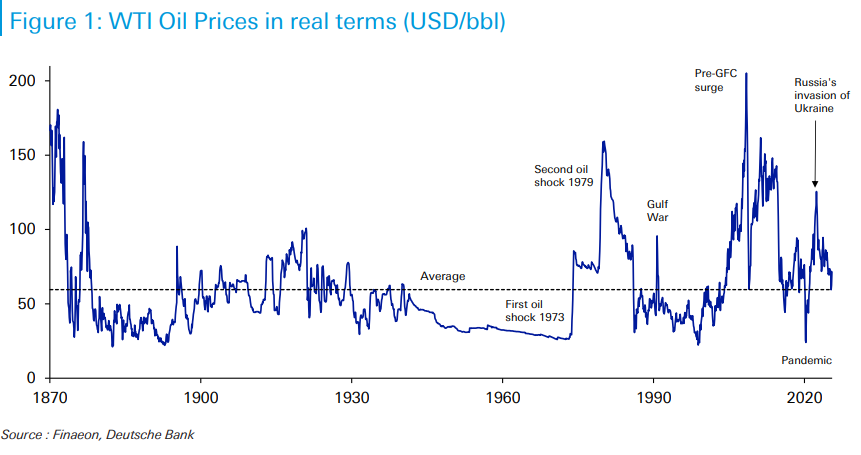
Group 1 - The core viewpoint of the analysis is that oil has provided a mere 0.5% annual real return over the past 150 years, significantly lagging behind U.S. stocks at 6.58% and U.S. 10-year Treasury bonds at 1.84% [1][4] - The main issue facing commodity investments, particularly oil, is the lack of cash flow returns, compounded by technological advancements that suppress price increases [3][4] - The analysis indicates that oil's long-term investment disadvantages stem from its inability to generate cash flow, unlike stocks and bonds, and that technological progress and substitution effects keep oil prices aligned with historical trends [4][5] Group 2 - Despite limited long-term investment value, oil prices can experience extreme short-term volatility, with significant fluctuations observed from 2008 to 2020, surpassing the stability seen from the late 1940s to 1973 [5] - Historical turning points, such as the 1973 oil crisis, have drastically altered pricing mechanisms, leading to substantial price increases and economic impacts on multiple countries [5] - The research suggests that for ordinary investors, the optimal strategy in the oil market is to capitalize on short-term volatility rather than holding for the long term, as current oil prices are near historical averages, limiting potential for significant increases [5]
假期分享 | 关于大宗商品投资的再思考
对冲研投· 2025-05-03 01:02
Group 1 - The article re-evaluates commodities as an asset class, highlighting their unique price returns and potential supply-demand changes as foundational to the global economy [1][2] - Commodities are characterized by their non-homogeneity and low correlation among different markets, with specific exceptions among commodities involved in the same production process [2][3] - Historical trends show that commodity prices have only moderately increased from 1970 to 2019, contradicting the belief that prices will inevitably rise over time due to limited natural resources [3][4] Group 2 - Commodities have three components of returns: spot price changes, roll yield, and collateral yield, with spot prices reflecting current supply-demand conditions [5][6] - The role of commodities in portfolios includes inflation protection and diversification, with historical evidence supporting their effectiveness against unexpected inflation [8][10] - The correlation between inflation rates and commodity returns is positive, indicating that higher inflation leads to higher average returns for commodities [11][13] Group 3 - Diversification benefits from commodities arise from their low correlation with traditional asset classes, potentially reducing overall portfolio volatility [15][17] - The performance of commodity-inclusive portfolios has varied over time, with lower volatility not necessarily compensating for lower returns compared to traditional portfolios [18][19] - The internal correlation among commodities increased during the 2008 financial crisis but has since returned to historical lows, suggesting potential for diversification benefits [19][20] Group 4 - The article discusses alternative methods for constructing commodity beta, emphasizing the need for diversified approaches to capture low correlations among commodities [23][24] - Commodities can serve as a foundation for expressing specific investment themes, allowing investors to capitalize on unique geopolitical or economic factors [28][30] - Tactical trading strategies using commodities can be based on fundamental changes in supply-demand dynamics, making them suitable for short-term investment objectives [30][31] Group 5 - The concept of risk premium in commodities suggests that investors can achieve repeatable returns by selling insurance to other market participants [32][34] - The article encourages a re-examination of commodity allocations in diversified portfolios, advocating for tactical approaches and factor-based investment strategies [34][35]

超20次!风险提示来了
Zhong Guo Ji Jin Bao· 2025-04-17 07:04
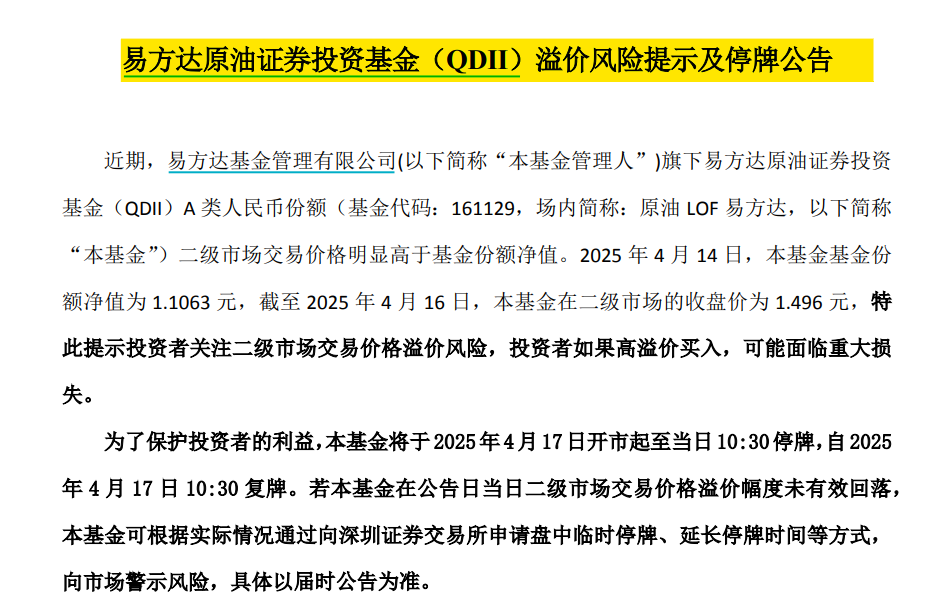
Core Viewpoint - Multiple commodity-themed LOFs have issued risk premium alerts, indicating significant premium risks in secondary market trading prices, with over 20 alerts issued in April alone [1][6]. Group 1: Risk Alerts and Market Reactions - On April 17, E Fund issued a premium risk alert for its gold-themed LOF, noting a premium rate exceeding 40% based on a net asset value of 1.293 CNY and a market price of 1.823 CNY [2]. - E Fund's crude oil LOF also reported a premium rate over 35%, with a net asset value of 1.1063 CNY and a market price of 1.496 CNY [2]. - Following the resumption of trading on April 17, both E Fund's gold and crude oil LOFs saw significant increases, rising over 6% and 7% respectively [6]. Group 2: Market Dynamics and Investor Guidance - Industry experts highlight that the rising demand for commodities like gold and crude oil is driven by inflationary pressures, which has led to increased prices and demand for related LOFs [8]. - A fund manager noted that the trading prices of LOFs are heavily influenced by supply and demand dynamics, warning that high premiums could lead to price corrections if not addressed promptly [8]. - Investors are advised to adhere to suitability guidelines and avoid unfamiliar products to mitigate potential losses from high premium purchases [5][8]. Group 3: Economic Factors and Future Outlook - The current economic landscape presents conflicting factors for commodities, including potential global economic recession due to U.S. tariff policies, which could reduce demand [8]. - However, trade protectionism and increased tariffs may exacerbate inflation risks, potentially elevating long-term commodity price levels [8]. - Experts suggest that while recent adjustments in commodity prices reflect pessimistic economic expectations, they may not fully account for future inflation risks, indicating potential investment opportunities beyond gold [9].