
车联网

Search documents
万马科技(300698.SZ):公司暂未布局金融相关领域
Ge Long Hui· 2025-11-27 06:37
Core Viewpoint - Wanma Technology (300698.SZ) is focused on the research, production, and sales of communication and industrial control products, with recent expansion into the vehicle networking sector [1] Group 1: Company Focus - The company is dedicated to the development of communication and industrial control products [1] - Wanma Technology has recently entered the vehicle networking field, offering vehicle networking connection platforms and services [1] - Currently, the company has not ventured into the financial sector [1]

智能汽车ETF(159889)盘中涨超1.4%,行业增长动能与技术迭代受关注
Mei Ri Jing Ji Xin Wen· 2025-11-27 05:37
Core Insights - The intelligent automotive industry in China has entered the AI Driving 2.0 phase, with accelerated technological iteration [1] - The VLA (Vision-Language-Action) technology architecture, represented by companies like Li Auto and Yuanrong Qihang, breaks the limitations of traditional end-to-end models by integrating three modalities to enhance system interactivity and long-term reasoning capabilities [1] - The industry is transitioning from rule-driven to data-driven approaches, although there are still concerns regarding technological pathways, investment returns, and policy implementation risks [1] Industry Developments - Huawei's ADS 4.0 adopts the WEWA architecture, emphasizing cloud simulation and vehicle model collaboration to create a direct cognitive model of the physical world, enabling rapid response and high safety redundancy [1] - Horizon Robotics and Momenta focus on one-stage end-to-end systems combined with reinforcement learning to enhance the human-like experience of intelligent driving systems [1] Investment Opportunities - The Intelligent Automotive ETF (159889) tracks the CS Intelligent Automotive Index (930721), which selects representative listed companies in the intelligent driving and vehicle networking sectors from the A-share market [1] - The index aims to reflect the overall performance of securities related to intelligent automotive companies, showcasing the industry's diversity and broad characteristics [1]
启明信息:公司持续关注并积极布局车联网相关业务
Zheng Quan Ri Bao· 2025-11-25 11:13
Core Viewpoint - The company, Qiming Information, is actively focusing on and expanding its business in the connected vehicle sector while exploring both internal and external markets [2] Group 1 - Qiming Information announced on November 25 that it is continuously monitoring and strategically positioning itself in the connected vehicle business [2] - The company is making efforts to expand its market presence both domestically and internationally [2]


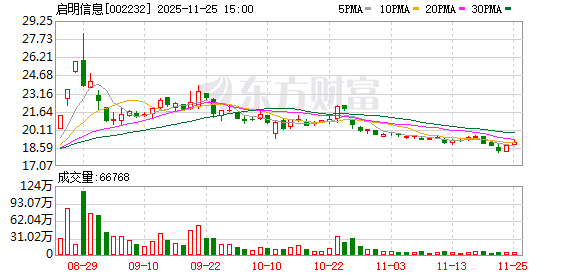
启明信息(002232) - 002232启明信息投资者关系管理信息20251125
2025-11-25 01:04
Group 1: Financial Performance - The company's single-quarter revenue reached 15.917 billion yuan, a significant increase of 77.91% compared to the adjusted data from the previous year [4] - Net profit attributable to shareholders was approximately 352 million yuan, a substantial increase of 525.14% year-on-year, while the net profit after deducting non-recurring gains and losses was about 227 million yuan, reflecting a growth of 204.05% [4] - Despite the growth in revenue and profit from the parent company, the company's overall revenue and profit have declined [4] Group 2: Market and Business Strategy - The company is focusing on transforming its core business towards the Internet of Vehicles (IoV) platform and is planning joint ventures and collaborations to enhance market share [1] - The company has signed a strategic cooperation agreement with Huawei, aiming to leverage partnerships for business growth [2] - The company is actively expanding its presence in the IoV sector and is monitoring external market share changes [1] Group 3: Operational Challenges - There has been a significant increase in inventory, indicating a rise in undelivered projects, raising concerns about delivery timelines and procurement practices [3] - The company has faced challenges in timely deliveries, leading to increased inventory and procurement, which has affected financial performance [3] - The company is experiencing a lack of major institutional investors, with no recent institutional research activities reported [2] Group 4: Research and Development - The company is investing in AI and data applications to enhance service efficiency and quality, focusing on building a robust AI technology platform [5] - R&D expenses are primarily attributed to personnel costs and related expenses, with ongoing projects aimed at increasing core competitiveness [6] Group 5: Investor Relations and Communication - The company emphasizes the importance of investor awareness regarding risks and encourages stakeholders to follow official announcements for updates [1][2][4] - The company is committed to improving communication with institutional investors and enhancing market management strategies [4]
国际复材:公司持续推进在5G、服务器等新兴领域的客户认证和市场推广工作
Zheng Quan Ri Bao Zhi Sheng· 2025-11-24 09:40
Core Viewpoint - The company is actively advancing customer certification and market promotion in emerging fields such as 5G and servers, leveraging its low dielectric glass fiber (LDK) products with excellent dielectric performance for various cutting-edge applications [1] Group 1: Product Development - The company's LDK products have a dielectric loss as low as 0.0002-0.0004, making them suitable for applications in 5G-A base station construction, AI servers, vehicle networking, and satellite communication [1] - The company has overcome key technical challenges, including achieving "zero bubbles," and has mastered both crucible and pool kiln production methods, allowing for flexible and independent production of low dielectric electronic yarns [1] Group 2: Strategic Focus - The company is committed to a high-end, differentiated product strategy, increasing R&D investment, and enhancing cross-departmental collaboration to ensure efficient integration from R&D to production and market application of high-end products like LDK [1] - Looking ahead, the company plans to continuously optimize the capacity configuration of LDK products, improve production stability and product yield, and ensure a stable supply of low dielectric yarns and fabrics to strengthen and expand its market advantage in emerging fields [1]
慧翰股份(301600) - 2025年11月19日-20日投资者关系活动记录表
2025-11-21 09:36
Group 1: eCall Certification and Implementation - The company began tracking eCall legislation since the EU's preliminary research in 2012 and obtained the first EU eCall certification in 2019, followed by certifications from multiple countries including the UK, Israel, and Turkey [2] - As of January 6, 2025, the company became the first in China to receive the next-generation NG-eCall certification from the EU [2] - The company's eCall system has passed the national standard AECS test, making it the first globally to achieve this certification [2][4] Group 2: eCall System Functionality - The eCall system consists of an in-vehicle terminal, mobile network, and PSAP call center, enhancing emergency response times and reducing accident fatalities [3] - It can be triggered automatically by vehicle sensors or manually via an in-car button, transmitting critical data such as location and vehicle information to emergency services [3] Group 3: Competitive Advantages - The company emphasizes the need for strong capabilities in R&D, production management, quality control, and supply chain management to maintain competitiveness [4] - A focus on technological innovation and product optimization is central to the company's strategy for sustaining market leadership [4][5] Group 4: Cost Management - The company maintains a low expense ratio through strict supply chain management and a commitment to technological innovation [5][6] - The platform and modular design approach allows for flexible product configurations, reducing development costs and enhancing market competitiveness [6] Group 5: TBOX Functionality - The TBOX serves as a core controller for in-vehicle information interaction, enabling communication with various vehicle systems and providing connectivity for smart services [7] - It supports multiple communication protocols and high-precision positioning services, essential for smart connected vehicles [7] Group 6: Future Development Plans - The company aims to accelerate the application of its TBOX in 5G-V2X networks, enhancing product value and expanding use cases [8] - Plans include leveraging its eCall expertise to support domestic and international vehicle manufacturers in meeting safety standards [8] - The company is also focusing on digital energy management solutions and expanding into unmanned logistics vehicles [8] - Continuous improvement in governance and compliance is targeted to meet international standards and support global expansion [8]
金溢科技:公司掌握ETC、V2X、RFID三大核心技术
Zheng Quan Ri Bao Wang· 2025-11-21 09:14
Core Insights - The company, Jin Yi Technology, is deeply engaged in the smart transportation sector, mastering three core technologies: ETC, V2X, and RFID [1] - The company has taken a leading role in formulating national and industry standards, including the "Technical Specifications for Road Electronic Non-stop Charging and Vehicle-Road Collaboration Expansion Services" [1] - The company collaborates closely with top institutions such as the Ministry of Transport's Highway Science Research Institute and Tsinghua University, undertaking over ten national-level research projects [1] Technology and Innovation - As of mid-2025, the company has accumulated 655 independent intellectual property rights, with several patents awarded the national "Excellent Patent Award," indicating a solid technological foundation [1] - The company has established a comprehensive innovation system from technology research and development to product development and standard formulation, leveraging provincial-level research platforms like the "Shenzhen Smart Transportation Vehicle Networking Engineering Center" [1] Business Development - By transforming core technologies and standard achievements into high-performance products and solutions, the company continuously expands its business boundaries and enhances customer loyalty [1] - The ongoing product iteration and market penetration efforts are aimed at converting technological advantages into sustained revenue growth, providing momentum for the company's long-term development [1]
慧翰股份股价连续5天下跌累计跌幅12.26%,广发基金旗下1只基金持900股,浮亏损失1.57万元
Xin Lang Cai Jing· 2025-11-20 07:33
Group 1 - The core point of the news is that Huihan Microelectronics Co., Ltd. has experienced a significant decline in its stock price, dropping 12.26% over the past five days, with a current price of 125.03 CNY per share and a market capitalization of 13.069 billion CNY [1] - Huihan's main business involves the research, development, production, and sales of vehicle networking smart terminals and IoT smart modules, with revenue composition being 74.71% from vehicle networking smart terminals, 18.17% from IoT smart modules, 7.00% from software and services, and 0.12% from other sources [1] - The company was established on July 11, 2008, and went public on September 11, 2024, located in Fuzhou, Fujian Province [1] Group 2 - From the perspective of fund holdings, one fund under GF Fund has a significant position in Huihan shares, with the GF Consumer Discretionary Link A fund holding 900 shares, representing 0.04% of the fund's net value [2] - The GF Consumer Discretionary Link A fund has experienced a floating loss of approximately 1,719 CNY today and a total floating loss of 15,700 CNY during the five-day decline [2] - The fund was established on April 15, 2015, with a current scale of 169 million CNY, and has recorded a year-to-date return of 6.2% and a one-year return of 8.87% [2]
慧翰股份(301600) - 2025年11月18日投资者关系活动记录表
2025-11-19 16:12
Company Overview - The company focuses on ICT core technologies, initially specializing in Bluetooth, WiFi, and GPS for automotive communication modules, establishing a strong position in a niche market despite limited market size [2] - In 2012, the company entered the automotive communication sector, launching the first generation of connected vehicle terminal products, TBOX 1.0, and became a primary supplier for SAIC Group [2][3] - The company has developed a diverse business matrix centered around TBOX, eCall systems, digital energy management solutions, and IoT smart modules [4] Product Development and Market Position - The company has achieved significant milestones in eCall technology, obtaining the first domestic EU eCall certification in 2019 and the next-generation NG eCall certification in January 2025, making it one of the first globally to achieve these certifications [3] - The TBOX market is expected to grow due to increasing consumer demand for smart driving and connectivity features, with the introduction of 5G-V2X technology enhancing the value per vehicle [5] - The company has established long-term partnerships with leading domestic and international automotive manufacturers, including SAIC, BYD, and Toyota, and is expanding its global footprint [4][5] Market Penetration and Future Growth - The penetration rate of TBOX products is anticipated to rise as automotive manufacturers increase investments in smart connectivity [5] - The eCall product's technical barriers include reliability and compliance with stringent safety standards, which the company has successfully navigated to gain a competitive edge [6] - The implementation of national standards (AECS) is expected to drive eCall system adoption to 100% in the domestic market [6] International Strategy and Revenue - The company is transitioning from "on-vehicle export" to "export on-vehicle" to enhance its international strategy, aiming to increase overseas revenue [7] - Current overseas revenue is low due to eCall products being classified as domestic income when installed in vehicles exported by domestic manufacturers [7] - The company has received the German VDA6.3 certification, enhancing its capabilities in quality management and compliance, which supports future international collaborations [7]
车卫士集团启动港股IPO计划 为国内知名的车联网服务平台
Zhi Tong Cai Jing· 2025-11-18 09:24
据车卫士集团微信公众号11月18日消息,近日,车卫士集团C轮融资启动仪式暨国泰海通证券与车卫士 集团签约仪式在东莞圆满举行。此次活动标志着车卫士集团的发展迈入了资本与产业深度融合的全新阶 段,同时也启动港股IPO计划。 公开资料显示,车卫士集团成立于2014年,总部位于广东东莞松山湖,是国内知名的车联网服务平台。 公司深耕车主服务生态,打造了国内领军的汽车车联网大数据服务平台,推出了多样化的车联网智能硬 件与各类汽车安全与用车福利及服务,并承接国家电子车牌、银联无感支付的商业化落地运营。目前集 团下辖7家子公司,于东莞、厦门、上海形成合力,业务辐射全国。 车卫士集团表示,本次活动的成功举办,不仅为车卫士集团的C轮融资奠定了坚实基础,也通过与国际 顶级券商的战略携手,为公司未来的上市之路构建了高起点的平台。 ...