AI原生

Search documents
华泰证券维持有道(DAO.US)“买入”评级 目标价12.46美元
智通财经网· 2025-11-21 13:46
Core Insights - NetEase Youdao (DAO.US) reported its Q3 2025 financial results, achieving profitability for five consecutive quarters, with operating profit increasing nearly 150% year-on-year in the first three quarters [1] - Huatai Securities maintained a "Buy" rating for Youdao, setting a target price of $12.46, highlighting accelerated growth in advertising and strong performance in AI subscription services [1] Financial Performance - In Q3 2025, Youdao's net revenue reached 1.63 billion yuan, a year-on-year increase of 3.6%, with operating profit at 28.3 million yuan [1] - Online marketing service revenue grew by 51.1% year-on-year to 740 million yuan, becoming the largest revenue source for the first time in a single quarter [1] - AI subscription service sales approached 100 million yuan, marking a historical high with over 40% year-on-year growth, serving as a key driver for the learning services segment [1] Business Strategy - Youdao's "AI-native" strategy has led to high-quality growth across multiple business lines, with learning services sales increasing by over 40% year-on-year [1] - The smart hardware segment continues to optimize, with the launch of the new AI Q&A pen, Space X, in August, enhancing competitiveness in real-time Q&A [1] Advertising Growth - The rapid growth in advertising revenue is attributed to Youdao's ongoing investment in AI technology, which includes three major AI engines: iMagicBox for creative generation, KOL platform, and Xiao Zhi AI optimizer, improving advertising efficiency and effectiveness [2] - During the reporting period, advertising revenue from the gaming industry grew by over 50%, while revenue from overseas markets increased by more than 100% [2] Future Outlook - Youdao's CEO, Zhou Feng, stated that the company will continue to deepen its "AI-native" strategy, promoting the in-depth application of the "Ziyue" large model in learning and advertising scenarios, aiming to build a more competitive digital learning and intelligent marketing platform [2]


有道目标价12.46美元,华泰证券重申“买入”,AI原生战略驱动高质量增长
Zhong Jin Zai Xian· 2025-11-21 11:56
Core Insights - NetEase Youdao (NYSE: DAO) reported its Q3 2025 financial results, achieving profitability for five consecutive quarters, with a nearly 150% year-on-year increase in operating profit for the first three quarters [1] - Huatai Securities maintained a "Buy" rating for Youdao, setting a target price of $12.46, highlighting accelerated growth in advertising and strong performance in AI subscription services [1] Financial Performance - In Q3 2025, Youdao's net revenue reached 1.63 billion yuan, a year-on-year increase of 3.6%, with operating profit of 28.3 million yuan [1] - Online marketing service revenue grew by 51.1% year-on-year to 740 million yuan, becoming the largest revenue source for the first time in a single quarter [1] - AI subscription service sales approached 100 million yuan, marking a historical high with over 40% year-on-year growth, serving as a key driver for the growth of the learning services segment [1] Business Strategy - Youdao's "AI-native" strategy has led to high-quality growth across multiple business segments, with learning services sales increasing by over 40% year-on-year [1] - The smart hardware business continues to optimize, with the launch of the new AI Q&A pen, Space X, in August, enhancing competitiveness in real-time Q&A [1] Advertising Growth - The rapid growth in advertising revenue is attributed to Youdao's ongoing investment in AI technology, which includes three major AI engines: iMagicBox for creative generation, KOL platform, and Xiao Zhi AI optimizer, significantly improving advertising efficiency and effectiveness [2] - During the reporting period, advertising revenue from the gaming industry increased by over 50%, while revenue from overseas markets more than doubled [2] Future Outlook - Youdao's CEO, Zhou Feng, stated that the company will continue to deepen its "AI-native" strategy, promoting the in-depth application of the "Ziyue" large model in learning and advertising scenarios, aiming to build a more competitive digital learning and intelligent marketing platform [2]
智能范式跃迁,OceanBase打造AI原生混搜数据库
2 1 Shi Ji Jing Ji Bao Dao· 2025-11-20 11:58
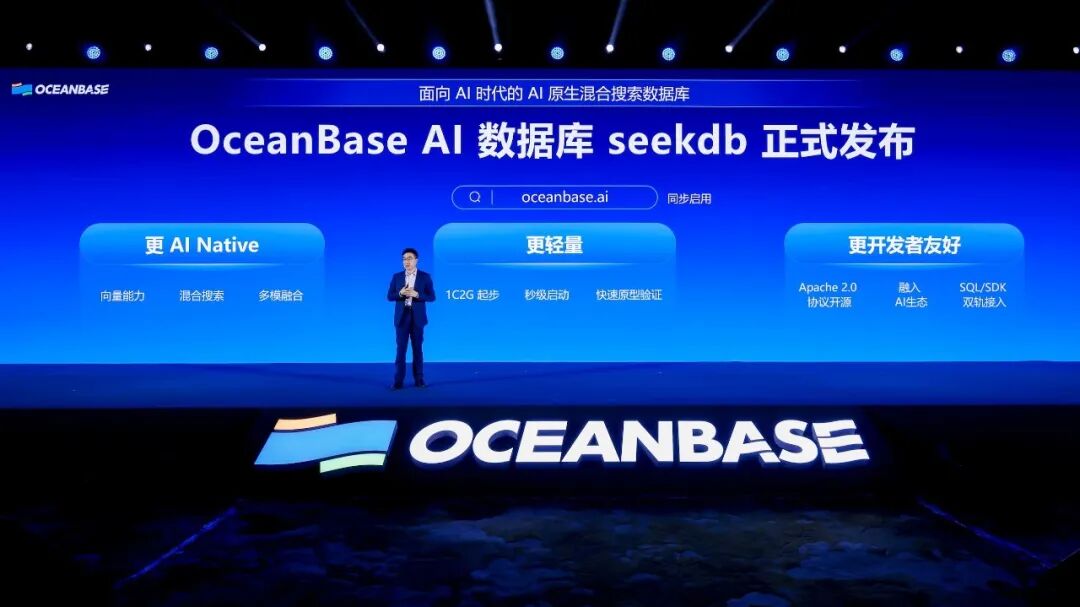
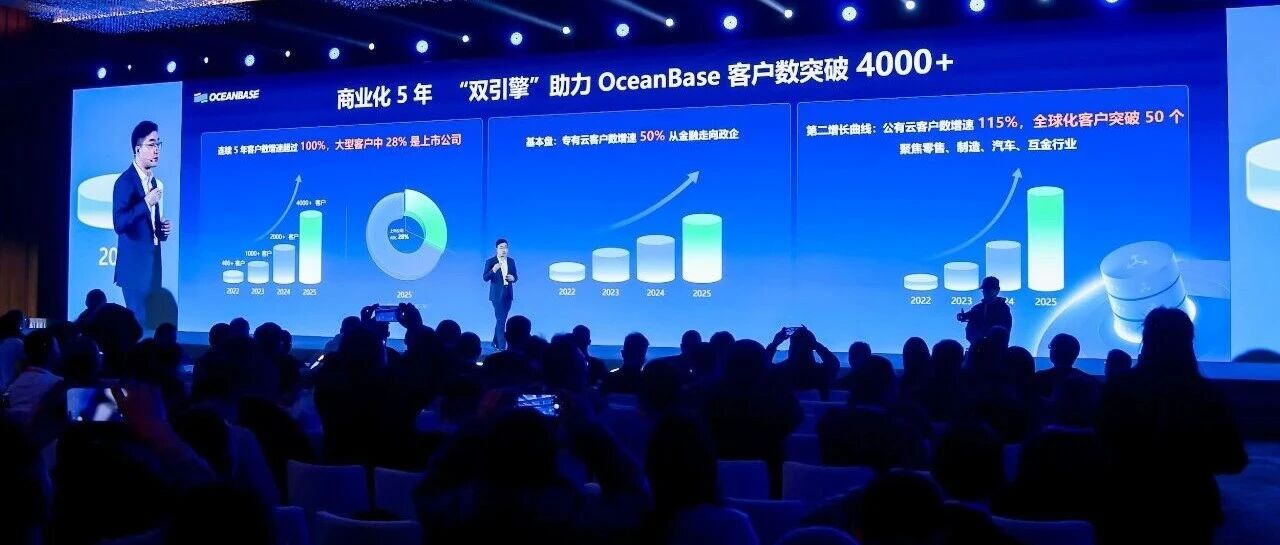
Core Insights - The article emphasizes the need for integrated data systems in the AI era, highlighting that fragmented data can lead to inefficiencies and a lack of understanding in AI models, akin to "brain damage" in humans [1][3] - OceanBase has launched its first AI-native hybrid search database, seekdb, which aims to provide a unified platform for managing diverse data types and workloads, thus addressing the challenges posed by fragmented data systems [1][6] Group 1: OceanBase's Strategic Response - OceanBase's strategy focuses on achieving "AI-native integration" by enhancing its core capabilities to support AI workloads while maintaining high reliability and consistency [1][6] - The seekdb database is designed to be lightweight and easy to deploy, requiring minimal resources (1 CPU core and 2GB RAM) and allowing developers to quickly build AI applications with just three lines of code [1][8][9] - The database supports a variety of data types, including vector, scalar, text, JSON, and GIS, enabling seamless mixed retrieval and analysis [8][9] Group 2: Market Context and Challenges - The article notes that 95% of enterprises have not seen measurable returns from their investments in generative AI, primarily due to fragmented data and complex system architectures [3][4] - Traditional database systems struggle to meet the demands of AI applications, necessitating a shift towards integrated and responsive data infrastructures [4][6] - Major database vendors are increasingly focusing on integrating various data capabilities to create "universal" databases suitable for the AI era [4][6] Group 3: OceanBase's Growth and Market Position - Since its commercialization in 2020, OceanBase has seen significant growth, with over 4,000 global customers and an average annual growth rate exceeding 100% [11][14] - The company has established a strong presence across multiple sectors, including finance, government, and retail, and has expanded its cloud services to major platforms like Alibaba Cloud, AWS, and Azure [11][14][18] - OceanBase's collaborative ecosystem has contributed to its growth, with over 350 ISVs and a significant increase in revenue from partnerships [18][20]

智能范式跃迁,OceanBase打造AI原生混搜数据库
21世纪经济报道· 2025-11-20 11:56
Core Viewpoint - The article emphasizes the necessity for integrated data systems in the AI era, highlighting that fragmented data can hinder AI performance and lead to inefficiencies. The focus is on creating an "AI-native integrated" database that supports real-time analysis and intelligent applications [1][6][10]. Group 1: AI Native Database Development - OceanBase launched its first AI-native hybrid search database, "seekdb," which allows developers to build knowledge bases and AI applications with just three lines of code, enabling efficient handling of multi-modal data retrieval at a scale of billions [2][4]. - The CEO of OceanBase stated that "seekdb" is not merely an addition of traditional database functions but a restructured database specifically designed for the AI era, aiming to be a real-time entry layer for large models and private data integration [4][10]. Group 2: Challenges in AI Implementation - A recent MIT study revealed that 95% of enterprises did not see measurable returns after implementing generative AI, primarily due to fragmented multi-modal data and complex system linkages, which hindered the models' ability to understand business contexts [7]. - Traditional fragmented systems are inadequate for AI demands, as they complicate cross-system queries and real-time responses, necessitating a shift towards integrated data management systems [7][8]. Group 3: OceanBase's Strategic Response - OceanBase's strategy involves a deep integration of four core capabilities: unified multi-modal data management, multi-workload support, native AI function capabilities, and hybrid multi-cloud deployment, all aimed at creating a modern data architecture that supports AI [10][11]. - The company aims to ensure that its database can handle various data types and workloads simultaneously, providing a seamless experience for developers and businesses [11][12]. Group 4: Market Performance and Growth - Since its commercialization in 2020, OceanBase has reported over 4,000 global customers, with an average annual growth rate exceeding 100% for five consecutive years, indicating strong market demand [15][18]. - The company has expanded its cloud services across major platforms like Alibaba Cloud, AWS, and Azure, supporting a "one architecture, global operation" model for Chinese enterprises [16][21]. Group 5: Ecosystem and Collaboration - OceanBase emphasizes the importance of ecosystem growth, with over 70% of its revenue coming from partners and an annual growth rate of 80% in the private cloud sector [21][22]. - The company collaborates with over 350 ISVs to create standardized solutions across various industries, enhancing its market presence and operational efficiency [22][23].
网易Q3财报:营收284亿元,净利润95亿元
Xin Lang Ke Ji· 2025-11-20 08:38
Core Insights - NetEase reported Q3 2025 net revenue of 28.4 billion yuan and a non-GAAP net profit attributable to shareholders of 9.5 billion yuan [1] - R&D investment reached 4.5 billion yuan, with an R&D intensity of 16% [1] - The gaming and related value-added services generated net revenue of 23.3 billion yuan in Q3 [1] Segment Summaries - NetEase Youdao achieved Q3 net revenue of 1.6 billion yuan, with operating profit for the first three quarters of 2025 increasing nearly 150% year-on-year due to the deepening of the "AI-native" strategy and focus on business structure [1] - Online marketing services net revenue and AI subscription service sales both reached record highs [1] - NetEase Cloud Music reported Q3 net revenue of 2 billion yuan, while the innovation and other businesses generated net revenue of 1.4 billion yuan [1]

Z Potentials|顾嘉唯,从百度技术少帅到两次创业,AI硬件的黄金时机不是技术顶峰,而是商业静默期
Z Potentials· 2025-11-17 14:38
Core Insights - The article discusses the evolution of AI hardware, emphasizing the importance of a "gentle penetration" approach rather than radical replacement in the market [2][5] - The founder of Ling Universe, Gu Jiawei, shares his unique entrepreneurial philosophy shaped by his experiences in both academia and the tech industry [2][4] Personal Journey - Vision and Refinement - Gu Jiawei's career has consistently focused on the next generation of human-computer interaction, with varying responsibilities and mindsets at different stages [4][5] - The transition from a scientist to an entrepreneur involves facing real-world challenges and balancing idealism with practical business needs [8][9] Industry and Product - Essence and Future of AI Hardware - Ling Universe is developing a product called "Xiaofangji," which serves as the first AI terminal for the "Gen Alpha" generation, aiming to create a new operating system called LingOS [15][18] - The product is designed to be a container for AI capabilities, moving away from traditional smartphone functionalities [15][20] Barriers and Moats - Standing Out in a Crowded Market - The primary distinction of Xiaofangji compared to other AI hardware is its focus on being a multi-functional AI terminal rather than a simple interactive toy [19][20] - The company leverages existing user data from previous products to enhance its AI capabilities and create a competitive edge [20][21] Timing and Market Readiness - Timing is crucial in technology commercialization, with the need to identify the right moment when technology is mature and user demand is activated [13][14] - Gu Jiawei emphasizes the importance of breaking down large goals into smaller, manageable steps to ensure gradual progress in product development [14][24]

在全球最大的科技峰会现场,他们用DeepSeek养出迷你“独角兽”
虎嗅APP· 2025-11-15 09:17
Core Insights - The article discusses the emergence of new AI startups at the Web Summit, highlighting the potential for innovation in various countries beyond traditional tech hubs like Silicon Valley and Beijing [2][3][7]. Group 1: AI Startup Landscape - The Web Summit has become a platform for showcasing AI startups from diverse regions, including Brazil, Turkey, and Poland, which are skipping traditional SaaS models to enter the AI-native era [5][8]. - Many startups are focusing on niche problems within their local markets, demonstrating a trend where AI applications are tailored to specific user needs [5][9]. - The rise of AI is evident in sectors like sales and programming, with AI agents becoming increasingly specialized and integrated into business processes [5][28]. Group 2: Global AI Adoption - Smaller countries are leveraging AI to revitalize their economies, with examples like Lovable in Sweden achieving rapid growth and user adoption [7][8]. - The article notes that many startups are self-funded and not as reliant on external financing, indicating a different approach to growth compared to their counterparts in the US and China [5][9]. - AI is reshaping organizational structures, with many startups operating with minimal full-time staff and relying on freelance talent [17][19]. Group 3: Innovative Applications - Several startups are developing unique AI applications, such as Hablla in Brazil, which utilizes WhatsApp for personalized marketing, and Lyway in South Korea, focusing on AI-driven language testing [14][15]. - The article highlights the importance of product understanding and user engagement in the AI space, as seen with companies like Headway, which has successfully gamified learning experiences [24][25]. - AI applications are increasingly being designed to address specific industry needs, such as manufacturing and sales, showcasing the versatility of AI technology [28].

百度拿到了赛点
远川研究所· 2025-11-13 13:29
Core Insights - The article discusses the ongoing AI arms race among tech giants, emphasizing the shift from using AI as a tool to integrating it as a core component of business operations and product development [2] - The concept of "AI native" is introduced, which refers to designing systems from the ground up with AI capabilities, rather than merely adding AI tools to existing processes [5][6] - Baidu's advancements in AI, particularly in autonomous driving and AI agents, are highlighted as examples of successful AI native applications [12][14] Group 1: AI Integration and Ecosystem - The real competition lies in building ecosystems that allow AI to emerge as a value creator within products and organizations, rather than just a supplementary tool [2] - Baidu's approach to internalizing AI capabilities is described as transforming AI from a cost into a productivity driver, enhancing decision-making and innovation cycles [2][5] - The integration of AI into daily operations is becoming a priority for more companies, indicating a clear shift towards AI being a fundamental aspect of business processes [2] Group 2: Market Potential and Risks - Morgan Stanley's report predicts that AI could save U.S. companies $920 billion annually and create up to $16 trillion in market value for S&P 500 companies, highlighting the immense potential of AI [5] - However, the report warns that not all companies will benefit equally, as the successful application of AI requires a comprehensive integration strategy that may take decades to achieve [5] - The lack of sufficient internalization of AI within some companies poses significant risks, limiting their ability to realize proportional returns on AI investments [5] Group 3: Baidu's AI Developments - Baidu's "LuoBo KuaPao" autonomous driving service has achieved over 1.4 billion kilometers of fully autonomous driving, with a safety record that outperforms competitors like Waymo [12][18] - The introduction of AI agents, such as "FaMou," represents a significant advancement in AI applications, enabling proactive problem-solving and continuous learning [14][16] - Baidu's comprehensive AI strategy includes the development of its Kunlun chips, which are essential for supporting its AI capabilities and have seen significant deployment across various industries [21][23][26] Group 4: Future Outlook - Baidu is positioned as a leader in the AI era, with a strong focus on creating AI native applications that drive value and efficiency [21][28] - The company is set to release new generations of its Kunlun chips and AI models, reinforcing its commitment to maintaining a competitive edge in the AI landscape [26] - The article concludes that the transformation towards AI native systems is a gradual process that requires a complete overhaul of existing structures, but the potential rewards are substantial [27][28]


IDC发布2026年中国智能终端市场十大洞察,谁将成为最大赢家?
Ge Long Hui· 2025-11-12 11:14
Core Insights - The article emphasizes that the Chinese smart terminal market is entering an AI-native era, where AI will reshape core values and interaction methods, driving deep innovation across ecosystems, scenarios, and categories, becoming a key engine for economic transformation and industrial upgrading [1][3]. Industry Trends - IDC predicts that by 2026, the shipment volume of smart terminals in China will exceed 900 million units, with traditional AI terminal penetration expected to surpass 93% by 2027, reflecting a 4% year-on-year growth [3]. - The transition from demographic dividends to "AI dividends" positions smart terminals as crucial carriers of new productive forces [3]. - The integration of AI with cutting-edge technologies like embodied intelligence, quantum technology, and 6G will drive the emergence of new economic models and innovations [3]. Company Performance - Lenovo has established a strong foothold in the AI terminal market, leading the global PC market with a shipment of 19.4 million units in Q3 2025, capturing a market share of 25.5% [4]. - Lenovo's AI PC business continues to lead globally, supported by its unique AI-native technology system and strong competitiveness in both consumer and commercial sectors [4]. Product Innovations - Lenovo's enterprise-level super intelligent agent, launched in May 2025, has generated revenue of 1.89 billion yuan, supporting over 1 million interactions daily and significantly improving user engagement and order conversion rates [5]. - The company is also focusing on emotional interaction, with over 40% of users expecting smart terminals to provide emotional support, shifting from function-oriented to understanding-oriented interactions [7]. Global and Local Strategies - Lenovo's global strategy includes a distributed manufacturing network across 11 countries, enhancing local delivery and reducing trade barriers, which has led to significant revenue growth in overseas markets [9]. - The company is exploring new terminal forms and vertical scenarios, such as AI notebooks and personalized learning agents, to capture growth in the education sector [10]. Supply Chain and Efficiency - Lenovo's AI-driven supply chain management has improved initial failure rates by 45% over five years, showcasing the effectiveness of its innovative quality management practices [12]. - The integration of AI across the entire value chain has led to enhanced marketing, sales, and service efficiencies, with significant improvements in customer engagement and service response times [12]. Competitive Landscape - IDC highlights that the core competitiveness of AI-native terminals will be defined by natural interaction, diverse forms, and scenario-based solutions, which Lenovo is addressing through its hybrid AI strategy [13]. - As the AI-native era accelerates, Lenovo's AI terminal business is expected to continue leading the market, setting a benchmark for Chinese smart terminal companies on a global scale [13].

对话蚂蚁集团余滨:AI不是纯粹的技术,而是科技与业务的结合体丨直击金融街论坛
Sou Hu Cai Jing· 2025-10-30 19:25
Core Insights - The integration of AI in finance is transitioning from exploration to value validation, focusing on the growth potential AI can bring rather than just its capabilities [1] - AI is becoming essential for financial institutions, shifting from a cost center to a core element of service, marketing, and value creation [1] Group 1: Challenges Faced by Financial Institutions - Leading financial institutions have ample resources and talent but face challenges in leveraging AI for deeper value extraction and innovation [2] - Smaller financial institutions are more focused on immediate business growth challenges due to narrowing net interest margins and increased competition [2][3] Group 2: AI Evolution Paths for Financial Institutions - Regional banks with limited budgets should start with scenario applications and gradually increase investment based on effectiveness [3] - Some banks are upgrading existing mobile applications to AI-enabled platforms to enhance user experience and engagement [3] - The ideal model involves establishing a dedicated team to create a comprehensive knowledge base and data set, leveraging AI for end-to-end business process transformation [3] Group 3: "Pay for Performance" Model - The "pay for performance" model is designed to ensure AI applications deliver tangible business results, addressing concerns of smaller institutions regarding initial investments [6][7] - This model allows institutions to pay based on agreed business outcomes, fostering a collaborative approach to AI implementation [7] Group 4: Data Compliance and AI Model Support - Ant Financial's approach to data compliance involves a two-phase training strategy for AI models, utilizing public data for initial training and proprietary data for further refinement [8] - The company adheres to regulatory requirements by ensuring data flows are compliant and leveraging privacy computing technologies to protect sensitive information [8]