养老金融

Search documents
打造老有所养“硬支柱”
Jin Rong Shi Bao· 2025-10-30 00:25
Group 1 - The core viewpoint emphasizes the importance of developing pension finance as part of the financial "five major articles" to address the challenges of an aging population and to enhance the policy mechanism for the coordinated development of pension services and industries [1] - On the occasion of the Double Ninth Festival, various banking institutions organized activities to promote respect and care for the elderly, integrating financial services with warm support for elderly clients [1][2] - Pension finance serves as a crucial "hub" connecting the funding, service, and industry sectors, with banks actively exploring innovative products and service models to create a comprehensive personal pension finance service system [1] Group 2 - Financial education activities for the elderly were conducted, focusing on enhancing their risk identification and prevention capabilities, addressing concerns about pension devaluation and fraud [2] - The activities included practical and engaging financial education, utilizing case studies to explain low-risk investment options and common fraud tactics targeting the elderly [2] - Banks are increasingly focusing on the needs of elderly clients, providing tailored financial services and knowledge to address their specific concerns [3] Group 3 - The aging population has made the adaptation of financial services for the elderly a necessity, with banks implementing both physical and service enhancements to improve accessibility and user experience [4] - China Bank has established standards for elder-friendly service branches, ensuring over 10,000 branches are equipped with facilities and services that cater to elderly clients [4] - Upgraded elder-friendly facilities in banks include low-position service machines, large-font operation guides, and various assistive devices to enhance the service experience for elderly customers [5] Group 4 - The People's Bank of China has allocated 500 billion yuan for service consumption and pension refinancing, encouraging financial institutions to increase support for the pension industry [7] - China Bank has actively responded by providing significant loans to support the construction of affordable elderly care facilities, addressing the shortage of beds and high costs in the sector [7] - The bank's loans have facilitated the establishment of integrated elderly care services, combining medical, cultural, and recreational offerings [7] Group 5 - The market potential of the silver economy is increasingly recognized, with financial institutions focusing on product innovation and service upgrades tailored to the changing needs of the elderly [8] - China Bank has reported a 20.90% increase in loans to the pension industry compared to the previous year, indicating a strong commitment to supporting the sector's growth [8] - The bank is exploring innovative service paths that combine finance with smart elderly care solutions, enhancing the quality of services provided to the elderly [8]


怎样守好养老钱袋子
Guang Xi Ri Bao· 2025-10-29 16:03
Core Insights - The aging population in China is driving increased public interest in commercial pension insurance and other financial products [1] - By the end of 2024, four pilot pension insurance companies are expected to have opened approximately 1.955 million commercial pension accounts, representing a nearly 230% increase from the end of 2023 [1] Group 1: Market Trends - The primary pension system in China is still based on a "pay-as-you-go" model, leading to growing pressure on the retirement population [1] - To address potential pension shortfalls and ensure quality of life post-retirement, more individuals are opting for commercial pension insurance [1] Group 2: Consumer Guidance - Consumers are advised to focus on the comprehensive return rate of products, avoid over-concentration in single products, and diversify risks [1] - It is recommended to reasonably allocate commercial pension insurance to secure long-term returns and establish a health management awareness throughout their life cycle [1] Group 3: Product Development - Financial institutions should design products that meet public needs, ensuring both savings and spending capabilities while also providing health risk coverage [1] - Insurance companies are encouraged to integrate critical illness coverage into traditional dividend insurance, creating comprehensive products that cover both retirement and health risks [1] Group 4: Regional Development Strategies - Guangxi, one of the earliest regions to enter an aging society, is projected to have over 10 million people aged 60 and above by the end of this year, exceeding 20% of the total population [1] - To tackle aging challenges, Guangxi should leverage national policy benefits to promote the "third pillar" personal pension system and implement incentive policies to establish itself as a national hub for pension services [1]
银发添彩重阳节 建行“港湾”送暖来
Guo Ji Jin Rong Bao· 2025-10-29 14:38
Core Viewpoint - The article emphasizes the importance of addressing the aging population issue for national development and the well-being of citizens, highlighting the proactive role of China Construction Bank (CCB) Shanghai Branch in developing pension finance and integrating financial services with humanistic care [1] Group 1: Initiatives and Activities - CCB Shanghai Branch organized a series of special activities for the Double Ninth Festival, incorporating AI experiences, aromatherapy, and photography to provide elderly individuals with a blend of technological and humanistic care [1][3] - Volunteers at CCB Shanghai Zhangjiang High-tech Road Branch taught elderly clients how to use AI software, demonstrating its applications in travel planning and health management, thereby enhancing their digital literacy [3][4] - The bank introduced aromatherapy sessions to promote health and well-being among elderly clients, using natural plant extracts to improve mood, sleep, and cognitive functions [5][6] Group 2: Service Enhancements - CCB Shanghai Jing'an Extension Road Branch has implemented a "Respect for the Elderly" service model, offering comprehensive support including financial services and assistance with daily tasks for elderly clients [6][8] - The bank has set up a "Time Photography Studio" to capture memorable moments for elderly clients, enhancing their emotional well-being and providing a platform for social interaction [8] - CCB Shanghai Branch aims to expand its financial services and deepen its commitment to pension finance, focusing on improving the financial well-being and happiness of the elderly population [8]


农业银行唱响“农银养老之歌”
Xin Hua Wang· 2025-10-29 13:21
Core Viewpoint - Agricultural Bank of China is launching a series of activities themed around elderly care and financial services, aiming to enhance the quality of life for senior citizens and provide tailored financial solutions for their retirement needs [1][4][7]. Group 1: Elderly Care Financial Services - The bank is initiating the "Golden Years, Agricultural Affection" campaign, which includes ten major themed activities focused on retirement asset preservation and growth, as well as financing for enterprises [4][6]. - Agricultural Bank is committed to offering comprehensive financial services that integrate loans, bonds, funds, stocks, consulting, and leasing to support the elderly care industry [7]. Group 2: Community and Lifestyle Support - The bank collaborates with local governments and communities to enhance home-based elderly care services, including medical assistance, meal delivery, and cleaning services [11]. - Activities promoting traditional culture, such as calligraphy, tea ceremonies, and cultural attire, are organized to enrich the quality of life for seniors [12]. Group 3: Digital and Financial Security - The bank aims to assist seniors in embracing the digital age by providing training on using smartphones and online banking for everyday conveniences [17]. - It emphasizes the importance of financial security by raising awareness about risks such as telecom fraud and illegal fundraising [18].


银行视角十五五规划建议稿解读:金融强国目标不变,兼顾发展与安全
Yin He Zheng Quan· 2025-10-29 12:55
Investment Rating - The report suggests a positive outlook for the banking industry, indicating a shift from homogeneous competition to differentiated development, which opens up new business opportunities [4]. Core Insights - The report emphasizes the goal of building a modern financial system that balances resilience, efficiency, inclusiveness, and security, aligning with the high-quality development needs of the economy [4]. - It highlights the importance of enhancing the central bank's role in macroeconomic regulation and financial stability, with a focus on preventing systemic financial risks [4]. - The report identifies five key areas for financial supply-side structural reform: technology finance, green finance, inclusive finance, pension finance, and digital finance, which are seen as major sources of new business for banks [4]. - It discusses the need for banks to transform their operating models, particularly in technology finance, and to address challenges such as product homogeneity and risk management [4]. - The report notes that regulatory constraints will remain strict, with an emphasis on risk prevention and resolution, particularly in key areas like real estate and local debt [4]. Summary by Sections Central Bank and Macro-Prudential Management - The report advocates for a robust macro-prudential management framework to mitigate systemic risks and enhance the central bank's regulatory capabilities [4]. Financial Supply-Side Structural Reform - The focus is on developing various financial sectors to guide resources to critical areas, fostering new productive forces and expanding credit opportunities [4]. Differentiated Development of Banks - Different types of banks are encouraged to adopt tailored strategies, with state-owned banks focusing on national strategies and regional banks serving local economies [4]. Regulatory Environment - The report anticipates stricter and more efficient regulatory measures, with an emphasis on the application of regulatory technology and accelerated financial legislation [4]. Investment Recommendations - The report recommends specific banks for investment, including Industrial and Commercial Bank of China, Agricultural Bank of China, Postal Savings Bank of China, Jiangsu Bank, Hangzhou Bank, and China Merchants Bank, highlighting their potential for recovery and transformation [4].




时光有信 幸福年华|中信银行幸福年华信用卡正式发布 养老金融体系再进阶
Di Yi Cai Jing· 2025-10-29 12:45
Core Insights - The launch of the "Happiness Years" credit card by CITIC Bank focuses on the comprehensive retirement needs of the elderly, enhancing its pension financial service system to cater to the well-being of senior citizens [1][3][9] Group 1: Product Launch and Features - CITIC Bank introduced the "Happiness Years" credit card, targeting the elderly demographic with a range of financial, health, and lifestyle benefits [1][4] - The credit card offers two versions: UnionPay and Mastercard, featuring various benefits related to finance, health, and travel [5][7] - New users receive an 18 yuan rebate upon their first transaction, with a maximum monthly cashback of 100 yuan for transactions made through WeChat and Alipay [5] Group 2: Service Enhancements - The credit card includes insurance benefits such as flight delay insurance, flight accident insurance, and fraud protection, providing comprehensive coverage for daily and travel expenses [5][7] - CITIC Bank's app has been optimized for elderly users, featuring simplified menus and a dedicated customer service hotline for enhanced user experience [8] Group 3: Strategic Importance - The pension finance sector is a key strategic focus for CITIC Bank, aligning with national policies aimed at addressing demographic changes and enhancing the quality of life for the elderly [3][9] - The bank aims to transition from basic pension services to high-quality retirement experiences, contributing to the development of the silver economy [9]


中信银行长沙分行成立25年来,创新服务模式书写金融“五篇大文章”
Chang Sha Wan Bao· 2025-10-29 10:25
Core Insights - CITIC Bank's Changsha branch has achieved significant milestones in its 25 years, including surpassing 1 trillion yuan in both deposits and loans, and leading the Hunan market in bond underwriting [1][3] - The bank has integrated its services into a "five leading banks" strategy, emphasizing its commitment to serving the real economy [1] Financial Empowerment in Technology - The bank has provided financing exceeding 30 billion yuan to nearly 1,000 technology enterprises in Hunan, with over 70% coverage for national-level specialized and innovative "little giant" companies [3] - In 2022, CITIC Bank successfully executed a $460 million loan as the lead bank, marking its first dual-currency offshore syndicate loan outside the free trade zone [3] - The bank's green finance loans have grown over 15% this year, supported by a comprehensive service system that includes a "bank + bank subsidiary + group subsidiary" model [3] Pension Financial Services - CITIC Bank has developed a specialized and systematic approach to pension finance, achieving full coverage for social security card issuance in its branches [4] - The bank has secured the largest annual pension transfer project in the system, with a total pension custody scale exceeding 18.5 billion yuan, leading the market in Hunan [4] - The "Happiness+" pension account service has provided personal pension services to over 75,000 users [4] Commitment to Economic Development - CITIC Bank's Changsha branch aims to support high-quality economic development in Hunan and contribute to the modernization of the region [5]

账户扩容、服务升级、产业赋能,银行业养老金融迈入“精耕时代”
2 1 Shi Ji Jing Ji Bao Dao· 2025-10-29 09:43
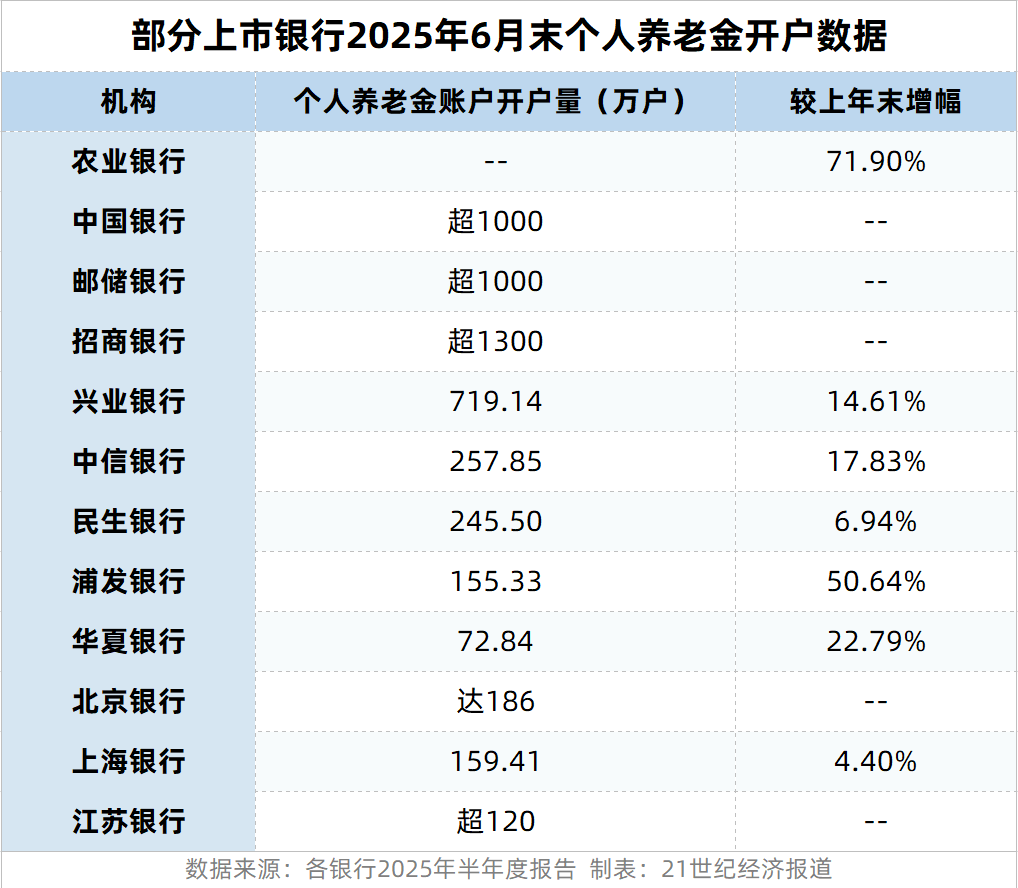
Core Insights - The article discusses the significant awakening of the "silver economy" in China, driven by the acceleration of the pension system and the elevation of pension services to a national strategic level [1][13] Group 1: Pension Financial Services - The competition in the pension financial sector is shifting from scale expansion to deep operation and value extraction, with personal pension accounts reaching over ten million for several banks [2][3] - Agricultural Bank of China saw a 71.9% increase in personal pension account openings compared to the previous year, while other banks like China Bank and Postal Savings Bank also reported significant growth [2][3] - The product supply for personal pensions is expanding, with banks offering a wider range of investment options to meet diverse customer needs [3][4] Group 2: Comprehensive Pension Services - Banks are moving towards a "one-stop" service model that integrates pension planning, wealth management, health management, and lifestyle services [5][6] - Several banks are targeting younger demographics to promote early pension planning, with initiatives aimed at educating and engaging younger clients [6] Group 3: Pension Service Financials - Banks are enhancing their service experiences through physical and digital adaptations, such as creating senior-friendly banking environments and improving online banking interfaces [7][8] - Initiatives like home service offerings and community engagement programs are being implemented to extend financial services to the elderly [8][9] Group 4: Pension Industry Financials - The pension industry financial sector is experiencing significant growth, with Agricultural Bank of China's pension industry loan balance reaching 21.6 billion yuan, a 94.6% increase from the previous year [10][11] - Innovative financial service models are emerging, such as loans linked to the usage rates of elderly care facilities, indicating a shift towards enhancing service quality in the sector [11][12] Group 5: Future Outlook - The banking sector is redefining its approach to the pension market, establishing dedicated departments and brands to enhance focus on pension financial services [13] - Digital transformation is seen as a key driver for the evolution of pension financial services, with technologies like AI and big data being leveraged to improve service delivery [13][14]
从“养老”到“享老” 一张信用卡的温度革新
Jing Ji Guan Cha Bao· 2025-10-29 09:41
Core Insights - The core message of the news is that CITIC Bank is launching the "Happiness Years Credit Card" aimed at addressing the aging population's financial needs, promoting a quality retirement lifestyle through a comprehensive financial service system [1][2][3]. Group 1: Product Launch and Features - CITIC Bank officially launched the "Happiness Years Credit Card" on October 29, targeting middle-aged and elderly users with a focus on enhancing their quality of life [1]. - The credit card offers various benefits related to finance, health, and travel, including insurance coverage for flight delays, accidents, and fraud protection [4]. - Specific perks include discounts on transportation services, smart devices, and healthcare services, catering to the diverse needs of the elderly [4]. Group 2: Evolution of Pension Finance - CITIC Bank has been a pioneer in pension finance since 2009, evolving from a single product to a comprehensive "Happiness+" ecosystem that includes a range of financial services [2]. - The bank's approach emphasizes a full lifecycle wealth management philosophy, integrating various financial products and services to create a holistic service experience for clients [2]. Group 3: Market Trends and Strategic Direction - The launch of the credit card reflects a broader trend in the financial industry, shifting focus from mere financial management to addressing the holistic needs of the elderly [6]. - Financial institutions are expected to collaborate with various sectors, including travel, healthcare, and technology, to create a seamless integration of financial products into everyday life [6]. - The evolving role of financial services is highlighted, moving from being mere custodians of wealth to active contributors to social welfare and quality of life for the elderly [7].
英华周播报|4000点得而复失,后市怎么看?创新药近期为何回调?
中国基金报· 2025-10-29 09:38
Group 1 - The article discusses the volatility in the gold market, highlighting the recent dramatic price fluctuations and their implications for investors [2] - It emphasizes the importance of having a long-term investment strategy, particularly in the context of technological advancements and market uncertainties [3] - The piece suggests that investors should focus on fundamental analysis and avoid excessive leverage in their investment decisions [5] Group 2 - The article mentions that certain segments of the non-ferrous metals market still show strong support despite recent market corrections [5] - It highlights the significance of education in personal finance, particularly regarding retirement planning, indicating that it is essential for all age groups [7] - The content also includes insights from fund managers on the high volatility of innovative pharmaceuticals and the potential for gold prices to continue rising [9][11]