食品安全

Search documents
查办“幽灵外卖”等违法案件 “守护消费”铁拳行动典型案例公布
Zhong Guo Xin Wen Wang· 2025-08-23 02:55
Core Viewpoint - The article highlights the enforcement actions taken by market regulatory authorities in China to combat illegal activities in the food and beverage sector, focusing on issues such as illegal additives, counterfeit products, and unlicensed operations, thereby ensuring consumer safety and market integrity [1][2][3][4][5][6][7][8][9][10][11][12][13]. Group 1: Illegal Additives and Food Safety - The Jiangxi market regulatory authority investigated a case involving the illegal addition of tadalafil in a liquor product, with a detected concentration of 151 mg/kg, leading to a total value of 1.9386 million yuan for 450 units [1] - In Fujian, a case was uncovered where meat products contained harmful substances like morphine and codeine, with sales exceeding 1 million yuan [2] - In Liaoning, a duck neck shop was found using excessive and unauthorized food additives, with illegal sales exceeding 200,000 yuan [3] Group 2: Ghost Restaurants and Licensing Violations - In Guangxi, a restaurant was penalized for using forged food operation licenses to conduct online delivery services, resulting in a fine of 7,000 yuan [4][5] - In Anhui, a restaurant operated multiple online entities without proper licenses, leading to fines totaling 8,600 yuan for both the restaurant and the third-party platform involved [6] Group 3: Regulatory Actions Against Platforms - In Beijing, two major food delivery platforms were investigated for failing to verify the licenses of their vendors, resulting in fines of 200,000 yuan and the confiscation of illegal earnings [7][8] Group 4: Trademark Infringement and Counterfeit Goods - In Shanghai, a construction company was found selling counterfeit paint products, leading to a total illegal operation value of 32,800 yuan and subsequent penalties [9][10] - The investigation revealed a network of counterfeit production, with significant quantities of infringing goods seized [9][10] Group 5: Compliance in Testing and Measurement - A testing company in Shandong was penalized for issuing reports without valid certification, resulting in fines totaling 81,400 yuan [11] - In Gansu, a gas station was found using tampered fuel dispensers, leading to fines of 788,700 yuan [12] Group 6: Consumer Safety in Household Products - In Jiangsu, a company was penalized for selling substandard gas stoves and hoses, with a total value of 65,000 yuan for the non-compliant products [13]
市场监管总局公布2025“守护消费”铁拳行动典型案例(第一批)
Yang Shi Wang· 2025-08-23 02:18
Core Viewpoint - The State Administration for Market Regulation (SAMR) is intensifying efforts to protect consumer rights and ensure food safety by cracking down on illegal activities in the food industry, including the illegal addition of harmful substances, "ghost takeout" services, and trademark infringements [1][2]. Group 1: Illegal Additives in Food Products - In Jiangxi Province, a case was reported where a company illegally added tadalafil to a liquor product, with a detected concentration of 151 mg/kg, leading to a total value of 1.9386 million yuan for 450 units produced [1]. - In Fujian Province, a business was found to be using meat products containing harmful substances like morphine and codeine, with sales exceeding 1 million yuan [3]. - In Liaoning Province, a duck neck shop was caught using food additives beyond legal limits, with nitrite levels ranging from 1.5 mg/kg to 17 mg/kg, and a total illegal revenue exceeding 200,000 yuan [3][4]. Group 2: Ghost Takeout Services - In Guangxi Province, a restaurant was penalized for operating "ghost takeout" services by using forged food business licenses, resulting in a fine of 7,000 yuan [5]. - In Anhui Province, a restaurant was found to be operating multiple online takeout services without the necessary food business licenses, leading to fines and warnings [6]. - In Beijing, two major food delivery platforms were investigated for failing to verify the licenses of their merchants, resulting in fines totaling 200,000 yuan [7][8]. Group 3: Trademark Infringement - In Shanghai, a construction company was caught selling counterfeit paint products under the "Nippon" trademark, with a total illegal revenue of 32,800 yuan [9]. - The investigation led to the dismantling of three counterfeit production sites, with significant quantities of infringing goods seized [9]. Group 4: Quality Control Violations - In Shandong Province, a gas station was found using modified fuel dispensers, resulting in illegal earnings of 786,800 yuan [10][11]. - In Jiangsu Province, a company was penalized for selling substandard gas stoves and hoses, with a total value of 65,000 yuan for the non-compliant products [12].
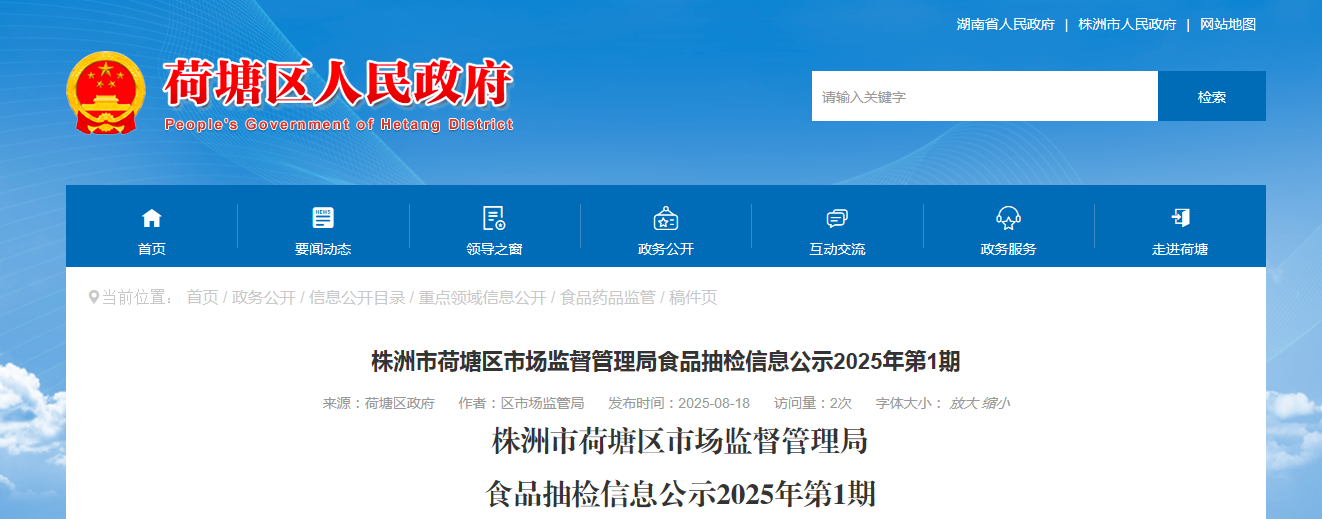
湖南省株洲市荷塘区市场监督管理局食品抽检信息公示2025年第1期
Zhong Guo Zhi Liang Xin Wen Wang· 2025-08-22 08:46
Summary of Key Points Core Viewpoint - The food safety supervision and sampling plan for 2025 in the Huatang District of Zhuzhou City has been announced, detailing the results of 130 batches of food samples, with 122 passing and 8 failing the safety tests [3]. Group 1: Sampling Results - A total of 130 batches were tested, with 122 batches deemed qualified and 8 batches found to be unqualified [3]. - Among the qualified samples, 83 batches were agricultural products, 8 batches were catering foods, and 4 batches were grain products [3]. - The unqualified samples included 6 batches of agricultural products, 1 batch of catering food, and 1 batch of grain products [3]. Group 2: Consumer Guidance - Consumers are advised to purchase food from legitimate channels and retain shopping receipts [3]. - Important factors to consider when purchasing food include checking the manufacturer's name and address, production date, and expiration date [3].

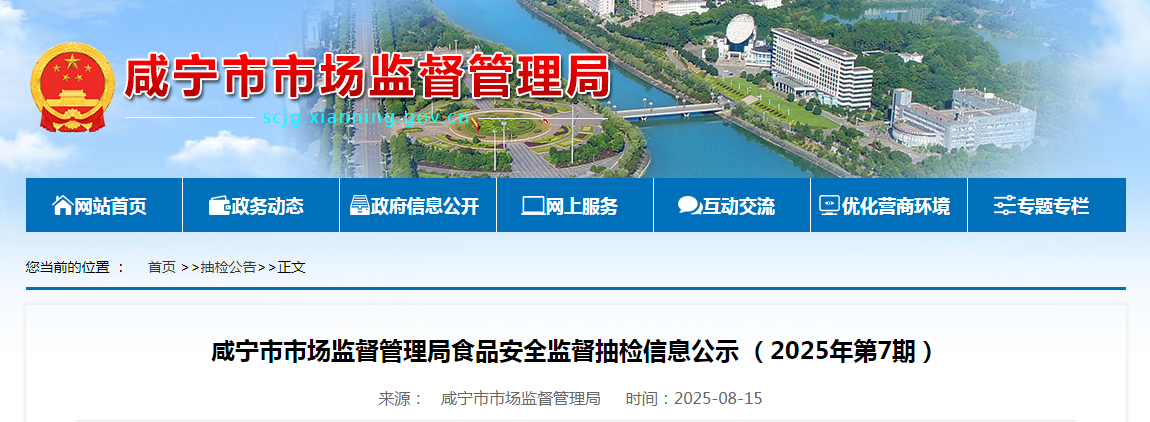
湖北省咸宁市市场监督管理局食品安全监督抽检信息公示 (2025年第7期)
Zhong Guo Zhi Liang Xin Wen Wang· 2025-08-22 07:35
Overall Situation - The Xian Ning Market Supervision Administration conducted a food safety inspection on 147 batches of six types of food, including livestock and poultry meat, vegetables, aquatic products, fruits, fresh eggs, and dried nuts, with 141 batches passing and 6 batches failing the inspection [3][4]. Non-compliant Products - The non-compliant products identified include: - Bananas from Zhongbai Supermarket, with a pesticide residue of 0.068 mg/kg, exceeding the standard of 0.05 mg/kg [3]. - Ginger from Tongshan Hengzhe Trading Co., with a pesticide residue of 0.54 mg/kg, exceeding the standard of 0.2 mg/kg [4]. - Celery from Tongshan Heshenghe Supermarket, with a pesticide residue of 0.36 mg/kg, exceeding the standard of 0.04 mg/kg [4]. - Long pepper from Tongshan Lejia Shopping Center, with a pesticide residue of 0.096 mg/kg, exceeding the standard of 0.05 mg/kg [4]. - Ginger from Tongshan Jiahe Shopping Plaza, with a pesticide residue of 0.70 mg/kg, exceeding the standard of 0.2 mg/kg [4]. - Bananas from Gaoxin Maima Supermarket, with a pesticide residue of 0.098 mg/kg, exceeding the standard of 0.05 mg/kg [4]. Actions Taken - The Xian Ning Market Supervision Administration has mandated local market supervision departments to immediately seal, remove from shelves, and recall the non-compliant products. Further investigations will be conducted to determine the batches, quantities, and reasons for the non-compliance, along with corrective measures [3][4].
“十四五”期间全国食品安全形势总体平稳 一批新规抓紧制定中
Yang Shi Wang· 2025-08-22 06:22
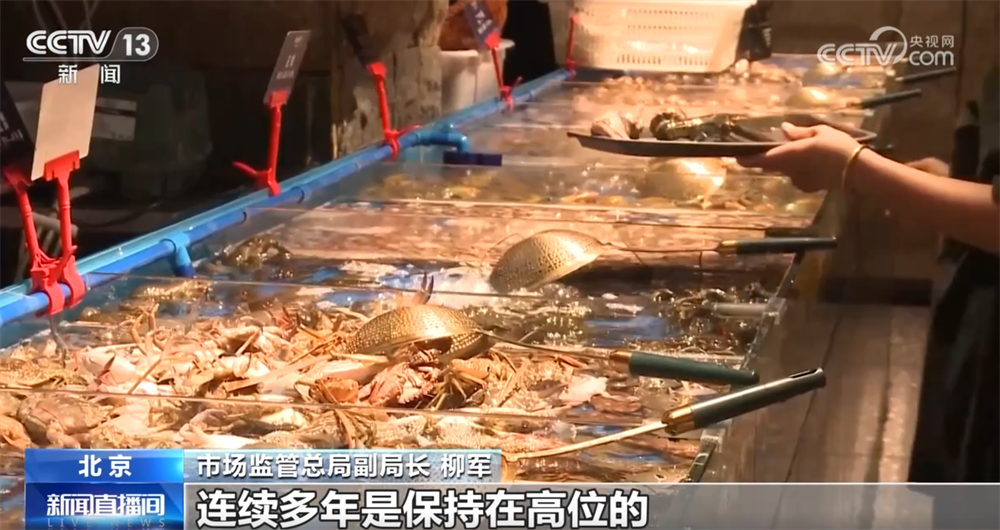
央视网消息:国务院新闻办公室22日上午举行"高质量完成'十四五'规划"系列主题新闻发布会,市场监管总局有关负责人表示,"十四 五"期间,通过推动强化全链条监管,严防各类风险,全国食品安全形势总体平稳。 市场监管总局副局长柳军称:"粮食加工品、肉制品、奶制品等合格率连续多年保持高位。针对近年来平台经济快速发展衍生的网络购 物、外卖点餐、直播带货等多种新消费场景,我们强化对平台企业的合规指导,加大专项抽检力度,综合治理'幽灵外卖'、虚假声称等突出问 题。" 市场监管总局正抓紧制定直播电商、网络销售等监管制度,进一步明确各类主体食品安全责任,在维护消费便利的同时及时消除新的风险 隐患。 市场监管部门通过严把许可准入关,强化全过程监管,组织全覆盖抽检,严防不合格食品流向餐桌。 ...
市场监管总局:“十四五”期间全国食品安全形势总体平稳
Jing Ji Guan Cha Wang· 2025-08-22 03:18
Group 1 - The core viewpoint of the news is the emphasis on high-quality market regulation during the "14th Five-Year Plan" period, focusing on food safety and risk prevention [1][2] Group 2 - The National Market Supervision Administration has prioritized the regulation of staple foods, ensuring high compliance rates for grain products, meat products, and dairy products [1] - There is a strong focus on protecting vulnerable groups, particularly in the quality safety regulation of infant formula and school food safety [1] Group 3 - The administration is implementing strict regulations on emerging business formats, such as online shopping and live-streaming sales, to address new risks while maintaining consumer convenience [2] - A crackdown on significant issues has led to the revocation of 3,072 licenses and restrictions on 238,000 individuals involved in illegal activities [2] Group 4 - The initiative encourages social co-governance in food safety, promoting public participation and media oversight to enhance the overall safety environment [2] - The administration plans to continue strengthening its regulatory framework to ensure food safety for the public [2]
莱伯泰科涨2.12%,成交额919.44万元,主力资金净流出26.89万元
Xin Lang Cai Jing· 2025-08-22 03:11
Core Viewpoint - Laibotai Technology's stock price has shown significant growth this year, with a 45.28% increase, indicating strong market performance and investor interest [2]. Company Summary - Laibotai Technology Co., Ltd. is located in the Tianzhu Airport Industrial Zone, Shunyi District, Beijing, and was established on January 8, 2002. The company went public on September 2, 2020 [2]. - The company specializes in the research and development of laboratory analytical instruments and falls under the machinery equipment sector, specifically in general equipment and instrumentation [2]. - As of March 31, 2025, Laibotai had 3,085 shareholders, an increase of 5.36% from the previous period, with an average of 21,864 circulating shares per shareholder, a decrease of 5.09% [2]. Financial Performance - For the first quarter of 2025, Laibotai reported a revenue of 99.05 million yuan, representing a year-on-year decrease of 6.09% [2]. - Since its A-share listing, Laibotai has distributed a total of 158 million yuan in dividends, with 115 million yuan distributed over the past three years [2]. Market Activity - On August 22, Laibotai's stock price increased by 2.12%, reaching 41.50 yuan per share, with a trading volume of 9.1944 million yuan and a turnover rate of 0.33%, resulting in a total market capitalization of 2.799 billion yuan [1]. - The net outflow of main funds was 26,890 yuan, with large orders buying 116.75 million yuan (12.70% of total) and selling 143.64 million yuan (15.62% of total) [1].

圣农发展跌2.01%,成交额1.03亿元,主力资金净流出626.26万元
Xin Lang Zheng Quan· 2025-08-22 02:41
Core Viewpoint - The stock of Shengnong Development has shown a mixed performance with a year-to-date increase of 20.93% and a recent decline of 2.01% on August 22, 2023, indicating volatility in the market [1]. Financial Performance - For the first half of 2025, Shengnong Development reported a revenue of 8.856 billion yuan, reflecting a year-on-year growth of 0.22%. The net profit attributable to shareholders reached 910 million yuan, marking a significant increase of 791.93% [2]. - Cumulatively, since its A-share listing, Shengnong Development has distributed a total of 6.860 billion yuan in dividends, with 1.113 billion yuan distributed over the past three years [3]. Shareholder and Market Activity - As of August 8, 2023, the number of shareholders for Shengnong Development was 33,100, a decrease of 3.06% from the previous period. The average number of circulating shares per shareholder increased by 3.16% to 37,554 shares [2]. - The stock experienced a net outflow of 6.2626 million yuan from major funds on August 22, 2023, with significant selling pressure observed [1]. Company Overview - Shengnong Development, established on December 21, 1999, and listed on October 21, 2009, is primarily engaged in the breeding and processing of meat chickens, with its main revenue sources being chicken meat (52.77%) and meat products (41.70%) [1]. - The company operates within the agriculture, forestry, animal husbandry, and fishery sector, specifically in the poultry farming industry [1].

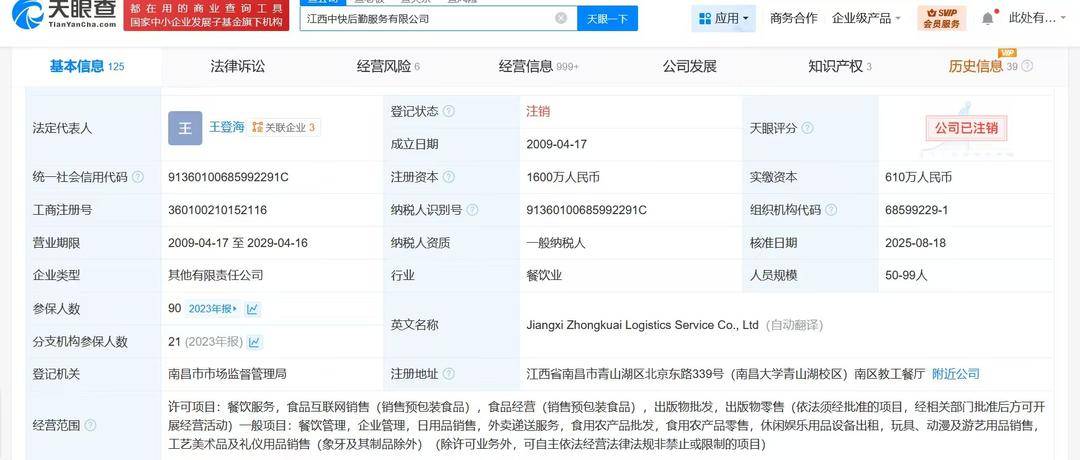
江西“鼠头鸭脖”涉事企业已注销!曾因经营污秽不洁食品被罚
Nan Fang Du Shi Bao· 2025-08-21 14:24
8月21日,南都N视频记者从国家企业信用信息公示系统获悉,"鼠头鸭脖"事件涉事企业江西中快后勤 服务有限公司的企业状态由存续变更为注销,注销原因为"决议解散"。南都N视频记者注意到,今年6 月,该公司已发布注销备案公告。 国家企业信用信息公示系统显示,江西中快后勤服务有限公司注销日期为8月18日,注销原因为"决议解 散"。 南都记者查询获悉,今年6月,该公司发布注销备案公告,公告期为6月30日至8月14日。公告内容显 示,"6月30日,江西中快后勤服务有限公司因决议解散,拟向登记机关申请注销登记,请债权人自公告 之日起45日内向清算组申报债权。" 南都此前报道,2023年6月1日,江西工业职业技术学院学生占某在该食堂"美卡香卤"档口所点饭菜中吃 出疑似鼠头的异物,此事引发舆情,专家通过比对研商一致认为,该"异物"是啮齿类动物的头部。同年 12月15日,"鼠头鸭脖"事件涉事企业江西中快后勤服务有限公司及责任人曾被罚没706万元。 据了解,江西中快后勤服务有限公司成立于2009年4月,法定代表人为王登海,经营范围包括餐饮服 务、食品互联网销售、食品经营等,由南昌永善餐饮管理中心(有限合伙)、盛国庆、王宝林共同持 ...
“鼠头鸭脖”事件中涉事公司注销
Yang Zi Wan Bao Wang· 2025-08-21 13:15
| | | 西中快后勤服务有限公司 | 天殿一下 FOR BOOK C 商务合作 | 企业发行 品 | 的合 ... | | --- | --- | --- | --- | --- | --- | | 基本信息 125 | 2天眼查 注销备案详情 | | | × | 历史信息 392 | | 注销备案 1 序号 | | 企业名称 统一社会信用代码/工商注册号 | 江西中快后勤服务有限公司 91360100685992291C | 0 导当 | で天眼直 操作 | | 江西中快后勤服 | | 登记机关 清算组备案日期 | 南昌市市场监督管理局 2025-06-30 | | 详情 | | 严重违法 2 | 清算组备案信息 | 清镇组成立日期 | 2025-06-30 | 日 导出 | 心天眼查 | | | | 注销原因 | 决议解散 | | | | 房屋 列入日期 | | | 江西省南昌市吉山湖区北京东路339号(南昌大学青山湖校区)南区教工餐 | | | | | | 清算组办公地址 | 厅 | | | | 2024-05-15 | | | | | | | 2 2024-03-19 | | 清算组联系电话 | 1 ...