加密货币

Search documents
加密货币ETF再度下跌 比特币市场遭新一轮避险情绪与科技股抛售拖累
Zhi Tong Cai Jing· 2025-11-21 01:49
Core Viewpoint - The cryptocurrency market continues to decline, with significant drops in various cryptocurrency ETFs, indicating a loss of momentum and support that had previously driven prices higher [1] Market Performance - As of the latest report, major cryptocurrency ETFs such as Bosera Ethereum (03009) fell by 5.7% to HKD 2.18, Huaxia Ethereum (03046) dropped 5.56% to HKD 6.79, and both Jiashi Bitcoin (03439) and Huaxia Bitcoin (03042) decreased by 5.56% and 5.5% respectively, with prices at HKD 10.71 and HKD 10.65 [1] - Bitcoin experienced a significant decline, dropping over 4% and falling below USD 87,000 for the first time since April, reflecting a broader market weakness [1] Market Dynamics - The recent downturn in the cryptocurrency market is attributed to a new wave of risk aversion and sell-offs in technology stocks, leading to the exit of major support players such as large investment funds and ETF allocators [1] - The withdrawal of institutional support, which had previously bolstered prices, has triggered a new phase of market vulnerability, making it more susceptible to selling pressure and volatility [1] External Influences - Analysts suggest that macroeconomic signals have acted as a catalyst for the current market conditions, with institutional allocations and spot ETF inflows that had supported prices in the first half of the year now rapidly retreating as the sentiment shifts to a defensive stance [1]
港股异动 | 加密货币ETF再度下跌 比特币市场遭新一轮避险情绪与科技股抛售拖累
智通财经网· 2025-11-21 01:46
Core Viewpoint - The cryptocurrency ETF market is experiencing a significant decline, with major ETFs like 博时以太币, 华夏以太币, 嘉实比特币, and 华夏比特币 all reporting drops between 5.5% to 5.7% as of the latest update [1] Market Performance - As of November 21, Bitcoin has seen a drop of over 4%, falling below $87,000 for the first time since April, indicating a lack of buying momentum and a clear decline from earlier gains this year [1] - The recent downturn follows a month-long trend of decreasing prices, exacerbated by the exit of rapid trading funds and high-position holders, making the market more susceptible to selling pressure and volatility [1] Influencing Factors - The decline in the cryptocurrency market is primarily driven by a new wave of risk aversion and sell-offs in technology stocks, leading to the exit of major support players such as large investment funds, ETF allocators, and corporate treasuries [1] - The withdrawal of these institutional players has stripped Bitcoin of crucial support that had previously bolstered its price during the early part of the year, pushing the market into a more vulnerable phase [1] - Macro signals are seen as merely igniting the current downturn, with previous institutional allocations and spot ETF inflows providing price support in the first half of the year, but these external supports are now retreating faster than retail liquidity as the sentiment shifts to a defensive stance [1]
纳指日内暴跌5%!4月以来最惨烈波动,美股怎么了?
美股IPO· 2025-11-21 01:05
Core Viewpoint - The article discusses the significant decline in the U.S. stock market, particularly focusing on Nvidia's performance and the broader implications of various economic indicators and market sentiments on investor behavior [1][3][10]. Group 1: Market Performance - Nvidia's stock initially rose by 2.4% but closed down 3.2%, erasing nearly $400 billion in market value, highlighting investor concerns about the sustainability of AI chip spending despite strong revenue forecasts [1][8]. - The Nasdaq 100 index experienced a nearly 5% drop from its intraday high, closing down 2.4%, marking a 7.9% pullback from its record high on October 29 [2]. - The S&P 500 index saw a 1.9% increase in the morning but ended the day down 1.6%, with the market capitalization evaporating by over $2.7 trillion [4]. Group 2: Economic Indicators - Strong non-farm payroll data from September is seen as a signal that the Federal Reserve may end its rate cuts this year, contributing to market volatility [10][13]. - The VIX index, which measures market volatility, closed above 26 points for the first time since April, indicating increased market uncertainty [6][15]. Group 3: Investor Sentiment and Concerns - Investors are increasingly worried about whether AI investments will generate sufficient revenue or profits to justify the substantial expenditures, leading to a risk-off sentiment in the market [10][14]. - Concerns about high valuations and the potential for further losses have prompted investors to seek hedges, reflecting a protective stance in the current market environment [14][16]. - The decline in high-risk assets was particularly pronounced, with indices tracking unprofitable tech companies and heavily shorted stocks experiencing significant drops [14].



纳指日内暴跌5%!4月以来最惨烈波动,美股怎么了?
Hua Er Jie Jian Wen· 2025-11-21 00:28
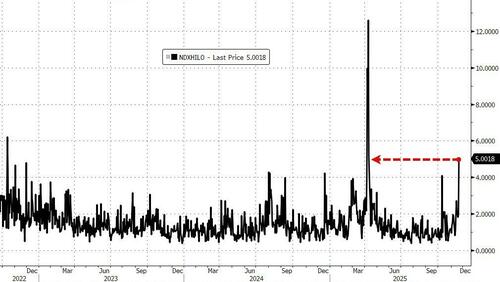
Core Viewpoint - The U.S. stock market experienced its most severe intraday reversal since April, with major indices dropping to their lowest levels in over two months, despite strong earnings reports from Nvidia and Walmart [1][2]. Market Performance - The Nasdaq 100 index fell nearly 5% from its intraday high, closing down 2.4%, marking a 7.9% pullback from its record high on October 29 [1]. - The S&P 500 index initially rose 1.9% but ended the day down 1.6%, resulting in a market capitalization loss exceeding $2.7 trillion [2]. - The VIX index, which measures market volatility, closed above 26 points for the first time since April [3]. Reasons for the Decline - Concerns resurfaced regarding whether AI can generate sufficient revenue or profits to justify substantial investments [5]. - Strong non-farm payroll data from September was interpreted by some traders as a signal that the Federal Reserve may end its rate cuts this year [5]. - Bitcoin's drop to a six-month low was seen as a risk-off signal contributing to the market's decline [5]. - High valuations and increased market volatility ahead of Friday's options expiration were additional concerns [5]. Multiple Negative Factors - Traders cited various explanations for the market drop, including unresolved economic and market issues such as labor market strength, tariffs, inflation, and the sustainability of AI investments [6]. - The strong employment report led some traders to believe it indicated the end of rate cuts by the Federal Reserve [6]. - The cryptocurrency market's downturn, driven by retail investors, highlighted vulnerabilities in the market [8]. Impact of Nvidia - Nvidia was the largest drag on the Nasdaq 100 index, initially rising 2.4% before closing down 3.2%, erasing nearly $400 billion in market value [7]. - Investor concerns about the sustainability of AI chip spending overshadowed the company's better-than-expected revenue outlook [7]. High-Risk Assets Affected - The sell-off was particularly pronounced in high-risk sectors, with short-sold indices dropping 3.5% and Goldman Sachs' unprofitable tech index falling 3.7% [9]. - The Russell Microcap Index declined 1.9%, extending its pullback from record highs to 10% [9]. - Major companies like Tesla, Alphabet, Apple, Microsoft, Broadcom, and Amazon saw market value fluctuations exceeding $100 billion [9]. Volatility and Options Expiration - The Nasdaq 100 volatility index (VXN) rose above 32 points for the first time since April, coinciding with the expiration of approximately $3.1 trillion in nominal value options [10]. - Mechanical fund outflows may remain strong in the coming days before completely dissipating [10]. - With Nvidia's earnings report concluded and the Fed unlikely to cut rates in December, investors are questioning what could drive a year-end rebound [10].
比特币一度跌破8.7万美元!加密货币全网超22万人爆仓 58亿元灰飞烟灭!
Mei Ri Jing Ji Xin Wen· 2025-11-20 23:59
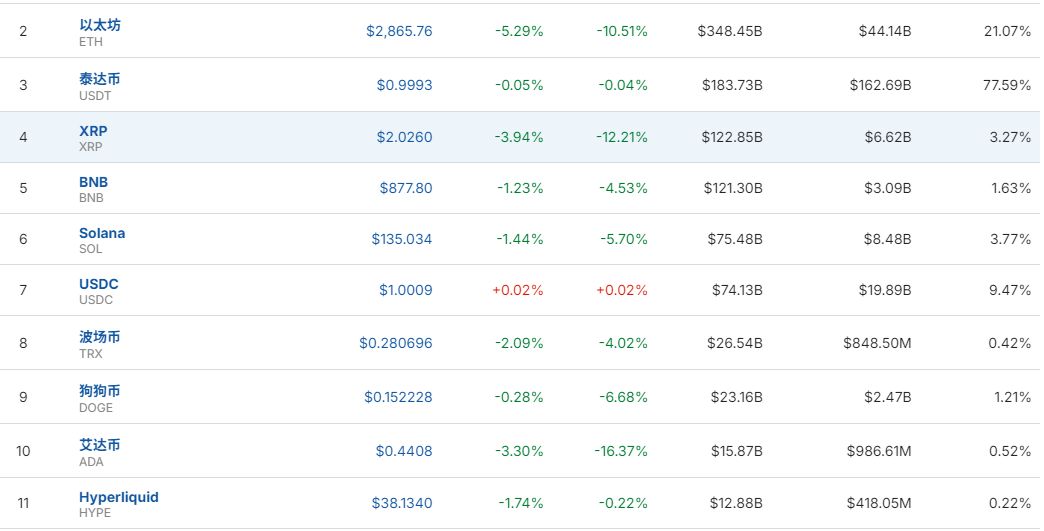
Core Viewpoint - The cryptocurrency market continues its downward trend, with Bitcoin dropping over 4% and falling below $87,000 for the first time since April, indicating a significant bearish phase in the market [1][4]. Market Performance - As of November 21, Bitcoin is priced at $87,632, reflecting a decline of 4.28%. Ethereum has decreased by over 5%, while Cardano has dropped more than 3% [1]. - The total market capitalization of Ethereum is approximately $348.45 billion, with a trading volume of $44.14 billion, showing a 21.07% market dominance [2]. Liquidation Events - Over the past 24 hours, more than 220,000 traders have been liquidated, resulting in a total liquidation amount of $814 million (approximately 5.8 billion RMB) [2][3]. - The largest single liquidation occurred on the HTX exchange, with a value of $30.92 million [3]. Market Sentiment and Analysis - Analysts attribute the recent cryptocurrency decline to renewed risk aversion and sell-offs in tech stocks, leading to a loss of support from major investment funds and corporate treasuries [4]. - The market is described as entering a "confirmed bear market phase," with weak ETF inflows, ongoing selling by long-term holders, and low retail investor interest indicating deteriorating market sentiment [4]. Macro-Economic Factors - Uncertainty in macroeconomic conditions is exacerbating market tensions, with unclear Federal Reserve policy paths impacting investor risk appetite, particularly for high-risk assets [6]. - The withdrawal of institutional support and liquidity is noted as a significant factor in the current market downturn, as external pillars of support have been quicker to exit than retail liquidity [6]. Options Market Insights - The options market is focusing on key support levels, with strong demand for downside protection around $85,000 and $82,000, indicating traders are preparing for further declines [5]. - The current environment is characterized by a collapse of speculative outlets in the cryptocurrency market, with high leverage contributing to the downturn [5].
美股上演“大逆转” 投资者开始寻找还有什么可以推动年末行情
Sou Hu Cai Jing· 2025-11-20 19:34
Core Viewpoint - Nvidia (NVDA.O) reported explosive earnings results and a strong employment report, indicating a robust economic foundation, yet the initial optimism in the trading hall did not last long due to emerging concerns about AI's ability to generate sufficient revenue or profits to justify its significant expenditures [1] Group 1: Market Reactions - Despite positive earnings from Nvidia, traders expressed skepticism about the sustainability of the market rally, with concerns resurfacing regarding AI profitability [1] - The decline in cryptocurrency prices to their lowest point since April contributed to the stock market's downturn [1] Group 2: Investor Sentiment - Chris Murphy, co-head of derivatives strategy at Susquehanna International, noted that with Nvidia's earnings now settled and the Federal Reserve unlikely to cut rates in December, investors are questioning what could drive the year-end rally [1] - Reports indicate that CTA positions remain fragile, with systematic strategies still in a mild net long position, suggesting that deeper pullbacks could trigger automatic liquidation by quantitative funds, potentially leading to further selling [1]
比特币跌穿9万!有人亏到失眠,这波血洗真不怪空头
Sou Hu Cai Jing· 2025-11-20 17:49
Core Viewpoint - The recent Bitcoin crash is attributed to a combination of factors rather than a sudden attack from short sellers, indicating that the bubble was bound to burst eventually [8] Group 1: Market Dynamics - Bitcoin experienced a dramatic decline from a peak of $126,000 to a low of $89,385 within 72 hours, representing a nearly 30% drop and erasing approximately $400 billion in market value [6][28] - The decline was exacerbated by a high leverage environment in the derivatives market, leading to forced liquidations of long positions when Bitcoin fell below critical support levels [17][20] Group 2: Economic Influences - The Federal Reserve's decision to maintain high interest rates (5.5%-5.75%) in response to persistent inflation (4.2% year-on-year in October) has made riskier assets like Bitcoin less attractive compared to safer investments like government bonds [11][13] - Institutional investors, as indicated by the decline in the Grayscale Bitcoin Trust's premium from 18% to -5%, have been pulling out of Bitcoin, signaling a lack of confidence in the asset [15][28] Group 3: Investor Behavior - Long-term investors have been selling off their Bitcoin holdings, with over 127,000 Bitcoins sold in the first two weeks of November, resulting in cashing out over $15 billion [28] - The correlation between Bitcoin and the Nasdaq index has reached 0.82, suggesting that Bitcoin is behaving more like a tech stock rather than a hedge against inflation [24]

比特币:下跌破支撑位,市场降息期待降温施压
Sou Hu Cai Jing· 2025-11-20 15:35
【11月20日,比特币多头面临挑战,市场降温施压加密货币】当日,Wolfe Research分析师称,虽不想 用"加密寒冬"一词,但行情转变正常。经历火热行情后,下跌不意外。 他指出,此次下跌打破诸多支 撑位,这些位置成反弹阻力。比特币多头挑战大,且暂无快速解法。 此外,市场对美联储短期降息期 待降温,进一步给加密货币施压。 本文由 AI 算法生成,仅作参考,不涉投资建议,使用风险自担 ...
Solana ETFs Post Second-Biggest November Inflows as Demand Grows During Downturn
Yahoo Finance· 2025-11-20 15:32
Core Insights - U.S. spot Solana (SOL) exchange-traded funds (ETFs) have seen inflows for 17 consecutive days, accumulating a total of $476 million since their launch on October 28 [1][2] - This inflow streak is the longest uninterrupted positive flow among crypto ETFs this year, contrasting with significant outflows in Bitcoin (BTC) and Ether (ETH) ETFs [2] - The leading contributor to Wednesday's inflows was Bitwise's BSOL with $35.9 million, followed by Grayscale's GSOL at $12.6 million, indicating a growing interest in Solana despite a general downturn in the crypto market [3] Inflow Performance - The Solana ETFs added $48.5 million on Wednesday, marking the second-largest inflow for the month [1] - Cumulative net inflows for Solana ETFs since inception reached $476 million, showcasing strong investor interest [1] Market Context - In November, Bitcoin ETFs experienced net outflows of approximately $2.96 billion, while Ether ETFs recorded about $107 million in outflows, highlighting a shift in investor preference towards Solana [2] - The CoinDesk 20 Index (CD20) has declined by 12% over the past week, yet Solana ETFs continue to attract investment [3]
前沿观察 | 电力需求激增,比特币跌破9万美元
Sou Hu Cai Jing· 2025-11-20 13:39
Group 1 - Bitcoin recently fell below $90,000, marking a significant drop since April, with a low of $89,426 and a final price around $91,200, representing a decline of over 20% and a complete reversal of gains made in 2025 [5][7] - The cryptocurrency market is experiencing extreme panic, exacerbated by rising electricity costs that increase supply pressure [5][7] - The demand for electricity driven by artificial intelligence is pushing up wholesale electricity prices, leading to shrinking profits for Bitcoin mining operations [5][7] Group 2 - In the first half of November, $2.3 billion flowed out of U.S. spot Bitcoin ETFs, alongside rising U.S. Treasury yields, contributing to the current sell-off [7] - Electricity costs account for 70%-80% of total Bitcoin mining costs, and in Texas, the average wholesale electricity price increased by 18% year-on-year in Q3 2025 [7][8] - The U.S. Energy Information Administration predicts that wholesale electricity prices will rise by 8.5% to $51 per megawatt-hour by 2026, driven by data center demand [8] Group 3 - Miners have transferred approximately 71,000 Bitcoins to exchanges in the first two weeks of November, marking the highest monthly transfer volume since the 2022 bear market [8] - Several publicly listed mining companies have acknowledged the shift towards AI computing, with Marathon Digital selling part of its output to maintain operations, while Core Scientific and Iris Energy have signed long-term AI hosting contracts [10] - AI hosting contracts typically yield 70%-80% EBITDA margins, providing stable income compared to the volatility of Bitcoin mining [10] Group 4 - Not all miners are selling; some are still profitable by utilizing low-cost electricity from renewable sources, particularly in regions like Canada and Scandinavia [11] - Approximately 52% of global Bitcoin hash rate currently comes from hydropower, wind, or nuclear energy [11] - The short-term effect of increased supply from miners has contributed to Bitcoin's drop below $90,000, while long-term predictions remain mixed, with some Wall Street firms maintaining a year-end target of over $100,000 [11]