数字孪生

Search documents
持续增强工业母机产业链供应链韧性和安全水平
Zhong Guo Zheng Quan Bao· 2025-09-02 01:20
Group 1 - The National Standardization Administration and the Ministry of Industry and Information Technology have issued a plan to establish a high-quality standard system for industrial mother machines by 2026, aiming to enhance the resilience and safety of the industrial mother machine supply chain [1][2] - The plan includes the development of at least 300 standards, with a target of leading the revision of at least 5 international standards and achieving a 90% conversion rate of international standards [1][2] - By 2030, the standard system is expected to fully adapt to the high-quality development of the industrial mother machine industry, with overall standards reaching advanced global levels [1][2] Group 2 - The high-quality standard system for industrial mother machines consists of six levels, including basic general standards, design support, manufacturing equipment, manufacturing processes, inspection and testing, and industry application, with a total of 34 categories and 17 subcategories [2] - Key tasks outlined in the plan include accelerating the development of urgently needed standards, promoting the revision of series standards, strengthening standards in cross-disciplinary fields, and enhancing the internationalization of standards [2] - The machine tool industry is currently undergoing a critical transformation and upgrade, with the industry scale ranking first globally for over a decade and entering the second tier of global technology levels [2][3] Group 3 - In the first half of 2025, China's machine tool industry achieved a revenue of 493.3 billion yuan, a year-on-year decrease of 1.7%, with a narrowing decline compared to the first quarter [3] - The production of metal cutting machine tools increased by 13.5% year-on-year, while the production of metal forming machine tools rose by 10.4% [3] - Investment in equipment and tools increased by 17.3% year-on-year, significantly higher than the overall investment growth, indicating a recovery in market demand for machine tools [3]
我国已建成5G基站459.8万个,部署5G行业虚拟专网6.4万个
Yang Shi Xin Wen· 2025-09-02 00:53
Core Insights - China has deployed 64,000 5G industry virtual private networks and over 100 types of 5G industrial gateways and routers, with a global share of 42% in essential 5G standard patents [1][2] - As of July 2023, China has built 4.598 million 5G base stations and over 30.53 million gigabit network capability ports, achieving "gigabit access in every county and 5G access in every township" [1] - The national integrated computing network system is accelerating its construction, with 10.85 million standard racks in use and an intelligent computing scale of 788 EFLOPS [1] Industry Developments - The information and communication technology industry in China is continuously improving, with breakthroughs in key technology areas and new achievements in industrial layout, enhancing the vitality of industry enterprises [2] - China has established a complete 5G industrial chain covering chips, terminals, base station equipment, and testing instruments, with emerging fields like artificial intelligence and satellite internet accelerating their layout [2] - The number of telecom business operating license holders has reached 186,500, a year-on-year increase of 10% [2] Application and Impact - New technologies such as 5G, industrial internet, artificial intelligence, and digital twins are widely applied in research and development, driving innovation in the industrial sector and improving efficiency [2] - In key areas like large aircraft, new energy vehicles, and high-speed trains, the average development cycle of smart manufacturing demonstration factories has been shortened by nearly 30% [2] - 5G applications have been integrated into 86 out of 97 major categories of the national economy, with over 138,000 cases accelerating into core production processes, resulting in an average capacity increase of 19.6% and a 14.5% reduction in operating costs [2] Future Directions - The Ministry of Industry and Information Technology will promote the "construction, use, and research" of the information and communication industry, accelerating the deployment of 5G-A product systems and high-quality networks, and advancing 6G technology research [3]
8点1氪:10月1日起纸质火车票将全面停用;巴黎世家8200元新包撞脸塑料袋;iPhone 8 Plus被苹果列为复古产品
36氪· 2025-09-02 00:10
Group 1 - Starting from October 1, paper train tickets will officially be phased out, replaced by electronic invoices, with a transition period ending on September 30 [3] - The electronic reimbursement certificate can only be claimed by the passenger themselves, not the purchaser, and will be sent via email [3] - The total box office for the summer movie season in 2025 reached 11.966 billion yuan, with 321 million admissions, marking a year-on-year increase of 2.76% and 12.75% respectively [6][7] Group 2 - Apple has added three products to its obsolete list, including the iPhone 8 Plus, which is now classified as a vintage product [6] - The price of gold has surged, with the price per gram of gold jewelry reaching 1,027 yuan, reflecting a significant increase [9] - The CEO of Ideal Auto stated the goal to stabilize monthly sales of their electric models at 18,000 to 20,000 units by the end of the year [13] Group 3 - High investment in AI technology is evident, with Chinese enterprises averaging over 10 trillion tokens daily in model calls, with Alibaba's Tongyi leading at 17.7% market share [16] - MINISO LAND's global flagship store achieved a monthly sales record of 16 million yuan, setting a new high for single-store performance [17] - Xiaomi announced limited-time purchase benefits for its vehicles, including lifetime free use of assisted driving features [18]



9月2日早餐 | 工业母机新规划出炉
Xuan Gu Bao· 2025-09-02 00:07
Key Points - The US stock market is closed due to Labor Day [1] - Trump may announce a housing emergency in the US this fall [2] - Elon Musk emphasized that expanding Full Self-Driving (FSD) and Optimus robots is crucial for Tesla's future, with about 80% of Tesla's value depending on Optimus [2] - Gold prices have risen over 0.8%, nearing historical highs, while silver has surpassed $40 for the first time since 2011 [2] - Google has reportedly completed the development of its own AI glasses [2] - Evercore ISI strategists predict the S&P 500 index will reach 7,750 points by the end of 2026, a 20% increase from last Friday's closing level [3] Domestic Major Events - China's September 3 military parade will consist of a review and a display, lasting approximately 70 minutes [4] - Wang Yi introduced eight major outcomes from the Shanghai Cooperation Organization (SCO) Tianjin Summit, including support for a fair multilateral trade system and the establishment of the SCO Development Bank [4] - The National Standardization Administration and the Ministry of Industry and Information Technology issued a plan to establish a high-quality standard system for industrial mother machines by 2026 [5] - The Ministry of Transport has approved the implementation of "Artificial Intelligence + Transportation" guidelines, indicating increasing innovation in smart transportation and logistics [6] Company Announcements - Morgan Stanley stated that Alibaba has become China's best AI enabler, expecting Alibaba Cloud's revenue growth to accelerate to over 30% this fiscal quarter [7] - UBTECH's CEO announced that humanoid robots have entered broader industry scenarios, with an expected annual production capacity exceeding 1,000 units [8] - Alibaba responded to claims of large-scale procurement from Cambricon, asserting support for domestic products [9] - Beijing Data Group is expected to be officially listed soon [10] - Yushutech announced a patent for digital twin robot motion control, enabling complex stage performances [11] - Tencent released its latest open-source translation model [12] - Hongmeng Zhixing reported that 44,579 new cars were delivered in August, with cumulative deliveries surpassing 900,000 [13] - Robotaxi GXR from Wenyan Zhixing has arrived in Singapore and has begun testing [14] - Longi Green Energy has reportedly invested in a storage company and is considering acquiring another [14] - JD Group made a voluntary public acquisition offer to CECONOMY AG [15] - BYD reported August sales of 373,626 new energy vehicles, nearly unchanged from the same period last year [15] Market Insights - Evercore ISI predicts a 20% increase in the S&P 500 index by the end of 2026 [3] - The market is expected to continue a trend of oscillating upward as the Federal Reserve approaches a rate cut in September [16] - The National Internet Information Office and other departments have implemented a new regulation on AI-generated content, effective September 1 [17] - The National Standardization Administration and the Ministry of Industry and Information Technology have issued a plan for a high-quality standard system for industrial mother machines, aiming for completion by 2026 [18] - The price of polysilicon has surged, with major domestic companies raising their prices due to market conditions [19] - The solar industry is expected to see price elasticity due to supply-side reforms and environmental regulations [19] Company Developments - Su Da Weige plans to acquire up to 51% of Changzhou Weipu Semiconductor Equipment Co., Ltd. for no more than 510 million yuan [22] - Tianqi Co., Ltd. signed a strategic cooperation framework agreement with Yiwei Lithium Energy to build a closed-loop system for lithium battery lifecycle management [22] - Samsung Medical signed a contract for an intelligent meter project in Egypt worth $58.8 million [23] - Longi Green Energy aims to balance gross profit and expenses in the fourth quarter [25] - China Shipbuilding Industry Corporation's A-shares will be delisted on September 5 [25]





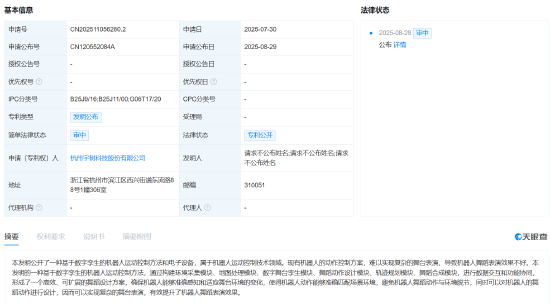
快讯|优必选获10亿美元战略融资授信;宇树科技公布基于数字孪生的机器人运动控制专利;现代威亚推出物流新品
机器人大讲堂· 2025-09-01 13:37
Group 1 - UBTECH has signed a strategic partnership agreement with Infini Capital for a $1 billion financing credit, aimed at establishing a super factory in the Middle East [1][3] - The partnership includes various financing methods and aims to enhance UBTECH's industrial layout capabilities, as well as to invest in the humanoid robot supply chain [1][3] - Infini Capital plans to increase its stake in UBTECH and assist in developing a joint venture for a super factory and R&D center in the Middle East [1][3] Group 2 - Yushu Technology has published a patent for a robot motion control method based on digital twins, addressing limitations in complex stage performances [4][5] - The patented technology includes modules for environmental sensing, map processing, and dance action design, enabling robots to adapt to stage changes and improve performance quality [4][5] Group 3 - Hyundai Wia has officially entered the mobile robot market with a new logistics robot product line, capable of handling payloads from 300 to 1500 kilograms [6][8] - The new robots utilize various navigation methods, including SLAM technology and AGV routes, and are designed to enhance efficiency in industrial logistics automation [6][8] - Hyundai Wia aims to expand its market influence beyond the Hyundai Motor Group by signing sales agency contracts with five domestic companies [6][8] Group 4 - Meta is facing controversy for allegedly creating flirtatious chatbots using the likenesses of celebrities like Taylor Swift and Selena Gomez without their consent [9][11] - The chatbots, developed by Meta employees, have been reported to engage users with suggestive content, raising ethical concerns regarding privacy and consent [9][11] Group 5 - Apple has introduced a new AI chatbot named Asa for retail employees, designed to enhance their understanding of Apple products and improve sales capabilities [12][13] - Currently in testing, Asa will soon be widely available within Apple's internal SEED application, although a public version has not yet been released [12][13]


专访Cadence高级副总裁:AI如何推动EDA走向虚拟工程师时代
半导体芯闻· 2025-09-01 10:27
Core Viewpoint - The semiconductor industry is experiencing a transformative phase driven by AI and advanced chip design methodologies, with a shift towards "agent-based AI" that enhances collaboration in chip design [1][2][4]. Group 1: Industry Trends - The demand for AI-related industries has surged, with official forecasts increasing from $950 billion to $1.2 trillion in just one year, driven by data center AI computing and extending to edge computing [2]. - Companies traditionally not involved in chip manufacturing, such as Xiaomi and Alibaba, have emerged as significant players in the semiconductor space, indicating a shift towards "software-defined chips" [2]. Group 2: Technological Innovations - Paul Cunningham introduced the "3D dimensional" integration technology, emphasizing the need for comprehensive system simulation and optimization across various dimensions, including mechanical, thermal, and fluid simulations [4]. - The combination of principle-based methods, accelerated computing, and AI is seen as crucial for addressing the challenges in the semiconductor industry, referred to as the "three-layer cake" architecture [4]. Group 3: AI Evolution in EDA Tools - Cadence's journey in AI began in 2016, focusing on integrating machine learning into tools for faster and higher-quality results, evolving from "AI optimization" to "human-computer interaction transformation" [5][6]. - The introduction of conversational capabilities in Cadence tools allows users to interact using natural language, marking a significant shift towards "virtual engineers" rather than just tools [5][6]. Group 4: Future of Automation and Digital Twins - The vision for the future includes a gradual transition towards full automation in design processes, with digital twins and AI playing a pivotal role in accelerating simulations and providing new scientific breakthroughs [9][10]. - The integration of AI with digital twins is expected to enhance the efficiency of simulations across various fields, including physics and biology, significantly reducing computation time [9][10]. Group 5: Talent Demand and Industry Challenges - There is a growing demand for engineers in the semiconductor industry, with AI seen as a tool to enhance productivity rather than replace human jobs, especially in regions like China where the demand for talent is exceptionally high [11]. - The industry faces a talent shortage, and the integration of AI is viewed as essential for addressing this gap, allowing engineers to work more efficiently alongside AI [11].


光明科学城数创中心打造产学研新生态 构建“大科学”教育体系
Shen Zhen Shang Bao· 2025-09-01 06:41
Group 1 - The core idea of the news is the establishment of the Guangming Science City Digital Industrial Innovation Center, which aims to transform advanced intelligent manufacturing scenarios into educational experiences for youth, promoting a "big science" education system in Guangming District [1] - The center has developed an "intelligent manufacturing popular science system" that provides immersive science and technology enlightenment courses for young people, integrating practical training for university students through collaboration with local universities [1][2] - The center's initiatives include signing production internship cooperation agreements with universities, offering dual-practice courses that combine technical disassembly and application exchange to enhance students' understanding of digital industrial equipment [1] Group 2 - For compulsory education students, the center has created three major popular science research and study course systems focused on intelligent manufacturing, emphasizing inquiry-based, experiential, and project-based learning [2] - The "Intelligent Manufacturing Magical Journey" course allows students to interact closely with industrial robots and smart production lines through video guides and immersive experiences, highlighting the impact of digital transformation in industry [2] - The center is located in Guangming Phoenix Square and has established a "7+2+1" public service platform, which includes seven industrial software platforms based on Siemens digital twin technology, two rapid prototyping hardware laboratories, and one digital industrial ecosystem base [2]
华体科技线上调研引机构热捧:数字能源战略清晰,超充+储能双轨推进
Quan Jing Wang· 2025-09-01 04:20
Core Viewpoint - The company is focusing on the development of its digital energy sector, emphasizing its collaboration with Huawei and the establishment of a high barrier in the ultra-fast charging field, which is expected to drive growth and enhance market position [2][6]. Group 1: Business Strategy - The company is implementing a dual-driven strategy of "smart streetlights + digital energy," aiming to deepen its presence in both sectors while leveraging innovative technologies to create competitive advantages [3]. - The collaboration with local government platforms through joint ventures is proving effective, leading to the expansion of charging and energy storage businesses, which accelerates project implementation and promotes win-win scenarios [3]. Group 2: Performance Expectations - Management provided a positive outlook regarding the company's performance, indicating that the successful implementation of the ultra-fast charging station model will support revenue and net profit in the third and fourth quarters [4]. - The company plans to participate in the investment of some ultra-fast charging stations to secure long-term cash flow, with project construction cycles expected to be efficient [4]. Group 3: Technology Implementation - The company is leading in liquid-cooled ultra-fast charging technology, with multiple patents and software copyrights, and is expanding its application across various scenarios [5][6]. - New products such as the 1000kW and 800kW liquid-cooled charging piles are being introduced, enhancing the company's competitive edge in the ultra-fast charging market [5][6]. Group 4: Market Opportunities - The company is targeting the rapidly growing market for ultra-fast charging and energy storage, with plans to penetrate both domestic and international markets [6]. - The digital energy business is not limited to ultra-fast charging; the company is also actively pursuing energy storage solutions, aiming to create a synergistic growth model of "ultra-fast charging + energy storage" [6].

能科科技跌2.04%,成交额4.69亿元,主力资金净流出1917.12万元
Xin Lang Cai Jing· 2025-09-01 03:19
Core Viewpoint - Nengke Technology's stock has experienced fluctuations, with a year-to-date increase of 52.61% and a recent decline of 2.04% on September 1 [1] Financial Performance - For the first half of 2025, Nengke Technology achieved operating revenue of 738 million yuan, a year-on-year increase of 4.91%, and a net profit attributable to shareholders of 111 million yuan, up 18.75% year-on-year [2] - Cumulative cash dividends since the A-share listing amount to 79.65 million yuan, with 21.40 million yuan distributed over the past three years [3] Stock Market Activity - As of September 1, 2023, Nengke Technology's stock price was 45.60 yuan per share, with a total market capitalization of 11.158 billion yuan [1] - The stock has seen significant trading activity, with a turnover rate of 4.12% and a net outflow of 19.17 million yuan in principal funds on September 1 [1] - The company has appeared on the "Dragon and Tiger List" three times this year, with the most recent occurrence on August 27 [1] Shareholder Structure - As of June 30, 2025, the number of shareholders for Nengke Technology was 26,000, a decrease of 13.21% from the previous period, with an average of 9,413 circulating shares per person, an increase of 15.23% [2] - Notable institutional shareholders include Huaxia Industry Prosperity Mixed Fund and new entrants such as Jiangyin Advanced Manufacturing Mixed Fund [3]

宇树科技公布数字孪生的机器人运动控制专利,可实现复杂的舞台表演
Xin Lang Ke Ji· 2025-09-01 03:06
据天眼查显示,近日,杭州宇树科技股份有限公司申请的"一种基于数字孪生的机器人运动控制方法和 电子设备"专利公布,专利于7月30日申请。 据摘要显示,本发明的一种基于数字孪生的机器人运动控制方法,通过构建环境采集模块、地图处理模 块、数字舞台孪生模块、舞蹈动作设计模块、轨迹规划模块、舞蹈合成模块,进行数据交互和功能协 同,形成了一个高效、可扩展的舞蹈设计方案,确保机器人能够准确感知和适应舞台环境的变化,使得 机器人动作能够准确匹配场景环境,避免机器人舞蹈动作与环境脱节,同时可以对机器人的舞蹈动作进 行设计,因而可以实现复杂的舞台表演,有效提升了机器人舞蹈表演效果。 责任编辑:李昂 ...