适度宽松的货币政策

Search documents
首月金融数据“开门红”
Di Yi Cai Jing· 2026-02-13 10:09
Group 1 - The core viewpoint of the articles highlights a positive trend in credit growth, supported by high M2 and social financing scale growth, creating a favorable monetary environment for economic recovery [2][10] - As of January 2026, M2 balance reached 347.19 trillion yuan, with a year-on-year growth of 9.0%, exceeding market expectations [2] - Social financing scale stock was 449.11 trillion yuan, with a year-on-year growth of 8.2%, indicating a stable financial support for the economy [2][10] Group 2 - Personal loans showed steady growth, with a balance of 276.62 trillion yuan, reflecting a year-on-year increase of 6.1%, supported by various favorable conditions [3][5] - The increase in household loans was 456.5 billion yuan, driven by pre-festival consumption activities, indicating a release of consumer vitality [5] - The Ministry of Finance extended the personal consumption loan interest subsidy policy until the end of 2026, which is expected to enhance consumer willingness and support loan growth [5] Group 3 - Significant project loans increased due to accelerated approval in the infrastructure sector, with corporate loans adding 4.45 trillion yuan in January, of which long-term loans accounted for over 70% [4] - The trend of "quality improvement" in credit is evident, with inclusive small and micro loans growing by 11.6% year-on-year, indicating a shift towards high-quality development [7][8] - The average interest rate for newly issued corporate loans was approximately 3.2%, reflecting a decrease of about 20 basis points from the previous year, which supports the operational efficiency of enterprises [8][9] Group 4 - The financing structure is evolving, with the importance of direct financing through bonds and stocks increasing significantly, as evidenced by a 47% share of stock and bond financing in the social financing scale increment [12] - Government bond financing reached its highest level since 2021, accounting for 13.5% of the total social financing scale, indicating a robust fiscal policy [11][12] - The macroeconomic policy is becoming more proactive, with expectations of continued expansion in fiscal spending and an increase in government bond issuance, projected to approach 1.5 trillion yuan [12]

首月金融数据“开门红”
第一财经· 2026-02-13 09:49
Core Viewpoint - The article highlights the positive trends in credit growth and monetary supply in January 2026, indicating a supportive financial environment for economic recovery, with M2 and social financing growth rates remaining high [3][11]. Group 1: Monetary and Credit Data - As of January 2026, the broad money supply (M2) reached 347.19 trillion yuan, growing by 9.0% year-on-year, exceeding market expectations [3]. - The total social financing stock was 449.11 trillion yuan, with a year-on-year increase of 8.2%, reflecting a stable financial environment [3][11]. - In January, the increment in social financing was 7.22 trillion yuan, which was 1.662 trillion yuan more than the same period last year [3][11]. Group 2: Loan Growth and Consumer Activity - By the end of January, the balance of RMB loans was 276.62 trillion yuan, with a year-on-year growth of 6.1%, indicating a recovery in demand [5]. - Personal loans increased by 456.5 billion yuan, driven by pre-festival consumption activities, with short-term loans rising by 109.7 billion yuan and medium to long-term loans by 346.9 billion yuan [7]. - The Ministry of Finance extended the personal consumption loan interest subsidy policy until the end of 2026, which is expected to enhance consumer willingness and support loan growth [7]. Group 3: Structural Changes in Lending - The balance of inclusive small and micro loans reached 37.16 trillion yuan, growing by 11.6% year-on-year, indicating a shift towards higher quality lending [8]. - The average interest rate for newly issued corporate loans was approximately 3.2%, down about 20 basis points from the previous year, reflecting a favorable financing environment for businesses [9]. - The financing costs for the real economy have been reduced, allowing businesses to operate more efficiently and stimulating market vitality [9]. Group 4: Fiscal Policy and Financing Trends - The article notes that various financing methods are increasingly substituting traditional loans, with a focus on social financing scale and monetary supply as better indicators of financial support for the real economy [11][13]. - In January, government bond financing accounted for 13.5% of the total social financing scale, the highest level for the same period since 2021 [12]. - The overall macroeconomic policy is becoming more proactive, with expectations for increased fiscal spending and government bond issuance in 2026, potentially reaching close to 1.5 trillion yuan [13].

首月金融数据“开门红”:M2增速9%超预期,需求端显回暖动能
Di Yi Cai Jing· 2026-02-13 09:36
Group 1 - The core viewpoint of the articles highlights the positive trends in monetary policy and credit growth, indicating a supportive environment for economic recovery at the beginning of 2026 [1][7] - The broad money supply (M2) reached 347.19 trillion yuan at the end of January 2026, growing by 9.0% year-on-year, exceeding market expectations [1][7] - The total social financing scale stood at 449.11 trillion yuan, with a year-on-year growth of 8.2%, reflecting a stable increase in credit demand [1][7] Group 2 - Personal loans increased by 456.5 billion yuan in January, driven by consumer demand ahead of the Spring Festival, with short-term loans rising by 109.7 billion yuan and medium to long-term loans by 346.9 billion yuan [3][4] - The demand for loans is supported by favorable conditions, including the implementation of a personal consumption loan interest subsidy policy extended until the end of 2026 [3][4] - Transaction data from online platforms indicates a stable growth in commodity consumption, with January 2026 showing a 16.8% year-on-year increase in transaction volume [3][4] Group 3 - The structure of credit growth is shifting towards higher quality, with inclusive small and micro loans growing by 11.6% year-on-year, and medium to long-term loans in the service sector (excluding real estate) increasing by 9.2% [5][6] - The weighted average interest rate for newly issued corporate loans was approximately 3.2%, down about 20 basis points from the previous year, indicating a favorable financing environment for businesses [6] - The financing costs remain low, reflecting a relatively abundant credit supply and the effectiveness of financial support for the real economy [6] Group 4 - The government bond financing increment accounted for 13.5% of the total social financing scale in January, the highest level for the same period since 2021 [8] - The overall financing structure is evolving, with direct financing through bonds and stocks becoming increasingly significant, surpassing traditional loan financing [8] - The macroeconomic policies are becoming more proactive, with expectations of continued expansion in fiscal spending and an increase in the issuance of government bonds, projected to approach 1.5 trillion yuan [8]
国债期货周报:节前交投清淡,债市窄幅震荡-20260213
Rui Da Qi Huo· 2026-02-13 09:11
1. Report Industry Investment Rating - No information provided in the report 2. Core Viewpoints of the Report - The domestic inflation in January showed a slight decline, and the weak fundamentals still supported the bond market. After the Spring Festival, the supply pressure of government bonds was limited, but as the Two Sessions approached, the expectation of pro - growth policies might gradually heat up. If the equity market continued the spring market, the bond market would face the pressure of capital diversion. In the short term, the probability of reserve requirement ratio cuts and interest rate cuts was not high, and the bond market sentiment before the Two Sessions might tend to be watchful, with interest rates expected to continue to fluctuate within a range [101] 3. Summary According to the Directory 3.1. Market Review - **Weekly data**: The 30 - year, 10 - year, and 5 - year Treasury futures' main contracts rose by 0.24%, 0.08%, and 0.03% respectively, while the 2 - year main contract fell by 0.01%. For the front two CTD of each term, their bond prices also showed different degrees of increase. The trading volume of TS, TF, T main contracts increased, while that of TL main contract decreased; the positions of TF, TS, T, TL main contracts all decreased [13][30] 3.2. News Review and Analysis - **Policy news**: The central bank will continue to implement a moderately loose monetary policy, use various policy tools such as reserve requirement ratio cuts and interest rate cuts, and carry out Treasury bond trading operations regularly. The three major exchanges optimized a package of refinancing measures, and the Ministry of Commerce encouraged consumer goods trade - in during the Spring Festival [33][34] - **Overseas news**: The U.S. non - farm payrolls in January increased strongly, the unemployment rate dropped to a new low since August 2025. Japan's ruling coalition won the election, and the prime minister mentioned tax cuts and cooperation with the U.S [35] 3.3. Chart Analysis - **Spread changes**: The yield spreads between 10 - year and 5 - year, 10 - year and 1 - year Treasury bonds narrowed; the spreads between 2 - year and 5 - year, 5 - year and 10 - year main contracts widened; the 10 - year contract's inter - term spread slightly narrowed, while the 30 - year contract's inter - term spread widened; the 5 - year and 2 - year contract's inter - term spreads widened [43][49][53] - **Treasury futures' main positions change**: The net short positions of the top 20 positions in the T Treasury futures main contract increased [67] - **Interest rate changes**: The overnight, 1 - week, and 1 - month Shibor rates declined, the 2 - week Shibor rate increased, and the DR007 weighted average rate fell to around 1.43%. Most of the Treasury bond spot yields declined, with the 2 - 7Y yields down 0.3 - 2.0bp, and the 10Y and 30Y yields down 2bp and 0.6bp to 1.78% and 2.22% respectively. The yield spreads between Chinese and U.S. 10 - year and 30 - year Treasury bonds narrowed [71][77] - **Central bank's open - market operations**: This week, the central bank conducted 1614.4 billion yuan of reverse repurchase in the open market, with 405.5 billion yuan due; carried out 50 billion yuan of outright reverse repurchase, and 15 billion yuan of treasury cash fixed - term deposit, achieving a net investment of 185.89 billion yuan [80] - **Bond issuance and maturity**: This week, the bond issuance was 127.0428 billion yuan, the total repayment was 140.8638 billion yuan, and the net financing was - 13.821 billion yuan [84] - **Market sentiment**: The central parity rate of the RMB against the U.S. dollar was 6.9398, up 192 basis points this week, and the spread between offshore and onshore RMB narrowed. The 10 - year U.S. Treasury yield declined, and the VIX index rose significantly. The 10 - year Treasury yield in China declined, and the A - share risk premium increased slightly [90][93][98] 3.4. Market Outlook and Strategy - Domestically, the CPI in January decreased slightly due to the Spring Festival effect, but the core inflation continued to improve. The PPI was expected to recover to the positive range in the first half of the year. Overseas, the U.S. employment market was stabilizing, and the market's expectation of the Fed's interest rate cut was postponed. Before the festival, the central bank injected a large amount of liquidity, and the bond market was supported by weak fundamentals. After the festival, the bond market might face capital diversion pressure, and interest rates were expected to fluctuate within a range [101]
2月份买断式逆回购净投放环比增加3000亿元
Zheng Quan Ri Bao· 2026-02-12 23:17
Core Viewpoint - The People's Bank of China (PBOC) is actively implementing monetary policy measures to maintain liquidity in the banking system, with a focus on using various tools like reverse repos and medium-term lending facilities (MLF) to inject liquidity into the market [1][2][3] Group 1: Reverse Repo Operations - On February 13, the PBOC will conduct a 10 trillion yuan reverse repo operation with a six-month term, resulting in a net injection of 5 trillion yuan after accounting for the maturity of a previous 5 trillion yuan operation [1] - In February, the total net injection from reverse repos is expected to reach 6 trillion yuan, an increase of 3 trillion yuan compared to January [1] Group 2: MLF and Monetary Policy - A total of 3 trillion yuan in MLF is set to mature on February 25, with expectations for the PBOC to either maintain or slightly increase the amount of MLF [2] - The PBOC's recent report emphasizes the continuation of a moderately loose monetary policy, aiming to keep liquidity ample through the use of various monetary policy tools [2] Group 3: Future Policy Directions - The PBOC is focusing on enhancing the efficiency of existing policies rather than simply increasing the scale of liquidity injections, indicating a cautious approach towards using reserve requirement ratio (RRR) cuts [3] - There remains potential for RRR cuts in the future, as the current average reserve requirement ratio is at 6.3%, suggesting room for adjustment [3]
节前1万亿买断式逆回购即将登场 助力信贷开门红
Mei Ri Jing Ji Xin Wen· 2026-02-12 14:43
Core Viewpoint - The People's Bank of China (PBOC) is injecting liquidity into the banking system through a 10 trillion yuan reverse repurchase operation to maintain a stable liquidity environment ahead of the Spring Festival [1][2]. Group 1: Monetary Policy Actions - On February 13, the PBOC will conduct a 10 trillion yuan reverse repurchase operation with a term of 6 months, marking the sixth consecutive month of increased liquidity support [1]. - The total net injection from the two types of reverse repos in February is expected to be 600 billion yuan, a significant increase of 300 billion yuan compared to the previous month [2]. - The PBOC's actions are aimed at ensuring sufficient liquidity for government bond issuance and supporting financial institutions' credit provision [1][2]. Group 2: Economic Context and Expectations - The PBOC's liquidity measures are in response to the anticipated demand for funding in key sectors and the increased issuance of government bonds, despite the upcoming Spring Festival [2][3]. - Analysts expect that the MLF (Medium-term Lending Facility) and government bond trading tools will also provide further liquidity support in February [2][3]. - The PBOC's monetary policy remains supportive, with a focus on maintaining liquidity and promoting stable economic growth [3][4]. Group 3: Future Policy Considerations - The likelihood of a reserve requirement ratio (RRR) cut is deemed low in the short term, as the PBOC is currently utilizing various tools to meet market liquidity needs [4]. - The potential for interest rate cuts exists, but the necessity for such actions is not high at this moment due to recent structural rate adjustments and a stable stock market [4].
央行最新报告揭示降息仍待时机,存款“搬家”不等于流动性收缩
Xin Lang Cai Jing· 2026-02-12 10:13
Group 1 - The central bank emphasizes a "moderately loose" monetary policy, indicating a flexible and efficient use of various policy tools such as reserve requirement ratio (RRR) cuts and interest rate reductions, while acknowledging the resilience of the global economy [1][2] - Short-term probability of further quantitative easing is low, with potential triggers such as significant geopolitical events or unexpected economic fluctuations needed for any policy adjustments [2] - The central bank has set an upper limit on long-term bond yields, alleviating concerns about excessive interest rate adjustments, and suggests that current yield levels for 10-year and 30-year government bonds are attractive for investors [3] Group 2 - The report reiterates the goal of guiding short-term money market rates to stabilize around the central bank's policy rates, indicating potential for further declines in short-term rates [4] - The central bank addresses the issue of deposit "migration," clarifying that it does not equate to liquidity contraction, and emphasizes the importance of observing total liquidity rather than focusing solely on marginal changes in deposits [5][6] - The analysis suggests that the slowdown in resident deposit growth is primarily due to funds flowing into wealth management and fund products, which ultimately return to the banking system, indicating that overall liquidity remains stable [6]
中国期货每日简报-20260212
Zhong Xin Qi Huo· 2026-02-12 01:46
Report Industry Investment Rating - Not provided in the content Core Viewpoints - On February 11, most equity index and CGB futures rose, and most commodities also showed high performances, with Lithium Carbonate and Nickel leading the raise [10][11][12] - The fundamentals of Lithium Carbonate are strong with continuous social inventory destocking, providing upward momentum for prices, but macro uncertainties are high during the Spring Festival, so investors are advised to exit temporarily and participate cautiously [19][20] - The fundamentals of Nickel have not shown marginal improvement, and the overall supply and demand in February are expected to remain loose with high visible inventories, but Indonesian policies provide some support to prices, so it is recommended to hold light positions cautiously before the holiday and continue to watch for dip - buying opportunities in the medium term [27][28][30] - Silicon Metal is in a situation of weak supply and demand, and prices are expected to remain range - bound. Although the supply - demand balance may improve around the Spring Festival after major producer cuts, medium - to - long - term prices will be pressured by flexible supply, weak demand and industry oversupply [33][35][36] Summary by Directory 1. China Futures 1.1 Overview - On February 11, in equity index futures, IC rose 0.4% and IF dropped 0.1%; in CGB futures, T rose 0.06%. In commodity futures, the top three gainers were Lithium Carbonate (up 9.2% with open interest increasing 3.0% month - on - month), Nickel (up 4.0% with open interest decreasing 4.7% month - on - month), and Tin (up 3.3% with open interest decreasing 2.9% month - on - month). The top three decliners were SCFIS(Europe) (down 1.4% with open interest decreasing 2.6% month - on - month), Coke (down 0.9% with open interest increasing 2.3% month - on - month), and Glass (down 0.7% with open interest increasing 0.4% month - on - month) [10][11][12] 1.2 Daily Raise 1.2.1 Lithium Carbonate - On February 11, the front - month contract of Lithium Carbonate rose 9.2% to 150,260 yuan/ton. The rally was driven by strong supply - demand fundamentals, with the market expecting a post - holiday tight balance. However, the fundamentals have marginally weakened, with new energy vehicle wholesale sales up 1% year - on - year in January and port lithium ore inventories increasing. Demand - side production scheduling in March is expected to be solid, while supply will see a notable rise in imports. Before the resumption of production at the Jianxiawo project, a tight balance is forecast to persist [15][17][18] 1.2.2 Nickel - On February 11, affected by Indonesia approving a nickel ore quota of approximately 260 - 270 million tons, the front - month contract of Nickel rose 4.0% to 139,360 yuan/ton. Considering the concentrated capacity expansion of HPAL projects in Indonesia in 2026, the domestic demand for nickel ore is expected to be around 15% higher than the approved quota. Fundamentally, supply - side pressure persists, demand is in the off - season, and global visible inventories are high. Indonesian policies support prices, but high inventories may limit the upside [24][25][26] 1.3 Daily Drop 1.3.1 Silicon Metal - On February 11, the front - month contract of Silicon Metal dropped 0.5% to 8,370 yuan/ton. The supply side is affected by the dry season in the southwest and producer cuts in the northwest, with short - term supply pressure easing but long - term oversupply pressure remaining. The demand side is weak, with polysilicon, silicone having high inventories and reduced output. The supply - demand balance may improve around the Spring Festival, but medium - to - long - term prices will be pressured [33][34][35] 2. China News 2.1 Industry News - In January, China's CPI rose 0.2% month on month and 0.2% year on year, and the core CPI increased 0.8% year on year as consumer demand continued to recover [39] - The PBOC will continue to implement a properly accommodative monetary policy, taking promoting steady economic growth and a reasonable recovery in prices as important considerations, and flexibly using various policy tools to maintain ample liquidity and relatively accommodative social financing conditions [39]
政策解读|聚焦内需,聚力开局——2025年四季度货币政策执行报告解读
Xin Lang Cai Jing· 2026-02-11 16:40
Core Viewpoint - The People's Bank of China (PBOC) emphasizes the need for a moderately loose monetary policy to support domestic demand and ensure a good start for the 14th Five-Year Plan, amid increasing uncertainties in external inflation and monetary policy adjustments [2][3][6]. Economic Situation Analysis - The report highlights the deepening impact of external environmental changes, with a focus on the uncertainty of inflation trends and monetary policy adjustments [2][14]. - It stresses the importance of strengthening domestic circulation and expanding internal demand to maintain economic stability and growth [2][6]. Policy Orientation - The PBOC will continue to implement a moderately loose monetary policy, utilizing various tools such as reserve requirement ratio (RRR) cuts and interest rate reductions flexibly and efficiently [3][11]. - The report emphasizes the importance of maintaining liquidity and ensuring that social financing conditions remain relatively loose [3][11]. - It introduces the goal of promoting low financing costs for society and enhancing the health of the banking system [3][11]. Key Issues - The report outlines three collaborative measures between fiscal and monetary policies to support internal demand: maintaining ample liquidity, using re-loans with fiscal subsidies, and risk-sharing through guarantees [4][7]. - It discusses the rapid growth of asset management products, which reached a total asset balance of 120 trillion yuan by the end of 2025, reflecting a year-on-year increase of 13.1% [4][8]. - The report also addresses the implementation of a one-time credit repair policy aimed at benefiting individuals and financial institutions [4][9]. Additional Insights - The PBOC aims to enhance green finance to support the transition to a low-carbon economy, focusing on optimizing standards and incentive mechanisms [4][7]. - The report indicates that the total liquidity, combining cash, deposits, and asset management products, grew by approximately 8.1% year-on-year by the end of 2025 [4][8].
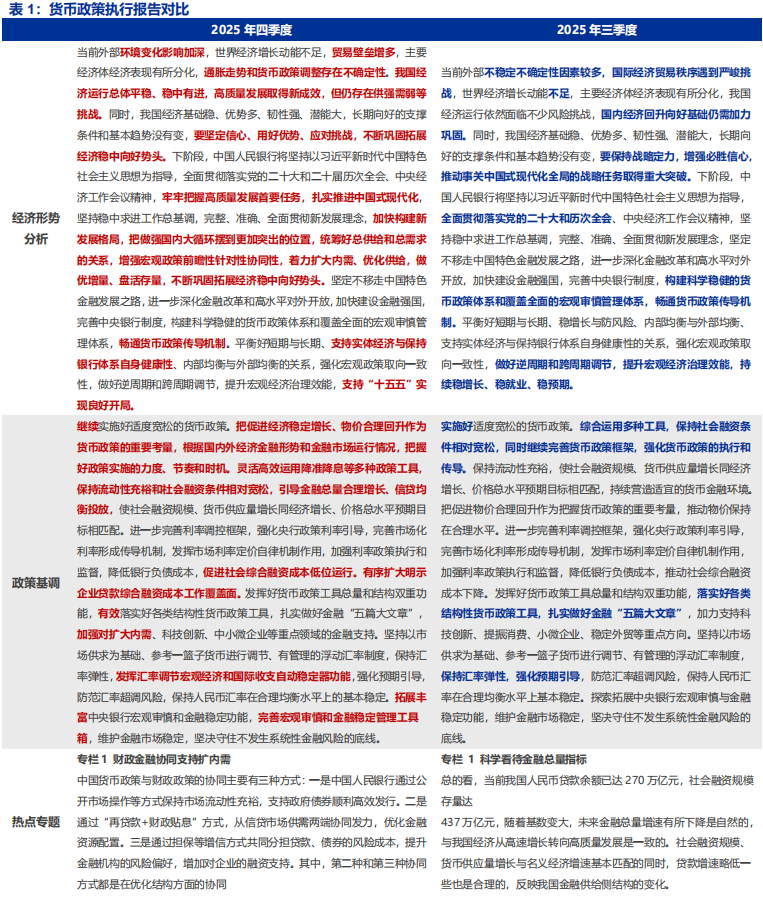
政策解读|聚焦内需,聚力开局——2025年四季度货币政策执行报告解读
赵伟宏观探索· 2026-02-11 16:03
Core Viewpoint - The central bank's report emphasizes the need to support domestic demand and ensure a good start for the "14th Five-Year Plan" amidst uncertainties in external inflation trends and monetary policy adjustments [2][15]. Economic Situation Analysis - The report highlights the deepening impact of external environmental changes, with a focus on the uncertainty of inflation trends and monetary policy adjustments, reflecting increased concerns about the complexity of the international environment since the fourth quarter [2][15]. - It assesses the domestic economy by prioritizing internal demand, stating the importance of strengthening the domestic circulation and supporting a good start for the "14th Five-Year Plan" [2][15]. Policy Tone - The report continues to implement a moderately loose monetary policy, emphasizing the flexible and efficient use of various policy tools such as reserve requirement ratio (RRR) cuts and interest rate reductions [3][16]. - It stresses the importance of maintaining a healthy banking system while promoting low financing costs for society, indicating a focus on the transmission mechanism of monetary policy [3][16]. Key Issues - The report discusses fiscal and financial coordination measures to support domestic demand, outlining three types of collaborative measures: maintaining ample liquidity, "re-lending + fiscal subsidies," and guarantees to enhance credit [4][17]. - It also examines the growth of asset management products, which reached a total asset balance of 120 trillion yuan by the end of 2025, reflecting a year-on-year increase of 13.1%, primarily directed towards interbank deposits and certificates of deposit [4][17]. Specialized Topics - The report addresses green finance, suggesting the optimization of carbon reduction support tools and the innovation of carbon financial products and derivatives [5][17]. - It introduces a one-time credit repair policy aimed at positively impacting individuals, financial institutions, and the economy as a whole [5][17].