
全国统一大市场

Search documents
鲁渤:完善现代流通网络畅通双循环
Jing Ji Ri Bao· 2025-11-05 00:20
Core Viewpoint - Accelerating the construction of a high-efficiency, standardized, fair competition, and fully open national unified market is crucial for breaking regional barriers and promoting the free flow of factors and efficient resource allocation, thereby unleashing the potential of a super-large-scale market and accelerating the establishment of a new development pattern [1] Group 1: Importance of Modern Circulation Network - The modern circulation network is a key carrier for addressing bottlenecks in the domestic circulation, effectively shortening time and space distances, and reducing circulation costs through modern infrastructure such as railways, highways, and ports [2] - The modern circulation network consists of "strategic pivot cities + backbone circulation corridors," playing a fundamental role in the national economic cycle and enhancing circulation efficiency while lowering costs [3] - A high-efficiency and smooth modern circulation network can significantly promote the national economic cycle by facilitating the efficient flow of goods and services through a three-dimensional layout of "channels + hubs + networks" [3] Group 2: Breaking Market Barriers - The advancement of a national unified market requires unified rules, interconnected facilities, and sufficient competition, with the modern circulation network playing a vital role in breaking physical barriers and promoting resource flow [4] - The construction of a modern circulation network can standardize and smartly build systems that facilitate the smooth flow of resources across larger areas, thereby optimizing allocation [4] Group 3: Reducing Logistics Costs - The level of social logistics costs reflects the quality of national economic development and competitiveness, and reducing these costs is beneficial for smoother flow of goods and services [5] - The modern circulation network can effectively lower social logistics costs and transaction costs through process optimization and smart scheduling, enhancing economic efficiency [5] Group 4: Addressing Market Blockages - The modern circulation network is essential for promoting the integration of markets and breaking through existing blockages in the super-large-scale market, focusing on high-standard connectivity of facilities and smooth flow of factors [6][7] - The network supports the integration of urban and rural markets, with e-commerce and cold chain logistics reshaping production and sales patterns [7] Group 5: Systematic Advancement of Modern Circulation Network - Building and improving the modern circulation network requires systematic advancement from top-level design, digital transformation, institutional reform, and enterprise cultivation [9] - Emphasizing top-level design and planning is crucial for establishing a unified national circulation network and ensuring collaborative approval and regulation across regions [9] - Promoting data element innovation and the application of technologies like IoT and digital twins in logistics can significantly enhance the efficiency and resilience of the circulation system [10]
把宏伟蓝图化成施工图路线图
He Nan Ri Bao· 2025-11-04 23:55
11月4日,省委书记刘宁主持召开部分省辖市及省直单位"十五五"时期经济社会发展座谈会,强调要深 入学习贯彻党的二十届四中全会精神和习近平总书记在河南考察时重要讲话精神,广泛听取意见建议, 深入研究重要问题,确保制定出符合发展规律、顺应人民期盼、具有河南特色的高质量规划,为奋力谱 写中原大地推进中国式现代化新篇章提供科学指引。 习近平总书记在我省考察时提出的奋斗目标和重大要求,为河南工作指明了前进方向、擘画了发展蓝 图。把宏伟蓝图变成美好现实,必须准确把握"十五五"时期经济社会发展的指导思想、重大原则、主要 目标、战略任务、重大举措、根本保证,把我省"十五五"发展放在中国式现代化建设战略全局中来审视 来定位,切实增强规划编制工作的科学性、预见性、主动性。 一份规划,就是一份施工图。要全面对标对表《中共中央关于制定国民经济和社会发展第十五个五年规 划的建议》,坚持国家所需与河南所能紧密结合、全面推进与重点突破有机贯通、质量效益与规模速度 统筹兼顾。要牢牢扭住高质量发展主题,坚持以经济建设为中心,完整准确全面贯彻新发展理念,特别 是要深入研究构建现代化产业体系、巩固壮大实体经济、发展民营经济等,推动经济实现质的有效 ...
完善现代流通网络畅通双循环
Jing Ji Ri Bao· 2025-11-04 22:52
Core Viewpoint - Accelerating the construction of a high-efficiency, standardized, fair competition, and fully open national unified market is crucial for breaking regional barriers, eliminating market restrictions, and promoting the free flow of factors and efficient resource allocation [1] Group 1: Importance of Modern Circulation Network - The modern circulation network is essential for addressing bottlenecks in domestic circulation and is characterized by modern infrastructure such as railways, highways, and ports, which reduce circulation costs and enhance the efficient flow of resources across regions [2][3] - A well-structured modern circulation network can significantly improve circulation efficiency, lower costs, and facilitate the national economic cycle by integrating various transportation modes and logistics systems [3][5] Group 2: Breaking Market Barriers - The advancement of a unified national market requires the elimination of barriers through standardized and intelligent infrastructure, enabling resources to flow smoothly across larger areas [4] - Establishing a modern circulation network can help unify market rules and standards, fostering a cross-regional, non-discriminatory market environment [4] Group 3: Reducing Logistics Costs - The level of social logistics costs reflects the quality of national economic development and competitiveness; reducing these costs facilitates smoother flow of goods and services, enhancing product competitiveness [5] - Modern circulation networks can lower overall logistics and transaction costs through process optimization and smart scheduling, thereby improving economic efficiency [5] Group 4: Enhancing Market Integration - The modern circulation network supports the integration of urban and rural markets, breaking geographical limitations and reshaping production and sales patterns [7] - Standardized logistics practices and unified market rules are foundational for market integration, improving circulation efficiency and consistency in market regulations [7] Group 5: Systematic Advancement of Modern Circulation Network - Building a modern circulation network requires top-level design, data-driven transformation, institutional reforms, and enterprise cultivation to promote a unified national market [9] - Emphasizing the importance of a national logistics data platform and the integration of advanced technologies like IoT and digital twins can significantly enhance logistics efficiency and resilience [10][11]
浙江5城霸榜长三角增速榜,江苏失落
21世纪经济报道· 2025-11-04 05:59
Core Viewpoint - The economic performance of the Yangtze River Delta (YRD) region is strong, with a GDP contribution of approximately 25% to the national total, driven by advanced manufacturing and a recovering consumer market [1][3]. Economic Growth - In the first three quarters, the total GDP of Jiangsu, Zhejiang, Shanghai, and Anhui reached 251,797.17 billion yuan, with 30 out of 41 cities in the YRD outpacing the national average growth rate of 5.2% [1][3]. - Zhejiang led the growth with a GDP increase of 5.7%, followed by Shanghai (5.5%), Jiangsu (5.4%), and Anhui (5.4%) [3][4]. - Jiangsu's GDP totaled 102,811 billion yuan, making it the largest in the YRD, while Zhejiang and Shanghai followed with 68,495 billion yuan and 40,721.17 billion yuan, respectively [3][4]. Advanced Manufacturing - Advanced manufacturing is a key driver of Jiangsu's economic stability, with significant contributions to GDP growth and risk resilience [3][4]. - In Shanghai, the AI and integrated circuit sectors saw double-digit growth, while Jiangsu's high-tech manufacturing also maintained strong growth rates [1][8]. - Anhui's high-tech manufacturing value added increased by 27.8%, showcasing its emerging advantages [1][8]. Consumer Market Recovery - The consumer market in the YRD is steadily recovering, with policies like "old-for-new" driving sales in appliances, automobiles, and electronics [1][10]. - Jiangsu's retail sales growth was supported by local sports events, with a 13% increase in sports service revenue [10][12]. - Zhejiang's retail sales growth of 5.2% was bolstered by events like the Wuzhen Theatre Festival and other local activities [9][11]. Structural Changes in Consumption - The integration of digital economy and consumer scenarios in Zhejiang has enhanced consumption, with innovations in e-commerce and payment systems [11]. - The "Su Chao effect" has strengthened regional consumption collaboration, encouraging cities to leverage their unique characteristics for enhanced consumer engagement [12].

学习贯彻党的二十届四中全会精神·权威访谈丨奋力开创高质量发展高效能治理新局面——访濮阳市委书记万正峰
He Nan Ri Bao· 2025-11-04 00:01
Group 1: Economic Development and Industrial Strategy - Puyang City aims to strengthen its manufacturing backbone and solidify the foundation for high-quality development, focusing on the chemical new materials industry with 185 large-scale industrial enterprises and an output value of 85 billion yuan [1] - The city plans to enhance its green chemical and new materials industry to achieve an output value exceeding 200 billion yuan during the 14th Five-Year Plan, establishing itself as a leading domestic base for chemical new materials [1] - Puyang will also upgrade its modern home furnishings, down products, and apparel industries while developing emerging sectors like biomanufacturing and high-end equipment, and will accelerate the layout of future industries such as hydrogen energy and artificial intelligence [1] Group 2: Market Integration and Infrastructure Development - Puyang City will actively integrate into the national unified market, leveraging its geographical advantages to enhance connectivity and drive economic circulation [2] - The city is committed to improving the business environment through six major actions, including market expansion and infrastructure connectivity, while focusing on the construction of key transportation corridors like the Xiongshan and Anpu-Henan high-speed railways [2] - Puyang aims to serve as a hub for both domestic and international market dual circulation, contributing to the national unified market [2] Group 3: Social Governance and Environmental Protection - Puyang City will enhance social governance by promoting efficient grassroots governance and utilizing a model that combines party building, grid management, and big data [3] - The city will focus on improving public welfare and addressing urgent issues faced by the populace, ensuring a high quality of life [2] - Puyang is committed to ecological protection, aiming to enhance the storage capacity of the Central Plains gas storage cluster to approximately 16 billion cubic meters and promote the development of non-grain bio-based materials [2]
把经济建设这个中心抓得更牢
Sou Hu Cai Jing· 2025-11-03 21:52
Core Insights - The latest data from the National Bureau of Statistics indicates that China's automotive manufacturing, railway, shipping, aerospace, and other transportation equipment manufacturing industries have maintained double-digit growth year-on-year in the first three quarters [1] - High-tech manufacturing sectors, such as intelligent drone manufacturing and intelligent vehicle-mounted equipment manufacturing, have seen significant increases in value added, with growth rates of 59.9% and 25.1% respectively [1] - The 20th Central Committee of the Communist Party emphasizes the importance of economic construction, high-quality development, reform and innovation, and the need to meet the growing demands of the people [1] Investment and Economic Strategy - The focus on enhancing quality while expanding total volume is crucial, with a need to balance reasonable growth rates with structural optimization [2] - Key performance indicators will include total factor productivity, innovation capability, industrial resilience, resource allocation efficiency, and public service quality [2] - The approach aims to stabilize short-term growth while laying a foundation for long-term high-quality development [2] Industrial Development - Strengthening and optimizing the real economy is essential for implementing the focus on economic construction at the industrial and supply side [3] - The development of the domestically produced C919 aircraft exemplifies the need for a coordinated system involving research, manufacturing, certification, market expansion, and talent cultivation [3] - There is a call to address weaknesses in the industrial supply chain, particularly in core components, basic processes, and key materials [3] Market Integration - Promoting a unified national market is vital for enhancing domestic circulation and strengthening the domestic market [4] - Efforts will be made to streamline regulations and eliminate unreasonable regional barriers to improve the business environment [4] - The focus will also be on optimizing consumer environments and directing investments towards key areas that address shortcomings and enhance capabilities [4] Innovation and Productivity - Cultivating new productive forces is essential for aligning economic construction with innovation across various chains, including industry, finance, and talent [5] - Emphasis will be placed on demand-driven research organization and improving the efficiency of transitioning from pilot projects to large-scale applications [5] - Continuous reforms in key areas such as property rights protection, market-oriented resource allocation, and financial systems are necessary to remove obstacles to high-quality development [5]
国家发改委:鼓励城市间数据基础设施互联互通
Zhong Guo Xin Wen Wang· 2025-11-03 09:39
Core Viewpoint - The National Development and Reform Commission (NDRC) has issued an "Action Plan" to promote the interconnectivity of data infrastructure between cities, aiming to facilitate efficient cross-domain data flow and address the issue of data silos in smart city development [1][2] Group 1: Action Plan Overview - The "Action Plan" emphasizes the need for a unified digital foundation by implementing standardized identification, registration, and interface requirements for city data infrastructure [1] - It aims to break down existing data silos that hinder collaboration between different departments and regions, which has led to inefficiencies in public services [1] Group 2: Regional Initiatives - Some regions, such as the Yangtze River Delta, have already begun to take action by establishing a data cooperation mechanism to promote data integration [2] - The focus areas for this regional cooperation include secure data circulation, collaborative development of computing resources, and integrated public data utilization [2] Group 3: National Implications - The NDRC's encouragement for inter-city data infrastructure interconnectivity signifies a shift from local initiatives to a national-level design, laying a solid foundation for the establishment of a unified national market [2]
招商引资的新路来了
母基金研究中心· 2025-11-03 09:09
Core Viewpoint - The article discusses the evolving landscape of investment attraction and industrial development in China, emphasizing the need for standardized practices and new strategies in response to recent regulatory changes and market dynamics [1][2][3]. Group 1: Regulatory Changes - The implementation of the "Fair Competition Review Regulations" (State Order No. 783) since August last year prohibits preferential tax policies and selective financial rewards for specific operators without legal basis or government approval [1]. - The State Council issued guidelines on promoting the high-quality development of government investment funds, stating that these funds should not be established solely for the purpose of attracting investment [2][3]. Group 2: Policy Guidance - The National Development and Reform Commission (NDRC) is focusing on rectifying irregularities in local investment attraction practices, which have led to unhealthy competition through tax and land incentives [3]. - A unified list of permissible and prohibited behaviors for local investment attraction is being developed to enhance transparency and accountability [2][3]. Group 3: New Investment Strategies - Local governments are shifting their investment attraction strategies to focus on nurturing their own advantageous industries based on local resources rather than merely attracting established external enterprises [5]. - Four new approaches to investment attraction have emerged, including capital-industry matching conferences, fund promotion events, industry forums, and international investment summits [5][11][19][24]. Group 4: Event Highlights - The "Fujian Capital and Industry Matching Conference" held in October 2025 attracted over 150 fund representatives, showcasing the importance of connecting financial capital with local projects [6]. - The "2023 Deyang Fund Promotion Conference" in Shanghai highlighted the collaboration between local governments and financial institutions to promote investment opportunities [11][12]. - The "First China-Arab Investment Summit" in April 2025 aimed to facilitate cross-border investment and cooperation between China and the Middle East [26][27]. Group 5: Outcomes and Impact - The various investment attraction models have proven effective, with past events resulting in over 10 billion yuan in fund collaborations and more than 50 projects being realized [27].

大国五年|中国市场,铸就公平竞争大舞台
Xin Hua She· 2025-11-03 03:24
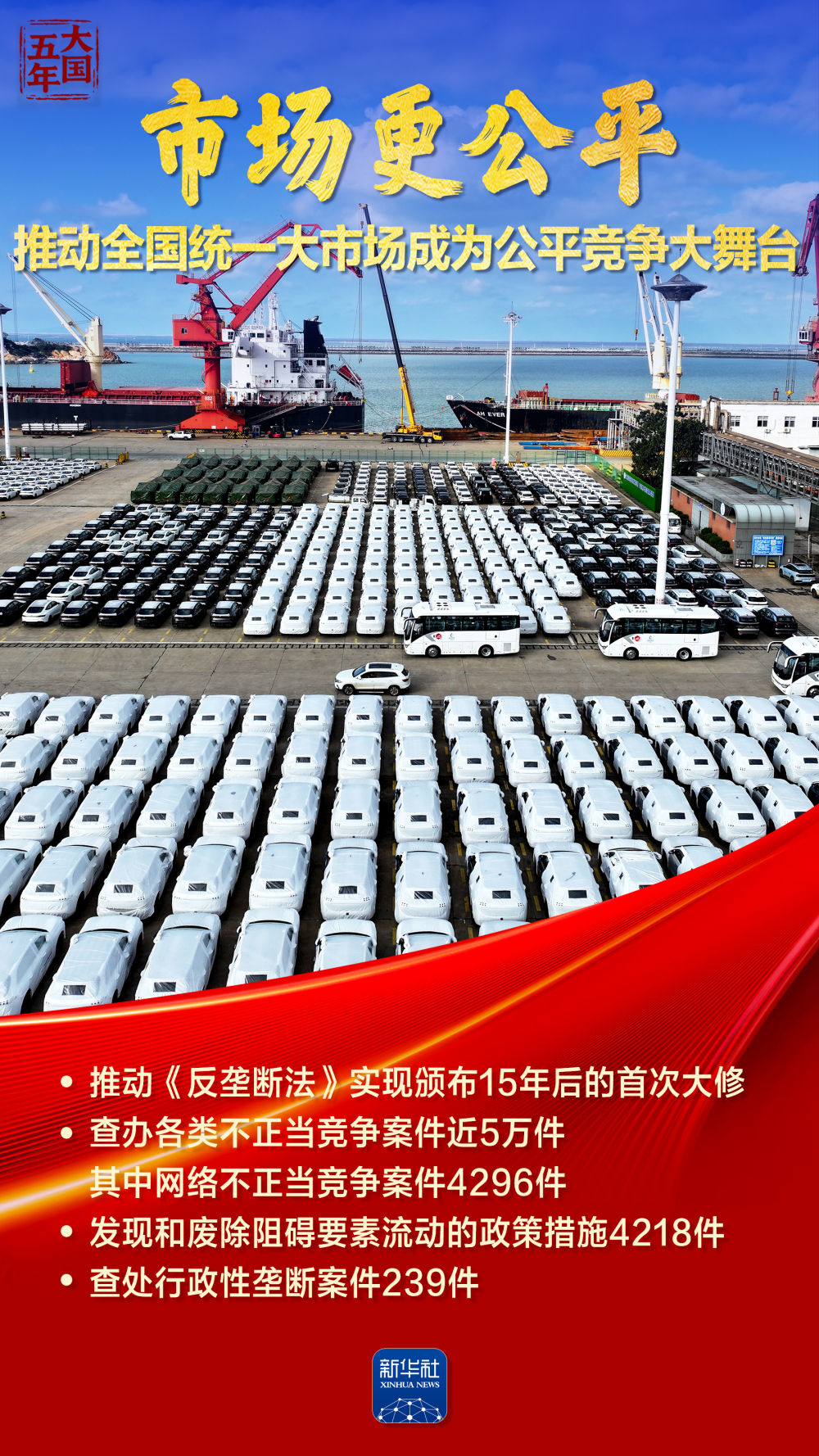
Core Viewpoint - The article emphasizes the transformation of China's market system, highlighting the establishment of a high-standard market framework and the optimization of the business environment, which collectively enhance market vitality and promote innovation and consumer confidence. Group 1: Market System Development - The establishment of a nationwide unified market facilitates the smooth flow of production factors and enhances the business environment, leading to increased vitality among over a billion market entities [1] - The "14th Five-Year Plan" aims to create a more standardized, efficient, and open Chinese market, reflecting in the innovation enthusiasm and convenience experienced by individuals [1] Group 2: Regulatory and Compliance Measures - The revision of the Anti-Monopoly Law marks a significant update after 15 years, with nearly 50,000 cases of unfair competition investigated, including 4,296 cases related to online competition [4] - The implementation of the "separation of licenses and permits" reform has streamlined the process for starting businesses, with 3.7 billion downloads of electronic business licenses [6] Group 3: Standardization and Quality Control - Over 13,000 national standards have been newly released, bringing the total to over 47,000, with a significant reduction in the average development cycle from 36 months to 16 months [8] - The inclusion of 15 products, including lithium batteries for electric bicycles, into CCC certification management enhances product safety and compliance [11] Group 4: Consumer Protection and Safety - A total of 226.04 million food safety cases have been investigated, maintaining high compliance rates for grain, meat, and dairy products [16] - The drug inspection pass rate remains stable at over 99.4%, with over 200 innovative drugs and 387 children's medications approved for market [20] Group 5: E-commerce and Online Regulation - Platforms have been urged to delete over 4.5 million illegal product listings, with significant actions taken against non-compliant online stores [13][14] - The government has introduced guidelines to enhance compliance management within online trading platforms [14]
拓展增量 提升效益 畅通循环——锚定三方面重点任务 建设强大国内市场
Zhong Guo Zheng Quan Bao· 2025-11-03 02:39
Core Viewpoint - The "15th Five-Year Plan" emphasizes the importance of a strong domestic market as a strategic foundation for China's modernization, focusing on expanding domestic demand and enhancing the interaction between supply and demand to boost economic resilience [1][2]. Group 1: Consumer Demand - The plan prioritizes boosting consumption as a key task for building a strong domestic market, leveraging the potential of over 800 million middle-income individuals in China [2]. - Measures include increasing public service spending and implementing inclusive policies to enhance consumer capacity, with a focus on improving employment as a fundamental aspect [2][3]. - The strategy involves both demand-side and supply-side efforts to stimulate consumption, with an emphasis on creating a favorable consumption environment through institutional guarantees [3]. Group 2: Investment Focus - The concept of "investing in people" is highlighted as crucial for economic and social structural transformation, with a call for optimizing investment structures and enhancing investment efficiency [4][5]. - The plan suggests increasing investments in public services and human capital, particularly in education, healthcare, and emerging technologies, to support sustainable economic growth [4][5]. - Specific measures include improving government investment management and reforming investment approval processes to ensure effective allocation of resources [5]. Group 3: Market Barriers - The plan aims to eliminate various market barriers to facilitate the efficient aggregation of domestic and international resources, thereby unlocking China's market potential [6][7]. - Significant progress has been made in cleaning up regulations that hinder market unity, with a reduction in market access restrictions and policies obstructing resource flow [6][7]. - The establishment of a unified national market is seen as essential for enhancing market efficiency and promoting coordinated regional development [6][7].