
硬科技

Search documents
西安上市公司数量将再“+1”!
Sou Hu Cai Jing· 2025-11-04 12:07
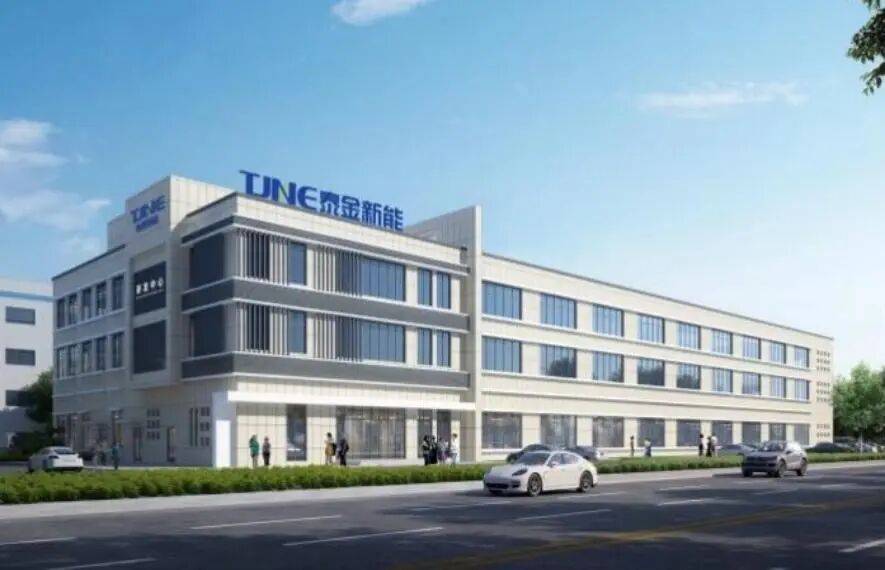
Core Points - Xi'an's enterprises are actively pursuing capital market opportunities, with multiple companies preparing for IPOs and listings, including TaiJin New Energy Technology Co., Ltd. [1][8] - TaiJin New Energy is set to become the 84th A-share listed company in Shaanxi and the 16th on the Sci-Tech Innovation Board [8][9] - The company specializes in high-end green electrolysis equipment and has significant applications in various high-tech fields [3][4] Company Overview - TaiJin New Energy, a subsidiary of the Northwest Institute of Nonferrous Metal Research, was established in 2000 and focuses on the R&D, design, production, and sales of advanced green electrolysis equipment, titanium electrodes, and metal glass sealing products [3][4] - The company is recognized as a national manufacturing champion and a key player in the titanium and titanium alloy industry chain in Shaanxi [3][4] Financial Performance - TaiJin New Energy's revenue from 2022 to the first half of 2025 shows a growth trajectory: 1.005 billion, 1.669 billion, 2.194 billion, and 1.164 billion yuan respectively, with net profits of 87 million, 138 million, 183 million, and 101 million yuan [5][6] - The core product, electrolysis equipment, accounted for over 50% of the main business revenue, with 65.11% in the first half of 2025 [5] IPO Details - The company plans to raise 990 million yuan through its IPO, focusing on projects related to high-end intelligent electrolysis equipment, titanium electrode materials, and R&D center construction [6][7] - The total investment for these projects is approximately 1.493 billion yuan, with significant portions allocated to the development of high-performance materials [6] Industry Context - As of October 31, 2025, Shaanxi ranks 14th in the number of A-share listed companies in China, with 83 companies, and is the second in the western region, following Sichuan [7][8] - The Northwest Institute has previously facilitated the listing of multiple companies, contributing to the growth of Shaanxi's presence in the capital market [12][13] Future Prospects - The recent developments in Shaanxi's capital market, including the upcoming listing of Shaanxi Tourism, indicate a growing trend of high-tech companies entering the market [9][14] - The establishment of the Qin Chuang Yuan Development Forum highlights the region's commitment to fostering innovation and capital integration [15][18]

科技回调或迎布局机会,科创板50ETF(588080)连续4个交易日获资金净流入
Mei Ri Jing Ji Xin Wen· 2025-11-04 10:23
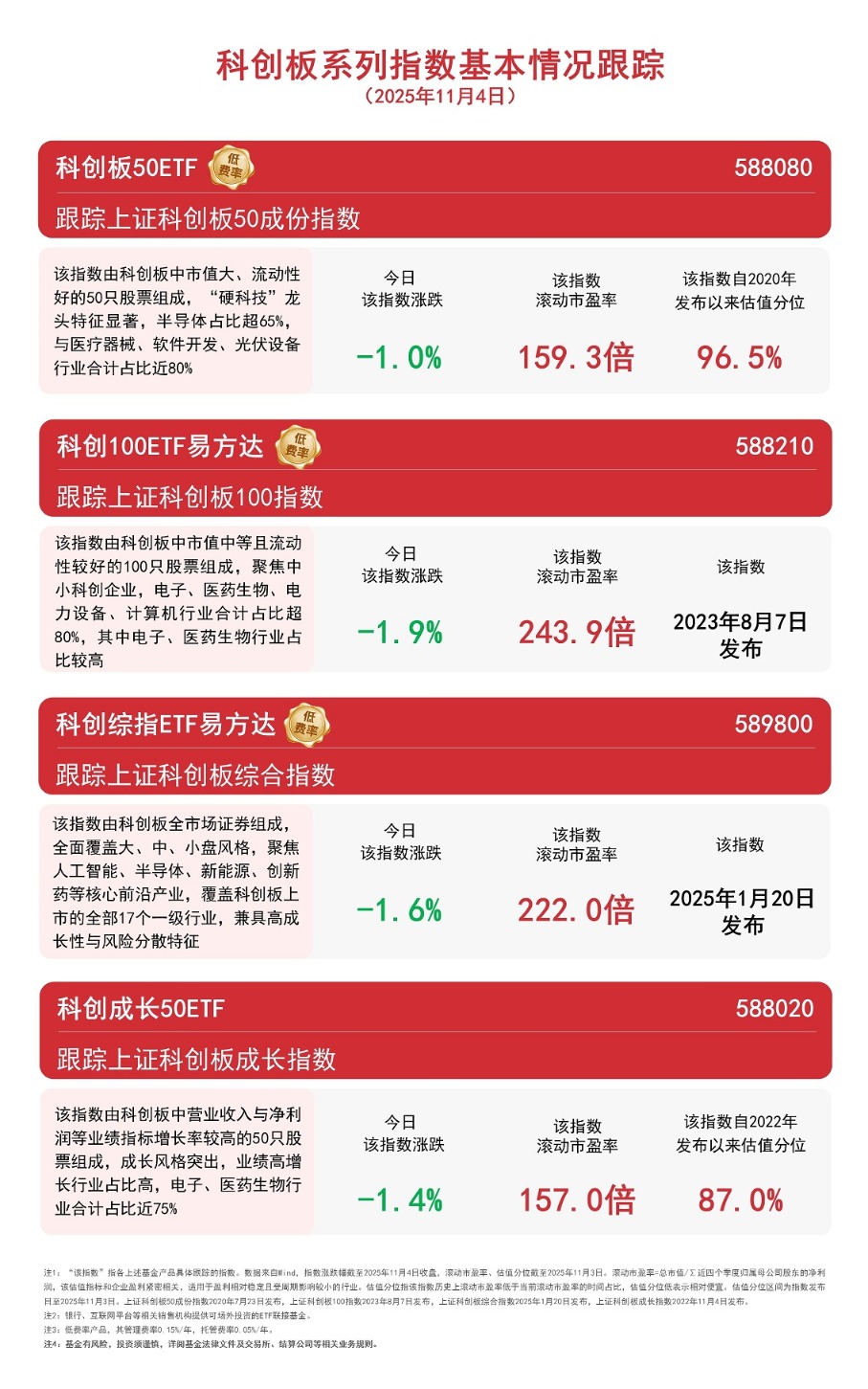
Group 1 - The technology sector experienced a volatile adjustment today, with the robotics sector leading the decline, and both computing hardware and innovative pharmaceutical and medical device stocks collectively falling [1] - As of the market close, the STAR Market 50 Index dropped by 1.0%, the STAR Growth Index fell by 1.4%, the STAR Composite Index decreased by 1.6%, and the STAR 100 Index declined by 1.9% [1] - According to Wind data, the STAR Market 50 ETF (588080) has seen a net inflow of funds for four consecutive trading days, totaling over 500 million yuan [1] Group 2 - The STAR Market 50 ETF tracks the STAR Market 50 Index, which consists of 50 stocks with large market capitalization and good liquidity, prominently featuring "hard technology" companies, with over 65% in semiconductors and nearly 80% in total across medical devices, software development, and photovoltaic equipment [3] - The STAR 100 ETF focuses on 100 medium-cap stocks with good liquidity, with over 80% in electronics, pharmaceuticals, and electrical equipment, and a significant portion in the electronics and pharmaceuticals sectors [3] - The STAR Composite Index ETF covers all securities in the STAR Market, focusing on core frontier industries such as artificial intelligence, semiconductors, new energy, and innovative pharmaceuticals, encompassing all 17 primary industries in the STAR Market [3]
“十五五”规划敲定投资方向,这类ETF迎来高光时刻!
市值风云· 2025-11-04 10:09
Core Viewpoint - The article emphasizes the importance of investing in hard technology sectors, highlighting that ETFs are ideal tools for sharing policy dividends as the "14th Five-Year Plan" transitions into actionable policies [3][6]. Group 1: Policy and Market Context - The "14th Five-Year Plan" aims to accelerate high-level technological self-reliance and establish a modern industrial system centered on advanced manufacturing, injecting strong momentum into China's high-tech industry [3][6]. - Historical data indicates that the technology sector, as a policy focus, has outperformed most other sectors in the 1-3 years following policy announcements [4][9]. - The recent A-share market recovery in the technology sector, with significant inflows into technology ETFs, signals a strong market response to policy expectations [7][9]. Group 2: Performance of Technology Sectors - The A-share market has shown robust performance, with the Shanghai Composite Index rising from 2748.92 points to 4000 points, largely driven by the electronics sector, which contributed 34.9% to this increase [10][11]. - The current market rally is characterized as a "hard technology-driven" structural bull market, reflecting a fundamental shift in economic growth dynamics [12][13]. Group 3: Investment Opportunities in ETFs - Technology ETFs have become a primary tool for investors to access the A-share market, with a total market size exceeding 5 trillion, offering low-cost, transparent, and convenient investment options [13][14]. - The Sci-Tech Innovation 50 ETF has shown an average return of 60.8% this year, with the largest fund, the Sci-Tech Innovation ETF, achieving a return of 61.5% [14][19]. - The top holdings in the Sci-Tech Innovation 50 Index include leading companies in semiconductor and renewable energy sectors, indicating strong growth potential [16][24]. Group 4: Risk and Stability in Investment - The article discusses the high volatility associated with the Sci-Tech Innovation 50 Index, which has experienced a maximum drawdown exceeding 60% since inception, suggesting that investors should be prepared for significant fluctuations [25][27]. - For risk-averse investors, the Sci-Tech Bond ETFs provide a more stable investment option, combining fixed income with exposure to technology sectors, thus reducing overall asset volatility [28][36].
科创200指数:小盘高弹性的“硬科技”备受关注
Sou Hu Cai Jing· 2025-11-04 09:14
Core Insights - The Sci-Tech 200 Index has gained over 47% year-to-date as of October 29, outperforming major A-share indices, highlighting its appeal to investors due to its small-cap characteristics and high growth potential [1] - The Sci-Tech 200 Index is part of a comprehensive index system that includes large, medium, and small-cap stocks, focusing specifically on small-cap companies within the Sci-Tech Board [1][3] - The industry distribution of the Sci-Tech series indices shows significant differences, with the Sci-Tech 50 heavily concentrated in the electronics sector, while the Sci-Tech 200 has a more balanced distribution across various industries, including electronics, pharmaceuticals, and machinery [1][3] Investment Style Comparison - The Sci-Tech 50 Index represents large-cap stocks with strong institutional backing, while the Sci-Tech 200 Index showcases a small-cap growth style, with over 40% of its constituents being "specialized and innovative" enterprises [3] - The R&D expenditure as a percentage of revenue for the Sci-Tech 200 constituents is higher than that of the Sci-Tech 50, indicating a strong commitment to innovation and future profitability [3] Long-term Growth Potential - The Sci-Tech 200 is positioned to benefit from policy catalysts and industry opportunities, with new regulations expanding the listing channels for frontier technology companies [3] - The predicted net profit growth rate for the Sci-Tech 200 Index in 2025 is 240%, significantly higher than the 40% expected for the Sci-Tech 50, driven by investments in AI, semiconductor materials, biomedicine, and new energy technologies [4] Strategic Importance - The Sci-Tech 200 Index is expected to play a crucial role in China's technological self-reliance journey, focusing on core technologies and self-controlled industrial chains [7]

“2025投中榜·锐公司100”榜单调研启动:寻找定义未来的产业新锐
投中网· 2025-11-04 07:04
Core Insights - The narrative of China's innovation economy has shifted towards "hard technology" as a cornerstone for survival and competition, indicating a paradigm shift in global tech competition from singular technological breakthroughs to the construction and dominance of complex system ecosystems [2] - The development of hard technology has become the main theme, with advancements in generative AI, carbon neutrality, biotechnology, and advanced manufacturing driving significant changes across various sectors [2] Industry Trends - The transition from model innovation to hard-core driving and from application integration to foundational breakthroughs is evident in China's industrial upgrade path [2] - Generative AI is moving from technical exploration to industrial integration, reconstructing the entire chain from research and development to service through vertical applications [2] - The carbon neutrality sector is expanding its technological boundaries with parallel developments in green hydrogen and new energy storage, pushing the energy revolution into deeper waters [2] - Biotechnology is experiencing a paradigm shift in research and development driven by AI for Science, leading to more precise and efficient solutions [2] - Advanced manufacturing is achieving breakthroughs in key areas such as semiconductor equipment and high-end materials under the dual goals of "self-control" and "global competitiveness" [2] Company Evaluation Criteria - The "VIGOROUS 100" list will evaluate companies based on external attention, industry synergy, and industry influence, focusing on those with strong drive and potential for innovation and growth [3][5] - Eligible companies must belong to key innovation categories such as new generation information technology, healthcare, carbon neutrality, and advanced manufacturing [7] - Participating companies should have a valuation of over 1 billion RMB, be at least in Series A funding, and have financing records within the last three years [8]
机构看好存储控制器市场!科创50ETF(588000)成交额超28亿
Mei Ri Jing Ji Xin Wen· 2025-11-04 06:52
Group 1 - The A-share market continues to show a downward trend, with the Sci-Tech 50 ETF experiencing a maximum decline of 0.61% and a trading volume exceeding 2.8 billion yuan, ranking first among similar products [1] - TSMC plans to implement annual price increases of approximately 3%-5% for advanced processes from 2026 to 2029, reflecting strong demand for AI and high-performance computing chips [1] - TSMC's gross margin is expected to reach 59%-61% in Q4, indicating sustained industry prosperity and reinforcing its leading position in the global semiconductor manufacturing sector [1] Group 2 - The storage controller market is projected to grow at a compound annual growth rate of 14.4% from 2025 to 2032, with the market size expected to exceed 66.1 billion USD by 2032 [2] - Investment focus areas include high-end PCIe 5.0 controllers driven by AI and cloud computing, as well as automotive electronics and industrial IoT opportunities [2] - The Sci-Tech 50 ETF tracks the Sci-Tech 50 Index, with 69.3% of its holdings in the electronics sector and 5.17% in the computer sector, aligning well with the development of AI and robotics [2]
半导体设备个股走强,科创板局部活跃,科创板50ETF(588080)助力布局产业链龙头
Mei Ri Jing Ji Xin Wen· 2025-11-04 06:03
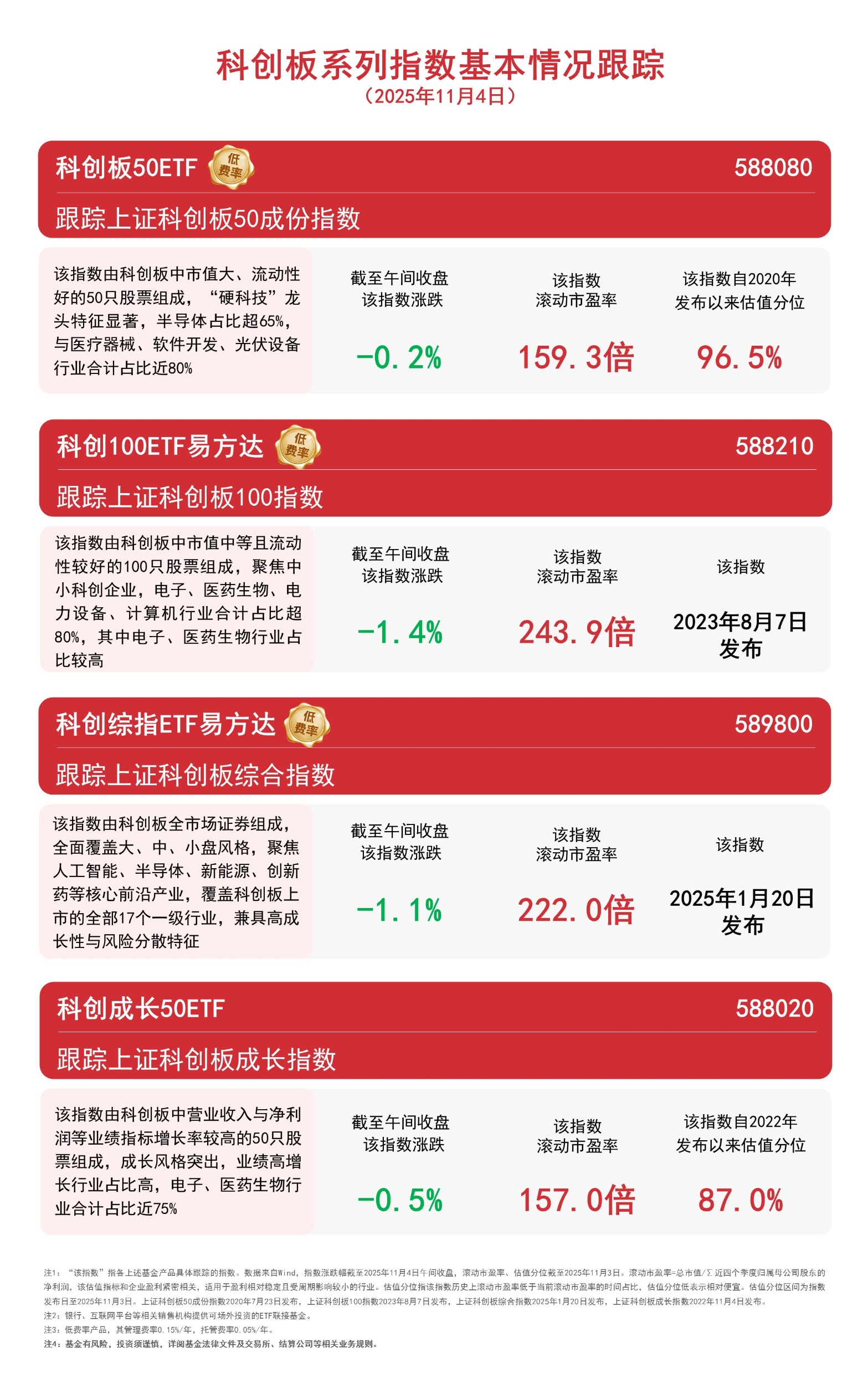
Group 1 - The Sci-Tech Innovation Board (STAR Market) has several ETFs that track different indices, focusing on companies with strong market capitalization and liquidity in the technology sector [2][3][4] - The STAR 50 ETF tracks the STAR 50 Index, which consists of 50 large-cap stocks, with over 65% in the semiconductor sector and nearly 80% combined with medical devices, software development, and photovoltaic equipment [2] - The STAR 100 ETF follows the STAR 100 Index, comprising 100 mid-cap stocks, with over 80% in electronics, biomedicine, and power equipment sectors, highlighting a significant focus on small and medium-sized tech enterprises [3] Group 2 - The STAR Comprehensive Index ETF tracks the overall STAR Market, covering all 17 primary industries listed on the board, including artificial intelligence, semiconductors, new energy, and innovative pharmaceuticals, showcasing both high growth potential and risk diversification [5] - As of the latest trading session, the STAR 50 Index increased by 2% with a rolling price-to-earnings ratio of 159.3, while the STAR 100 Index rose by 4% with a rolling price-to-earnings ratio of (0).243 [2][3] - The STAR Comprehensive Index experienced a decline of 1.1% with a rolling price-to-earnings ratio of 222.0, indicating varying performance across different indices [5]
逢低布局,资金连续流入科创50ETF
Mei Ri Jing Ji Xin Wen· 2025-11-04 05:05
Core Insights - The A-share market shows mixed performance with the Shanghai Composite Index up by 0.02%, while the Shenzhen Component Index and the ChiNext Index are down by 0.43% and 0.37% respectively [1] - The Science and Technology Innovation 50 ETF (588000) has seen a 0.61% increase, with a latest price of 1.479 yuan and a trading volume of 1.087 billion yuan, indicating a turnover rate of 1.48% [1] - The ETF has experienced a net inflow of funds for four consecutive trading days, with a peak single-day net inflow of 1.647 billion yuan, totaling 2.395 billion yuan and an average daily net inflow of 599 million yuan [1] Sector Performance - The constituent stocks of the Science and Technology Innovation 50 ETF show mixed results, with notable gainers including Shengyi Electronics up by 6.9%, Zhongwei Company up by 6.38%, and Huahai Qingke up by 4% [1] - Conversely, leading decliners include Baiwei Storage down by 4.29%, Te Bao Biological down by 3.44%, and Baili Tianheng down by 2.87% [1] ETF Composition - The Science and Technology Innovation 50 ETF tracks the Science and Technology Innovation 50 Index, with 69.3% of its holdings in the electronics sector and 5.17% in the computer sector, totaling 74.47% [1] - The ETF aligns well with the development trends in cutting-edge industries such as artificial intelligence and robotics, while also covering various sub-sectors including medical devices, software development, and photovoltaic equipment [1]
陕西:加快秦创原体系化升级、健全教育科技人才一体发展体制机制
Jing Ji Guan Cha Wang· 2025-11-04 03:32
Core Insights - The 2025 Qin Chuang Yuan Development Forum and Hard Technology Innovation Conference opened in Xi'an, focusing on enhancing innovation capabilities and promoting the integration of technological and industrial innovation [1][2] - Shaanxi province aims to leverage the Xi'an regional technology innovation center to accelerate the transformation of scientific achievements and optimize the innovation ecosystem [1] - The China Association for the Promotion of Industry-University-Research Cooperation emphasizes the importance of collaboration between government, industry, academia, and research to enhance core competitiveness and promote the Qin Chuang Yuan model nationwide [1] Group 1 - Shaanxi's strategy includes deepening "three reforms" to boost the overall effectiveness of innovation [1] - The conference features various activities, including regional technology innovation meetings and discussions on drone industry development [2] - The event aims to facilitate efficient flow of capital, talent, and data within the innovation chain [1][2] Group 2 - The West's investment cooperation bureau highlighted Xi'an's policy advantages in industry support and market potential [2] - The Qin Chuang Yuan innovation-driven platform has achieved significant results in promoting technology transfer and nurturing innovative enterprises [2] - The conference is themed "Qin Chuang Yuan Leading Development, Hard Technology Driving the Future" and spans five days with multiple parallel sessions [2]
AI政策重磅释放!科创50ETF(588000)成交额超13亿居同类第一,近5日吸金23亿
Sou Hu Cai Jing· 2025-11-04 02:44
11月4日,A股开盘三大指数集体低开。科创50ETF(588000)开盘后冲高后震荡回落,最高涨幅超 1%。盘面上,持仓股中微公司、生益电子等涨超5%;资金上,科创50ETF(588000)近期持续受到资 金青睐,近5个交易日"吸金"23.11亿元,近10个交易日"吸金"13.64亿元,近20个交易日"吸金"41.23亿 元。截至发文,科创50ETF(588000)成交额超13亿元,位居同类产品第一。 科创50ETF(588000)追踪科创50指数,指数持仓电子行业69.3%,计算机行业5.17%,合计74.47%, 与当前人工智能、机器人等前沿产业的发展方向高度契合。同时涉及医疗器械、软件开发、光伏设备等 多个细分领域,硬科技含量高,看好中国硬科技长期发展前景的投资者建议持续关注。 相关ETF:科创50ETF(588000)。 每日经济新闻 消息面上,11月3日工信部发文,明确释放加速人工智能赋能新型工业化的重磅政策信号。文章强调, 将全力攻坚AI关键核心技术,夯实算力、算法、数据三大基础底座。具体举措包括:强化算力供给等 核心技术,并建设算力互联互通平台以强化协同调度。同时,政策层面计划出台"人工智能+制 ...