《大美丽法案》

Search documents
海外市场2026年度策略:云开雾霁,科技擎旗
Ping An Securities· 2025-12-14 12:42
Market Review - The MAGA policy framework has been established, leading to a rise in gold and a decline in the US dollar. In 2025, the Trump administration strongly promoted the "America First" policy, resulting in increased volatility in global capital markets, with gold leading the gains and the dollar weakening. The S&P 500 and Nasdaq indices rose by 17% and 22% respectively, while the dollar index fell by 8.8% throughout the year [3][9][10]. US Market - The US economy is expected to grow moderately in 2026, supported by both investment and consumption. The impact of previous tariffs is diminishing, and fiscal and monetary policies are showing effects. AI-related investments are anticipated to continue their strong momentum, while consumer spending is expected to gradually recover [3][4][9]. - Inflation remains sticky, with limited room for interest rate cuts. The expected range for rate cuts in 2026 is between 25-50 basis points, influenced by resilient wage growth and economic recovery [3][4][9]. - The political landscape, particularly the midterm elections, is likely to maintain a moderate policy tone, balancing economic stimulus with inflation control to create a favorable socio-economic environment [3][4][9]. US Stock Market - The US stock market is expected to continue its upward trend, driven by the AI narrative and recovery in cyclical and consumer sectors. Key investment opportunities include AI-related industries, which are still in the early stages of a potential bubble, and sectors benefiting from the "Great Beautiful Act" [3][4][9]. - The manufacturing and information sectors are projected to be the main beneficiaries of corporate tax cuts, while cyclical and consumer sectors are expected to recover as the economy stabilizes [3][4][9]. Hong Kong Stock Market - The Hong Kong stock market is anticipated to maintain a trend of oscillating upward, with structural opportunities emerging. The earnings growth in sectors such as semiconductors, automotive parts, and discretionary consumption is expected to improve significantly in 2026 [3][4][9]. - The liquidity environment is characterized by a decline in US Treasury yields, with foreign capital continuing to flow into the market. The strategic stability in US-China relations is likely to support risk appetite [3][4][9].
美股Q2财报季拉开帷幕:市场预期盈利骤降、关税成为关键摇摆因素、四大主题值得关注
Hua Er Jie Jian Wen· 2025-07-15 09:17
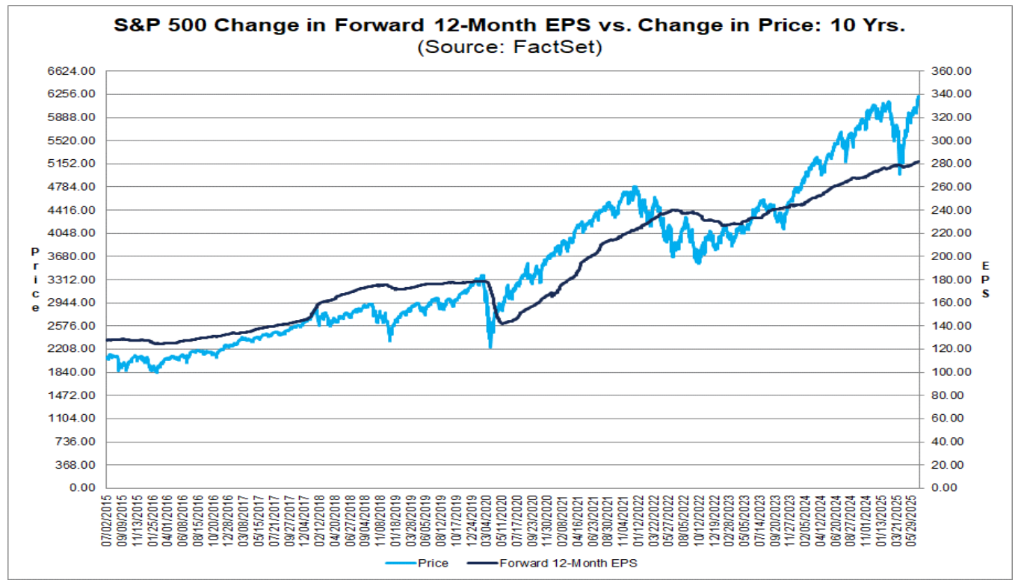
Core Viewpoint - The earnings growth for S&P 500 companies in Q2 is expected to slow significantly, with a projected increase of only 5%, marking the slowest growth since Q4 2023, down from 13% in Q1 [1][2][4]. Earnings Expectations - Analysts have downgraded earnings expectations due to tariff policies and weaker economic data, with a 4% reduction in Q2 forecasts, exceeding the historical average of 3% [4]. - Among the 11 sectors, 6 are expected to see year-over-year growth, led by communication services and information technology, while 5 sectors, including energy, are projected to decline [2][6]. Early Reporting Performance - Early reporting companies have shown strong performance, with 71% exceeding EPS expectations and 81% surpassing sales expectations among the 21 S&P 500 companies that have reported [4][5]. - The current forecast suggests a slight EPS beat of 2%, reaching $64, which represents a 6% year-over-year increase [4]. Sector Analysis - Technology and communication services are expected to drive earnings growth, with a combined growth rate of 20%. Excluding these sectors, S&P 500 earnings growth is projected to be negative 3% [6]. - The growth range for the overall market is expected to be narrow, with negative growth anticipated when excluding technology and communication services [5]. Guidance Trends - Recent trends indicate an improvement in earnings guidance, with the three-month guidance ratio returning to the average level of 0.8 [9]. - Approximately 30% of S&P 500 companies provided annual EPS guidance, a significant increase from 10% during the pandemic [11]. Tariff Impact - Tariff uncertainties remain a key volatility factor, with estimates suggesting a potential 5% direct impact on S&P 500 revenues if no mitigation measures are taken [11]. - Analysts are divided on the ability of companies to pass on tariff costs, with 25% expecting price increases to cover most tariff hikes, while 21% believe companies will struggle to raise prices [11]. Key Themes for Investors - Investors are advised to focus on four key themes: capital expenditure guidance, layoffs, foreign exchange impacts, and the influence of the "Big Beautiful Bill" [12][22]. - The proportion of CEOs planning to increase capital expenditures has dropped to 28%, the lowest level since the pandemic began [12]. Foreign Exchange and Economic Indicators - A 10% depreciation of the dollar is estimated to boost S&P 500 EPS by 3%, with foreign exchange providing a 60-70 basis point benefit in Q2 [18]. - The performance of large tech companies remains strong, with significant capital expenditure growth expected to continue [15][17].

中金研究 | 本周精选:宏观、策略、量化及ESG、食品饮料
中金点睛· 2025-07-11 11:59
Group 1: Macroeconomy - The core of the "Great Beautiful Act" signed by Trump includes significant tax cuts for corporations and individuals, reductions in clean energy subsidies, and cuts to Medicaid and SNAP, which will increase the fiscal deficit in the future [3] - The act is projected to boost the actual GDP by less than 0.5 percentage points and has an inflationary impact of no more than 0.15 percentage points by 2026 [3] - Over the next decade, the combination of tariffs and tax cuts is expected to increase the net deficit by approximately $1.3 trillion, maintaining a deficit rate around 6% [3] - Current economic conditions, including low unemployment and moderate inflation, suggest that the U.S. government debt does not face immediate risks [3] Group 2: Strategy - The passage of the "Great Beautiful Act" is anticipated to increase bond supply, which may lead to higher U.S. Treasury yields, potentially affecting market sentiment and stock prices in the short term [7] - Despite short-term liquidity disturbances, the overall credit cycle recovery and the Federal Reserve's interest rate reduction trajectory remain unchanged, providing better buying opportunities for both U.S. stocks and bonds [7] Group 3: Quantitative & ESG - A real-time forecasting model driven by large language models (LLMs) is proposed to address the lag in macroeconomic indicators, allowing for timely adjustments in investment strategies based on economic changes [11] Group 4: Strategy - A forecast for the mid-year report indicates that A-share earnings growth may slow compared to the first quarter, but the second half of the year could see improved performance, particularly in the non-bank financial sector due to high market activity [14] - In the non-financial sector, midstream and upstream companies may face performance pressures due to price impacts, while sectors like gold, consumer upgrades, and tech hardware are expected to show structural strengths [14] Group 5: Food and Beverage Industry - The food and beverage sector is expected to stabilize in demand in the second half of 2025, driven by government policies aimed at boosting consumption and encouraging births [17] - The mass food segment has shown signs of improvement since March, with new consumption trends in snacks and health drinks likely to drive valuation increases in the sector [17] - The liquor sector is currently in a valuation correction phase, but the basic valuation has reflected pessimistic expectations, indicating emerging investment value [17]

宏观视界第1期:《大美丽法案》利好富人or穷人?
一瑜中的· 2025-06-10 10:03
Group 1 - The document emphasizes that the research is intended for professional investors only, and it should not be shared with non-professional investors [1][2][3] - It highlights the potential misunderstanding that ordinary investors may face due to the lack of interpretative services regarding key assumptions, ratings, and target prices in the reports [3] - The content is derived from previously published research reports by Huachuang Securities, and any discrepancies should refer to the complete report from the publication date [3]