
助学贷款

Search documents
国家开发银行关于落实中国人民银行一次性信用修复政策的公告
Ren Min Ri Bao· 2026-02-26 22:22
Core Viewpoint - The People's Bank of China has announced a one-time credit repair policy for student loans, allowing borrowers with overdue payments to have their credit records rectified under specific conditions [1][2]. Group 1: Policy Applicability - The policy applies to overdue student loan information generated between January 1, 2020, and December 31, 2025 [1]. - The overdue amount for a single student loan contract must not exceed 10,000 RMB [1]. - Borrowers must fully repay the overdue principal and interest by March 31, 2026, to qualify for the credit repair [1]. Group 2: Implementation Process - The credit repair process does not require individual applications; the People's Bank of China will automatically handle qualifying overdue records [2]. - For overdue payments fully repaid by November 30, 2025, the credit report will not display related overdue information starting January 1, 2026 [3]. - For payments made between December 1, 2025, and March 31, 2026, the overdue information will be removed from the credit report by the end of the month following repayment [3]. Group 3: Credit Repair Result Inquiry - Borrowers can check their credit reports through official platforms to confirm if overdue information has been removed [4]. - If borrowers find that their overdue information is still displayed after repayment, they can report this to the National Development Bank for verification and correction [4]. Group 4: Important Reminders - Borrowers should verify the repayment amount and results through official systems before making payments to avoid errors that could disqualify them from the credit repair policy [5]. - It is advised to plan repayment times carefully to avoid missing the policy deadline due to potential delays in payment processing [6]. - The credit repair policy is free of charge, and borrowers should be cautious of potential scams related to this policy [8].
消费信贷的常见种类有哪几种?
Sou Hu Cai Jing· 2026-02-07 07:17
Core Insights - Consumer credit is a vital component of the modern financial system, aimed at meeting individual consumption needs and promoting market growth and economic structure optimization [1] - The types of consumer credit have diversified due to improved financial regulations and varied market demands, allowing users to select products based on their specific situations [1] Group 1: Types of Consumer Credit - Credit cards are a widely used form of consumer credit, allowing cardholders to make purchases within a set credit limit and repay within a specified period, with features like revolving credit and interest-free repayment periods [1] - Personal loans are issued for designated consumption purposes, with a loan term typically ranging from 1 to 5 years, and are subject to comprehensive assessments of the applicant's credit status and financial stability [2] - Auto loans support personal vehicle purchases, categorized into direct and indirect loans, with typical loan terms of 3 to 5 years and varying down payment requirements based on vehicle type and regulatory policies [2] - Student loans are designed to alleviate educational expenses, divided into government-backed and commercial loans, with flexible repayment terms allowing for a grace period post-graduation [3] - Installment plans cater to small, frequent purchases, allowing users to spread payments over multiple periods, with terms usually ranging from 3 to 12 months [3] Group 2: Regulatory Framework - The revised financial regulations effective in 2025 mandate credit card businesses to adhere to interest rate caps and clearly disclose all fees to protect consumer rights [1] - The updated consumer finance regulations require transparency in installment plans, prohibiting hidden fees and ensuring consumers are informed about total costs [3]
金融有力支持巩固拓展脱贫攻坚成果 同乡村振兴有效衔接
Jin Rong Shi Bao· 2026-01-29 06:16
Core Viewpoint - The Chinese government has established a five-year transition period starting in 2021 to consolidate and expand poverty alleviation achievements while effectively connecting them with rural revitalization efforts [1] Group 1: Financial Support and Policy Implementation - The People's Bank of China in Qinghai Province has adhered to the central government's "four no drop" policy, enhancing financial service supply and optimizing the financial environment in rural areas [1] - From 2021 to October 2025, the total amount of agricultural and small enterprise re-loans issued by the provincial banking system reached 37.46 billion yuan, while financial institutions provided 76.77 billion yuan in targeted financial assistance loans [1] - As of October 2025, the balance of agricultural loans in the province reached 182.18 billion yuan, with growth rates for loans in agriculture, forestry, animal husbandry, and fishery at 6.9% and for farmer loans at 9.4% [2] Group 2: Industry Revitalization and Economic Development - Financial institutions are encouraged to focus support on key areas, implementing differentiated credit support policies for county-level industries and enterprises that connect farmers [3] - Innovative financial products such as "livestock loans" and "noodle loans" have been developed, enhancing financial services for the entire industrial chain of agricultural products [3] - Since 2021, loans in 15 key counties for rural revitalization have seen annual growth rates exceeding 10%, with the highest reaching 22.4% [3] Group 3: Inclusive Development and Financial Services - A multi-tiered financial service system has been established to support various groups in rural revitalization, including entrepreneurship guarantee loans and small loans for impoverished populations [4] - From 2021 to September 2025, a total of 660 million yuan in entrepreneurship guarantee loans, 2.78 billion yuan in student loans, and 1.109 billion yuan in small loans for impoverished populations have been issued, benefiting 571,000 individuals [4] Group 4: Credit Cultivation and Financial Environment Optimization - Financial institutions are guided to extend service chains and build rural credit systems, with a total of 324 credit towns and 3,558 credit villages established by October 2025 [5] - The balance of credit loans for rural households reached 41 billion yuan, 2.7 times that of the end of 2020, with 500 million yuan in interest relief provided to credit users during the transition period [5] - A total of 6,017 financial service points have been established, facilitating 1.839 million transactions amounting to 670 million yuan, with a 100% coverage rate for rural payment networks [5]
人民银行:2025年普惠小微贷款余额36.57万亿元,同比增长11.1%
Bei Jing Shang Bao· 2026-01-27 09:31
Core Viewpoint - The People's Bank of China released the loan allocation statistics report for financial institutions for the fourth quarter of 2025, highlighting significant growth in various loan categories, particularly in inclusive micro and small loans [1] Group 1: Loan Growth - As of the end of the fourth quarter of 2025, the balance of RMB inclusive micro and small loans reached 36.57 trillion yuan, representing a year-on-year growth of 11.1%, which is 4.7 percentage points higher than the growth rate of all loans [1] - The total increase in inclusive micro and small loans for the year amounted to 3.63 trillion yuan [1] Group 2: Specific Loan Categories - The balance of individual credit loans for agricultural operations, with a single credit amount less than 5 million yuan, stood at 9.81 trillion yuan, with an annual increase of 241.4 billion yuan [1] - The balance of student loans reached 372.5 billion yuan, showing a year-on-year growth of 32.5% [1]
央行:2025年四季度末人民币普惠小微贷款余额36.57万亿元,同比增长11.1%
Sou Hu Cai Jing· 2026-01-27 09:23
Core Insights - The People's Bank of China released a report on the loan allocation statistics for financial institutions for Q4 2025, highlighting significant growth in various loan categories [1] Group 1: Loan Growth - The balance of RMB inclusive micro and small loans reached 36.57 trillion yuan, with a year-on-year growth of 11.1%, outpacing the overall loan growth by 4.7 percentage points, and an annual increase of 3.63 trillion yuan [1] - The balance of individual credit loans for agricultural operations, with a single credit limit of less than 5 million yuan, stood at 9.81 trillion yuan, with an annual increase of 241.4 billion yuan [1] - The balance of student loans reached 372.5 billion yuan, reflecting a year-on-year growth of 32.5% [1]
守护每一个求学梦想(大数据观察)
Ren Min Ri Bao· 2025-12-24 22:32
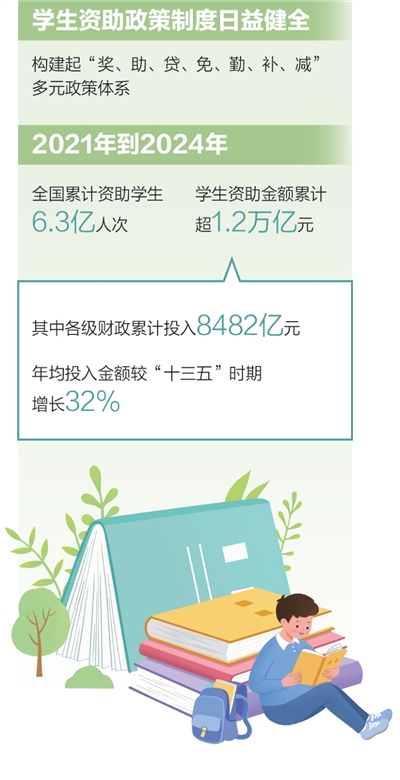
Core Viewpoint - The article discusses the continuous improvement of student financial aid policies in China during the "14th Five-Year Plan" period, emphasizing the expansion of coverage, enhancement of standards, and the establishment of a multi-faceted support system to ensure educational equity and support for economically disadvantaged students [3][4]. Summary by Sections Financial Aid Overview - From 2021 to 2024, a total of 630 million students have been supported, with cumulative financial aid exceeding 1.2 trillion yuan, of which 848.2 billion yuan (70%) comes from various levels of government funding, reflecting a 32% increase in annual investment compared to the "13th Five-Year Plan" period [3]. Expansion and Enhancement of Aid - The financial aid scope has been broadened, with increased standards. For instance, the maximum loan amount for undergraduate students has been raised to 20,000 yuan per year, with a loan term of up to 22 years [5][6]. - The national scholarship for undergraduates has been increased to 10,000 yuan, while the average aid for undergraduates has risen to 3,700 yuan [6]. Policy Direction - The main direction of the financial aid policy adjustment is to expand coverage and raise standards, ensuring that no student drops out due to financial difficulties. This includes a comprehensive support system for all educational stages and economically disadvantaged families [7]. Data Sharing and Monitoring - A nationwide student financial aid management information system has been established, enabling data sharing among various departments to accurately identify and support students from special hardship groups [14]. Development-Oriented Support - The concept of financial aid has evolved from merely providing security to also focusing on development. Programs like the "Cocoon Breaking Plan" aim to enhance students' comprehensive qualities and core competitiveness, providing various training camps and courses for economically disadvantaged students [15][16].

2021年到2024年,全国累计资助学生6.3亿人次 守护每一个求学梦想(大数据观察)
Ren Min Ri Bao· 2025-12-24 22:16
Core Insights - The article emphasizes the importance of student financial aid in promoting educational equity and improving the well-being of citizens, highlighting the comprehensive support system established during the "14th Five-Year Plan" period [1] Group 1: Financial Aid Overview - From 2021 to 2024, a total of 630 million students will receive financial aid, with the cumulative amount exceeding 1.2 trillion yuan, of which 848.2 billion yuan (70%) comes from various levels of government funding, reflecting a 32% increase in annual investment compared to the "13th Five-Year Plan" period [1] - The financial aid policy has evolved to include a diverse system of scholarships, grants, loans, exemptions, work-study programs, and reductions [1] Group 2: Expanded Coverage and Increased Standards - The financial aid coverage has been expanded, with the maximum loan amount for undergraduate students increased to 20,000 yuan per year, and for graduate students to 25,000 yuan per year starting from the 2024 fall semester [4] - The interest rate for student loans has been adjusted to 70 basis points below the market rate, providing further financial relief [4] - The number of national scholarships for undergraduates and graduates has doubled to 120,000 and 90,000 respectively, and vocational school students are now included in the national grant program [4] Group 3: Precision in Aid Distribution - A comprehensive tracking system has been established to monitor students from impoverished households, ensuring that financial aid reaches those in need through dynamic monitoring and data sharing among various government departments [10][12] - The national student financial aid management information system has been integrated with data from multiple ministries to accurately identify and support students from 13 categories of special groups [10][12] Group 4: Development-Oriented Financial Aid - The concept of financial aid has shifted from merely providing security to also focusing on development, as seen in programs like the "Cocoon Breaking Plan" which aims to enhance students' comprehensive skills and employability [11][12] - Initiatives such as tuition compensation for students serving in the military and loan repayment assistance are designed to alleviate financial burdens while also guiding talent towards areas of national need [12]
数读普惠金融
Bei Jing Shang Bao· 2025-12-10 12:00
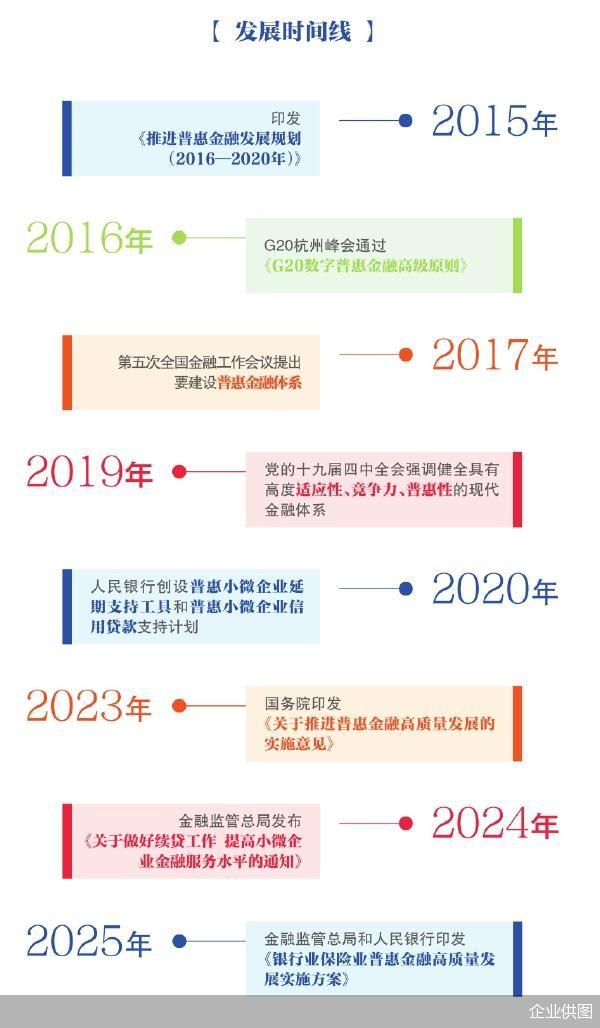
Core Insights - The development of inclusive finance in China has been steadily advancing since the issuance of the "Plan for Promoting the Development of Inclusive Finance (2016-2020)" in 2015, with significant improvements in financial service coverage and quality [1] Timeline of Development - In 2015, the "Plan for Promoting the Development of Inclusive Finance (2016-2020)" was issued [3] - In 2016, the G20 Hangzhou Summit adopted the "G20 High-Level Principles for Digital Inclusive Finance" [3] - In 2017, the Fifth National Financial Work Conference emphasized the need to build an inclusive financial system [3] - In 2019, the Fourth Plenary Session of the 19th Central Committee of the Communist Party of China stressed the importance of a modern financial system that is highly adaptable, competitive, and inclusive [3] - In 2020, the People's Bank of China established support tools for small and micro enterprises [3] - In 2023, the State Council issued "Implementation Opinions on Promoting High-Quality Development of Inclusive Finance" [3] - In 2024, the Financial Regulatory Administration released a notice to improve financial services for small and micro enterprises [3] - In 2025, the Financial Regulatory Administration and the People's Bank of China will issue an implementation plan for high-quality development in the banking and insurance sectors [3] Key Indicator Analysis - The number of bank accounts and digital payment transactions has shown growth, with electronic payment transactions reaching 339.53 trillion yuan in 2024, a year-on-year increase of 1.86% [5] - The balance of inclusive small and micro enterprise loans reached 36.5 trillion yuan in 2024, up from 32.58 trillion yuan in 2023, reflecting a growth of 6% [10] - The balance of loans for technology-based small and medium enterprises reached 3.27 trillion yuan, with a year-on-year increase of 21.2%, outpacing the growth rate of other loans by 14 percentage points [11] - The balance of consumer loans, excluding personal housing loans, was 21.29 trillion yuan in 2024, compared to 20.43 trillion yuan in 2023 [9] Accessibility Dimension - By the end of 2024, there will be an average of three bank outlets per township, with a coverage rate of 97.9% for insurance services [14][15] - There are 59.28 million rural cash withdrawal service points, with rural payment transactions reaching 3.99 billion [17] Quality Dimension - 67.4% of respondents recognize that high returns on financial products often imply high risks, indicating a more rational attitude towards financial product investments [18] - The total credit amount reached 22.9 trillion yuan by the end of 2024, with a year-on-year growth of 1% [19]
《中国普惠金融指标分析报告(2024—2025年)》发布
Zheng Quan Ri Bao Wang· 2025-11-07 14:07
Core Insights - The People's Bank of China released the "Analysis Report on China's Inclusive Finance Indicators (2024-2025)", highlighting 2024 as a crucial year for achieving the goals of the 14th Five-Year Plan, amidst increasing external pressures and internal challenges [1] Group 1: Financial Support and Development - Financial support for rural revitalization is strengthening, with increased financial resources directed towards agricultural sectors, and a steady growth in the balance of loans for farmers and consumer loans [2] - Credit support for private and small micro enterprises continues to increase, with a growing scale of loans for the private economy and improved quality of inclusive small micro loans [2] - The policies for entrepreneurship guarantee loans and student loans for key groups have been further optimized, enhancing accessibility to financial services for the elderly and disabled [2] Group 2: Digital Finance and Payment Systems - The number of bank settlement accounts is on the rise, with improved service efficiency, and the pilot application of digital RMB has expanded to 26 regions across 17 provinces [2] - The scale of digital payments is steadily increasing, reflecting a broader adoption of digital finance solutions [2] Group 3: Financing Mechanisms and Capital Markets - The financing support mechanisms are being continuously improved, with the launch of a national credit information sharing platform for small and micro enterprises [2] - The inclusiveness and accessibility of multi-level capital markets are enhancing, with ongoing pilot programs in the Beijing Stock Exchange and New Third Board [2] - The issuance and existence of rural revitalization bonds and asset-backed securities remain stable, supporting agricultural risk management [2] Group 4: Insurance and Risk Management - The supply system for inclusive insurance products is being further developed, with ongoing optimization of insurance policies for key grain crops [2] - Both insurance density and depth have increased, along with a rise in the scale of agricultural insurance risk coverage and claims payments [2]
中国普惠金融指标分析报告:丰富普惠金融产品服务,切实满足重点领域和特定群体的金融需求
Xin Hua Cai Jing· 2025-11-07 13:57
Core Viewpoint - The People's Bank of China is conducting a survey to assess the development of inclusive finance in 2024, focusing on various dimensions such as usage, accessibility, and quality, and will release an analysis report for 2024-2025 [1] Group 1: Financial Support and Policy Measures - Various departments are enhancing the quality and effectiveness of inclusive finance through multiple measures, including the implementation of monetary policy tools to create a favorable financial environment [2] - The government is focusing on the financial support for the private economy and small and micro enterprises, with initiatives to improve financial services and establish a long-term lending mechanism [2] - There is a special action plan for financial support in rural revitalization, aiming to improve the rural financial service system and direct financial resources towards rural development [2] Group 2: Trends in Inclusive Finance - In 2024, inclusive finance in China shows new characteristics, such as increased financial support for rural revitalization, with growing loan balances for agricultural operations and consumption [3] - There is a sustained increase in credit support for private and small micro enterprises, with a notable rise in loans for technology-based small and medium enterprises [3] - The product system for financial services in the livelihood sector is becoming increasingly diverse, with optimized policies for entrepreneurship and student loans [3] Group 3: Digital and Technological Advancements - The number of bank settlement accounts is increasing, and the efficiency of account services is improving, with the digital RMB pilot expanding to 26 regions [3] - A national credit information sharing platform for small and micro enterprises has been launched, enhancing the coverage of financial credit information databases [3] Group 4: Capital Market and Insurance Developments - The inclusiveness and accessibility of multi-level capital markets are improving, with ongoing pilot programs in the Beijing Stock Exchange and the New Third Board [3] - The supply system for inclusive insurance products is being further developed, with an increase in agricultural insurance risk coverage and claims payments [3]