
胶版印刷纸期货

Search documents
国泰君安期货商品研究晨报-20260306
Guo Tai Jun An Qi Huo· 2026-03-06 01:59
1. Report Industry Investment Rating The document does not provide an overall industry investment rating. 2. Core Views of the Report The report provides trend outlooks and fundamental analysis for various commodities, including precious metals, base metals, energy, agricultural products, and chemical products. Geopolitical conflicts, especially the situation in the Middle East, have a significant impact on the prices and trends of many commodities. For example, the conflict in the Middle East has led to concerns about inflation, affecting the prices of gold, oil, and other commodities. Additionally, factors such as supply and demand, production capacity, and inventory levels also play important roles in determining the price trends of different commodities [5][8][12]. 3. Summary by Commodity Precious Metals - **Gold**: Geopolitical conflicts have broken out, and the price is affected by factors such as inflation concerns and changes in the US dollar index. The trend strength is 1 [5]. - **Silver**: In a volatile pattern, with a trend strength of 1 [2]. - **Platinum**: Continues to be weak, with a trend strength of 0 [25]. - **Palladium**: High - frequency data is sluggish, and it is in a low - level volatile state, with a trend strength of - 1 [25]. Base Metals - **Copper**: The narrowing of the spot discount restricts the price decline. The trend strength is 0 [8]. - **Zinc**: In a range - bound pattern, with a trend strength of 0 [11]. - **Lead**: The reduction of overseas inventory restricts the price decline, with a trend strength of 0 [15]. - **Tin**: In a volatile adjustment, with a trend strength of 0 [18]. - **Aluminum**: A slight correction, with a trend strength of 0 [22]. - **Alumina**: In a sideways volatile pattern, with a trend strength of 0 [22]. - **Cast Aluminum Alloy**: Follows the trend of electrolytic aluminum, with a trend strength of 0 [22]. - **Nickel**: The reality of the Indonesian ore end is catching up, and beware of speculative attributes in March, with a trend strength of 0 [30]. - **Stainless Steel**: The contradiction at the ore end increases marginally, and the cost support center moves up, with a trend strength of 0 [30]. Energy - **Crude Oil**: Although not specifically mentioned in detail, geopolitical conflicts in the Middle East have led to concerns about supply, pushing up oil prices [5][8]. - **Fuel Oil**: Maintains a retracement trend and short - term high - volatility, with a trend strength of - 1 [133]. - **Low - Sulfur Fuel Oil**: In a weak adjustment, and the spot price difference between high - and low - sulfur fuels continues to decline, with a trend strength of - 1 [133]. - **Natural Gas**: Not specifically analyzed in detail, but geopolitical factors may affect its supply and price [91]. - **Coal**: - **Coking Coal**: In a wide - range volatile pattern, with a trend strength of 0 [58]. - **Coke**: A first - round price cut has begun, and it is in a wide - range volatile pattern, with a trend strength of 0 [57]. - **Steam Coal**: Market sentiment is weakening, and the short - term price fluctuates within a narrow range, with a trend strength of - 1 [62]. Agricultural Products - **Palm Oil**: The spill - over of sentiment finally arrives, showing a short - term strong performance, with a trend strength of 1 [158]. - **Soybean Oil**: Supported by the cost of US soybeans, it may break through upwards, with a trend strength of 1 [158]. - **Soybean Meal**: Rebounds and fluctuates, and pay attention to the situation in the Middle East, with a trend strength of 0 [165]. - **Soybean**: The spot price is stable and slightly strong, and the futures price fluctuates in adjustment, with a trend strength of 0 [165]. - **Corn**: Fluctuates strongly, with a trend strength of 0 [168]. - **Sugar**: In a range - bound arrangement, with a trend strength of 0 [172]. - **Cotton**: Waiting for new drivers, with a trend strength of 1 [176]. - **Eggs**: Maintains a volatile pattern, with a trend strength of 0 [180]. - **Hogs**: The inventory pressure is difficult to solve, and the weakness continues, with a trend strength of - 1 [183]. - **Peanuts**: Fluctuates, with a trend strength of 0 [188]. Chemical Products - **P - Xylene (PX)**: In a high - level volatile market, it is recommended to go long on PX and short on PTA. The trend strength is 1 [68]. - **Purified Terephthalic Acid (PTA)**: In a high - level volatile market, with a trend strength of 1 [68]. - **Ethylene Glycol (MEG)**: In a high - level volatile market, with a trend strength of 1 [68]. - **Rubber**: Fluctuates weakly, with a trend strength of - 1 [78]. - **Synthetic Rubber**: The price center moves up, with a trend strength of 1 [81]. - **Linear Low - Density Polyethylene (LLDPE)**: The expectation of cracking supply contraction continues, and pay short - term high attention to geopolitical factors, with a trend strength of 2 [85]. - **Polypropylene (PP)**: The C3 raw material remains strong, and the reduction of PDH devices continues, with a trend strength of 2 [85]. - **Caustic Soda**: Supported by strong export expectations, with a trend strength of 1 [90]. - **Paper Pulp**: Fluctuates, with a trend strength of 0 [95]. - **Glass**: The price of the original sheet is stable, with a trend strength of 0 [102]. - **Methanol**: In a high - level volatile pattern, with a trend strength of 0 [105]. - **Urea**: Fluctuates, with a trend strength of 0 [111]. - **Styrene**: Fluctuates strongly, with a trend strength of 1 [115]. - **Soda Ash**: The spot market changes little, with a trend strength of 0 [117]. - **Liquefied Petroleum Gas (LPG)**: Short - term geopolitical disturbances are strong, with a trend strength of 0 [122]. - **Propylene**: The cost end is affected by geopolitical factors, and the fundamentals remain tight, with a trend strength of 1 [122]. - **Polyvinyl Chloride (PVC)**: In a range - bound pattern, with a trend strength of 0 [130]. Shipping Index - **Container Freight Index (European Line)**: Pay attention to geopolitical sentiment disturbances, with a trend strength of 0 [135]. Fibers - **Short - Fiber**: Geopolitical risks are not eliminated, and it is short - term strong, with a trend strength of 1 [148]. - **Bottle - Grade Chip**: Geopolitical risks are not eliminated, and it is short - term strong, with a trend strength of 1 [148]. Paper - **Offset Printing Paper**: It is recommended to wait and see, with a trend strength of 0 [150]. Aromatics - **Pure Benzene**: Fluctuates strongly, with a trend strength of 1 [155].
国泰君安期货商品研究晨报-20260305
Guo Tai Jun An Qi Huo· 2026-03-05 02:02
Report Industry Investment Ratings Not provided in the content Core Views - The report provides investment outlooks and trend intensities for various commodities, taking into account factors such as geopolitical conflicts, supply - demand dynamics, and cost changes. For example, geopolitical conflicts have a significant impact on commodities like gold, oil - related products, and some chemical products, while supply - demand fundamentals drive the trends of agricultural products and metals [7][10][148]. Summary by Commodity Precious Metals - **Gold**: Geopolitical conflict has broken out. The price of Comex gold 2602 rose 1.02% to 5151.60, and London gold spot rose 0.63% to 5120.54. The trend intensity is 1 [3][7]. - **Silver**: In a shock pattern. The price of Comex silver 2602 rose 1.78% to 83.765, and London silver spot rose 1.86% to 83.540. The trend intensity is 1 [3][7]. - **Platinum**: The sentiment is relatively pessimistic. The trend intensity is 0 [3][27]. - **Palladium**: Overall weak. The trend intensity is 0 [3][27]. Base Metals - **Copper**: Inventory increase restricts price recovery. The price of the Shanghai copper main contract fell 0.43% to 101,660. The trend intensity is 0 [3][10]. - **Zinc**: Oscillating strongly. The Shanghai zinc main contract closed at 24480, up 0.45%. The trend intensity is 1 [3][13]. - **Lead**: Inventory is stable, and the price oscillates. The Shanghai lead main contract closed at 16840, with no change. The trend intensity is 0 [3][17]. - **Tin**: Pay attention to the stabilization of risk appetite. The Shanghai tin main contract fell 5.17% to 401,130. The trend intensity is 1 [3][20]. - **Aluminum**: Middle - East aluminum plants are reducing production, and supply concerns are intensifying. The Shanghai aluminum main contract closed at 24795, up 890. The trend intensity is 1 [3][24]. - **Alumina**: Sell on rebounds. The trend intensity is - 1 [3][24]. - **Cast Aluminum Alloy**: Follows electrolytic aluminum. The trend intensity is 1 [3][24]. - **Nickel**: The reality of the Indonesian ore end is catching up. Be vigilant about speculative attributes in March. The trend intensity is 0 [3][31]. - **Stainless Steel**: The contradiction at the ore end is increasing marginally, and the cost support center is moving up. The trend intensity is 0 [3][32]. Energy and Chemicals - **Crude Oil - related (implied)**: Geopolitical conflicts have a significant impact on the energy market, affecting the prices of related products such as fuel oil and LPG [14][120]. - **Fuel Oil**: The night session had a slight pullback, and price fluctuations continued to widen. The trend intensity is 1 [3][131]. - **Low - Sulfur Fuel Oil**: Weakened in the short - term, and the spot high - low sulfur spread in the outer market fell again. The trend intensity is 1 [3][131]. - **LPG**: Short - term geopolitical disturbances are strong. The trend intensity is 1 [3][120]. - **Propylene**: Geopolitical disturbances at the cost end, and the fundamentals remain tight. The trend intensity is 1 [3][120]. - **Methanol**: High - level shock. The trend intensity is 0 [3][103]. - **Urea**: Entered a shock pattern in the short - term. The trend intensity is 0 [3][110]. - **PTA**: High - level shock. The trend intensity is 1 [3][71]. - **MEG**: High - level shock. The trend intensity is 1 [3][71]. - **PX**: High - level shock market, go long PX and short PTA. The trend intensity is 1 [3][71]. - **Rubber**: Oscillating strongly. The trend intensity is 1 [3][79]. - **Synthetic Rubber**: The center moves up. The trend intensity is 1 [3][82]. - **LLDPE**: The expectation of cracking supply contraction is increasing. Pay attention to geopolitical factors in the short - term. The trend intensity is 1 [3][86]. - **PP**: C3 raw materials remain strong, and the reduction of PDH devices continues. The trend intensity is 2 [3][86]. - **Caustic Soda**: Oscillating strongly. The trend intensity is 1 [3][90]. - **Paper Pulp**: Oscillating. The trend intensity is 0 [3][95]. - **Glass**: The price of the original sheet is stable. The trend intensity is 0 [3][100]. - **PVC**: Range shock. The trend intensity is 0 [3][128]. Agricultural Products - **Palm Oil**: The fundamental contradiction is limited. Pay attention to the impact of oil prices. The trend intensity is 0 [3][161]. - **Soybean Oil**: Supported by the cost of US soybeans. Pay attention to the previous high pressure. The trend intensity is 0 [3][161]. - **Soybean Meal**: Oscillating. Pay attention to market sentiment fluctuations. The trend intensity is 0 [3][167]. - **Soybean**: Oscillating. Pay attention to the policy sentiment of the Two Sessions. The trend intensity is 0 [3][167]. - **Corn**: Oscillating. The trend intensity is 0 [3][170]. - **Sugar**: Range consolidation. The trend intensity is 0 [3][174]. - **Cotton**: Waiting for new drivers. The trend intensity is 1 [3][178]. - **Eggs**: Maintaining a shock. The trend intensity is 0 [3][182]. - **Hogs**: The inventory pressure is difficult to solve, and the weakness continues. The trend intensity is - 2 [3][185]. - **Peanuts**: Oscillating. The trend intensity is 0 [3][190]. Others - **Iron Ore**: Waiting for steel mills to resume production, and the ore price rebounds from a low level. The trend intensity is 1 [3][48]. - **Rebar**: Oscillating repeatedly. The trend intensity is 0 [3][52]. - **Hot - Rolled Coil**: Oscillating repeatedly. The trend intensity is 0 [3][52]. - **Silicon Iron**: Wide - range shock. The trend intensity is 0 [3][56]. - **Manganese Silicon**: Wide - range shock. The trend intensity is 0 [3][56]. - **Coke**: The first round of price cuts has started, and wide - range shock. The trend intensity is 0 [3][59]. - **Coking Coal**: Wide - range shock. The trend intensity is 0 [3][59]. - **Steam Coal**: There is insufficient support for price increases, and short - term prices fluctuate in a narrow range. The trend intensity is 0 [3][64]. - **Log**: The game between expectation and reality, with a slight shock. The trend intensity is 0 [3][67]. - **Container Freight Index (European Line)**: Volatility has declined, mainly oscillating. The trend intensity is 0 [3][133]. - **Short - Fiber**: Geopolitical factors raise costs, and it is strong in the short - term. The trend intensity is 1 [3][148]. - **Bottle Chip**: Geopolitical factors raise costs, and it is strong in the short - term. The trend intensity is 1 [3][148]. - **Offset Printing Paper**: Wait - and - see. The trend intensity is 0 [3][151]. - **Pure Benzene**: Oscillating strongly. The trend intensity is 1 [3][156].
交易所连发公告!紧急调整
Sou Hu Cai Jing· 2026-02-10 07:20
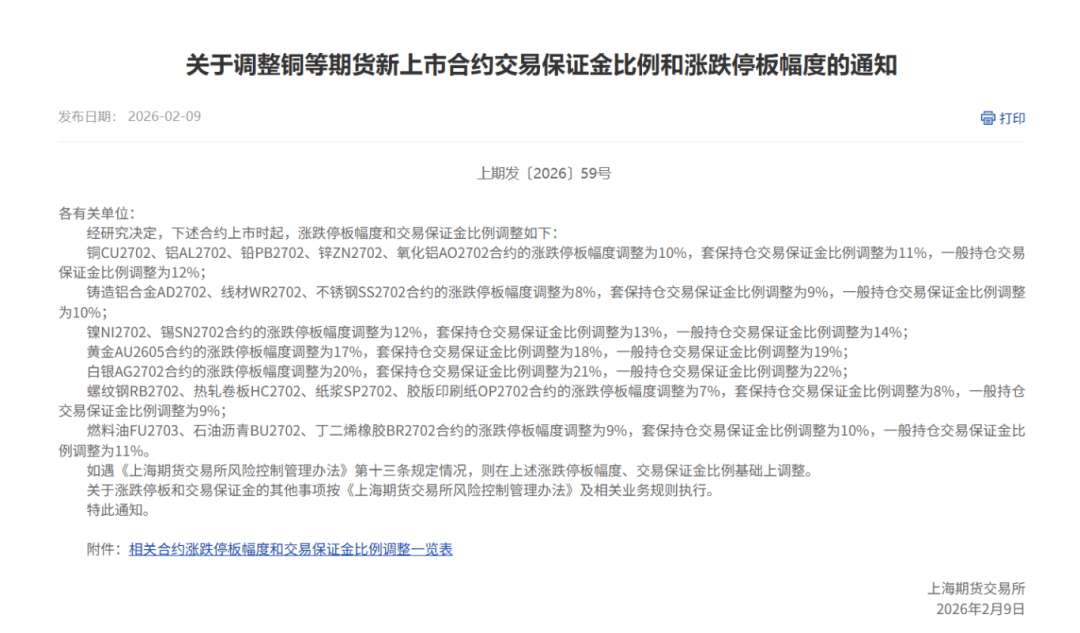
Core Viewpoint - The Shanghai Futures Exchange and Shanghai Gold Exchange have announced adjustments to margin ratios and price limits for various futures contracts, as well as work arrangements for the 2026 Spring Festival period to mitigate market risks during this time [1][7][14]. Group 1: Margin Ratio and Price Limit Adjustments - The margin ratios and price limits for newly listed futures contracts such as copper, aluminum, lead, and zinc have been adjusted, with price limits set at 10% and margin ratios at 11% for hedged positions and 12% for general positions [4]. - For contracts like nickel and tin, the price limit is set at 12% with margin ratios of 13% for hedged positions and 14% for general positions [4]. - Gold contracts have a price limit of 17% and margin ratios of 18% for hedged positions and 19% for general positions, while silver contracts have a price limit of 20% and margin ratios of 21% for hedged positions and 22% for general positions [4]. - Other contracts, including rebar and hot-rolled coils, have a price limit of 7% and margin ratios of 8% for hedged positions and 9% for general positions [4]. Group 2: Spring Festival Work Arrangements - The Shanghai Futures Exchange will not conduct night trading on February 13, 2026, and will be closed from February 14 to February 23, 2026, resuming trading on February 24, 2026 [8][14]. - On February 24, 2026, all futures and options contracts will undergo a collective auction from 08:55 to 09:00, followed by the resumption of night trading [9]. Group 3: Risk Control Measures - The Shanghai Gold Exchange has implemented measures to adjust margin ratios and price limits for gold and silver contracts to prevent price fluctuations during the Spring Festival [16]. - Starting from the close on February 11, 2026, the margin ratio for gold contracts will increase from 18% to 21%, and the price limit will rise from 17% to 20% [16]. - For silver contracts, the margin ratio will increase from 24% to 27%, with the price limit changing from 23% to 26% [16].

上期所、广期所公布春节假期风控安排
Qi Huo Ri Bao Wang· 2026-02-09 23:19
Core Viewpoint - The Shanghai Futures Exchange, Shanghai International Energy Exchange, and Guangzhou Futures Exchange have announced adjustments to the price limits and margin requirements for various futures contracts ahead of the 2026 Spring Festival [1] Group 1: Adjustments by Shanghai Futures Exchange - Starting from the settlement on February 12, 2026, the price limit for copper, aluminum, zinc, lead, and alumina futures will be adjusted to 13%, with margin requirements set at 14% for hedging and 15% for general positions [2] - Nickel and tin futures will have a price limit of 15%, with margin requirements of 16% for hedging and 17% for general positions [2] - Futures for casting aluminum alloy, wire rod, and stainless steel will see a price limit of 11%, with margin requirements of 12% for hedging and 13% for general positions [2] - Gold futures will have a price limit of 20%, with margin requirements of 21% for hedging and 22% for general positions [2] - Silver futures will have a price limit of 25%, with margin requirements of 26% for hedging and 27% for general positions [2] - Futures for rebar, hot-rolled coils, pulp, and printing paper will have a price limit of 10%, with margin requirements of 11% for hedging and 12% for general positions [2] - Futures for fuel oil, petroleum asphalt, butadiene rubber, and natural rubber will have a price limit of 12%, with margin requirements of 13% for hedging and 14% for general positions [2] Group 2: Adjustments by Shanghai International Energy Exchange - From February 12, 2026, the price limit for international copper futures will be set at 13%, with margin requirements of 14% for hedging and 15% for general positions [3] - Crude oil, low-sulfur fuel oil, and No. 20 rubber futures will have a price limit of 12%, with margin requirements of 13% for hedging and 14% for general positions [3] - The shipping index (European line) futures will have a price limit of 18%, with a margin requirement of 20% [3] Group 3: Adjustments by Guangzhou Futures Exchange - Starting from February 12, 2026, the price limit for industrial silicon futures will be adjusted to 11%, with speculative margin requirements set at 13% and hedging margin requirements at 12% [3] - The price limit for polysilicon futures will be adjusted to 12%, with margin requirements remaining unchanged for both speculative and hedging positions [3] - The price limit for lithium carbonate futures will be adjusted to 15%, with speculative margin requirements set at 17% and hedging margin requirements at 16% [3] - The price limit for platinum and palladium futures will be adjusted to 24%, with both speculative and hedging margin requirements set at 26% [3] Group 4: Resumption of Trading - Trading will resume on February 24, 2026, and the price limits and margin requirements for industrial silicon, polysilicon, platinum, and palladium futures will revert to pre-adjustment levels on the first trading day without price limits and continuous quotes [4] - The price limit for lithium carbonate futures will be adjusted to 13%, with speculative margin requirements set at 15% and hedging margin requirements at 14% [4]
上期所:2月24日8:55—9:00所有期货、期权合约进行集合竞价,当晚恢复夜盘交易
Sou Hu Cai Jing· 2026-02-09 13:15
Group 1 - The Shanghai Futures Exchange announced the trading arrangements for the Spring Festival in 2026, including a market closure from February 14 to February 23, with night trading resuming on February 24 [2] - The margin ratios and price fluctuation limits for various futures contracts will be adjusted starting from the market close on February 12, 2026, with specific percentages outlined for different commodities [2] - The price fluctuation limits and margin ratios will revert to their original levels after the first trading day without a one-sided market following February 24, 2026 [3] Group 2 - Specific adjustments include a 13% price fluctuation limit for copper, aluminum, zinc, and lead futures, with varying margin ratios for hedging and general positions [2] - Nickel and tin futures will have a 15% price fluctuation limit, with higher margin requirements for different types of positions [2] - Gold and silver futures will see significant adjustments, with price fluctuation limits set at 20% and 25% respectively, along with corresponding margin ratio changes [2]
金银价格大反攻!交易所再出手,调整白银、原油等涨跌停板幅度和保证金比例
Sou Hu Cai Jing· 2026-02-03 14:46
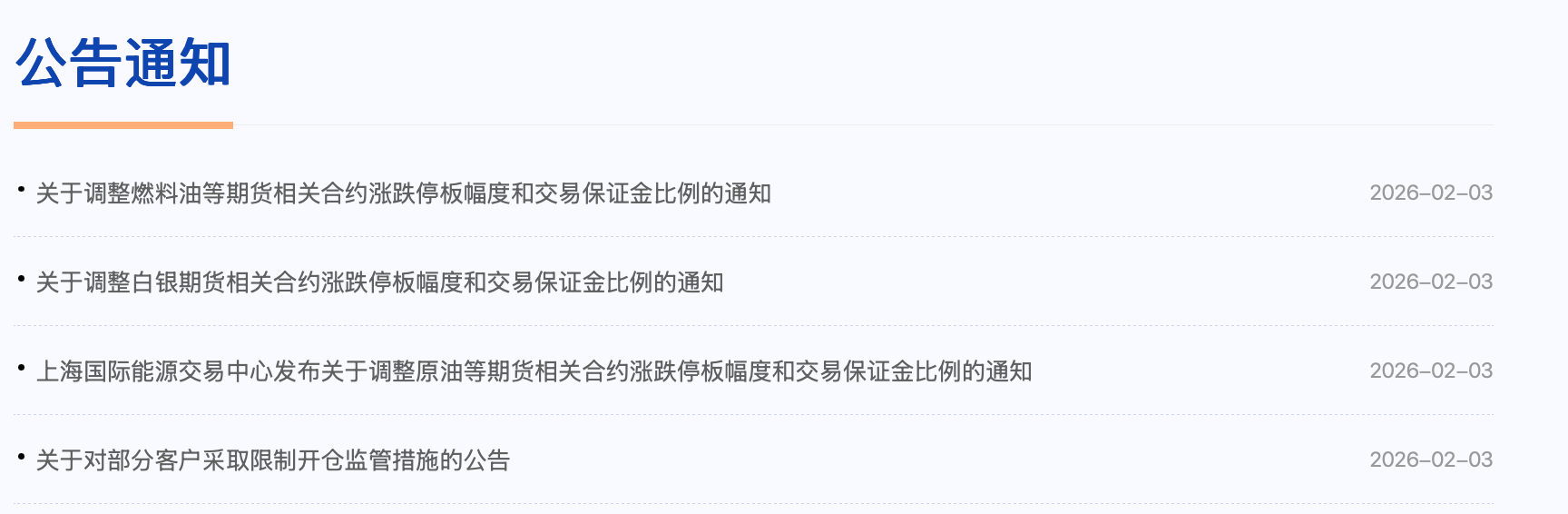
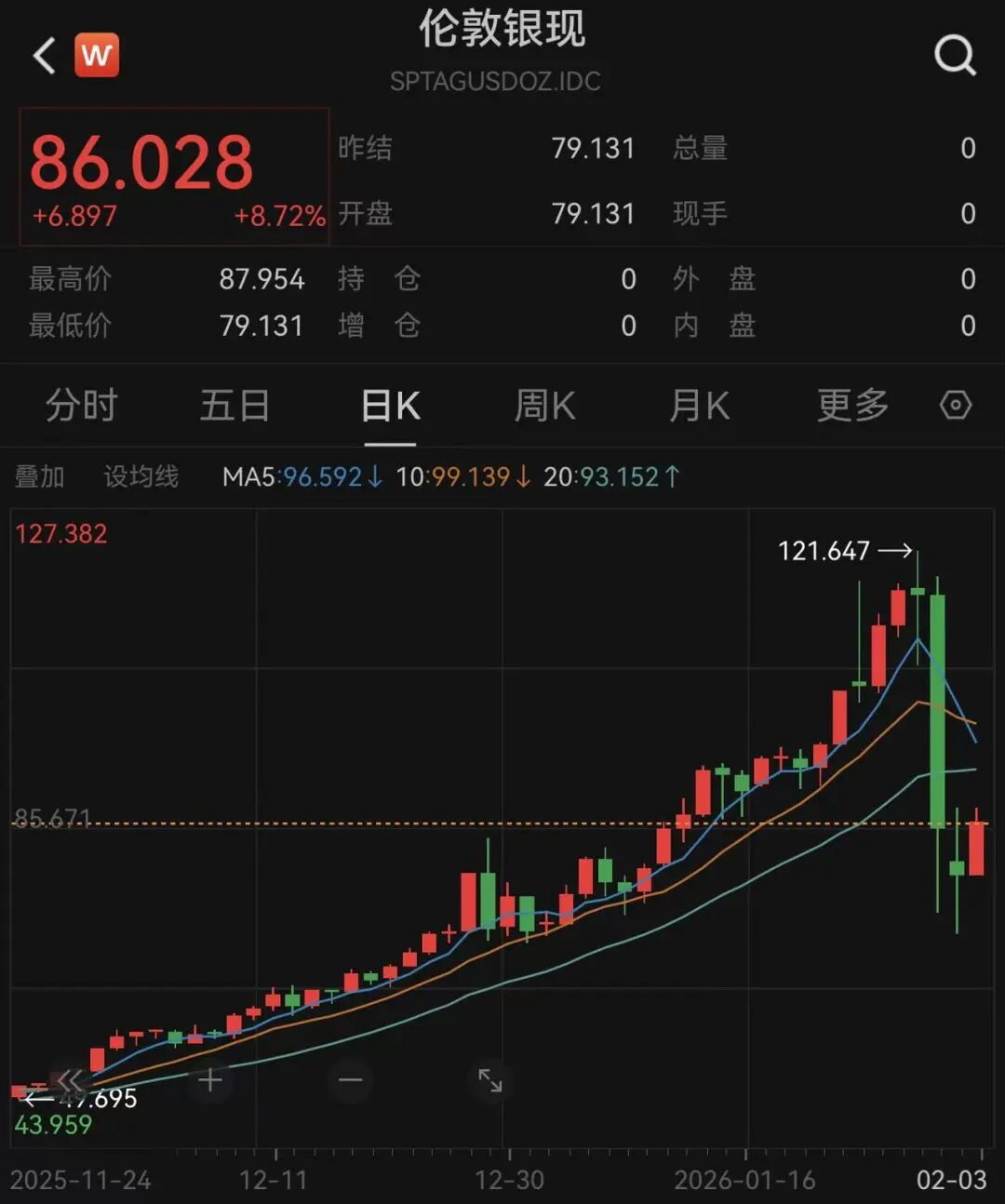
Core Viewpoint - After a historic plunge, gold and silver prices rebounded significantly on February 3, prompting exchanges to take action to adjust trading limits and margin requirements for various futures contracts [1]. Group 1: Adjustments by Shanghai Futures Exchange - Starting from February 4, 2026, the Shanghai Futures Exchange will adjust the price fluctuation limits for silver futures to 19%, with the margin requirement for holding positions set at 20% and for general positions at 21% [2]. - From February 5, 2026, the fluctuation limits for fuel oil, asphalt, butadiene rubber, and natural rubber futures will be adjusted to 9%, with margin requirements for holding positions at 10% and for general positions at 11% [6]. - The fluctuation limits for pulp and printing paper futures will be adjusted to 7%, with margin requirements for holding positions at 8% and for general positions at 9% [6]. Group 2: Adjustments by Shanghai Gold Exchange - The Shanghai Gold Exchange announced that starting February 4, 2026, the margin requirement for several gold contracts will increase from 16% to 17%, and the price fluctuation limit will rise from 15% to 16% [8]. - For the CAu99.99 contract, the margin per contract will increase from 120,000 yuan to 150,000 yuan [8]. - For silver contracts, the margin level will decrease from 26% to 23%, and the price fluctuation limit will decrease from 25% to 22% starting February 3, 2026 [10]. Group 3: Market Reactions and Trends - Following a "Black Monday" where 13 futures contracts hit their daily limit down, the main futures contracts showed a narrowing of losses on February 3, with silver down over 16% and oil down over 4% [11]. - By the night session of February 3, many domestic futures contracts entered an upward trend, with gold rising over 4% and silver over 7% [11]. - Internationally, spot gold rebounded over 6%, reaching a price of 4,923.39 USD/ounce, with a year-to-date increase of over 14% [12][13]. Group 4: Market Sentiment and Institutional Views - The volatility in gold and silver prices has led to mixed sentiments among market participants, with Wall Street traders reducing directional risks while retail demand for physical gold remains strong [13]. - Deutsche Bank maintains a long-term bullish outlook for gold, setting a target price of 6,000 USD/ounce, citing unchanged macro drivers [14]. - Goldman Sachs also holds a bullish forecast for gold prices, predicting a rise to 5,400 USD by December 2026, driven by central bank purchases and potential interest rate cuts by the Federal Reserve [14].
密集调整!多个交易所,最新出手
Sou Hu Cai Jing· 2026-02-03 14:21
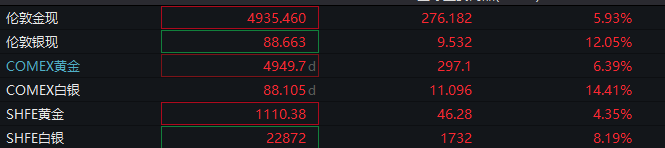
Group 1 - Multiple exchanges have announced adjustments to the price limits and margin requirements for various futures contracts, effective from February 5, 2026 [1] - The price limit for fuel oil, asphalt, butadiene rubber, and natural rubber futures will be adjusted to 9%, with margin requirements set at 10% for hedged positions and 11% for general positions [1] - The price limit for pulp and printing paper futures will be adjusted to 7%, with margin requirements of 8% for hedged positions and 9% for general positions [1] Group 2 - The price limit for silver futures will be adjusted to 19%, with margin requirements of 20% for hedged positions and 21% for general positions, effective February 4, 2026 [1] - The price limit for crude oil, low-sulfur fuel oil, and No. 20 rubber futures will also be set at 9%, with similar margin requirements as mentioned above [1] - Platinum and palladium futures will have their price limits adjusted to 20%, with a margin requirement of 22% [1] Group 3 - As of February 3, 2026, the margin level for Ag(T+D) contracts will be adjusted from 26% to 23%, and the price limit will be reduced from 25% to 22% [2] - International gold and silver prices have seen a significant rebound, with spot gold rising nearly 6% to $4,930 per ounce and spot silver increasing over 12% to $88 per ounce [2] Group 4 - In the domestic market, on February 3, the main contract for silver on the Shanghai Futures Exchange rose over 8%, while the main contract for gold increased over 4% [3] - The SGE gold T+D rose over 3%, and the SGE silver T+D increased over 7% [4]
密集调整!多个交易所,最新出手
证券时报· 2026-02-03 14:11
Core Viewpoint - Multiple exchanges have made significant adjustments to the price limits and margin requirements for various futures contracts, indicating a response to market volatility and aiming to stabilize trading conditions [1][2]. Group 1: Futures Contract Adjustments - From February 5, 2026, the price limit for futures contracts on fuel oil, asphalt, butadiene rubber, and natural rubber will be adjusted to 9%, with margin requirements set at 10% for hedging and 11% for general positions [1]. - The price limit for futures contracts on pulp and printing paper will be adjusted to 7%, with margin requirements of 8% for hedging and 9% for general positions [1]. - The price limit for silver futures will be set at 19%, with margin requirements of 20% for hedging and 21% for general positions starting February 4, 2026 [1]. - For crude oil, low-sulfur fuel oil, and No. 20 rubber futures, the price limit will also be 9%, with similar margin requirements as above [1]. - Platinum and palladium futures will have a price limit of 20% and a margin requirement of 22% starting February 5, 2026 [1]. Group 2: Margin Adjustments for Specific Contracts - The margin level for Ag(T+D) contracts will be adjusted from 26% to 23%, with the price limit changing from 25% to 22% starting February 3, 2026 [2]. - For Au(T+D) and related contracts, the margin ratio will increase from 16% to 17%, with the price limit changing from 15% to 16% starting February 4, 2026 [2]. - The margin for CAu99.99 contracts will be adjusted from 120,000 yuan to 150,000 yuan per contract [2]. Group 3: Market Reactions - On February 3, international gold and silver prices experienced a significant rebound, with gold rising nearly 6% to approximately $4,930 per ounce and silver increasing over 12% to around $88 per ounce [3]. - Specific market data shows that London gold reached $4,935.46, reflecting a 5.93% increase, while London silver hit $88.663, up 12.05% [4]. - In the domestic market, the Shanghai Futures Exchange reported that the main silver contract rose over 8% and the main gold contract increased over 4% on the night of February 3 [4].

黄金白银今日大反弹,继续向上冲,交易所再出手
Mei Ri Jing Ji Xin Wen· 2026-02-03 12:30
Group 1 - The core viewpoint of the articles highlights a significant rebound in gold and silver prices after recent declines, with gold rising by 5.47% and silver experiencing fluctuations of over 11% [1][3] - As of February 3, 2026, the Shanghai Gold Exchange announced adjustments to margin levels and price fluctuation limits for gold and silver futures contracts due to high volatility in precious metals [3][4] - The margin for gold futures contracts will increase from 16% to 17%, and the price fluctuation limit will rise from 15% to 16% starting February 4, 2026 [3][4] Group 2 - For silver futures, the margin level will decrease from 26% to 23%, and the price fluctuation limit will be adjusted from 25% to 22% effective February 3, 2026 [5][6] - The Shanghai Futures Exchange also announced similar adjustments for other commodities, including fuel oil and rubber, with specific changes to margin levels and price fluctuation limits [8][10] - The adjustments are part of a broader risk management strategy to ensure market stability amid increased trading activity and volatility in the precious metals sector [4][5]
上期所调整燃料油等期货相关合约涨跌停板幅度和交易保证金比例
Mei Ri Jing Ji Xin Wen· 2026-02-03 11:15
Core Viewpoint - The Shanghai Futures Exchange has announced adjustments to the price fluctuation limits and margin requirements for various futures contracts, effective from February 5, 2026, which may impact trading strategies and market dynamics in the affected commodities [1] Group 1: Price Fluctuation Limits - The price fluctuation limit for futures contracts of fuel oil, petroleum asphalt, butadiene rubber, and natural rubber will be adjusted to 9% [1] - The price fluctuation limit for futures contracts of pulp and offset printing paper will be adjusted to 7% [1] Group 2: Margin Requirements - The margin requirement for hedging positions in fuel oil, petroleum asphalt, butadiene rubber, and natural rubber will be set at 10% [1] - The margin requirement for general positions in these commodities will be set at 11% [1] - The margin requirement for hedging positions in pulp and offset printing paper will be set at 8% [1] - The margin requirement for general positions in these commodities will be set at 9% [1] Group 3: Risk Management - Adjustments to the price fluctuation limits and margin requirements may be further modified in accordance with the Shanghai Futures Exchange's risk control management regulations [1]