
中国—东盟自贸区3.0版升级议定书

Search documents
2025年湖南对东盟进出口超1000亿元
Zhong Guo Xin Wen Wang· 2026-01-27 23:50
Core Insights - In 2025, Hunan's import and export volume with ASEAN is projected to exceed 101.27 billion RMB, representing a year-on-year growth of 2.8% [1] - Exports are expected to reach 63.28 billion RMB, while imports will amount to 37.99 billion RMB [1] Trade Partners - The top three trading partners for Hunan with ASEAN are Malaysia, Indonesia, and Vietnam, with trade volumes of 25.47 billion RMB, 23.17 billion RMB (up 30.5%), and 23.08 billion RMB (up 26.5%) respectively [1] Import Composition - Hunan's imports primarily consist of energy, minerals, rubber, and agricultural products, with significant growth in crude oil (up 23.7%), coal and lignite (up 6.6%), and metal ores (up 9.2%) [1] - Agricultural imports reached 3.82 billion RMB, marking a 41.4% increase, including 900 million RMB in palm oil, which had no imports in the previous year [1] Export Composition - Exports of electromechanical products are projected to be 40.81 billion RMB, reflecting a growth of 23.6% and accounting for over 60% of total exports [1] - Exports of "new three types" products, including electric vehicles, are expected to reach 5.81 billion RMB, showing a remarkable growth of 460% [1] Strategic Recommendations - Hunan's foreign trade enterprises are encouraged to leverage the upgraded China-ASEAN Free Trade Area 3.0 protocol and RCEP to enhance cooperation in the supply chain and reduce costs [2]
新加坡驻华大使陈海泉:携手开辟新中贸易合作新路径
人民网-国际频道 原创稿· 2025-12-16 01:39
Core Insights - China has been Singapore's largest trading partner for 12 consecutive years since 2013, with bilateral trade expected to reach $111.11 billion in 2024 [1] - The China-Singapore (Chongqing) Strategic Connectivity Demonstration Project has become an efficient trade channel connecting Southeast Asia with China's western regions, showcasing significant growth in container throughput [1] Group 1 - Singapore serves as a global logistics hub, facilitating the flow of goods between other countries and China, while Guangxi Qinzhou Port is a key node in the new western land-sea corridor [2] - The "Buy in China (Guangxi Station) and Guangxi Silk Road E-commerce Carnival" event aims to promote trade and investment, enhancing communication between ASEAN countries and Guangxi [2] - The signing of the upgraded version 3.0 of the China-ASEAN Free Trade Area agreement is seen as a significant boost for high-quality and resilient growth between ASEAN and China [2] Group 2 - The 3.0 version of the agreement is expected to facilitate cross-border transactions, reduce compliance costs, and enhance confidence for SMEs in cross-border operations between ASEAN and China [2] - New chapters on supply chain connectivity, digital economy, and green economy in the agreement will help businesses and citizens seize new opportunities and enhance resilience against risks [2] - The agreement includes strong commitments to consumer protection, aiming to prevent unfair business practices that could harm consumers [2] Group 3 - Future collaboration between Singapore and Guangxi is anticipated to further enhance connectivity, improve logistics services, and open new pathways for trade and investment [3]

外贸一线观察 | 外贸业务首次突破7000亿元 “小”义乌装下“大”世界
Yang Shi Wang· 2025-12-03 08:20
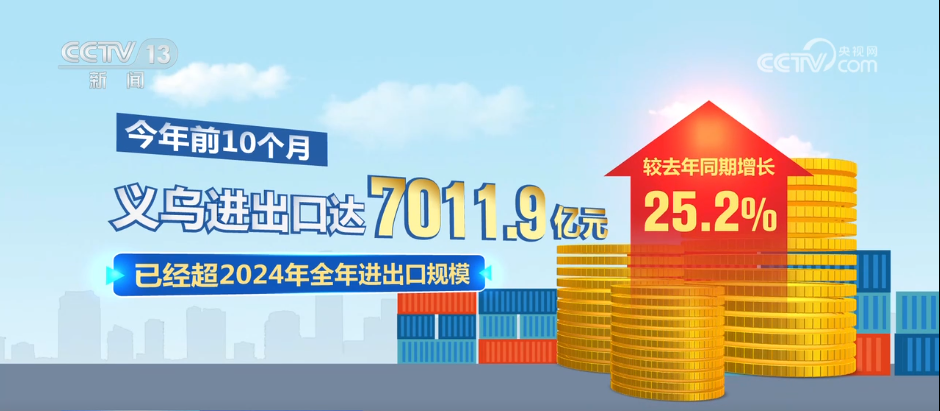
Core Insights - Yiwu's foreign trade has shown strong resilience in a complex international trade environment, with the import and export scale exceeding 700 billion yuan for the first time in history [1] - In the first ten months of this year, Yiwu's total import and export reached 701.19 billion yuan, a year-on-year increase of 25.2%, with exports growing by 24.4% and imports by 31.1% [1] Trade Market Performance - Yiwu's trade with emerging markets such as Africa and Latin America increased by 21.8% and 14% respectively, while trade with ASEAN countries surged by over 50%, reaching 51% [3] - The significant growth in trade with ASEAN is attributed to various product exhibitions held in countries like Thailand and Vietnam, aimed at expanding the influence of "Yiwu manufacturing" [7] Product Innovation and Market Adaptation - Yiwu businesses are adapting products to meet the preferences of international clients, such as designing insulated cups for Indonesian customers that can keep beverages cold for up to 120 hours [5] - Export sales of products like water cups have increased by at least 10% compared to the previous year, particularly in ASEAN countries [8] Trade Agreements and Opportunities - The signing of the upgraded version of the China-ASEAN Free Trade Area agreement in October is expected to create new opportunities for enterprises to expand into the ASEAN market [10] - Yiwu customs issued 130,000 certificates of origin for China-ASEAN trade, valued at 2.867 billion USD, allowing products like insulated cups to enjoy zero tariff treatment when exported to Indonesia [12] Transportation and Logistics - Yiwu's TIR international road transport business has surpassed 100 trips this year, transitioning from a few trips per month to ten trips weekly, enhancing connectivity along the Belt and Road Initiative [13] - The TIR system offers advantages such as expedited customs procedures and flexible transport, establishing a robust land transport network for Yiwu's small commodity exports to Central Asia [16]
“果篮子”折射中国—东盟经贸活力(环球热点)
Ren Min Ri Bao Hai Wai Ban· 2025-11-21 22:12
Core Insights - The trade of agricultural and food products between China and ASEAN has seen significant growth, with bilateral trade reaching $51.3 billion in the first ten months of this year, a year-on-year increase of 8.9% [2][8] - China imported over $10 billion worth of fresh and dried fruits from ASEAN, accounting for more than two-thirds of its global imports [2][8] - The signing of the upgraded version 3.0 of the China-ASEAN Free Trade Area agreement is expected to inject new vitality into bilateral agricultural and food product trade [8] Trade Characteristics - The fruit trade, while a small part of the overall trade volume, is crucial due to its broad impact on consumers and farmers alike [3][4] - China has become the largest source of fruit imports for Indonesia, maintaining a market share of over 50% since 2017 [2][3] - The complementary nature of fruit varieties between China and ASEAN is a key feature, with China producing temperate fruits and ASEAN known for tropical fruits [3][4] Mechanisms and Logistics - Continuous improvement in cooperation mechanisms, logistics infrastructure, and technological advancements are driving the growth of fruit trade [4][5] - The opening of the China-Laos Railway has significantly enhanced the efficiency and cost-effectiveness of transporting agricultural products [5][6] - Digital economy developments are diversifying trade channels, with e-commerce platforms becoming increasingly important for fruit trade [6][7] Economic Integration - The fruit trade exemplifies deep economic integration and mutual benefit between China and ASEAN, with a target of importing $150 billion worth of quality agricultural products from ASEAN over five years [8][10] - The RCEP agreement has led to tariff reductions and simplified customs procedures, further facilitating trade [7][10] - The growth of the fruit trade is expected to continue, with an increase in variety and added value as market demand expands [10][11]
巴西咖啡供应告急,这杯越南咖啡却卖爆全球 | 东盟商品观察
2 1 Shi Ji Jing Ji Bao Dao· 2025-11-21 07:19
Core Insights - Arabica coffee futures in New York have reached a historic high of $4.36 per pound, marking a nearly 4% increase from the record set in February 2023, indicating a shift towards coffee becoming a "luxury good" [1] - Brazil, the largest coffee producer, is facing severe drought and extreme heat, leading to warnings of an unprecedented global supply shortage that may not recover until 2029-2030 [1] - In contrast, Vietnam's coffee industry is thriving, with exports reaching approximately 1.25 million tons and over $7 billion in revenue in the first nine months of 2025, significantly surpassing the previous year's records [1] Group 1 - Vietnam is projected to maintain its position as the world's second-largest coffee producer, accounting for 17% of global coffee production, with a cultivation area of about 732,000 hectares and an average yield of 2.9 tons per hectare [1] - The European Union is the largest market for Vietnamese coffee, with Germany, Italy, and Spain being the top three markets, collectively accounting for about 40% of Vietnam's coffee exports [1] - The potential for Vietnam's coffee industry to exceed $8 billion in revenue during the 2024-2025 planting season is highlighted, indicating strong growth prospects [1] Group 2 - The geographical advantages of Vietnam for coffee cultivation are noted, with the southern region suitable for Robusta coffee and the northern region for Arabica coffee [2] - The U.S. plans to impose a 20% tariff on Vietnamese coffee, which, although lower than the initially proposed 46%, may still impact its competitiveness [2] - The upcoming EU Deforestation Regulation (EUDR) is expected to affect over 600,000 Vietnamese coffee farmers by prohibiting the sale of products linked to deforestation in the EU [2] Group 3 - The signing of the upgraded China-ASEAN Free Trade Area 3.0 agreement is expected to increase the presence of Southeast Asian coffee in Chinese markets, suggesting a potential for local coffee cultivation and export to China [3] - Recommendations include establishing coffee processing zones at the Yunnan port to create a model of "ASEAN raw materials + Chinese processing," which could lower supply chain costs and meet the demand of the large Chinese market [3] - Vietnam's coffee industry is focusing on deep processing and enhancing supply chain transparency, aiming to leverage multiple free trade agreements to access high-end markets in Europe, Japan, South Korea, and China [3]
事关安世半导体问题、中美大豆贸易等 商务部最新发声
Zhong Jin Zai Xian· 2025-11-14 00:11
Group 1: Semiconductor Industry - The Chinese Ministry of Commerce has engaged in multiple rounds of consultations with the Netherlands regarding the ASML semiconductor issue, emphasizing the importance of restoring global semiconductor supply chain stability [2] - The Ministry hopes that the Netherlands will demonstrate a sincere willingness to cooperate and propose constructive solutions to resolve the issue effectively [2] Group 2: Agricultural Trade - The Ministry of Commerce has announced recent developments in China-U.S. soybean trade, highlighting the importance of agricultural trade in the context of broader economic discussions [3] - China remains committed to maintaining an open and cooperative stance in global agricultural trade, aiming to deepen mutually beneficial cooperation with trade partners [3] Group 3: Rare Earth Export Controls - The Ministry of Commerce is implementing a new export licensing system for rare earth materials, which is expected to expedite the export process [4] - This initiative reflects China's commitment to balancing national security interests with the need to maintain global supply chain stability [4] Group 4: Trade Events and Initiatives - The "Shared Market · Export to China" initiative has been launched as part of the China International Import Expo, facilitating a new channel for global goods to enter the Chinese market [5] - The recent expo achieved a record transaction volume of $83.49 billion, marking a 4.4% year-on-year increase, showcasing the effectiveness of the initiative [5] Group 5: Regional Trade Agreements - The signing of the China-ASEAN Free Trade Area 3.0 upgrade protocol is a significant milestone, expanding economic integration into new areas such as digital, green, and supply chain cooperation [6][7] - The Ministry is accelerating the domestic approval process for the protocol to ensure its timely implementation, recognizing the substantial business opportunities it presents [8]
商务部:努力推动中国—东盟自贸区3.0版升级议定书尽早生效实施
Xin Hua She· 2025-11-13 18:06
Core Viewpoint - The Ministry of Commerce is accelerating the domestic approval process for the China-ASEAN Free Trade Area 3.0 upgrade protocol, aiming for its early implementation in collaboration with ASEAN [1] Group 1: Economic Integration - The signing of the China-ASEAN Free Trade Area 3.0 upgrade protocol marks a significant milestone in cooperation, expanding economic integration from traditional trade and investment liberalization to emerging areas such as digital, green, and standards [1] - The upgrade is expected to enhance regional digital technology empowerment, green industry cooperation, and the interconnectivity of industrial and supply chains, promoting the accelerated integration of large markets and supply chains within the region [1] Group 2: Business Opportunities - Enterprises from both sides are highly attentive to the protocol, recognizing the substantial business opportunities it presents [1]
商务部:正在加快推进中国—东盟自贸区3.0版议定书的国内核准工作
Xin Hua Cai Jing· 2025-11-13 09:27
Core Viewpoint - The signing of the China-ASEAN Free Trade Area 3.0 upgrade protocol marks a significant milestone in cooperation, expanding economic integration into emerging areas such as digital, green, standards, and supply chains [1] Group 1: Economic Integration - The upgrade protocol facilitates regional digital technology empowerment, green industry cooperation, and the interconnection of industrial and supply chains [1] - It promotes the accelerated integration of large markets and supply chains within the region [1] Group 2: Business Opportunities - Enterprises are highly attentive to the protocol, recognizing the substantial business opportunities it presents [1] - Many localities and companies have already begun to actively study the new rules of the protocol to seize new opportunities once it comes into effect [1]
前10个月广西对东盟进出口保持较快增速
Zhong Guo Xin Wen Wang· 2025-11-10 14:06
Core Insights - Guangxi's trade with ASEAN has maintained a rapid growth rate, with imports and exports totaling 344.74 billion yuan, a year-on-year increase of 12.1% [1] - The total foreign trade value of Guangxi reached 650.35 billion yuan, also growing by 12.1%, with exports at 381.28 billion yuan (up 18.3%) and imports at 269.07 billion yuan (up 4.4%) [1][2] - Key trading partners include Vietnam, Thailand, and Indonesia, with respective growth rates of 8.4%, 7%, and 53.6% [1] Trade Performance - Guangxi's exports of lithium batteries surged to 20.54 billion yuan, marking a 76.6% increase [2] - The cross-border electronic information industry has driven significant growth in related product exports, with flat panel display modules, computer accessories, and printed circuit boards increasing by 86%, 41.8%, and 225.8% respectively [2] - Major imports included metal ores valued at 103.14 billion yuan, up 16.1%, with copper ore imports increasing by 27.6% due to favorable policies [2] Future Opportunities - The upgrade of the China-ASEAN Free Trade Area is expected to create new opportunities for cooperation in new energy and electronic information industries, as well as cross-border e-commerce [1] - Timor-Leste, as the 11th member of ASEAN, has potential to enhance trade with Guangxi, particularly in natural resources like crude oil and liquefied propane [1]
中国—东盟自贸区迈入3.0时代,意味着什么?
Huan Qiu Wang· 2025-10-28 12:25
Core Points - The signing of the China-ASEAN Free Trade Area 3.0 upgrade protocol marks a significant enhancement in economic cooperation between China and ASEAN, providing new momentum and confidence for regional economic development [1][2][3] Group 1: Economic Cooperation - The 3.0 upgrade protocol was signed on October 28, 2023, during the 47th ASEAN Summit in Malaysia, with leaders from both sides witnessing the event [2] - The China-ASEAN Free Trade Area is the first free trade zone established by both parties, with its construction starting in 2002 and the first version completed in 2010 [2][4] - The protocol aims to deepen cooperation in nine major areas, including digital economy, green economy, and supply chain connectivity, reflecting a shift from tariff concessions to rule-building [4][5] Group 2: Impact on Businesses - The protocol provides clear development guidance for enterprises in sectors such as digital economy and green economy, allowing them to focus on business development without external disruptions [3][5] - It is expected to create new opportunities for Malaysian companies, particularly in digital economy collaborations with Chinese firms, facilitating access to advanced technologies [5][6] - The emphasis on high-quality development and innovation-driven growth in China is likely to enhance the competitiveness and stability of investments in emerging sectors [6][7] Group 3: Regional Integration - The signing of the protocol is seen as a strong demonstration of support for multilateralism and free trade, countering rising protectionism and unilateralism [2][3] - The cooperation between China and ASEAN is viewed as a model for regional integration, with potential benefits for both parties in terms of economic growth and stability [3][7] - The protocol is expected to facilitate deeper economic integration and trade liberalization, enhancing the flow of products, investments, and personnel within the region [5][6]