
主权风险溢价

Search documents
日韩股市大涨,日经225飙涨5%创新高,软银涨超7%,三星电子涨超5%
2 1 Shi Ji Jing Ji Bao Dao· 2026-02-09 00:59
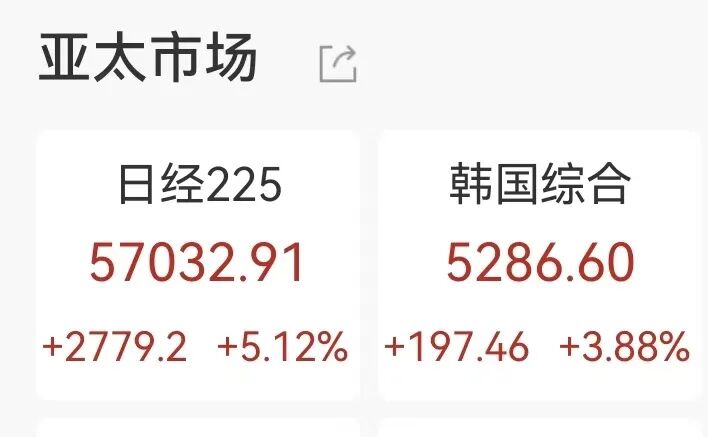
Group 1 - Japanese and South Korean stock markets opened strongly, with the Nikkei 225 index rising over 5%, reaching multiple historical highs during the session [1] - SoftBank Group's stock saw a peak increase of 8.5%, marking its largest gain since January 28, and was up over 7% at the time of reporting [1] - The KOSPI index in South Korea rose by 3.8%, closing at 5286.6 points, with major companies like Samsung Electronics and SK Hynix both increasing by over 5% [1] Group 2 - The ruling coalition of the Liberal Democratic Party and the Japan Innovation Party secured a majority in the recent Japanese House of Representatives election [1] - Japan's Ministry of Health, Labour and Welfare reported a 1.3% year-on-year decrease in real wages per capita for 2025, marking four consecutive years of negative growth [1] - The yield on Japan's 10-year government bonds rose by 4.5 basis points to 2.275%, while the 40-year bond yield surpassed 4%, the highest level since its issuance in 2007, raising concerns about Japan's fiscal and monetary policy [1] Group 3 - Pictet Asset Management's chief economist highlighted that the surge in yields is driven by increased inflation risks and sovereign risk premiums, indicating a lack of credibility in the Bank of Japan's anti-inflation measures [2] - The turmoil in Japan's bond market and potential punitive measures on U.S. fiscal deficits could trigger a shift of global capital from the U.S. to other markets [2] - The economist affirmed that Japan may sell U.S. Treasuries to defend the yen, citing the need for balance sheet management by the central bank and the desire to diversify geopolitical risks [2]


日韩股市大涨,日经225飙涨5%创新高,软银涨超7%,三星电子涨超5%
21世纪经济报道· 2026-02-09 00:53
Group 1 - Japanese stock markets opened high, with the Nikkei 225 index rising over 5%, reaching multiple historical highs during the session [1] - SoftBank Group's stock surged by up to 8.5%, marking its largest increase since January 28, and was up over 7% at the time of reporting [1] - The KOSPI index in South Korea increased by 3.8%, closing at 5286.6 points, with major companies like Samsung Electronics and SK Hynix rising over 5% [1] Group 2 - The ruling coalition of the Liberal Democratic Party and Japan Innovation Party secured a majority in the recent Japanese House of Representatives election [3] - Japan's Ministry of Health, Labour and Welfare reported a 1.3% year-on-year decrease in real wages for 2025, marking four consecutive years of negative growth [3] - The yield on Japan's 10-year government bonds rose by 4.5 basis points to 2.275%, with the 40-year bond yield surpassing 4%, the highest since its issuance in 2007, raising concerns about Japan's fiscal and monetary policy [3] Group 3 - The chief economist at Pictet Asset Management highlighted that the surge in bond yields is driven by increased inflation risks and sovereign risk premiums, indicating a lack of credibility in the Bank of Japan's anti-inflation measures [3] - The turmoil in Japan's bond market and potential punitive measures on U.S. fiscal deficits could trigger a return of global capital from the U.S. to other markets [4] - The economist affirmed that Japan may sell U.S. Treasuries to defend the yen, citing the need for balance sheet management and geopolitical risk diversification [4]


外汇专题:当加息不再等于升值,日元重构中轴
Hua Tai Qi Huo· 2026-02-04 12:54
Report Industry Investment Rating No relevant content provided. Core Viewpoints - The traditional logic of currency tightening fails to support the yen's exchange rate. Instead, it triggers market panic about "soaring debt costs," and the yen has entered a non - linear fluctuation period dominated by "sovereign risk premium" [11]. - The core contradiction lies in the decoupling of nominal and real returns. The rise in Japanese interest rates is seen as a punitive premium for "rising debt costs" rather than an attraction for asset repatriation [3]. - In the "high - market trading," the stock market and the foreign exchange market have different pricing logics. The stock market prices "nominal prosperity," while the foreign exchange market prices "credit dilution," resulting in a long - term "stock up, exchange down" structure [30][31]. - The yen's weakening is self - reinforcing due to factors such as negative real interest rates, asset offshoreization, and direct foreign investment. Its reversal depends on external liquidity shocks [4][38]. - In 2026, the yen's pricing logic is shifting from "interest rate spread fluctuations" to "credit risk pricing." The exchange rate is expected to be in a high - level platform with increased volatility, and the yen's safe - haven property has basically collapsed [46][52]. Summary by Directory I. Phenomenon and Contradiction: The "Abnormal Picture" after Interest Rate Hikes and the Collapse of Pricing Power - In early 2026, the yen market is experiencing a systemic collapse of pricing power. Despite the Bank of Japan raising the benchmark interest rate to 0.75%, the traditional currency tightening logic fails to support the exchange rate [11]. - The "interest rate up, exchange rate down" phenomenon is due to the market's confirmation of "insufficient real returns" after the interest rate hike. The 160 - level for the yen is a reflection of the shift in the core contradiction from "monetary policy speed" to "structural collapse of the national balance sheet" [11][12]. - Japan has a negative real interest rate and a large budget deficit, which makes the nominal interest rate hike an amplifier of sovereign risk premium [13]. II. Why Do Interest Rate Hikes Suppress the Yen? —— An Explanation of Credit Pricing - The yen has shifted from a "interest - rate - spread currency" to a "credit asset." The increase in nominal interest rates is regarded as a risk signal of "soaring government debt costs," and the exchange rate weakness is a discount on Japan's fiscal sustainability [15]. - The current interest rate increase is a "term premium penalty" rather than a return repair. As long as the real return remains negative, the yen's depreciation pressure cannot be reversed by marginal interest rate hikes [15][18]. - The Bank of Japan is "captured" by fiscal policy, and interest rates have become a policy ceiling. International balance of payments' structural blood loss provides an irreversible physical basis for the yen's credit discount [18]. III. "High - Market Trading": Why Does the Japanese Stock Market Rise While the Yen Weakens? - "High - market trading" is an asset allocation paradigm based on the "fiscal - led" logic. The stock market and the foreign exchange market have different pricing logics, resulting in a stable "stock up, exchange down" structure [30][31]. - Cross - border funds show a pattern of "buying assets and stripping the currency." The yen plays the role of a "depreciation accelerator" in the derivatives market, and the "high - market trading" may switch from a "credit discount model" to an "extreme reversal game" [31][32]. IV. Carry Trade Momentum and Structural Blood Loss: The Self - Reinforcing Mechanism of the Yen's Weakness - The yen's depreciation is driven by a systemic financing subsidy due to negative real interest rates. The difference in nominal interest rates between the US and Japan creates a carry trade floor [36]. - The change in the US Treasury yield curve is reshaping the microstructure of short positions. As long as the long - term US Treasury yield does not collapse, the existing yen short positions will form a sticky configuration [37]. - The overall "offshoring" of the balance sheet, including the institutional asset offshoring driven by NISA for residents and the large - scale direct investment in the US by enterprises, has led to the yen's weakness becoming a long - term sovereign credit discount [38]. V. Outlook, Point Anchors, and Risk Warnings 1. Operation Rhythm Judgment: From Political Premium to Yield Convergence - In the first half of 2026, the exchange rate will be affected by the election and subsequent fiscal legislation. The exchange rate may frequently hit 159, and the US - Japan interest rate spread will remain around 200bp [47]. 2. Strategy Ideas and Core Pricing Range - Future operations should focus on defending key risk ranges rather than simple interest - rate - spread trading [49]. 3. Non - linear Risk Warnings - The 159 - 162 range is a game area for Japan's sovereign credit and bond market stability. The 152 - 159 range is a core allocation area for structural foreign exchange purchase demand. The 150 - 152 range is a liquidity bottom for position games and intervention expectations [50]. - Risks include political uncertainties, sovereign credit downgrades, Fed policy uncertainties, and the risk of crowded trades [50][51]. 4. Conclusion: From "Collapse Pricing" to "Normalized Valuation Reconstruction" - The yen's core pricing logic has been restructured. It is no longer a simple interest - rate - spread currency but a dynamic discount tool for Japan's sovereign balance sheet quality. The yen's safe - haven property has collapsed, and it will be in a state of high volatility and low certainty [52].
特朗普圣诞夜动手!美国空袭尼日利亚,目标直指石油和稀土?
Hua Er Jie Jian Wen· 2025-12-26 00:31
Group 1 - The U.S. military action against Nigeria is framed as a counter-terrorism effort but is deeply intertwined with economic interests, particularly in energy and strategic minerals [1][2] - The timing of the airstrikes coincides with Nigeria's Dangote refinery nearing full operational capacity, which poses a threat to U.S. oil export interests [2] - The U.S. has historically been a major supplier of refined oil to Nigeria, with exports valued at approximately $4.2 billion in 2023, making the protection of these interests a key motive behind the military action [2] Group 2 - Nigeria is rich in rare earth minerals and critical metals, essential for electric vehicles and U.S. defense technology, making it a strategic target for U.S. interests [3] - Following the military threats, Nigeria's sovereign bonds experienced a significant drop, indicating increased market volatility and risk perception [3] - The military actions are expected to raise Nigeria's sovereign risk premium, leading to higher financing costs and potential capital flight, which could adversely affect non-oil service sector growth [3]
美联储是否会在12月份继续降息??
Sou Hu Cai Jing· 2025-11-02 08:47
Core Viewpoint - The Federal Reserve's decision to lower the federal funds rate by 25 basis points to a range of 3.75% to 4.0% and end balance sheet reduction on December 1 aligns with market expectations, but the two-year U.S. Treasury yield rose by approximately 10 basis points due to a hawkish statement from Powell regarding future rate cuts [5][4]. Group 1: Federal Reserve Decisions - The Federal Reserve lowered the federal funds rate by 25 basis points to a range of 3.75% to 4.0% [5]. - The balance sheet reduction will conclude on December 1 [5]. - Market expectations for a December rate cut have significantly decreased following Powell's hawkish remarks [4][6]. Group 2: Interest Rate Expectations - The implied interest rate path for two-year U.S. Treasury yields indicates a significant shift in market sentiment regarding future rate cuts, with the probability of a December cut now perceived to be around 50% [6][30]. - The effective federal funds rate minus the ten-year U.S. Treasury yield indicates a reduction in the Fed's rate cut space from 57 basis points to 29 basis points after the October cut [20]. Group 3: Economic Context and Risks - The Fed's ability to lower rates is constrained by the international pricing of long-term sovereign debt, which has shifted due to the U.S. sovereign debt situation [10][15]. - The current economic environment, including the government shutdown, complicates the Fed's decision-making process, as it limits access to reliable economic data [21][22]. - Powell's hawkish stance is partly driven by concerns over rising sovereign risk premiums, which could hinder the effectiveness of rate cuts [21][30]. Group 4: Global Debt Market Dynamics - The ongoing geopolitical situation, particularly the Russia-Ukraine conflict, has altered the dynamics of the U.S. debt market, increasing the total U.S. debt by $8 trillion [26][28]. - The perception of U.S. Treasuries has shifted from being viewed as risk-free to being treated like ordinary sovereign debt, affecting their pricing and the Fed's rate cut strategy [28][30].

英债市场紧张情绪缓和,但英镑依旧走弱
news flash· 2025-07-07 10:03
Core Insights - The tension in the UK bond market has eased due to the Labour Party's significant concessions on welfare reform policies, yet the British pound continues to weaken [1] Group 1: Market Reactions - The UK government has made substantial concessions in the welfare bill following strong opposition from Labour Party MPs, indicating a potential rise in future taxes [1] - The reasons for the pound's weakness have shifted from concerns over "sovereign risk premium" to a more common macroeconomic narrative of tightening fiscal policy versus relatively loose monetary policy [1]