乘用车智能化

Search documents
【联合发布】2026年2月乘用车智能化指数为34.3
乘联分会· 2026-03-31 08:21
Core Insights - The article discusses the Passenger Car Intelligence Index, which monitors the development of intelligence in the domestic passenger car market and predicts future trends based on historical data [3][4]. Summary by Sections Overall Index - As of February 2026, the Passenger Car Intelligence Index stands at 34.3, reflecting a month-on-month increase of 2.1 units, despite a significant decline in overall retail sales [13]. Sub-Indices - The Smart Cockpit Index is at 36.1, showing a month-on-month increase of 2 units but a year-on-year decrease of 1.6 units [7]. - The Smart Driving Index is at 37.2, with a month-on-month increase of 2.2 units and a year-on-year decrease of 0.6 units [10]. - The External Intelligence Index is at 21.6, reflecting a month-on-month increase of 2.1 units and a year-on-year increase of 4.0 units [11]. Market Performance - In February 2026, the national retail sales of passenger cars reached 1.034 million units, a year-on-year decline of 25.4% and a month-on-month decline of 33.1%. The new energy vehicle market saw retail sales of 464,000 units, with a year-on-year decline of 32.0% and a month-on-month decline of 22.1% [13]. Future Outlook - Despite the overall decline in sales, the penetration rate of new energy vehicles has increased, contributing to a rebound in the intelligence index. The market is expected to stabilize and improve in March 2026 due to the resumption of effective working days, spring promotions, and the upcoming auto show [13]. Index Calculation Methodology - The Passenger Car Intelligence Index is composed of one primary index and three secondary indices, which reflect the market performance of models meeting specific intelligence criteria. The calculation method involves weighted contributions from the Smart Cockpit Index, Smart Driving Index, and External Intelligence Index [14]. Weighting of Indices - The Smart Cockpit has a weight of 47.5%, emphasizing its immediate impact on user experience. The Smart Driving Index has a weight of 37.5%, indicating its long-term transformative potential. The External Intelligence Index carries a weight of 15.0%, representing its emerging role in the industry [18][19][20].


【联合发布】2026年1月乘用车智能化指数为32.2
乘联分会· 2026-02-28 08:49
Core Viewpoint - The article discusses the Passenger Vehicle Intelligence Index, which monitors the development of intelligence in the domestic passenger vehicle market and predicts future trends based on historical data [4][5]. Summary by Sections Overall Index - As of January 2026, the Passenger Vehicle Intelligence Index is at 32.2, showing a significant month-on-month decline of 6.5 units, with all three core sub-indices experiencing notable year-on-year decreases [14]. Sub-indices - The Intelligent Cockpit Index stands at 34.1, down 6.9 units month-on-month but up 2.7 units year-on-year [8]. - The Intelligent Driving Index is at 35.0, reflecting a month-on-month decrease of 6.5 units and a year-on-year increase of 2.7 units [11]. - The External Intelligence Index is recorded at 19.5, with a month-on-month decline of 4.9 units and a year-on-year increase of 6.1 units [12]. Market Performance - In January 2026, the national retail sales of passenger vehicles reached 1.544 million units, representing a year-on-year decline of 13.9% and a month-on-month decline of 31.7%. The retail sales of new energy vehicles were 596,000 units, down 20.0% year-on-year and 55.4% month-on-month [14]. Influencing Factors - The decline in sales is attributed to multiple factors, including the expiration of purchase tax incentives, preemptive demand at the end of the year, and a gap in local subsidies. The impact is particularly pronounced in new energy vehicles, which are more sensitive to policy changes [14]. Future Outlook - The fluctuations in the intelligence index and vehicle sales are viewed as short-term adjustments rather than indicative of a long-term weakening trend in the industry. The article emphasizes the need for continuous monitoring and adjustment of the intelligence index to better reflect market dynamics [14].

2025年12月乘用车智能化指数为38.7 三大核心分项指数同步刷新年内峰值
Zhi Tong Cai Jing· 2026-01-29 11:19
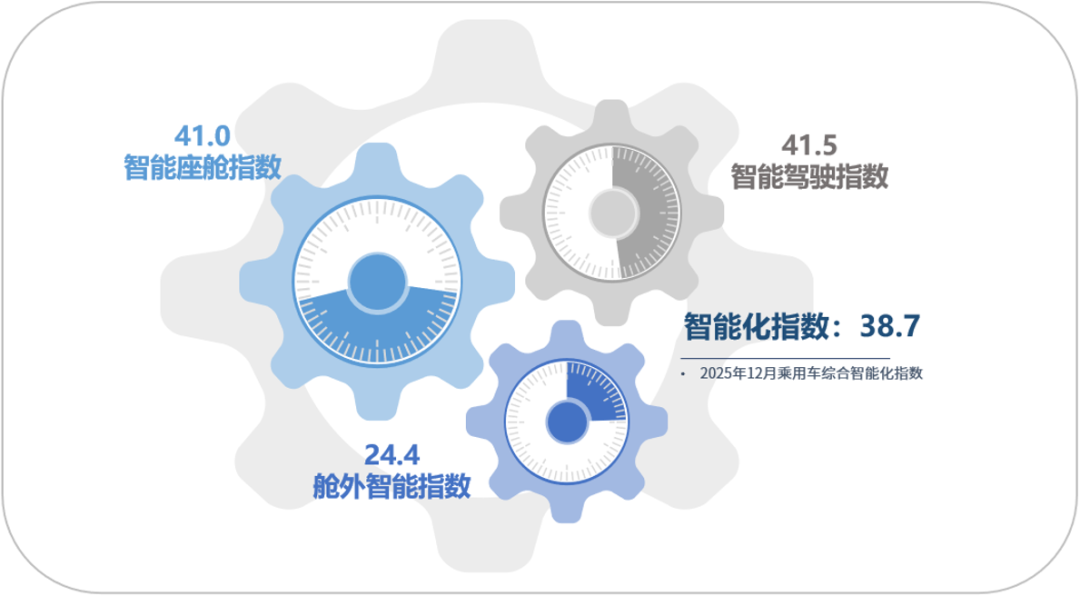
通过追溯2025年1月起的乘用车智能化指数数据,可以清晰观察12个月以来的乘用车智能化指数走势变化。 2025年12月,智能驾驶指数41.5,环比增长了0.3个单位,创年内新高。 2025年12月,舱外智能指数24.4,环比增长了2.9个单位,创年内新高。 乘联分会联合上海安路勤企业管理咨询有限公司联合发布乘用车智能化指数:2025年12月,乘用车智能化指数为38.7,创年内新高。具体而言,智能座舱 指数达41.0,环比提升1.0个单位,增长幅度显著;智能驾驶指数攀升至41.5,环比上涨0.3个单位,延续稳健增长态势;舱外智能指数为24.4,环比大幅增 长2.9个单位,上行趋势持续凸显。三大核心分项指数同步刷新年内峰值,行业智能化发展动能充沛、势头强劲。 目前,乘用车智能化指数有三个分项指数,分别为智能座舱指数、智能驾驶指数和舱外智能指数。 2025年12月,智能座舱指数41.0,环比增长1个单位,创年内新高。 2025年12月全国乘用车市场零售销量为226.1万辆,同比下降14.0%,环比增长1.6%,其中新能源车市场零售133.7万辆,同比增长2.6%,环比增长1.2%。 ...
【联合发布】2025年12月乘用车智能化指数为38.7
乘联分会· 2026-01-29 08:51
Core Viewpoint - The article discusses the development of the passenger vehicle intelligence index in China, highlighting the growth trends and performance of various sub-indices related to vehicle intelligence [4][13]. Summary by Sections Passenger Vehicle Intelligence Index Overview - The passenger vehicle intelligence index is designed to monitor the development of intelligence in the domestic passenger vehicle market and predict future trends based on historical data [4]. - As of December 2025, the overall intelligence index reached 38.7, marking a new high for the year, with significant contributions from the sub-indices [13]. Sub-Indices Performance - The smart cockpit index stood at 41.0, reflecting a month-on-month increase of 1.0 units, achieving a new peak for the year [8][13]. - The smart driving index reached 41.5, with a month-on-month growth of 0.3 units, indicating a steady growth trend [10][13]. - The external smart index was recorded at 24.4, showing a substantial month-on-month increase of 2.9 units, highlighting a continuous upward trend [13]. Market Sales Data - In December 2025, the national retail sales of passenger vehicles totaled 2.261 million units, representing a year-on-year decline of 14.0% but a month-on-month increase of 1.6% [13]. - The retail sales of new energy vehicles reached 1.337 million units, showing a year-on-year growth of 2.6% and a month-on-month increase of 1.2% [13]. Index Calculation Methodology - The passenger vehicle intelligence index is calculated using a weighted formula that incorporates the smart cockpit index, smart driving index, and external smart index [15]. - Each sub-index reflects the market performance of vehicles meeting specific intelligence criteria, with the smart cockpit and smart driving being the most influential areas [18][19]. Future Development Goals - The article indicates that as the intelligence of vehicles continues to evolve, the standards for measuring these indices will be adjusted to better reflect market dynamics [13].

佑驾创新获知名车企智驾项目定点:订单总额超13亿元,覆盖海内外车型
IPO早知道· 2026-01-25 12:18
Core Viewpoint - Youjia Innovation (2431.HK) has secured a significant project with a well-known automotive company, marking a crucial step in the global advancement of intelligent driving in passenger vehicles, with a total order value exceeding RMB 1.3 billion expected to commence mass production by mid-2026 [2][5]. Group 1: Project and Market Position - The project will involve the development and provision of advanced intelligent driving products for a wide range of domestic and overseas vehicle models [2]. - Youjia Innovation has established a strong reputation in the intelligent driving and automotive-grade hardware-software integration sector, having achieved mass production for 42 automakers by mid-2025 [3]. - The increasing demand for integrated hardware-software solutions and compliance capabilities for global markets has become a critical factor in supplier selection by automotive manufacturers [2][3]. Group 2: Strategic Developments - Youjia Innovation is expanding its international presence, having accumulated compliance experience with EU regulations and successfully assisting automakers in passing various certifications, thus laying the groundwork for larger-scale international operations [3]. - A memorandum of understanding has been signed with Sterling Tools Ltd. to collaborate on the localization of intelligent driving solutions and components, indicating a new phase in Youjia Innovation's overseas strategy [4]. - The company is set to deploy over 1,000 autonomous vehicles in Saudi Arabia, further enhancing its international footprint [4]. Group 3: Industry Outlook - According to recent research, 2026 may be a pivotal year for intelligent driving suppliers to expand internationally, with Youjia Innovation identified as a leading choice in the Tier 1 sector [5]. - The ability to secure high-quality projects and convert technological capabilities into production results will be crucial for companies to navigate industry changes and cycles [5]. - Youjia Innovation's upcoming mass production phase in 2026 is expected to amplify its global momentum, serving as a key example of the advancement path for Chinese Tier 1 intelligent driving suppliers [5].
2026年汽车行业总投资策略:坚定“破旧立新”(附下载)
Xin Lang Cai Jing· 2026-01-05 11:45
Group 1: Passenger Vehicle Market Outlook - The overall expectation for the passenger vehicle market in 2026 is a decline of 3.5% in domestic demand due to the 5% new energy vehicle purchase tax [1][6] - As of October 22, 2025, over 10 million applications for vehicle trade-in have been submitted, with over 340 million scrapped and 660 million replaced, resulting in a total subsidy expenditure of 140 billion yuan [1][6] - The new energy vehicle purchase tax will be reinstated at a reduced rate of 5% from January 1, 2026, with a maximum tax exemption of 15,000 yuan per vehicle [1][6] Group 2: Smart Driving Technology - In 2026, the penetration rate of urban NOA (Navigation on Autopilot) in new energy vehicles is expected to rise to 40% [2][7] - The market share of chip suppliers is projected to change, with Nvidia's share decreasing to 45%, Tesla at 15%, Huawei at 25%, and other domestic suppliers at 15% [2][7] Group 3: Heavy Truck Market Forecast - The wholesale sales of heavy trucks are expected to reach 1.16 million units in a neutral scenario, reflecting a year-on-year increase of 1.5%, while domestic sales are projected to decline by 5.5% [3][8] - In an optimistic scenario, wholesale sales could reach 1.25 million units, with domestic sales increasing by 2.7% [3][8] Group 4: Heavy Truck Export Outlook - The export of heavy trucks is expected to accelerate in 2026 as the impact from Russia diminishes, with significant growth anticipated in Southeast Asia, Africa, and the Middle East driven by local infrastructure and mining demands [4][9] - The conservative estimate for exports in 2026 includes a year-on-year increase of 20% for Asia, 30% for Africa, and 40% for the Middle East [4][9] Group 5: Globalization Strategy for Passenger Vehicles - The selection of automotive companies for investment should focus on those with high export ratios and established overseas production capacity, particularly those like Chery, Great Wall, and BYD [10] - Companies with a dual strategy of BEV (Battery Electric Vehicle) and PHEV (Plug-in Hybrid Electric Vehicle) are better positioned for sustained market access and growth [10]

乘联分会:11月乘用车智能化指数为37.7
Di Yi Cai Jing· 2025-12-30 08:42
Group 1 - The core viewpoint of the article indicates that the passenger car intelligence index is projected to reach 37.7 by November 2025 [1] - The intelligent cockpit index is expected to be 40.0, reflecting advancements in in-car technology [1] - The intelligent driving index is forecasted to be 41.2, suggesting significant improvements in autonomous driving capabilities [1] - The external intelligent index is anticipated to be 21.5, indicating a lower level of development in external vehicle intelligence compared to other areas [1]
【联合发布】2025年11月乘用车智能化指数为37.7
乘联分会· 2025-12-30 08:39
Core Viewpoint - The article discusses the significant growth in the intelligence index of China's passenger car market, highlighting the advancements in smart cockpit, smart driving, and external smart technologies, indicating a robust development trend in the industry [3][13]. Group 1: Smart Car Intelligence Index - The passenger car intelligence index for November 2025 is reported at 37.7, showing a substantial increase compared to the previous month [13]. - The smart cockpit index reached 40.0, with a month-on-month increase of 1.8 units, indicating a significant growth trend [8][13]. - The smart driving index stood at 41.2, reflecting a month-on-month increase of 1.6 units, showcasing a notable upward trajectory [10][13]. - The external smart index was recorded at 21.5, with a month-on-month increase of 2.1 units, continuing its previous upward trend [13]. Group 2: Market Performance - In November 2025, the retail sales of passenger cars in China totaled 2.225 million units, representing a year-on-year decline of 8.1% and a month-on-month decrease of 1.1% [13]. - The retail sales of new energy vehicles reached 1.32 million units, showing a year-on-year growth of 4.2% and a month-on-month increase of 3.0% [13]. Group 3: Index Composition and Methodology - The passenger car intelligence index consists of one primary index and three secondary indices: smart cockpit index, smart driving index, and external smart index, which reflect the market performance of vehicles meeting corresponding smart standards [15]. - The calculation method for the intelligence index incorporates weighted contributions from the smart cockpit, smart driving, and external smart indices, with respective weightings of 47.5%, 37.5%, and 15.0% [16][19][20].

【联合发布】2025年9月乘用车智能化指数为36.1
乘联分会· 2025-10-31 08:39
Core Viewpoint - The article discusses the development of the passenger car market's intelligence index in China, highlighting the growth trends and future expectations for smart vehicles, driven by policy support and market demand [4][13]. Summary by Sections Smart Car Intelligence Index - The passenger car intelligence index for September 2025 is reported at 36.1, marking a month-on-month increase of 0.4 units, reaching a historical high [13]. - The index consists of three sub-indices: smart cockpit index (38.5), smart driving index (40.1), and external smart index (18.5) [8][10]. Market Performance - In September 2025, the retail sales of passenger cars reached 2.243 million units, showing a year-on-year growth of 6.4% and a month-on-month increase of 11.2% [13]. - The retail sales of new energy vehicles amounted to 1.299 million units, with a year-on-year increase of 15.7% and a month-on-month increase of 16.5% [13]. Factors Influencing Growth - The increase in the intelligence index is attributed to multiple factors, including policy incentives (such as trade-in programs and subsidies), market demand during the traditional peak season, and the launch of new models [13]. - The article anticipates that the intelligence index will continue to rise in the fourth quarter of 2025 due to the fading off-season, ongoing policy support, and accelerated technological iterations [13]. Index Calculation and Structure - The intelligence index is calculated using a weighted formula that incorporates the smart cockpit index, smart driving index, and external smart index [14]. - The smart cockpit index is weighted at 47.5%, the smart driving index at 37.5%, and the external smart index at 15.0%, reflecting their respective impacts on the industry [17][18][19]. Definitions and Evaluation Criteria - Smart cockpit evaluation focuses on hardware configuration, software ecosystem, user interaction, safety, comfort, and intelligence levels [16]. - Smart driving evaluation emphasizes hardware configuration, functionality, safety, comfort, and intelligence levels [16]. - External smart evaluation centers on vehicle interaction with external entities, enhancing safety and user experience [16].

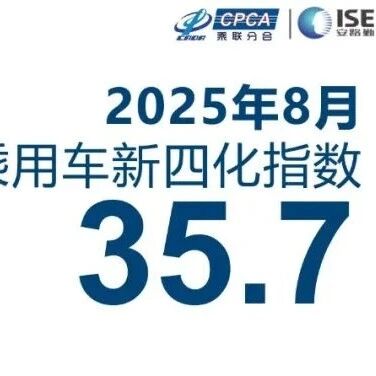
【联合发布】2025年8月乘用车智能化指数为35.7
乘联分会· 2025-09-30 09:36
Core Insights - The article discusses the Passenger Car Intelligence Index, which monitors the development of smart features in domestic passenger vehicles and predicts future trends based on historical data [4][12]. Group 1: Passenger Car Intelligence Index Overview - As of August 2025, the Passenger Car Intelligence Index stands at 35.7, with a month-on-month increase of 1.5 units, marking a historical high [12]. - The index comprises three sub-indices: Smart Cockpit Index (38.0), Smart Driving Index (39.9), and External Intelligence Index (18.3) [4][8][10]. - The Smart Driving Index reached a new high for the year, reflecting a month-on-month growth of 1.5 units [10]. Group 2: Market Performance and Trends - In August 2025, retail sales of passenger cars reached 2.018 million units, showing a year-on-year growth of 5.9% and a month-on-month increase of 9.5% [12]. - The retail sales of new energy vehicles amounted to 1.115 million units, with a year-on-year increase of 8.8% and a month-on-month rise of 13.0% [12]. - The increase in the intelligence index is attributed to several factors, including government policies, new model launches, and rising consumer demand [12]. Group 3: Future Expectations - The article anticipates a steady increase in the Passenger Car Intelligence Index from September to December 2025, driven by the end of the market off-season, ongoing policy support, and accelerated technological iterations [12]. - The index will be adjusted based on the characteristics of each sub-index to better reflect market dynamics [12]. Group 4: Index Composition and Calculation - The Passenger Car Intelligence Index is calculated using a weighted formula that includes the Smart Cockpit Index, Smart Driving Index, and External Intelligence Index [14]. - Each sub-index reflects the market performance of vehicles meeting specific smart criteria, with the Smart Cockpit and Smart Driving being the primary focus areas due to their direct impact on user experience [17][18]. Group 5: Weighting Factors - The Smart Cockpit has a weight of 47.5%, emphasizing its immediate influence on user experience [18]. - The Smart Driving holds a weight of 37.5%, indicating its long-term transformative potential for the automotive industry [18]. - The External Intelligence Index is weighted at 15.0%, representing its emerging role in enhancing vehicle interaction with the environment [19].