价格回升

Search documents
上游价格持续回升
Hua Tai Qi Huo· 2026-01-28 05:04
1. Report Industry Investment Rating There is no information about the report industry investment rating in the provided content. 2. Core Viewpoints of the Report - Since December 2025, the prices of Chinese chemical products have bottomed out and rebounded, with a trend reversal. As of January 26, 2026, the Chinese chemical product price index rose to 4084, a month - on - month increase of 4.2%. The year - on - year decline in PPI of the chemical raw materials and chemical products manufacturing and chemical fiber manufacturing industries in December has narrowed, indicating that the industry's price pressure is continuously easing [1]. - The newly revised "Regulations for the Implementation of the Drug Administration Law of the People's Republic of China" was announced on the 27th and will come into effect on May 15. Encouraging innovation is a prominent feature of this revision [1]. 3. Summary by Relevant Catalogs 3.1 Upstream - **Chemical**: The price of PTA continues to rise [1]. - **Energy**: The prices of international crude oil and liquefied natural gas have rebounded [1]. 3.2 Midstream - **Chemical**: The PX operating rate remains at a high level [2]. - **Energy**: The coal consumption of power plants continues at a low level [2]. - **Infrastructure**: The operating rate of road asphalt is at a low level [2]. 3.3 Downstream - **Real Estate**: The sales of commercial housing in first, second, and third - tier cities have seasonally declined [2]. - **Service**: The number of domestic flights has increased [2]. 3.4 Key Industry Price Indicators - **Agriculture**: On January 27, the spot prices of corn, eggs, palm oil, cotton, and pork increased year - on - year by 0.19%, 5.81%, 2.46%, 0.64%, and 0.92% respectively [36]. - **Non - ferrous Metals**: On January 27, the spot prices of copper, zinc, aluminum, and nickel increased year - on - year by 0.85%, 1.76%, 0.76%, and 2.34% respectively, while the spot price of aluminum decreased by 0.18% [36]. - **Ferrous Metals**: On January 27, the spot price of iron ore increased year - on - year by 1.13%, while the spot prices of rebar and wire decreased by 0.35% and 1.15% respectively [36]. - **Non - metals**: On January 27, the spot prices of glass and natural rubber increased year - on - year by 1.56% and 2.79% respectively, and the China Plastic City price index increased by 0.46% [36]. - **Energy**: On January 27, the spot prices of WTI crude oil, Brent crude oil, and liquefied natural gas increased year - on - year by 2.17%, 1.58%, and 3.63% respectively, while the coal price decreased by 0.12% [36]. - **Chemical**: On January 27, the spot prices of PTA and polyethylene increased year - on - year by about 5.87% and 2.18% respectively, while the spot prices of urea and soda ash decreased by 0.43% and 0.12% respectively [36]. - **Real Estate**: On January 27, the national cement price index and building materials composite index decreased year - on - year by 0.75% and 0.46% respectively, and the national concrete price index remained unchanged [36].
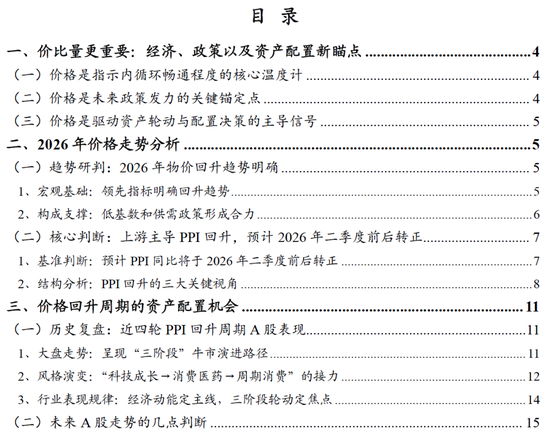
财信宏观深度|价格趋势确立,牛市行至中局——2026年物价走势与A股策略研判
Xin Lang Cai Jing· 2026-01-27 01:28
Group 1 - The focus of macroeconomic analysis is shifting from "quantity" to "price," with "price" becoming a key variable for observing the internal circulation of the economy, predicting policy directions, and driving asset rotation [9][10][14] - Price signals are crucial for activating the "price-profit-income-consumption" positive cycle, which is essential for understanding economic vitality and guiding policy [10][11][14] - The report predicts that the Producer Price Index (PPI) will enter an upward cycle in 2026, primarily driven by upstream industries, fundamentally reshaping profit patterns and market styles [8][15][28] Group 2 - The analysis indicates a clear upward trend in prices for 2026, supported by macroeconomic indicators such as narrowing supply-demand gaps and improving financial liquidity [17][18][19] - The report highlights that the PPI is expected to turn positive around the second quarter of 2026, with structural characteristics emphasizing the role of upstream industries [28][31][32] - The low base effect and supportive supply-demand policies are anticipated to create a combined force that will support moderate price increases in 2026 [25][26] Group 3 - Historical analysis shows that the PPI's transition from negative to positive corresponds with three stages of bull market evolution, with distinct patterns in market performance and sector rotation [49][52][58] - The report identifies a clear rotation in market styles during bull markets, transitioning from technology growth to consumer healthcare and then to cyclical consumption [58][66] - The report emphasizes that the leading sectors during these cycles reflect the core drivers of economic growth and strategic focus, with upstream industries like coal, oil, and metals expected to lead the recovery [36][66] Group 4 - The current market is in the second phase of a bull market, with expectations for reduced return forecasts for 2026, as historical trends indicate diminishing returns in later stages [69] - The focus for the first half of the year will remain on new productive forces, particularly in sectors like computing, electronics, military, and power equipment, driven by the AI technology revolution [70] - The report suggests that while the valuation of technology sectors is high, the potential for profit recovery remains a key driver for performance in these areas [70]

全年经济增长目标顺利完成
ZHONGTAI SECURITIES· 2026-01-19 10:26
Report Summary - The annual GDP growth rate in 2025 was 5%, achieving the annual target. Exports grew by 5.5%, consumption by 3.7%, and investment declined by 3.8%. Compared with 2024, the economic structure was further transformed, with high-tech industries standing out. The growth rate of total retail sales of consumer goods increased by 0.2 pct, exports decreased by 0.3 pct, and investment growth declined by 7 pct [3]. - In December, the production of the manufacturing industry improved significantly, while the growth rate of the mining industry declined. The year-on-year growth rates of the mining, manufacturing, and production and supply of electricity, heat, gas, and water industries were 5.4%, 5.7%, and 0.8% respectively, with changes of -0.9 pct, +1.1 pct, and -3.5 pct compared to the previous month [1]. - The service industry's business climate improved, especially the producer services. In December, the production index increased by 5% year-on-year, up 0.8 pct from the previous month. Among service industries, information software, leasing and business services, and the financial industry increased by 14.8%, 11.3%, and 6.5% respectively, with growth rates up 1.9 pct, 2.9 pct, and 1.4 pct from the previous month [2]. - In December, the growth rate of the three major investment categories declined, but the investment growth rate of some high-tech manufacturing industries showed resilience. The investment growth rates of manufacturing, infrastructure, and real estate were -10.6%, -16.0%, and -35.8% respectively, down 6.1 pct, 4.0 pct, and 5.5 pct from the previous month [4]. - Real estate sales showed marginal stabilization, and new construction and completion improved. In December, the year-on-year sales volume and area of commercial housing were -23.6% and -15.6% respectively, with growth rates up 1.5 pct and 1.7 pct from the previous month. The year-on-year unit price was -9.5%, almost the same as the previous month. In terms of investment, the new construction and completion areas of real estate improved, with year-on-year rates of -19.4% and -18.3% respectively [4]. - Consumption growth slowed down, and the year-on-year growth of catering revenue was weaker than the previous month. In December, total retail sales of consumer goods increased by 0.9% year-on-year, down 0.4 pct from the previous month and lower than the market consensus forecast of 1.48%. Both catering revenue and commodity sales declined from the previous month [4][5]. - In commodity retail, post-real estate cycle products improved, while general consumer goods weakened. In December, the sales growth rates of decoration materials, furniture, home appliances, and automobiles improved compared to the previous month. In contrast, the retail growth rates of grains, oils, beverages, office supplies, and clothing declined. Although precious metals rose rapidly in December, the sales growth rate of gold and silver jewelry declined for the second consecutive month [5]. - In the short term, interest rates showed a muted reaction to economic data. After the data release, the 10-year Treasury bond yield fluctuated by only about 0.3 bp. In the medium to long term, the annual economic data was generally in line with expectations. Two trends emerged: economic structural transformation and improved internal growth momentum. For 2026, "anti-involution" and rising prices suggest limited downside for interest rates [6]. Industry Investment Rating No industry investment rating is provided in the report. Core Viewpoints - The 2025 economic data shows that the economy achieved the growth target, with structural transformation and high-tech industry development being prominent features [3]. - In December, there were mixed trends across different sectors, with manufacturing production improving, service industry business climate rising, investment growth slowing, and consumption growth weakening [1][2][4]. - In the medium to long term, the economic structure is transforming, and internal growth momentum is improving. Interest rates are expected to have limited downside in 2026 [6].
华泰证券:核心通胀指标延续修复趋势
Xin Lang Cai Jing· 2026-01-10 03:50
Group 1 - The core viewpoint of the report indicates that the Consumer Price Index (CPI) in December rose to 0.8% year-on-year from 0.7% in November, while the annual CPI slightly decreased to 0% compared to 0.2% in 2024 [1] - Food prices continued to improve in December, with the core CPI rising 0.2% month-on-month and remaining stable at 1.2% year-on-year compared to November, supported by industrial consumer goods including gold jewelry [1] - High-frequency indicators in January show an accelerated increase in industrial product prices, likely driven by supply-side constraints, credit issuance, and expectations of fiscal spending in the new year [1] Group 2 - The significant increase in travel during the New Year holiday, with a notable rise in the number of trips and expanded travel radius, is expected to boost service sector prices [1] - The sustainability of the overall price recovery will depend on the actual effects of fiscal expansion in the first quarter of this year [1] - The 2026 policy for replacing old products with new ones continues to provide subsidy support for consumer goods, with an optimized scope, potentially offering additional support for service consumption and bolstering demand [1]

更多行业步入盈利复苏通道
Zheng Quan Shi Bao· 2026-01-04 17:30
Core Viewpoint - The chief strategist of Industrial Securities, Zhang Qiyao, indicates that the recovery of fundamentals is expected to support further market growth by 2026 [1] Group 1: Market Performance - By analyzing the performance of listed companies in the first three quarters of 2025, it is observed that revenue has stabilized, but gross margins are still declining, indicating that pricing remains a major drag on profitability [1] - Since the second half of 2025, policies promoting "de-involution" have led to a rebound in prices in resource sectors, which has contributed to an improvement in gross margins [1] Group 2: Economic Outlook - For 2026, nominal economic recovery and price increases are expected to be the most evident trends in the market [1] - According to the latest IMF forecast, China's nominal GDP growth rate in USD terms is projected to reach 6.45% in 2026, significantly higher than in 2025, with continued improvement in listed company profits [1] - The ongoing global liquidity easing is likely to result in a sustained upward trend in the A-share market in 2026 [1] Group 3: Industry Configuration - The market is currently in a structural recovery phase in 2025, with significant differentiation in industry prosperity, leading to a focus on eliminating weaker sectors [1] - As more industries enter the profitability recovery phase in 2026, the market allocation logic may shift from internal competition within sectors to identifying superior industries [1] - Key areas of focus for investment include trends in the AI industry, the "price increase chain," the "overseas expansion chain," and the structural recovery of domestic demand [1]

杨德龙:本轮慢牛长牛有望提升居民财产性收入 从而带动消费增长
Xin Lang Cai Jing· 2025-12-15 05:15
Group 1: Economic Overview - The macroeconomic data for November shows a clear characteristic of "strong production, weak demand, rising prices, and improved structure" [1][5] - The industrial added value for large-scale enterprises increased by 4.8% year-on-year, with significant internal structural differentiation; equipment manufacturing and high-tech manufacturing grew by 7.7% and 8.4% respectively, leading the overall industrial growth by 2.9 and 3.6 percentage points [1][5] - The retail sales of consumer goods only increased by 1.3% year-on-year, marking a new low for the year, with online retail sales growing by 5.7% but unable to offset the weakness in offline sales [1][6] Group 2: Consumer Behavior and Investment - The weak consumption is attributed to declining expectations of household income and a rise in "precautionary" savings, with household deposits increasing by over 10 trillion yuan in the first eleven months [6] - There is a significant shift in household assets from savings to investments, with over 25 million new stock accounts opened this year and equity public funds surpassing 500 billion yuan in sales [6][7] - Fixed asset investment decreased by 2.6% year-on-year, but excluding real estate development, it showed a slight increase of 0.8% [6][7] Group 3: Foreign Trade and Price Trends - In November, the total import and export value increased by 4.1% year-on-year, with exports and imports growing by 5.7% and 1.7% respectively, and a historic trade surplus exceeding 1 trillion USD [7] - The Consumer Price Index (CPI) rose by 0.7% year-on-year, while the Producer Price Index (PPI) decreased by 2.2%, indicating a potential for PPI to turn positive by 2026 [7] - The monetary environment shows a widening gap between M1 and M2, with a notable shift of funds towards equity investments as the one-year fixed deposit rate falls below 1% [7] Group 4: Future Outlook - The policy direction for 2026 will focus on "three stabilizations and three expansions," aiming to stabilize employment, enterprises, and expectations while expanding domestic demand, high-end supply, and institutional openness [7] - The current market trend is expected to enhance household financial income, counteract real estate wealth depreciation, and provide financing support for technology innovation enterprises [8]
国家统计局:下阶段要继续促进价格合理回升
Xin Hua Cai Jing· 2025-09-15 06:05
Core Viewpoint - The current positive changes in prices in China are continuing to accumulate, but the consumer price index (CPI) remains low, necessitating efforts to promote a reasonable recovery in prices [1] Group 1: CPI Analysis - In August, the CPI remained flat month-on-month and shifted from stable to a decline year-on-year, primarily due to the high base effect from the previous year [1] - Food prices in August decreased by 4.3% year-on-year, with the decline expanding by 2.7 percentage points compared to the previous month, significantly impacting the CPI [1] - The core CPI, excluding food and energy, increased by 0.9% year-on-year, marking a 0.1 percentage point increase from the previous month and continuing a trend of rising for four consecutive months [1] Group 2: Industrial and Service Prices - Industrial consumer goods prices saw an increase, with a year-on-year rise of 1.5% in August, up by 0.3 percentage points from the previous month, driven by improved supply and demand [2] - Prices for household appliances and entertainment durable goods rose by 4.6% and 2.4% respectively, contributing approximately 0.09 percentage points to the CPI [2] - Service prices increased by 0.6% year-on-year in August, with a 0.1 percentage point rise from the previous month, influenced by increased demand for high-quality social services [2] - Medical and educational service prices rose by 1.6% and 1.2% respectively, while transportation rental and tourism prices increased by 0.8% and 0.7% [2] Group 3: Future Outlook - The market supply-demand relationship remains prominent, and the consumer price level is still low, indicating the need for continued efforts to expand domestic demand and implement consumption-boosting initiatives [2]
华夏时评:从需求端政策发力,促进价格合理回升
Hua Xia Shi Bao· 2025-07-18 14:25
Economic Growth and Price Trends - The GDP growth for the first half of the year is reported at 5.3%, with Q1 at 5.4% and Q2 at 5.2%, indicating a resilient performance despite challenges [2] - Consumer Price Index (CPI) has seen a slight decline of 0.1% year-on-year, while Producer Price Index (PPI) has decreased by 2.8%, suggesting room for improvement in demand-side policies [2] - The core CPI is showing a mild recovery, influenced by rising gold prices and the "old-for-new" policy, which should be continued to support consumer price increases [2] Policy Measures and Market Regulation - The government is focusing on addressing irrational competition in various industries, particularly in sectors like photovoltaic, cement, and steel, to stabilize prices and improve PPI [3] - A meeting on July 1 emphasized the need to regulate low-price competition and promote the orderly exit of outdated production capacity, which is expected to enhance market order and improve corporate profits [3] - The State Council is implementing actions to boost consumption, including optimizing the "old-for-new" policy and expanding investments in emerging service sectors [4] Real Estate Market Focus - The real estate market is highlighted as a critical economic cycle, with stable housing prices being essential for consumer confidence and demand [5] - The government aims to prevent a decline in housing prices and is committed to policies that will stabilize the real estate market [5] - Overall, the focus is on expanding domestic demand and regulating market order to ensure prices remain within a reasonable range [5]