住房增值税政策

Search documents
一批新规,今起施行!每一条都能帮你省钱→
中国能源报· 2026-01-01 12:13
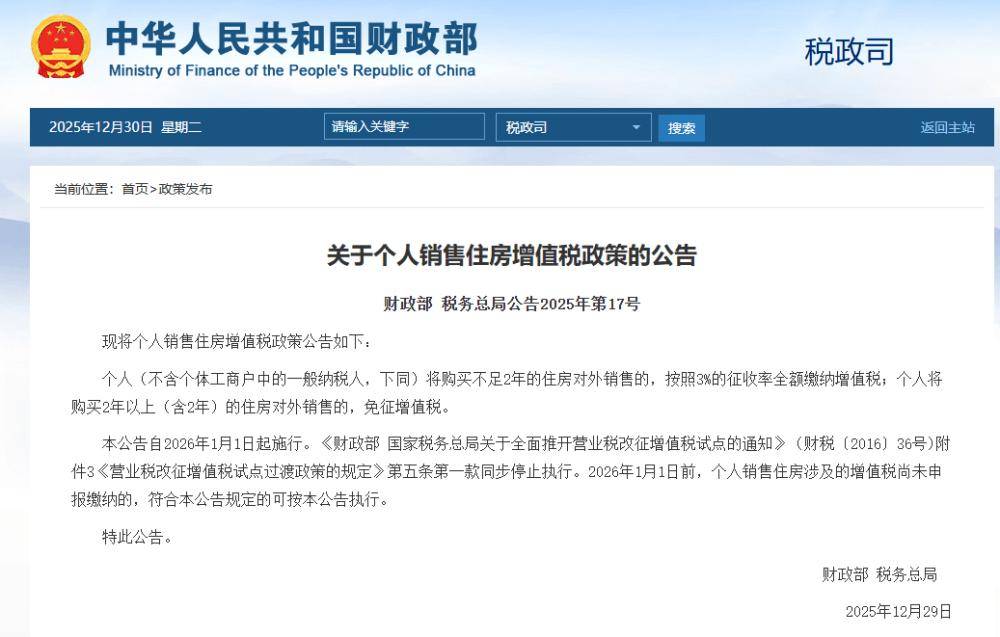
Group 1: Policy Announcements - The National Development and Reform Commission and the Ministry of Finance issued a notice regarding the implementation of large-scale equipment updates and consumer goods replacement policies in 2026, specifying support areas, subsidy standards, and work requirements [1] - The policy for replacing consumer goods continues to include subsidies for scrapping and replacing cars, as well as for old appliances, focusing on six categories: refrigerators, washing machines, televisions, air conditioners, computers, and water heaters [2] - The Ministry of Finance and the State Taxation Administration announced a new policy on the value-added tax for individuals selling residential properties, effective January 1, 2026, with a 3% tax rate for properties sold within two years and exemption for properties sold after two years [3] Group 2: Housing and Loan Adjustments - For housing provident fund loans issued before May 8, 2025, the interest rate will be reduced by 0.25 percentage points starting January 1, 2026, with new rates set at 2.1% for loans of five years or less and 2.6% for loans over five years for first-time homebuyers [5] - The interest rates for second home loans will also be adjusted, with rates not lower than 2.525% for loans of five years or less and 3.075% for loans over five years [5] Group 3: Education and Childcare Policies - A joint notice from the National Development and Reform Commission, the Ministry of Education, and the Ministry of Finance outlines the fee structure for kindergartens, effective January 1, 2026, including government-guided pricing for non-profit kindergartens and market-regulated pricing for for-profit kindergartens [7] Group 4: New Energy Vehicle Policies - The Ministry of Finance and the State Taxation Administration announced a continuation and optimization of the vehicle purchase tax exemption policy for new energy vehicles, with a 50% tax reduction for purchases made between January 1, 2026, and December 31, 2027, and a maximum tax reduction of 15,000 yuan per vehicle [8] - New technical requirements for electric and hybrid vehicles will be implemented starting January 1, 2026, including a minimum all-electric range for plug-in hybrid vehicles [8]


明天起,这些新规将影响你我生活!
Xin Lang Cai Jing· 2026-01-01 11:32
Group 1 - The revised Public Security Administration Punishment Law will take effect on January 1, 2026, adding provisions for legitimate defense, stating that actions taken to prevent ongoing illegal harm that result in damage will not be considered violations of public security management and will not incur penalties [2] - The "Notice on Improving Kindergarten Charging Policies" will also be effective from January 1, 2026, specifying that kindergartens can only charge for five categories of fees, including care education fees and accommodation fees, and must establish a fee directory list, prohibiting charges outside this list [4] - A mandatory standard for electric vehicle energy consumption will be implemented on January 1, 2026, requiring companies to upgrade new products technically, with a limit of 15.1 kWh per 100 km for vehicles around 2 tons, which is expected to increase the average range of electric vehicles by approximately 7% under unchanged battery capacity [6] Group 2 - The revised Cybersecurity Law will come into effect on January 1, 2026, emphasizing national support for research in artificial intelligence and key technology development, enhancing infrastructure for training data resources and computing power, and increasing penalties for certain illegal activities [8] - The Ministry of Finance and the State Taxation Administration announced that starting January 1, 2026, individuals selling homes purchased for less than two years will be subject to a 3% value-added tax, while those selling homes purchased for two years or more will be exempt from this tax [10] - According to the People's Bank of China, starting January 1, 2026, overdue records will no longer be displayed in personal credit reports if they meet specific conditions, including being generated between January 1, 2020, and December 31, 2025, with a single overdue amount not exceeding 10,000 yuan, and full repayment by March 31, 2026 [12] Group 3 - The revised National Common Language and Writing Law will take effect on January 1, 2026, mandating that online literary programs, web dramas, online movies, and online games use the national common language and writing as the basic language [14] - The revised "Civil Case Cause Regulations" will be effective from January 1, 2026, adding causes related to data and virtual property, and refining causes related to intellectual property [15] - The People's Bank of China will implement a digital renminbi action plan starting January 1, 2026, allowing digital renminbi wallet balances to earn interest calculated like demand deposits, making China the first economy to pay interest on central bank digital currency [17]

注意!一批新规,今起施行!每一条都能帮你省钱→
证券时报· 2026-01-01 10:53
Group 1 - The National Development and Reform Commission and the Ministry of Finance announced a policy for large-scale equipment updates and consumer goods replacement starting in 2026, focusing on various sectors including old residential areas, safety equipment, and consumer infrastructure [1] - The policy includes subsidies for replacing old cars and household appliances, specifically targeting six categories: refrigerators, washing machines, televisions, air conditioners, computers, and water heaters, as well as expanding subsidies for digital and smart products [1] Group 2 - The Ministry of Finance and the State Taxation Administration issued a notice regarding the value-added tax policy for individuals selling residential properties, effective January 1, 2026, with a 3% tax rate for properties held for less than two years and exemption for those held for two years or more [2] Group 3 - For housing provident fund loans issued before May 8, 2025, the interest rates will be reduced by 0.25 percentage points starting January 1, 2026, with new rates set at 2.1% for loans under five years and 2.6% for loans over five years for first-time buyers [4] Group 4 - A joint notice from the National Development and Reform Commission, the Ministry of Education, and the Ministry of Finance outlines the kindergarten fee policy effective January 1, 2026, detailing the types of fees that can be charged and the pricing mechanisms for different types of kindergartens [6] Group 5 - The Ministry of Finance, the State Taxation Administration, and the Ministry of Industry and Information Technology announced a continuation and optimization of the vehicle purchase tax exemption policy for new energy vehicles, effective from January 1, 2026, with a tax reduction of up to 15,000 yuan per vehicle [7]
冠通期货早盘速递-20251231
Guan Tong Qi Huo· 2025-12-31 03:06
Group 1: Hot News - The 2026 national subsidy program is officially released, with the first batch of 62.5 billion yuan in funds for consumer goods trade - in. New subsidy objects include smart products, and home decoration and electric bicycles are removed. Car purchase subsidies remain at 2025 caps, and home appliance subsidy scope and rates are reduced [2] - From 2026, the VAT levy rate for individuals selling homes bought less than 2 years ago drops to 3%, and those bought 2 or more years ago are exempt. This will boost second - hand housing trading activity but increase supply [2] - Indonesia plans to cut production in 2026 to balance supply and demand, controlling nearly 70% of global nickel output [2] - In December 2025, the coking coal long - term agreement coal - steel linkage floating value drops 55 yuan/ton, a 3.6% decline [3] - Last week, domestic oil mills had high operating rates, and soybean meal inventory continued to accumulate. During the New Year's Day holiday, soybean crushing is expected to fall to about 1.8 million tons, but inventory may remain high at around 1 million tons [3] Group 2: Sector Performance - Key sectors to focus on are urea, coking coal, Shanghai silver, PVC, and plastic [4] - Night - session performance shows different percentage changes for various commodity futures sectors, with precious metals at 32.77%, non - metallic building materials at 2.20%, etc. [4] Group 3: Sector Positions - The chart shows the changes in commodity futures sector positions in the past five days [5] Group 4: Performance of Major Asset Classes - Different asset classes have various daily, monthly, and annual percentage changes. For example, the Shanghai Composite Index has a 0.00% daily change, 1.97% monthly change, and 18.30% annual change [6] Group 5: Stock Market Risk Preference and Commodity Trends - The document shows the trends of major commodities, including the Baltic Dry Index, CRB Spot Index, WTI crude oil, etc. [8]
个人出售购买满2年的住房将免征增值税
Xin Lang Cai Jing· 2025-12-30 22:18
Core Viewpoint - The Ministry of Finance has announced a new policy regarding the value-added tax (VAT) on the sale of residential properties by individuals, effective from January 1, 2026, which introduces a 3% VAT for properties sold within two years of purchase and exempts properties sold after two years from VAT [1]. Group 1: Tax Policy Changes - Individuals selling residential properties purchased within two years will be subject to a full VAT payment at a rate of 3% [1]. - Properties sold after being owned for two years (including exactly two years) will be exempt from VAT [1]. - The new policy will replace the previous regulations outlined in the notice regarding the transition from business tax to VAT, which will cease to be effective from the same date [1]. Group 2: Implementation Timeline - The new VAT policy will come into effect on January 1, 2026 [1]. - Prior to this date, individuals can apply the new VAT rules for any unsold residential properties that have not yet been declared for VAT payment [1].
两部门发布政策公告 个人对外销售购买2年及以上的住房 明起免征增值税
Xin Lang Cai Jing· 2025-12-30 19:09
Core Viewpoint - The Ministry of Finance and the State Taxation Administration announced a new policy regarding the value-added tax (VAT) on the sale of personal housing, effective from January 1, 2026, which introduces a 3% VAT for properties sold within two years of purchase and exempts properties sold after two years from VAT [1] Group 1: Tax Policy Changes - Individuals selling housing purchased within two years will be required to pay a full VAT at a rate of 3% [1] - Individuals selling housing purchased for two years or more will be exempt from VAT [1] - The new policy will replace the previous transitional regulations regarding the VAT reform, which will cease to be effective from the same date [1]
个人对外销售购买2年及以上的住房 明起免征增值税
Xin Lang Cai Jing· 2025-12-30 19:09
Group 1 - The Ministry of Finance and the State Taxation Administration announced a new policy regarding the value-added tax (VAT) on the sale of personal housing [1] - Individuals selling housing purchased for less than 2 years will be subject to a VAT rate of 3% on the total amount [1] - Individuals selling housing purchased for 2 years or more will be exempt from VAT [1] Group 2 - The new policy will take effect on January 1, 2026, and will supersede previous regulations regarding the transition from business tax to VAT [1] - Individuals who have not yet declared or paid VAT on housing sales before January 1, 2026, can apply the new policy if they meet the specified conditions [1]
二手房交易,重大利好!
Shang Hai Zheng Quan Bao· 2025-12-30 15:18
Core Points - The announcement outlines the new value-added tax (VAT) policy for individuals selling residential properties in China, effective from January 1, 2026 [2] - Properties purchased for less than 2 years will incur a VAT at a rate of 3% upon sale, while properties held for 2 years or more will be exempt from VAT [2] - The previous regulations regarding the transition from business tax to VAT will be repealed simultaneously with the new policy [2] Summary by Categories - **Policy Changes** - Individuals selling residential properties purchased for less than 2 years will be required to pay a VAT of 3% [2] - Sales of residential properties held for 2 years or more will be exempt from VAT [2] - **Implementation Timeline** - The new VAT policy will take effect on January 1, 2026 [2] - Prior to this date, individuals can apply the new regulations for any VAT that has not yet been declared or paid [2] - **Regulatory Context** - The announcement also indicates that the previous business tax regulations will cease to be effective as of the implementation date of the new VAT policy [2]
贝壳(BEKE)盘前涨超1% 两部门推新政策 有条件减免卖房增值税
Xin Lang Cai Jing· 2025-12-30 14:03
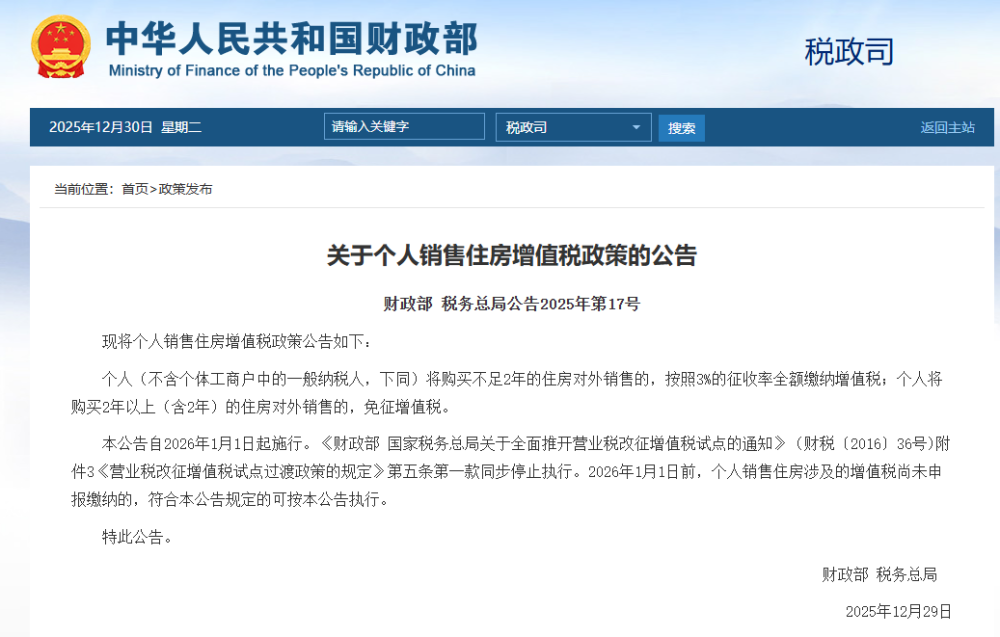
Group 1 - The core viewpoint of the article highlights the impact of new tax policies on the real estate market, specifically regarding the sale of residential properties in China [1] - The Ministry of Finance and the State Administration of Taxation announced a new policy where individuals selling homes purchased for less than 2 years will be subject to a 3% value-added tax (VAT) [1] - Homes purchased for 2 years or more will be exempt from the VAT, which may encourage longer-term ownership and potentially stabilize the housing market [1] Group 2 - The stock price of Beike (BEKE) increased by over 1% in pre-market trading, reaching $16.310 at the time of reporting [1] - The announcement of the tax policy could influence investor sentiment and market dynamics in the real estate sector, particularly for companies like Beike [1]
刚刚发布!二手房市场迎利好
Sou Hu Cai Jing· 2025-12-30 13:22
Core Viewpoint - The announcement from the Ministry of Finance outlines new regulations regarding the value-added tax (VAT) on the sale of residential properties by individuals, effective from January 1, 2026, which introduces a 3% VAT for properties sold within two years of purchase and exempts properties sold after two years from VAT [1]. Group 1 - Individuals selling residential properties purchased within two years will be subject to a full VAT rate of 3% [1]. - Properties sold after being owned for two years will be exempt from VAT [1]. - The new policy will come into effect on January 1, 2026, and will replace previous regulations regarding the transition from business tax to VAT [1].