
体制机制改革

Search documents
魔都券商2025争霸:巨头业绩答卷,谁是王者?
Xin Lang Cai Jing· 2026-01-28 12:11
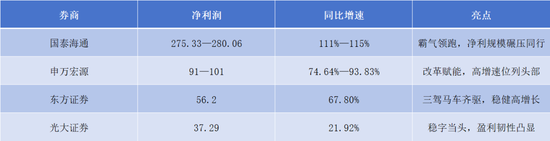
Core Viewpoint - The Shanghai brokerage industry is experiencing a redefinition of its landscape, with firms achieving impressive performance through mergers, reforms, and steady growth strategies [1][20]. Group 1: Performance Overview - The current top four brokerages in Shanghai have established their positions, showcasing a clear performance pattern of "one leading, two peaks, and steady growth" [2][21]. - Guotai Haitong leads with a projected net profit of 275.33 to 280.06 billion, reflecting a year-on-year growth of 111% to 115%, significantly surpassing competitors [3][22]. - Shenwan Hongyuan and Dongfang Securities are in a competitive "dual-hero" scenario, both maintaining high growth rates around 70%, with Shenwan Hongyuan slightly ahead in net profit due to stronger capital [3][22]. Group 2: Individual Brokerage Strategies - Guotai Haitong's success is attributed to its merger strategy, which has created a comprehensive financial service system, resulting in a net profit scale 2.7 times that of Shenwan Hongyuan [6][25]. - Shenwan Hongyuan's growth is driven by internal reforms that enhance collaboration across its wealth management, trading, and investment banking sectors, leading to a significant increase in client assets and transaction revenues [7][27]. - Dongfang Securities employs a balanced approach across its three main business segments, achieving substantial growth in wealth management and investment banking, with a notable increase in client acquisition and asset management [10][29]. - Everbright Securities focuses on meticulous management and core business optimization, achieving steady growth despite lower growth rates compared to peers, maintaining a solid client base and profitability [13][32]. Group 3: Market Dynamics and Future Outlook - The competitive landscape among Shanghai brokerages reflects the advantages of being in an international financial center, with Guotai Haitong posing a direct challenge to the leading position of CITIC Securities [14][34]. - The rivalry between Shenwan Hongyuan and Dongfang Securities will be crucial in determining their future standings, particularly in reaching the 100 billion net profit milestone [15][35]. - The ongoing reforms in the capital market, including the full implementation of the registration system and the influx of medium to long-term funds, are expected to intensify competition among brokerages [17][35].

云南省出台行动计划推动园区经济发展壮大
Xin Lang Cai Jing· 2026-01-26 16:56
Core Viewpoint - The Yunnan Provincial Government has issued an "Action Plan" to further develop and strengthen the park economy, aiming for significant growth in industrial output and the establishment of a high-quality development framework by 2030 [1][2]. Group 1: Goals and Targets - By 2026-2028, Yunnan's park revenue and industrial output are expected to grow by approximately 7% annually, with an average of 600 new large-scale industrial enterprises added each year [1]. - By 2028, parks are projected to contribute over 25% to the provincial GDP and over 85% to the industrial output, with a concentration of leading industries reaching around 60% [1]. - The number of billion-level development zones is expected to double by 2030, alongside the cultivation of a number of hundred-billion-level county-level characteristic parks [1]. Group 2: Key Tasks - The plan outlines eight main tasks, including enhancing party leadership, upgrading park classifications, promoting industrial clustering, empowering technological innovation, deepening open cooperation, improving infrastructure, reforming systems and mechanisms, and strengthening factor supply [2]. - Specific measures include focusing each park on 1-3 leading industries, optimizing the business environment, and accelerating the transformation of technological achievements [2]. Group 3: Characteristics of the Action Plan - The plan adopts a problem-oriented approach, addressing key issues in park development and proposing targeted measures [3]. - Emphasis is placed on quality and efficiency, with specific indicators set for evaluating infrastructure investments and overall performance [3]. - The plan incorporates differentiated management strategies based on the varying scales and types of parks, ensuring tailored requirements for different categories [4]. - A comprehensive policy system is established, including multiple action plans and management guidelines to create a closed-loop from objectives to policy support and evaluation [4].
津电:深化体制机制改革 加速科技自立自强
Xin Lang Cai Jing· 2026-01-20 03:29
Core Viewpoint - The company, Tianjin Electric, has achieved significant operational improvements during the 14th Five-Year Plan period, with a focus on strategic governance, innovation mechanisms, and talent management to drive high-quality development [2][3][4]. Strategic Leadership and Mechanism Innovation - During the 14th Five-Year Plan, Tianjin Electric's operating performance has more than doubled compared to the beginning of the period, with core operating indicators surpassing expectations [2]. - The company has established a new strategic governance framework led by the party committee, with a complete management system for research, planning, implementation, and evaluation [2]. - An integrated product development (IPD) model has been introduced to enhance agile R&D capabilities, significantly improving R&D efficiency and success rates [2]. - A value creation-oriented distribution mechanism has been implemented, linking employee benefits closely with corporate value and individual contributions [2]. Comprehensive Breakthrough and Industrial Synergy - Over the past five years, Tianjin Electric has made historic strides in market expansion, achieving key system qualifications across all major models [3]. - The company has made breakthroughs in the defense market, contributing to significant projects such as the Long March rocket and naval fleet support [3]. - In the civil aviation sector, Tianjin Electric has transitioned from a follower to a competitor, with products for key national models like C919 and AG600 now in operation [3]. Technological Leadership and Innovation Drive - Tianjin Electric has achieved systematic breakthroughs in technology innovation, completing 176 innovation projects and overcoming 435 key technical challenges over five years [4]. - The company has established a technology and product asynchronous development model, enhancing decision-making efficiency and quality [4]. - Significant achievements in standardization include the formulation of 5 ISO international standards and 5 national military standards during the 14th Five-Year Plan [4]. Digital Integration and Manufacturing Upgrade - The company has advanced its digital transformation, establishing five digital assembly production lines and implementing various core information systems [6]. - Lean management practices have led to a more than 30% reduction in production cycles for major product lines, generating substantial economic benefits [6]. Quality Foundation and Supply Chain Enhancement - Tianjin Electric has deepened its supply chain system construction, significantly compressing supply chain cycles and enhancing responsiveness [7]. - The company has achieved various quality certifications, improving process control capabilities and ensuring compliance with industry standards [7]. - A comprehensive information system has been developed to support R&D, manufacturing, management, and decision-making processes [7].
聚焦三大改革路径 激活文化产业内生动力
Xin Lang Cai Jing· 2026-01-08 21:03
Core Viewpoint - The article emphasizes the importance of cultural strength in enhancing national image and spiritual power, highlighting the need for systemic reforms in the cultural industry to overcome structural contradictions and institutional barriers, thereby achieving high-quality development and strengthening national cultural soft power [1]. Group 1: Market Access Reform - Deepening market access reform is essential to activate the vitality of cultural industry entities by eliminating hidden barriers and creating a fair, open, and efficient market environment [2]. - Implementing a negative list management approach will lower entry barriers for cultural creative enterprises and small businesses, allowing for a more inclusive regulatory model for emerging sectors like digital publishing [2]. - Optimizing the business environment by streamlining administrative approval processes and promoting online services will significantly reduce institutional transaction costs for enterprises [2]. - Ensuring fair competition among different ownership cultural enterprises by eliminating hidden discrimination will foster a vibrant cultural market [2]. Group 2: Resource Allocation Mechanism - Improving the allocation mechanism for key resources such as funding, talent, and data is crucial to address the supply-demand imbalance in quality cultural products [3]. - Establishing a multi-tiered and multi-channel financing system for the cultural industry will facilitate access to funding through innovative financial products and investment channels [3]. - Enhancing talent cultivation and evaluation mechanisms by promoting collaboration between academia and industry will help attract high-end creative talent [3][4]. Group 3: Innovation Incentive System - Strengthening intellectual property protection is vital for fostering content innovation, including enhancing legal frameworks and utilizing new technologies for copyright protection [5]. - Reforming evaluation and reward mechanisms in the cultural sector to prioritize originality and artistic value will encourage diverse creative activities and support innovative projects [6]. - Creating a supportive cultural environment that tolerates failure and encourages exploration will significantly boost the creative confidence of cultural workers [6]. Group 4: Systematic Approach to Cultural Strength - Building a cultural strong nation requires a systematic approach, with institutional reforms acting as a key to unlocking industry potential [7]. - The interconnection of market access reform, resource allocation improvement, and innovation incentive systems forms a comprehensive pathway to drive high-quality development in the cultural industry [7].
长治机场以创新担当书写高质量发展答卷
Zhong Guo Min Hang Wang· 2026-01-01 12:58
Core Insights - Longzhi Airport has successfully completed its reform efforts by focusing on its core responsibilities and overcoming development bottlenecks, achieving significant growth in flight operations, passenger throughput, and cargo volume in 2025 [1] Group 1: Operational Performance - In 2025, Longzhi Airport handled 8,190 flight takeoffs and landings, a year-on-year increase of 19% [1] - The airport achieved a passenger throughput of 851,000, representing a 31% increase compared to the previous year [1] - Cargo and mail throughput reached 2,003.7 tons, marking a 64% year-on-year growth [1] Group 2: Structural Reforms - Longzhi Airport initiated internal reforms to address issues in logistics management, leading to the establishment of an Aviation Logistics Center in March 2024, which improved operational efficiency [3] - The airport implemented a new performance evaluation system that quantifies key indicators and promotes accountability among staff, fostering a more motivated workforce [6] Group 3: Route and Cargo Development - The airport expanded its route network by adding and optimizing domestic flights, including new routes to Northeast China, enhancing connectivity to major cities [7] - The establishment of the Aviation Logistics Center led to a dramatic increase in cargo throughput, which grew from 213 tons in 2023 to over 2,000 tons in 2025, a nearly ninefold increase [3] Group 4: Non-Aviation Revenue Growth - Longzhi Airport's non-aviation revenue increased by 5.26% in 2025, contributing to overall revenue growth through advertising, leasing, and integrated travel products [10] Group 5: Infrastructure Improvements - The airport focused on upgrading its infrastructure, including runway enhancements and navigation systems, to improve safety and operational capacity [11][12] - Key projects included the relocation of the runway's southern end and the construction of a new navigation station, which are expected to enhance flight operations significantly [14] Group 6: Technological Innovation - Longzhi Airport is advancing towards a "smart airport" model by implementing various technology-driven projects aimed at improving operational efficiency and safety [15] - The airport has collaborated with universities for technological advancements, resulting in successful projects that enhance operational capabilities without additional investment [18]

邮储银行中层调整涉及多家省分行行长
Xin Lang Cai Jing· 2025-11-10 09:08
Core Insights - Postal Savings Bank of China reported total assets of 18.61 trillion yuan as of September 30, 2025, representing an 8.9% increase from the end of the previous year [1] - The bank achieved a revenue of 265.08 billion yuan in the first three quarters of this year, reflecting a year-on-year growth of 1.82%, while net profit reached 76.794 billion yuan, showing a similar upward trend [1] - The bank is undergoing significant personnel changes, including the resignation of non-executive director Han Wenbo and various leadership adjustments across its branches [2][4] Financial Performance - For the first three quarters, the net interest margin narrowed to 1.68%, yet remains the highest among the six major state-owned banks [6] - Interest income for the period was 210.505 billion yuan, a decrease of 2.07% year-on-year, although the decline rate has slowed compared to the mid-year figures [6] - Non-interest income has increased as the bank focuses on diversifying its revenue streams and enhancing its retail business while expanding corporate and funding operations [6] Cost Management - Business and management expenses for the first three quarters totaled 152.167 billion yuan, down by 4.165 billion yuan or 2.66% year-on-year [6] - The cost-to-income ratio improved to 57.40%, a reduction of 2.65 percentage points compared to the same period last year [6] Asset Quality - As of September 30, 2025, the bank's non-performing loan balance stood at 91.009 billion yuan, an increase of 10.690 billion yuan from the end of the previous year [6] - The non-performing loan ratio was 0.94%, still the lowest among the six major banks, although it increased by 0.04 percentage points from the previous year [6] - The provision coverage ratio was reported at 240.21% [6] Organizational Changes - The bank is implementing reforms focusing on organizational structure, network operations, market service systems, incentive mechanisms, digital transformation, risk management, and operational management [5] - The bank aims to strengthen its first-level branches' operational capabilities and optimize personnel allocation as part of its "one branch, one sub-branch" reform pilot [5]

【省科技厅】陕西“三项改革”激活创新“一池春水”
Shan Xi Ri Bao· 2025-10-29 23:07
Core Insights - The article highlights the significant impact of the "three reforms" in Shaanxi province, which have alleviated concerns regarding the transformation of scientific and technological achievements into marketable products [1][6] - The reforms have led to a more efficient and clear management of intellectual property rights, enabling researchers to engage in technology transfer without bureaucratic hurdles [2][6] Group 1: Reforms and Their Impact - The "three reforms" include separate management of job-related scientific achievements, evaluation of technology transfer personnel, and funding mechanisms for technology transformation, which have collectively stimulated innovation [1][4] - The reforms have resulted in a notable increase in technology contract transactions, with the total amount reaching 4,831.38 billion yuan in 2024, doubling since 2021 [5][6] - The establishment of 2,820 new technology transformation companies and the promotion of 697 researchers to higher academic titles due to their contributions in technology transfer demonstrate the reforms' effectiveness [5][6] Group 2: Financial and Structural Support - The introduction of innovative funding mechanisms, such as "cash and technology equity" models, has alleviated financial pressures on researchers, facilitating the transformation of scientific achievements [3][4] - A comprehensive policy framework has been developed, linking management, evaluation, and profit distribution to encourage researchers to focus on technology transfer [4][6] - The province has also launched various initiatives, including a "first invest, then share" pilot program, which has attracted significant social capital investment [5]
专访|郑永年看“十五五”:经济发展,才能真正解决问题
Nan Fang Du Shi Bao· 2025-10-27 13:06
Core Insights - The 20th Central Committee's Fourth Plenary Session emphasized the importance of the "15th Five-Year Plan" as a critical period for achieving socialist modernization, highlighting the need for development amidst changing domestic and international conditions [2][4]. Economic Development Focus - The "15th Five-Year Plan" reiterates the centrality of economic construction, reflecting the necessity to adapt to both international economic nationalism and domestic modernization goals [5][6]. - The current economic strategy should shift investment focus from material construction to human capital, aligning with the need for high-quality development [5][6]. GDP Growth and New Industries - Future GDP growth is projected to maintain around 5%, with a strong emphasis on nurturing new industries to drive economic activity [9][10]. - The need for regulatory reform is highlighted to facilitate the emergence of new sectors, particularly in services and technology, which are currently underdeveloped [9][10]. Regional Coordination and Development - The Guangdong-Hong Kong-Macao Greater Bay Area is identified as a key economic growth region, with recommendations for improved coordination among cities to enhance competitiveness and innovation [11][12]. - The potential for the Greater Bay Area to develop into a highly integrated market is emphasized, drawing parallels with the European common market model [13].

“十五五”规划前瞻
Guo Tai Jun An Qi Huo· 2025-10-20 08:32
1. Report Industry Investment Rating There is no information provided in the report regarding the industry investment rating. 2. Core Viewpoints of the Report - The "15th Five - Year Plan" is expected to be gradually implemented in three steps: the core content will be announced on October 23, 2025; the full text of the Party's "15th Five - Year Plan Outline Suggestions" will be released in the following days; the full text of the "15th Five - Year Plan Outline" will be officially released after being approved by the Fourth Session of the 14th National People's Congress in March 2026. The plan will inherit and innovate on previous goals, especially in key areas such as economic growth, technological innovation, and institutional reform [1]. - Five - year plans have a profound impact on the macro - underlying logic, economic context, and capital markets. They often lead to significant stock market rallies and clearly define core investment tracks. They also affect the supply and demand of commodities, thereby influencing prices [2]. 3. Summary According to the Table of Contents 3.1 "15th Five - Year Plan" Later Implementation Process and Main Nodes - The implementation process will follow three steps: on October 23, 2025, the "Fourth Plenary Session" will release a communiqué with the core content of the "15th Five - Year Plan"; in the following days, the Party's "15th Five - Year Plan Suggestions" will be released, along with an explanation by the General Secretary; the State Council will compile the final version of the plan based on the Party's suggestions and submit it to the National People's Congress for approval in March 2026 [1][6]. 3.2 Five - Year Plan Document Framework Content Overview - The "Five - Year Plan Outline" includes a general introduction (covering economic situation judgment, guiding ideology, principles, and goals), specific area discussions (detailing key tasks in various fields), and a conclusion (emphasizing Party leadership, implementation, and guarantee mechanisms). Quantitative indicators in previous plans mainly cover five areas: economic development, people's well - being, ecological environment, innovation drive, and security [10]. 3.3 "15th Five - Year Plan" Key Content Outlook 3.3.1 Economic Growth Target Setting - Long - term growth targets require China to reach the level of a high - income country by the end of the "14th Five - Year Plan" and double its economic aggregate or per - capita income by 2035. As of 2024, China's per - capita GDP was $13,300. To reach the minimum threshold of a moderately developed country ($24,000) by 2035, the average nominal growth rate from 2026 - 2035 should be no less than 5.6% (assuming a 4.5% nominal growth rate in 2025). The actual GDP growth rate from 2026 - 2035 should be around 4%. Market expectations suggest setting a target of around 5% in 2026 and gradually reducing it to 4.8% [17][18][23]. 3.3.2 Key Work Task Deployment - The "15th Five - Year Plan" will continue to focus on economic, institutional, industrial, innovation, people's well - being, and ecological fields. Key areas include institutional reform, technological innovation, domestic demand expansion, green development, and industrial chain security. New quality productivity development is expected to accelerate, and the plan will also address issues such as effective demand shortage and international competition [24][29][30]. 3.4 Five - Year Plan's Market Impact 3.4.1 Five - Year Plans as Investment Mainlines - Five - year plans reshape the economic underlying logic, clarify development priorities, and provide clear investment tracks for the capital market. Different periods have seen different industries thrive, such as traditional cyclical industries during the "11th Five - Year Plan" and technology industries during the "12th" and "13th Five - Year Plans" [33]. 3.4.2 Stock Market Impact - Historically, stock markets have often rallied around the release of five - year plans. Currently, the technology - growth sector has outperformed the market, with some sub - themes like optical modules and AI computing power showing significant excess returns. If the "15th Five - Year Plan" has unexpected content, it will create short - term trading opportunities and support medium - term technology and reform - related investments [35][37]. 3.4.3 Commodity Market Impact - Five - year plans affect commodity supply and demand through national economic logic, industrial policies, and resource security strategies. They have led to a shift in demand from traditional commodities like steel and cement to manufacturing and new - energy - related metals. Supply - side reforms and national policies also influence commodity prices [40].
“给成长快的孩子换上一件大衣服”
Ren Min Ri Bao· 2025-09-08 01:59
Core Insights - The metaphor of "changing clothes for a fast-growing child" illustrates the need for timely reforms to overcome institutional barriers and promote development [1][2][3] Group 1: Reform and Development - The purpose of advancing reforms is to continuously improve and develop the socialist system in China, injecting new vitality into socialism [2] - Recent years have seen local governments exploring new models and services to optimize the business environment, enhancing efficiency and satisfaction among enterprises and the public [2][4] Group 2: Challenges in Reform - Some party members lack a sense of responsibility for reform, relying on past experiences and resisting new approaches, which can hinder progress and lead to missed opportunities [3] - The ability to "change clothes" reflects the capability of party members to identify and address the needs of the economy and society effectively [4] Group 3: Practical Examples of Reform - Successful case studies include the establishment of working groups to streamline project approvals in Fujian and the creation of a provincial automotive office in Anhui to enhance coordination and address industry challenges [4] - These examples highlight the importance of targeted reforms that focus on pressing issues faced by enterprises and the public, breaking down barriers to foster economic vitality [4] Group 4: Principles of Reform - Reforms must be grounded in reality and respect established rules, avoiding excessive ambition that could lead to ineffective policies and resource waste [5] - It is crucial for party members to maintain a spirit of reform while adhering to practical considerations, ensuring that initiatives genuinely support economic and social development [5]
