
信用对冲

Search documents
Ellington Residential Mortgage REIT(EARN) - 2025 Q4 - Earnings Call Transcript
2026-03-05 17:00
Financial Data and Key Metrics Changes - For Q4 2025, the company reported a GAAP net loss of $0.56 per share, with a net asset value (NAV) per share of $5.19, reflecting a net quarterly loss overall due to significant mark-to-market losses on CLO equity [12][17] - The net asset value based total return for the quarter was negative 9.1%, with the company limiting fund losses to approximately 9% of NAV, outperforming the overall peer set [5][17] Business Line Data and Key Metrics Changes - The company increased its allocation to CLO mezzanine debt tranches, which represented approximately 70% of CLO purchases during the nine-month period following its conversion to a CLO closed-end fund [7] - CLO equity represented 52% of total CLO holdings, remaining roughly unchanged from the prior quarter, while CLO debt accounted for nearly 50% of the portfolio by year-end [14][17] Market Data and Key Metrics Changes - The CLO equity market faced significant challenges, with the median CLO equity return for Q4 being negative 9% and negative 14% for the full year, driven by elevated credit dispersion and ongoing coupon spread compression [6][12] - In the U.S. leveraged loan market, lower-rated CCC loans experienced significant pressure, while premium-priced loans continued to refinance at par, leading to a divergence in performance [12] Company Strategy and Development Direction - The company emphasized a disciplined and active portfolio management strategy, focusing on CLO mezzanine debt for better yield and downside protection, while avoiding new issue CLO equity due to unattractive pricing dynamics [7][19] - The company plans to explore the potential issuance of long-term unsecured debt to provide additional capital, viewing the current market environment as an opportunity-rich investment landscape [27] Management's Comments on Operating Environment and Future Outlook - Management acknowledged the challenging market conditions for CLOs in Q4 but expressed confidence in the company's active trading approach and risk management, positioning it well for future opportunities [11][22] - The company believes that a substantial portion of recent price declines are reversible, as they reflect yield spread widening rather than fundamental credit impairment [27] Other Important Information - The company executed 218 CLO trades during the nine-month period following its conversion, comprising $272 million of purchases and $63 million of sales, indicating a highly active trading strategy [24] - The company maintained a significant credit hedge portfolio, equal to roughly 90% of its NAV, to protect against market volatility [10][17] Q&A Session Summary Question: What is the company's stance on the software sector amid negative headlines? - Management noted that while there has been damage in the software sector, the diversified nature of the CLO portfolio helps mitigate risks, and there will be both winners and losers within the sector [31][34] Question: Can the company quantify the proportion of loans that are triple C rated or lower? - Management indicated that the typical CCC bucket in a CLO is around 7.5%, and they believe their exposure is not far off from the CLO market average of about 4.4% [39][45] Question: What is the drag from credit hedges on the portfolio? - Management estimated that the drag from credit hedges amounts to about 1%-2% of fund NAV per annum, which they consider reasonable for the protection provided against larger market shocks [48][54] Question: How does the company view the relationship between redemptions and spread widening in the CLO market? - Management highlighted that redemptions create opportunities for active trading, as flows move between different funds, allowing for better price discovery [66] Question: What is the recovery rate for potential defaults in the CLO market? - Management stated that historically, recoveries in leveraged loans have been well above zero, with an average par burn or loss rate of about 75 basis points annually, indicating that recoveries can vary significantly based on deal specifics [70]

宝城期货贵金属有色早报(2026年2月5日)-20260205
Bao Cheng Qi Huo· 2026-02-05 01:14
Report Summary 1. Report Industry Investment Rating No information provided. 2. Core Viewpoints - The gold market has entered a complex game stage of "unchanged long - term narrative but short - term valuation under pressure". The long - term core logic driving gold remains strong, but short - term price has incorporated a lot of optimistic expectations [3]. - The copper market has entered a new stage of "policy setting the tone and industry determining the amplitude". China's strict capacity control and resource reserve policies have set a higher valuation bottom and clearer upward risk for global copper prices [5]. 3. Summary by Related Catalogs Gold - **Time - cycle Views**: Short - term: oscillating; Mid - term: oscillating; Intraday: oscillating and slightly stronger; Reference view: on - look [1]. - **Core Logic**: After a short - term emotional sell - off, the gold market rebounded. The core drivers are concerns about the Fed's independence and policy path, and geopolitical tensions. The long - term core logic remains strong, but short - term price may face profit - taking [3]. Copper - **Time - cycle Views**: Short - term: strong; Mid - term: oscillating; Intraday: strong; Reference view: long - term bullish [1]. - **Core Logic**: After a macro - emotional shock, copper prices rebounded strongly. China's policy of halting new copper smelting capacity and considering copper concentrate as strategic reserves has fundamentally changed the supply expectation and provided long - term support for copper prices [5].
21评论丨黄金定价逻辑为何变了?
2 1 Shi Ji Jing Ji Bao Dao· 2026-02-04 23:56
Core Viewpoint - The price of gold has surged from around $2,000 to approximately $5,000 per ounce since early 2024, reflecting an increase of over 100%, while the actual yield on U.S. Treasury bonds has remained stable around 1.9% [1] Group 1: Changes in Gold Pricing Logic - Traditional analysis suggests a strong negative correlation between actual interest rates and gold prices, where rising rates increase the opportunity cost of holding gold, thus pressuring its price [1] - The shift in gold's pricing logic is attributed to a fundamental change in its role, transitioning from a tool for hedging inflation to an "absolute value" asset that does not rely on sovereign credit backing [3][6] - The modern monetary theory (MMT) posits that governments issuing their own currency theoretically will never run out of money, but it faces challenges regarding inflation management [4] Group 2: Implications of Persistent Inflation - High inflation can lead to a debt crisis by pushing bond yields higher, which in turn increases borrowing costs for governments, creating a negative feedback loop between inflation and fiscal health [5] - As inflation erodes the purchasing power of currencies like the dollar, trust in these currencies diminishes, prompting investors to seek alternative assets like gold [6] - The investment attributes of gold have shifted from being an inflation hedge to a credit hedge, emphasizing its role as a safe haven when confidence in fiat currencies wanes [6] Group 3: Strategic Considerations for Investors - The significance of gold allocation has changed, with a focus on long-term positioning to hedge against potential declines in currency credit risk rather than short-term trading [7] - The correlation between gold and equities or bonds may evolve, with gold potentially rising alongside risk assets during periods of heightened credit risk [7] - Monitoring signals of dollar credit risk is crucial, as persistent inflation, rising debt pressures, and expanding fiscal deficits will enhance the value of gold as a strategic asset [7]


黄金定价逻辑为何变了?
2 1 Shi Ji Jing Ji Bao Dao· 2026-02-04 22:47
Core Viewpoint - The international gold price has surged from around $2000 to approximately $5000 per ounce since the beginning of 2024, reflecting an increase of over 100%, while the actual yield on U.S. Treasury bonds has remained stable around 1.9% [2][12] Group 1: Changes in Gold Pricing Logic - Traditional analysis suggests a strong negative correlation between actual interest rates and gold prices, where rising rates increase the opportunity cost of holding gold, thus pressuring its price [2][12] - The shift in gold's pricing logic is attributed to a fundamental change in its role from a relative value asset to an absolute value asset, as market confidence in sovereign currencies like the dollar begins to wane [6][17] Group 2: Modern Monetary Theory (MMT) Implications - MMT posits that governments issuing their own currency theoretically will never run out of money or default, with inflation being the primary constraint [6][14] - The optimistic low-inflation assumption of MMT may be challenged as favorable global conditions reverse, potentially leading to higher-than-expected inflation in economies like the U.S. [14] Group 3: Debt Crisis Dynamics - High inflation can lead to a debt crisis through several stages, starting with rising bond yields as investors demand higher nominal returns to compensate for purchasing power loss [7][14] - The relationship between inflation rates and debt yields is critical; when debt yields exceed inflation rates, the actual borrowing cost for governments increases, potentially triggering a self-reinforcing debt cycle [7][14] Group 4: Market Reactions to Currency Credibility - As inflation erodes the purchasing power of currencies like the dollar, market trust in these currencies diminishes, prompting investors to seek alternative assets such as gold [8][15] - Central banks increasing gold purchases indicate a reassessment of currency credibility, while institutional investors adjust their asset allocations in response to perceived currency risks [8][15] Group 5: Gold as a Hedge - The investment property of gold has transformed from an inflation hedge to a credit hedge, focusing on absolute value rather than relative value [17] - Holding gold now serves as a potential risk hedge against declining currency credibility, suggesting a longer investment horizon for gold allocations [9][17] - The correlation between gold and risk assets may change, with gold potentially rising alongside risk assets during periods of increased currency credit risk [9][17]

华安基金:金价历史性站上5000美元大关,全球传统秩序正迎重构
Sou Hu Cai Jing· 2026-01-27 10:16
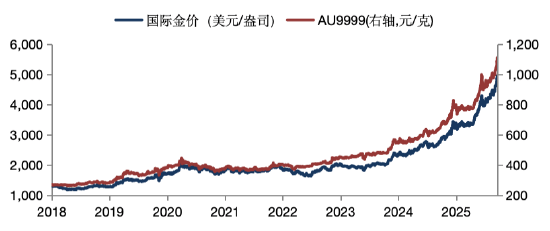
Core Viewpoint - Gold prices have recently reached historic highs, driven by geopolitical turmoil, a fiscal trust crisis, and ongoing de-dollarization efforts by global central banks [1][2][3] Group 1: Gold Price Trends - London spot gold closed at $4,981 per ounce, a week-on-week increase of 8.3%, while domestic AU9999 gold reached 1,110 yuan per gram, up 7.7% week-on-week [1] - On January 26, gold prices broke the $5,000 per ounce mark for the first time, marking a significant psychological milestone [1] Group 2: Geopolitical Factors - The deterioration of U.S.-European ally relations, highlighted by U.S. tariff threats against eight European allies, has triggered market risk aversion and increased demand for gold [1] - In the Middle East, rising tensions and potential military conflict have escalated, while the Russia-Ukraine situation remains volatile, further increasing global risk premiums and driving investment into gold [2] Group 3: Central Bank Actions - Global central banks continue to purchase gold, with Poland's central bank approving a plan to acquire 150 tons, aiming to increase its reserves to 700 tons [3] - China's central bank has been net buying gold for 14 consecutive months, reflecting a broader trend among central banks to optimize reserve assets and hedge against geopolitical and dollar credit risks [3] Group 4: Market Outlook - The upcoming Federal Reserve meeting is expected to maintain interest rates, which may influence gold prices [4] - In the medium to long term, gold is viewed as a critical hedge against the restructuring of global geopolitical order and sovereign fiscal discipline, with its value likely to be reassessed during this transition [3]
12.19商业观察:贵金属期货未来走势猜想和选择瑞达期货的理由
Sou Hu Cai Jing· 2025-12-18 22:08
Group 1: Gold Market Insights - Core Logic: "De-dollarization" and credit hedging are the fundamental drivers, with central banks continuing to purchase gold amid concerns over U.S. debt and dollar credit [1] - Strong Trend: Institutions predict potential for gold prices to continue rising due to ongoing central bank purchases and Federal Reserve's accommodative stance [1] - Global Central Bank Demand: This is the most solid long-term demand source for gold [1] Group 2: Silver Market Insights - Financial and Industrial Attributes: Silver benefits from both its financial properties and additional support from industrial demand, particularly in sectors like renewable energy [3] - High Volatility and Elasticity: Due to a smaller market size and structural supply-demand gaps, silver often experiences larger price increases compared to gold [4] - Long-term Supply-Demand Imbalance: Visible inventories are at historical lows, significantly below safe boundaries, providing fundamental price support [5] Group 3: Market Scenarios - Scenario One: If the Federal Reserve maintains a dovish stance through 2026 and U.S. debt issues persist, gold may continue its upward trend steadily [8] - Scenario Two: If strong U.S. economic data leads to a slowdown in Fed easing or unexpected rate hikes from the Bank of Japan trigger capital flow reversals, significant market volatility may occur [10] Group 4: External Factors and Risks - External Risks: Geopolitical conflicts and sudden liquidity shocks could heighten short-term volatility across all assets [12] - Regulatory Changes: Monitoring adjustments in margin ratios and price limits by domestic exchanges is crucial for risk management [12]
