准备金管理购买(RMP)

Search documents
深度专题 | QE时代的终结——美联储资产负债表分析框架(申万宏观·赵伟团队)
赵伟宏观探索· 2026-02-03 16:03
Core Viewpoint - The article discusses the implications of Kevin Warsh's nomination as the next Federal Reserve Chair and his proposed policy of "rate cuts + balance sheet normalization," highlighting the complexities and contradictions of this approach in the context of the current monetary policy landscape [1]. Group 1: Evolution of the Federal Reserve's Balance Sheet - Since the 2008 global financial crisis, the Federal Reserve has undergone four rounds of quantitative easing (QE) and two rounds of quantitative tightening (QT), with total assets reaching $6.6 trillion by November 2025, which is over seven times the level in early 2008 [2][10]. - The December 2025 FOMC meeting marked the beginning of a "normalization of expansion" phase, with initial monthly purchases set at $40 billion, potentially slowing to $20-25 billion by May [2][10]. Group 2: RMP vs. QE - RMP (Reserve Management Purchases) is fundamentally different from QE in terms of quantity, quality, and market implications. RMP aims to maintain sufficient reserves without affecting the stance of monetary policy, while QE is a non-standard tool aimed at lowering long-term interest rates [3][41]. - RMP operates under a framework of "ample reserves," where the control of interest rates is decoupled from the quantity of reserves, contrasting with the previous "scarce reserves" framework [4][68]. Group 3: End of the QE Era - The article posits that the QE era may have ended, with future monetary policy likely to focus on maintaining sufficient reserves rather than expanding the balance sheet significantly. The ability to shrink the balance sheet depends on reserve demand and the duration of held securities [6][10]. - In a non-war or non-zero interest rate environment, it is unlikely that the Fed will use QE or yield curve control (YCC) to lower Treasury yields, as the most effective method to achieve this is to lower rates to zero [6][10]. Group 4: Market Implications - The article suggests that RMP's impact on capital markets should be rationally ignored, as it primarily serves to reduce the likelihood of liquidity shocks affecting stock prices rather than driving bullish sentiment [7][10]. - The Federal Reserve's balance sheet expansion is now seen as a new normal, with cash and reserve provision methods including RMP and reinvestment of agency securities [33][10].


热点思考 | 美联储扩表与QE时代的终结——“流动性笔记”系列之七(申万宏观·赵伟团队)
申万宏源研究· 2025-12-30 01:29
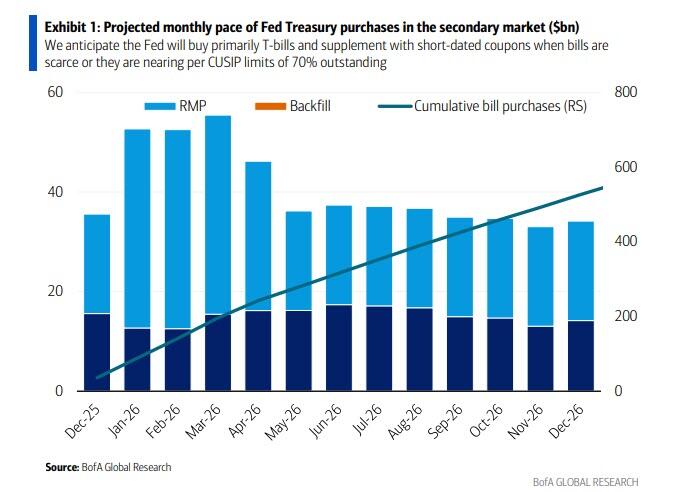
Core Viewpoint - The Federal Reserve's initiation of the Reserve Management Purchase (RMP) after the December 2025 FOMC meeting signals the end of the QE era rather than a restart, despite both leading to an expansion of the Fed's balance sheet. The RMP and QE have fundamental differences in policy and market implications [2][7]. Group 1: Federal Reserve's Balance Sheet Expansion - The Federal Reserve announced a restart of balance sheet expansion at the December FOMC meeting, with the pace slightly exceeding expectations, aligning with liquidity management needs. By the end of 2025, reserves may have fallen to ample levels, necessitating early expansion to accommodate economic growth and seasonal demand fluctuations [3][8][14]. - The RMP is a new phase of "normalization" in balance sheet expansion, with two methods of providing reserves: RMP and reinvestment of agency securities. The RMP will start at a scale of $40 billion per month, expected to remain high until April 2026, then slow to an average of $20-25 billion per month [3][18][69]. Group 2: Nature of RMP - The RMP is a technical operation aimed at assisting the effective implementation of monetary policy without altering the Fed's policy stance. It primarily refers to interest rate policy, allowing market rates to fluctuate narrowly around the policy rate without frequent open market operations [4][41][69]. - RMP and QE both lead to balance sheet expansion but differ fundamentally. While they have similar quantitative impacts on the Fed's and commercial banks' balance sheets, they differ qualitatively. RMP is a conventional liquidity management operation, while QE is a broad "yield curve management" tool [4][65][69]. Group 3: Conclusion on QE - QE is not likely to restart until interest rates are lowered to near zero, as this is the inherent order of monetary easing. Not all balance sheet expansions are classified as QE; the precondition for QE is that monetary policy faces a zero lower bound constraint [5][71]. - Historical instances of QE-style expansions by the Fed occurred only after interest rates were lowered to zero or near zero, including during the Great Depression, post-World War II, after the 2008 financial crisis, and following the 2020 pandemic [5][47][71].

申万宏源:美联储开启“常态化”扩表新阶段 重启QE或需等待下一次危机
Zhi Tong Cai Jing· 2025-12-27 23:29
Core Viewpoint - The report from Shenwan Hongyuan indicates that the Federal Reserve's initiation of Reserve Management Purchases (RMP) after the December 2025 FOMC meeting has sparked optimism for a "QE-style" liquidity easing, but in reality, it marks the end of the QE era rather than a restart [1] Group 1: RMP and Normalization of Balance Sheet - The Federal Reserve has entered a new phase of "normalization" in balance sheet expansion with the announcement of RMP, which slightly exceeded expectations but aligns with liquidity management needs [2] - By the end of 2025, reserves are expected to have declined to an ample level, necessitating early balance sheet expansion to accommodate economic growth and seasonal demand fluctuations [2] - RMP will be implemented starting December 12, with an initial scale of $40 billion, expected to remain high until April 2026, after which it may slow to an average of $20-25 billion per month [2] Group 2: Nature of RMP vs. QE - RMP is fundamentally a technical operation aimed at assisting effective monetary policy implementation without altering the Fed's policy stance, primarily focusing on interest rate policy [3] - While both RMP and QE lead to balance sheet expansion, they differ fundamentally; RMP is a routine liquidity management operation, whereas QE is a broader "yield curve management" strategy [3] - RMP is not a new tool, having been implemented after the end of balance sheet reduction in October 2019, and its pace of normalization may align with nominal GDP growth rates [3] Group 3: Conclusion on QE - The report concludes that the Fed is unlikely to restart QE before returning to a zero or near-zero interest rate environment, as the internal order of monetary easing dictates that rate cuts are more effective in stimulating demand prior to hitting the zero lower bound [4] - Historical instances of QE-like balance sheet expansions occurred only after reaching zero interest rates, indicating that the Fed may need to wait for the next crisis to consider restarting QE [4] - In conventional monetary policy ranges, interest rates serve as the primary indicator of policy stance, making it unnecessary to focus excessively on the Fed's balance sheet operations [4]

热点思考 | 美联储扩表与QE时代的终结——“流动性笔记”系列之七(申万宏观·赵伟团队)
申万宏源宏观· 2025-12-27 16:42
Core Viewpoint - The Federal Reserve's initiation of the Reserve Management Purchase (RMP) after the December 2025 FOMC meeting signals the end of the QE era rather than a restart, despite both leading to an expansion of the Fed's balance sheet. RMP and QE have fundamental differences in policy and market implications [2][7]. Group 1: Federal Reserve's Balance Sheet Expansion - The Federal Reserve announced a restart of balance sheet expansion at the December FOMC meeting, with the pace slightly exceeding expectations, aligning with liquidity management needs. By the end of 2025, reserves may have fallen to ample levels, necessitating early expansion to accommodate economic growth and seasonal demand fluctuations [3][8][14]. - The RMP, starting on December 12, 2025, has an initial scale of $40 billion, expected to remain high until April 2026, after which it may slow to an average of $20-25 billion per month [3][18][69]. Group 2: Nature of RMP - RMP is a technical operation aimed at assisting the effective implementation of monetary policy without altering the Fed's policy stance. It primarily refers to interest rate policy, allowing market rates to fluctuate narrowly around the policy rate without frequent open market operations [4][41][69]. - RMP and QE both lead to balance sheet expansion but differ fundamentally in quality. RMP is a conventional liquidity management operation, while QE is a broad "yield curve management" tool. RMP is market-neutral, whereas QE is market-non-neutral [4][65][69]. Group 3: Conclusion on QE - QE is only likely to be considered after interest rates are lowered to near zero, as this is the inherent order of monetary easing. Not all balance sheet expansions are classified as QE, which requires a zero lower bound constraint on monetary policy. Prior to reaching this limit, rate cuts are a more effective means of stimulating aggregate demand [5][71][60]. - Historical instances of QE-style expansions by the Fed occurred only after interest rates were lowered to zero or near-zero levels, indicating that a return to QE may require a future crisis [5][47][71].

华尔街纷纷改预期:美联储明年将鲸吞逾5000亿美元短期国库券?
Xin Lang Cai Jing· 2025-12-12 01:27
Core Viewpoint - The Federal Reserve's announcement of a $40 billion monthly purchase of Treasury securities exceeds market expectations and is expected to lower borrowing costs while impacting the Treasury market dynamics in the coming months [1][2]. Group 1: Federal Reserve's Actions - The Federal Reserve will initiate a "Reserve Management Purchase" (RMP) program to rebuild financial system reserves and lower short-term rates, alongside reinvesting approximately $14.4 billion in maturing agency debt into Treasury securities [1]. - Analysts expect that these measures will alleviate market pressures accumulated from the Fed's asset reduction over the past months, aiding swap spreads and SOFR-federal funds rate basis trades [1][3]. Group 2: Market Predictions - Barclays estimates that the Fed's Treasury purchases could reach approximately $525 billion by 2026, significantly higher than their previous forecast of $345 billion, with monthly purchases starting at about $55 billion [3]. - Morgan Stanley and TD Securities predict that the Fed will absorb more short-term Treasury securities, maintaining a $40 billion purchase rate until mid-April before slowing to $20 billion [4]. - Wells Fargo anticipates that the Fed will purchase $425 billion in Treasury securities during the 2026 fiscal year, which will constitute a large portion of the net supply from the Treasury [5]. Group 3: Implications for Treasury Supply - The net issuance of Treasury securities by the U.S. Treasury is expected to decrease from a prior estimate of $400 billion to only $220 billion due to the Fed's purchasing actions [3]. - The anticipated net issuance of Treasury securities is projected to drop to $2.74 trillion, reflecting the impact of the Fed's increased buying activity [4].