
资产负债表操作

Search documents
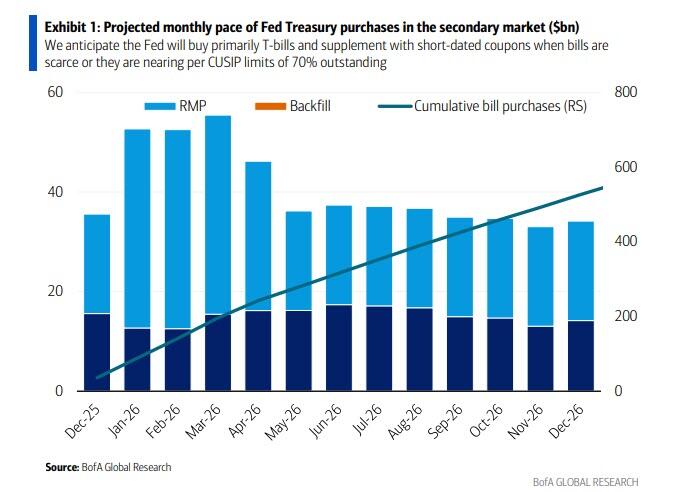
华尔街纷纷改预期:美联储明年将鲸吞逾5000亿美元短期国库券?
Xin Lang Cai Jing· 2025-12-12 01:27
Core Viewpoint - The Federal Reserve's announcement of a $40 billion monthly purchase of Treasury securities exceeds market expectations and is expected to lower borrowing costs while impacting the Treasury market dynamics in the coming months [1][2]. Group 1: Federal Reserve's Actions - The Federal Reserve will initiate a "Reserve Management Purchase" (RMP) program to rebuild financial system reserves and lower short-term rates, alongside reinvesting approximately $14.4 billion in maturing agency debt into Treasury securities [1]. - Analysts expect that these measures will alleviate market pressures accumulated from the Fed's asset reduction over the past months, aiding swap spreads and SOFR-federal funds rate basis trades [1][3]. Group 2: Market Predictions - Barclays estimates that the Fed's Treasury purchases could reach approximately $525 billion by 2026, significantly higher than their previous forecast of $345 billion, with monthly purchases starting at about $55 billion [3]. - Morgan Stanley and TD Securities predict that the Fed will absorb more short-term Treasury securities, maintaining a $40 billion purchase rate until mid-April before slowing to $20 billion [4]. - Wells Fargo anticipates that the Fed will purchase $425 billion in Treasury securities during the 2026 fiscal year, which will constitute a large portion of the net supply from the Treasury [5]. Group 3: Implications for Treasury Supply - The net issuance of Treasury securities by the U.S. Treasury is expected to decrease from a prior estimate of $400 billion to only $220 billion due to the Fed's purchasing actions [3]. - The anticipated net issuance of Treasury securities is projected to drop to $2.74 trillion, reflecting the impact of the Fed's increased buying activity [4].


美联储哈玛克:通胀仍将高于目标 政策紧缩不可松懈
Sou Hu Cai Jing· 2025-11-14 00:55
Core Viewpoint - The Federal Reserve Governor Lisa D. Cook emphasized that inflation pressures remain severe, with expectations that inflation rates will stay above the 2% policy target for the next 2 to 3 years, advocating for a restrictive monetary policy to maintain the Fed's credibility [1] Group 1: Inflation and Monetary Policy - Cook highlighted the challenges faced by the Fed in balancing its dual mandate of inflation and employment, describing the current monetary policy environment as difficult [1] - She noted that while recent economic performance seems unaffected by Fed policies, service inflation is concerning, and upcoming tariffs may further elevate inflation rates early next year [1] - Cook made a seemingly contradictory assessment of the current policy stance, stating that monetary policy is nearly non-restrictive, yet there is a need to maintain some degree of tightening to alleviate inflation pressures [1] Group 2: Economic Indicators and Market Response - Cook indicated that the recent rise in neutral interest rates suggests that even if nominal rates remain unchanged, the actual policy stance could become more accommodative [1] - Regarding the dollar's performance, she reassured that the recent weakening of the dollar is not alarming, as it is a correction from an extremely strong position, bringing it closer to its theoretical fair value [1] Group 3: Employment and Technological Impact - On the employment front, Cook described the current job market as seemingly balanced but still concerning, with the unemployment rate near its highest level and a softening job market posing challenges for the Fed's employment mandate [2] - She reiterated the importance of the Fed's independence in achieving employment and inflation goals, asserting that political factors do not influence monetary policy decisions [2] - Cook expressed caution regarding the impact of emerging technologies, stating it is premature to assess the effects of artificial intelligence, suggesting that time will reveal whether valuations of AI companies are justified [2]
美联储降息25个基点 黄金跌破3930美元 加密货币近13万人爆仓 解读来了
2 1 Shi Ji Jing Ji Bao Dao· 2025-10-29 23:34
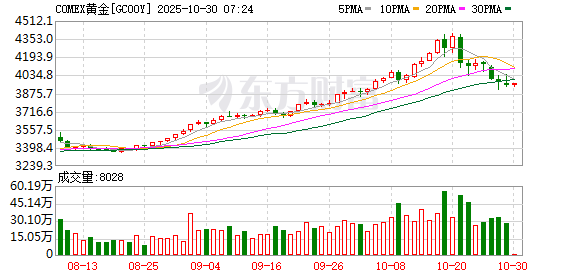
Group 1 - The Federal Reserve announced a 25 basis point cut in the federal funds rate target range to 3.75% to 4.00%, marking the fifth rate cut since September 2024 [2] - Fed Chairman Jerome Powell indicated that the decision for a rate cut in December is not guaranteed and may be influenced by uncertainties such as a potential government shutdown [6][8] - Traders have reduced their bets on a December rate cut, with the probability now at 65%, down from 90% prior to the meeting [7] Group 2 - Powell noted that a government shutdown could impact economic activity and that many American consumers remain dissatisfied with inflation [8] - The Fed's FOMC statement announced the end of balance sheet reduction on December 1, with Powell stating that market pressures necessitate immediate adjustments to balance sheet operations [9] - Following Powell's comments, U.S. stock markets experienced a downturn, with notable movements in tech stocks such as Nvidia and Apple, while Meta's stock fell over 8% after disappointing earnings [12] Group 3 - The two-year U.S. Treasury yield surged to 3.59%, and the dollar index rose, while onshore RMB depreciated against the dollar [13] - Bitcoin saw a decline, with approximately 130,000 traders liquidated in the past 24 hours, totaling around $558 million in liquidations [14][15] - Emerging markets are becoming more attractive as the Fed's rate cuts are expected to lower global financing costs and improve market conditions, potentially driving capital flows into these markets [16]
欧洲央行管委马赫鲁夫:利率仍然是我们工具箱中的默认政策杠杆;当受到下限限制时,诸如定向贷款和资产负债表操作等其他工具也具有其作用。
news flash· 2025-05-13 08:10
Core Viewpoint - The European Central Bank (ECB) continues to view interest rates as the primary tool in its policy toolbox, while also acknowledging the potential role of other instruments like targeted loans and balance sheet operations when faced with lower bound constraints [1] Group 1 - Interest rates remain the default policy lever for the ECB [1] - Other tools, such as targeted loans and balance sheet operations, can be effective when interest rates hit their lower limits [1]