危旧房改造

Search documents
居民增收计划、养老金上涨、支持AI开源社区……45个关键词读懂2026政府工作报告
经济观察报· 2026-03-05 09:11
Economic Growth - The GDP growth target for 2026 is set at 4.5% to 5%, reflecting a pragmatic policy approach and considering both internal and external pressures on the economy [4][5] - The adjustment in the growth target aims to balance quality and reasonable growth, laying a foundation for high-quality economic development [5] Fiscal Policy - The proposed deficit rate for 2026 is around 4%, with a deficit scale of 5.89 trillion yuan, an increase of 230 billion yuan from the previous year [7] - Public budget expenditure is expected to reach 30 trillion yuan for the first time, with a focus on optimizing expenditure structure to support consumption and improve living standards [9][10] Tax and Financial Reforms - The government plans to advance tax and financial system reforms, including increasing the proportion of state-owned capital returns and enhancing local tax systems [12] - The emphasis on zero-based budgeting aims to optimize fund allocation and improve the efficiency of fiscal spending [12] Employment and Income - The urban survey unemployment rate target is set at around 5.5%, reflecting the need for policies to stabilize employment amid structural pressures [18] - The government aims to synchronize resident income growth with economic growth, emphasizing measures to increase income for low-income groups and improve social security systems [20][22] Environmental Goals - The target for reducing carbon dioxide emissions per unit of GDP is set at around 3.8%, aligning with the goal of achieving carbon peak by 2030 [26][27] - The shift from energy consumption control to carbon emission control reflects the need for a more precise approach to managing carbon emissions [27][28] State-Owned Enterprise Reforms - The government plans to implement a systematic approach to deepen state-owned enterprise reforms, focusing on optimizing the layout of state-owned capital and structural adjustments [29][30] - The emphasis on improving the modern enterprise system aims to enhance corporate governance and promote market-oriented reforms [31] Open Economy - The government intends to further expand high-level opening-up, focusing on service sector liberalization and enhancing international cooperation [35][36] - The approach aims to balance reform depth with security, promoting a competitive and fair business environment [36] Agricultural and Rural Development - The government is set to promote agricultural insurance development and enhance comprehensive disaster prevention capabilities in agriculture [59] - Policies will focus on improving rural elderly care services and implementing long-term care insurance systems to address the challenges of an aging population [45][47] Capital Market Stability - Measures to stabilize the stock market include comprehensive policies to enhance market confidence and promote active trading [54] - The government aims to improve the mechanism for long-term capital entering the market, ensuring a stable and healthy capital market [63] Innovation and Technology - The government plans to cultivate emerging and future industries, encouraging state-owned enterprises to lead in opening application scenarios for new technologies [69][70] - Support for artificial intelligence and open-source community development is expected to drive innovation and commercialization in various sectors [75]

老屋旧房“蝶变” 居民喜提“新居”
Xin Lang Cai Jing· 2026-02-07 04:19
Core Points - The article highlights the successful completion of the dilapidated housing renovation project in Daban District, Nanning, which has transformed the old neighborhood into a modern and livable community [1][2] - The project involved the construction of 29 high-rise residential buildings, providing a total of 3,110 housing units, with the official handover scheduled for February 6 to 11, 2026 [1] - Residents expressed satisfaction with the new living environment, emphasizing the high standards in layout, materials, and community amenities [2] Group 1 - The Daban District renovation project is a key livelihood initiative by the autonomous region, aimed at improving living conditions for residents [1] - The project has been in development for over a decade, culminating in the transformation of the old neighborhood into a safe and clean living space [1] - The handover event was marked by a festive atmosphere, with residents engaging in a structured process for receiving keys and completing necessary paperwork [2] Group 2 - Property management and engineering staff provided personalized, complimentary inspection services to homeowners, ensuring quality and addressing any concerns [2] - Convenience services such as gas and water utilities were made available on-site, facilitating a one-stop service experience for residents [2] - Homeowners expressed high expectations for their new living environment, reflecting the quality of construction and community planning [2]
380套安置房,主体结构封顶!
Xin Lang Cai Jing· 2026-01-13 23:59
Group 1 - The core project of Sanya's Haidong Bay area has completed its main structure 48 days ahead of schedule, providing 380 housing units to improve living conditions for residents [1][3] - The project, a key municipal livelihood initiative, began construction on April 21 last year, covering a total area of 49,000 square meters and consisting of 15 residential buildings [3] - The project has now entered the decoration and electromechanical installation phase, with a focus on quality, safety, and progress to ensure timely delivery of the housing [5]

广州市将分区分策开展危旧房改造工作
Guang Zhou Ri Bao· 2025-10-20 03:19
Core Points - The "Guangzhou Land Space Planning Regulations" will be implemented on December 1, 2025, marking the first local legislation for land space planning in a super-large city in China [1] Group 1: Comprehensive Planning - The regulations emphasize systematic, coordinated, and integrated spatial planning, establishing a comprehensive management approach for planning formulation, implementation, supervision, governance, and land space development and protection [2] - The regulations categorize land space planning into three types: overall planning, detailed planning, and special planning, and legally formalize the control lines for industrial zones to ensure rational industrial layout and strict management of zone exits [2] Group 2: Resource Protection and Utilization - The regulations implement a "from mountain top to ocean" approach for comprehensive protection and utilization of all elements, establishing rules for the protection and management of various natural resources and special spaces [3] - An ecological restoration mechanism for land space will be established to promote overall protection, systematic restoration, and comprehensive governance of ecological elements [3] Group 3: Transportation and Infrastructure - The regulations mandate a comprehensive traffic survey every five years to understand citizen travel characteristics and urban traffic conditions, providing reliable data for traffic planning and management [3] - The regulations aim to improve project construction efficiency by requiring coordination with stakeholders and minimizing changes to project plans, thereby reducing time costs and enhancing the business environment [4] Group 4: Housing and Public Welfare - The regulations focus on improving living conditions by addressing the renovation of dilapidated housing through various methods, including repair, reconstruction, and compensation [5] - The regulations introduce measures to ensure public participation in planning processes, safeguarding citizens' rights to information, objections, and compensation [5][6] Group 5: Archive Management and Public Access - The regulations establish a classified management system for planning archives, allowing individuals and organizations to access planning results and information [6]
广州中心区首个!越秀小石集“原拆原建”危改为何能快速落地
Nan Fang Du Shi Bao· 2025-07-31 07:06
Core Viewpoint - The article discusses the successful implementation of the "original demolition and reconstruction" model for dilapidated housing in Guangzhou, highlighting the experiences from the Xiaoshiji project and its potential as a reference for future urban renewal projects in the city [2][5][6]. Group 1: Project Overview - The Xiaoshiji project involves the renovation of 17 old buildings constructed between the 1960s and 1980s, housing 45 households with 82 residents, many of which are in poor structural condition [5][6]. - The project is part of Guangzhou's first batch of pilot projects for dilapidated housing renovation, utilizing a "business + residents" model for collective self-renewal [6][13]. Group 2: Implementation Strategy - The project benefits from a concentrated ownership structure primarily consisting of government and state-owned housing, facilitating consensus for renovation compared to other projects with fragmented ownership [5][7]. - A dedicated working group was established to coordinate efforts, hold weekly meetings, and ensure timely progress on the project [6][7]. Group 3: Community Engagement - The project team actively engaged with residents to address concerns and facilitate the relocation of existing tenants, ensuring that their needs were met during the transition [7][8]. - A joint creation committee was formed to gather public opinion and adjust project plans to maximize benefits for property owners [8][10]. Group 4: Design and Construction - The project adopted a unified design and collective approval approach to address the complexities of multiple land ownerships, ensuring a cohesive architectural style and functional layout [13][14]. - The design includes features to improve fire safety and community spaces, such as a 4-meter setback for fire truck access and the addition of public service areas [13][14]. Group 5: Financial Model - The project utilizes a funding model where contributions come from owners, enterprises, and government support, effectively injecting capital into the renovation efforts [14]. - The project is eligible for a 6% increase in floor area ratio as a reward for using modular construction techniques, which will be allocated for essential community facilities [10][14].
21评论丨城市更新是构建房地产发展新模式的切入点
2 1 Shi Ji Jing Ji Bao Dao· 2025-07-23 22:33
Core Viewpoint - The recent Central Urban Work Conference emphasizes the need for a shift in urban development strategies, focusing on quality improvement and efficiency in existing urban areas rather than large-scale expansion, reflecting a transition in China's urbanization process from rapid growth to stable development [1][2]. Group 1: Urban Development Principles - The conference introduced "Five Transformations" as key principles for urban development, which include a human-centered approach, efficient and intensive development, emphasis on distinctive growth, increased governance investment, and coordinated methods [2]. - The rapid growth of the real estate sector is seen as a necessary outcome of the previous expansion phase, and the focus is now shifting towards updating existing urban structures rather than relying on real estate for financing [2][3]. Group 2: Real Estate Development Model - The meeting highlighted the need to accelerate the construction of a new real estate development model, which includes steady progress in the renovation of urban villages and dilapidated housing [2][3]. - The rental and purchase housing supply model has shown significant results in first and second-tier cities, with rental housing accounting for 10% to 15% of the market share and continuing to grow [2]. Group 3: Urban Village and Dilapidated Housing Renovation - The focus on urban village renovation is aimed at improving quality rather than large-scale demolition, with an emphasis on safety, public facilities, and social governance [4][5]. - The criteria for urban village renovation include the presence of safety hazards, mature renovation plans, and balanced funding, indicating a move away from the old model of large-scale demolition [4][6]. Group 4: Integration of New Citizens - The renovation efforts aim to integrate the 260 million migrants into urban life, providing them with affordable housing and access to public services, thereby enhancing urban vitality and consumption [5][6]. - The focus on improving living conditions in urban villages is expected to stabilize the housing market by addressing the needs of new citizens and enhancing their living environment [7]. Group 5: Urban Renewal as Growth Driver - The Ministry of Housing and Urban-Rural Development's guidelines for urban renewal projects provide a clear technical roadmap from planning to execution, indicating a structured approach to urban development [7]. - Financial and fiscal support for urban renewal is anticipated to stimulate new growth dynamics in cities, reinforcing the role of real estate as a pillar industry and a significant consumer market [7].
6月房地产行业月报:销售同比承压,开工竣工修复-20250717
Yin He Zheng Quan· 2025-07-17 11:08
Investment Rating - The report maintains a "Recommended" rating for the real estate industry [1]. Core Viewpoints - The real estate sector is experiencing pressure on sales year-on-year, with a total sales area of 45,851 million square meters in the first half of 2025, representing a year-on-year decline of 3.50% [4][8]. - In June 2025, the monthly sales area was 10,535.81 million square meters, showing a month-on-month increase of 49.37% but a year-on-year decrease of 5.46% [4][8]. - The total sales amount for the first half of 2025 was 44,241 billion yuan, down 5.50% year-on-year, with June's sales amounting to 10,150.16 billion yuan, reflecting a month-on-month growth of 43.85% but a year-on-year decline of 10.79% [4][8]. - The average sales price for the first half of 2025 was 9,649 yuan per square meter, down 2.07% year-on-year [4][8]. Sales Summary - National Market: The sales area in the eastern region was 20,800 million square meters, down 5.2% year-on-year; the central region saw a decline of 1.2% with a sales area of 11,926 million square meters; the western region's sales area was 11,515 million square meters, down 2.5% [8]. - Regional Sales Amount: The eastern region's sales amount was 26,945 billion yuan, down 5.8% year-on-year; the central region's sales amount was 7,988 billion yuan, also down 5.8%; the western region's sales amount was 8,163 billion yuan, down 4.30% [8]. Investment Summary - Investment in real estate development for the first half of 2025 totaled 46,658 billion yuan, down 11.20% year-on-year [14]. - In June 2025, the monthly development investment was 10,424 billion yuan, reflecting a month-on-month increase of 22.58% but a year-on-year decline of 12.90% [14]. - New construction area for the first half of 2025 was 30,364 million square meters, down 20.00% year-on-year, with June's new construction area at 7,180 million square meters, showing a month-on-month increase of 34.27% [17]. - The completion area for the first half of 2025 was 22,567 million square meters, down 14.80% year-on-year, with June's completion area at 4,182 million square meters, reflecting a month-on-month increase of 52.77% [19]. Funding Summary - Total funds available to real estate companies in the first half of 2025 were 50,202 billion yuan, down 6.20% year-on-year [23]. - Domestic loans accounted for 8,245 billion yuan, showing a year-on-year growth of 0.60% [23]. - Self-raised funds were 17,544 billion yuan, down 7.20%, while personal mortgage loans were 6,847 billion yuan, down 11.40% [23]. Investment Recommendations - The report suggests that the real estate sector's configuration value is highlighted under supportive policies, with a focus on leading companies such as China Merchants Shekou, Poly Developments, and Longfor Group [41][40]. - Recommended stocks include Poly Developments, China Merchants Shekou, and others, with a focus on quality developers and property management firms [41][39].



X @外汇交易员
外汇交易员· 2025-07-15 04:12
Urban Development & Policy - Central government emphasizes building comfortable and convenient livable cities [1] - Focus on integrated planning of population, industry, towns, and transportation to optimize urban spatial structure [1] - Government aims to accelerate the construction of a new real estate development model [1] - Government plans to steadily promote the renovation of urban villages and dilapidated houses [1] - Focus on vigorously developing lifestyle service industries and improving public service levels [1] - Government aims to firmly safeguard the people's livelihood [1]
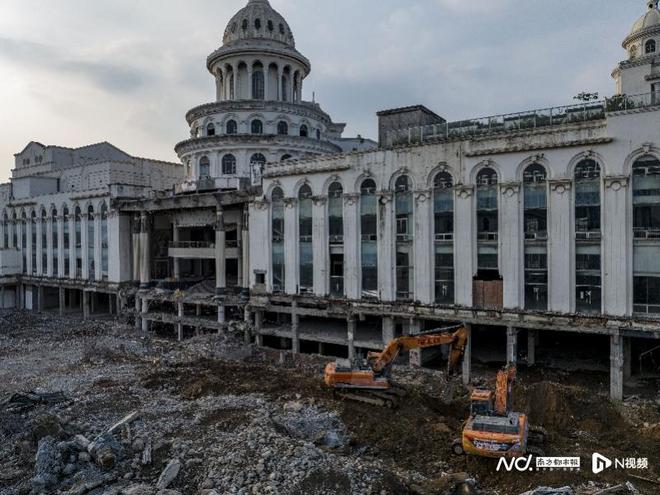
“番禺白宫”今年底完成改造:保留三栋老楼,新建商业综合体
Nan Fang Du Shi Bao· 2025-05-12 10:57
Core Viewpoint - The "Panyu White House" project, formerly known as Lijiang Mingzhu Hotel, is undergoing significant renovation, transforming into a commercial complex named "Rongyu" with an area of approximately 100,000 square meters, while preserving the iconic circular dome structure [5][6]. Group 1: Project Overview - The project has been included in the city's first batch of dilapidated housing renovation pilot projects, with two dangerous buildings set for demolition [5][6]. - The renovation is driven by the need to address outdated infrastructure issues, as the original hotel faced operational difficulties due to aging facilities [6][7]. Group 2: Renovation Details - The final renovation plan includes the demolition of two old buildings and the construction of a new five-story commercial building, while three existing buildings will undergo exterior repairs and internal renovations [7]. - The project will also feature a two-level underground parking garage of approximately 20,000 square meters, providing over 300 car parking spaces and 900 bicycle spaces [7]. Group 3: Business Strategy and Market Positioning - The project has achieved over 70% pre-leasing, focusing on a park-style commercial theme that includes lifestyle, cultural arts, pet-friendly spaces, dining, and entertainment experiences [8]. - A 16,000 square meter sports and entertainment experience center will be introduced, featuring AR sports and VR gaming for immersive experiences [8]. - The renovation aims to create job opportunities and inject economic vitality into the region, contributing to urban prosperity [8].