基金销售规范

Search documents
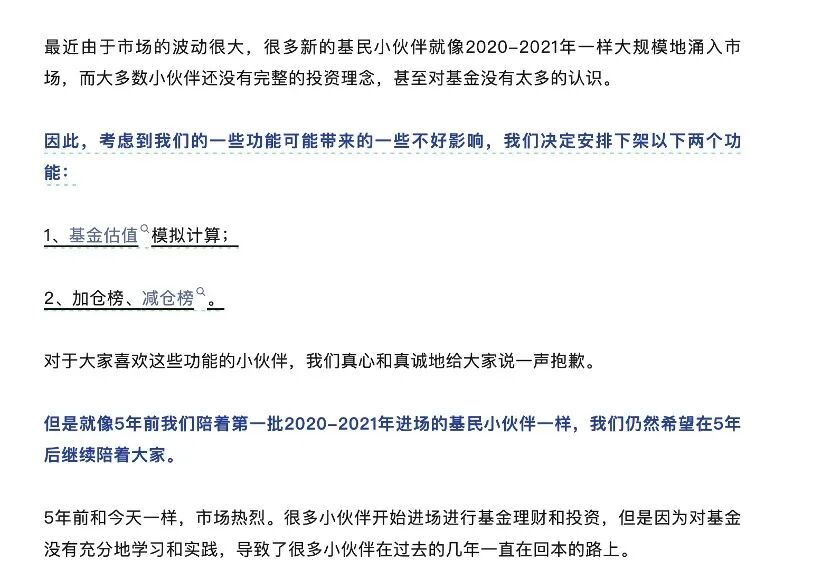
“基金实时估值”遭全面封杀
3 6 Ke· 2026-02-02 03:09
Core Viewpoint - The regulatory authorities have taken swift action to address misleading marketing practices in the fund industry, particularly concerning real-time fund valuations and related features that could mislead investors [1][3][4]. Group 1: Regulatory Actions - Following the penalties imposed on Debon Fund, the company has rapidly removed features such as "real-time fund valuation," "increased holdings list," and "actual trading list" as per regulatory requirements [1]. - The latest regulatory bulletin issued on January 29 highlights the discovery of violations involving fund companies collaborating with unqualified influencers, leading to the removal of misleading features [1][3]. - Regulatory bodies are focusing on the resurgence of real-time fund valuation features, which can mislead investors, and have mandated their removal across all platforms by January 30 [1][4]. Group 2: Industry Response - As of February 1, platforms like Ant Fund, JD Finance, and Tencent Finance have complied by removing the aforementioned features, while others like Xiaobei Yangji and Yangji Bao have also taken corrective actions [2]. - Despite the removal of certain features, some platforms continue to display other lists such as "fund hot search list" and "fund self-selected list," which may still encourage short-term trading behaviors [2][11]. - The industry has shown a quick response to regulatory demands, with platforms working over the weekend to ensure compliance by the next trading day [4]. Group 3: Investor Impact - The removal of real-time valuation features is aimed at preventing misleading information that could lead to irrational investment behaviors among investors, especially in a volatile market [4][5]. - Some platforms have acknowledged that the previous features may have negatively impacted investors' understanding of funds, leading to a decision to remove them [5][9]. - The presence of misleading lists can exacerbate short-term trading tendencies, which may not align with the long-term investment strategies recommended by regulators [11][13].

和无资质大V合作,监管出手了!
Zhong Guo Ji Jin Bao· 2026-01-30 04:17
Core Viewpoint - The regulatory authorities have intensified scrutiny on fund companies, particularly focusing on D Fund Company for engaging in marketing collaborations with unqualified influencers, leading to corrective measures and accountability for responsible personnel [1][2]. Group 1: Regulatory Actions - The regulatory report indicates that D Fund Company faced a significant increase in daily subscription volume exceeding 10 billion, raising concerns about potential violations in sales practices [2]. - D Fund Company was found to have collaborated with unqualified internet influencers, paying substantial advertising fees to promote its products, which misled investors regarding risk levels [2]. - The regulatory authorities have mandated D Fund Company to rectify its practices and have suspended the acceptance of new public fund product registrations [2]. Group 2: Violations and Concerns - The report highlights that some fund sales institutions and unlicensed third-party platforms have resumed offering "real-time fund valuation" features, which could mislead investors and dilute fund product returns [3][4]. - The emergence of features like "increased investment rankings" and "real account rankings" on these platforms has raised further concerns about investor misguidance [3]. Group 3: Regulatory Requirements - The report emphasizes the need for fund companies and sales institutions to enhance investor suitability management, ensuring that appropriate products are sold to suitable investors to prevent risk mismatches [5]. - Fund companies and sales institutions are strictly prohibited from collaborating with unqualified internet influencers for any form of fund sales or promotional activities [5]. - Fund sales institutions and third-party platforms are required to conduct self-inspections and remove misleading features such as "real-time fund valuation" and "investment rankings" [6].
监管通报D基金公司旗下产品单日狂卖百亿:违规销售,暂停新发,追责总经理、督察长等
Sou Hu Cai Jing· 2026-01-30 03:45
Core Viewpoint - The recent report from the regulatory authority highlights that a fund company has violated sales regulations by collaborating with unqualified internet influencers, leading to excessive daily subscription amounts exceeding 10 billion yuan, prompting immediate regulatory actions [1][2]. Group 1: Regulatory Actions - The China Securities Regulatory Commission (CSRC) has mandated corrective actions and suspended the registration of public fund products for the D fund company, holding responsible personnel accountable, including the general manager and heads of relevant departments [2]. - The report emphasizes the need for strict adherence to laws and regulations in fund sales and promotional activities to protect investor rights and maintain industry reputation [2]. Group 2: Industry Guidelines - Fund companies and sales institutions must enhance investor suitability management to ensure appropriate products are sold to suitable investors, preventing risk mismatches [3]. - Collaboration with unqualified internet influencers for any form of fund sales or promotions is strictly prohibited [3]. - Fund sales institutions and third-party platforms are required to conduct self-inspections and remove misleading features such as "real-time fund valuation" and "ranking lists" to avoid misleading investors [3].
新规在路上!基金销售要“变天”?
Guo Ji Jin Rong Bao· 2025-12-18 15:04
Core Viewpoint - The China Securities Investment Fund Industry Association (CSRC) has issued a draft regulation aimed at standardizing fund sales behavior, enhancing investor protection, and supporting the high-quality development of public funds [1][8]. Group 1: General Promotion and Marketing Behavior - The draft regulation specifies that fund performance must be displayed for a minimum of six months and prohibits annualized performance displays for periods under one year [2]. - Fund performance rankings must be based on publicly available data from fund evaluation agencies for periods longer than three years, including necessary disclosures [2]. - The use of terms like "positive return" or "probability of positive return" is banned to prevent misleading investors about risks [2][3]. - Fund managers and sales institutions are required to avoid exaggerated or misleading promotional language and cannot promote fund size or growth [2][3]. Group 2: Live Streaming Regulations - The draft includes strict guidelines for live streaming promotions, stating that only qualified personnel can conduct fund-related discussions [4]. - Non-qualified platforms are prohibited from engaging in fund sales or collecting investor transaction information [4]. - Live streaming scripts must undergo compliance review, and platforms must maintain records of promotional materials for at least 20 years [4]. Group 3: Fee Disclosure - Fund management and sales institutions must clearly disclose all fees associated with fund transactions, including subscription, redemption, and maintenance fees [5]. - Sales institutions are required to provide detailed information about service fees and cannot use misleading statements regarding fee waivers [5]. Group 4: Long-term Orientation in Sales Performance - The draft emphasizes the need for a scientific approach to sales performance evaluation, focusing on long-term investor outcomes rather than short-term sales metrics [6]. - The traditional focus on sales volume is to be replaced with metrics that assess investor profitability and retention over longer periods [6]. - Performance evaluation criteria must include a minimum assessment period of one year for sales activities and three years for investor outcomes [6]. Group 5: Industry Impact and Future Directions - The new regulations are seen as a significant shift in the industry, aiming to correct previous marketing practices that prioritized scale over investor returns [8]. - The draft is part of a broader initiative to enhance investor experience and ensure that sales practices align with long-term investment goals [8][9]. - The industry is encouraged to focus on investor education and transparent fee structures to build trust and improve client relationships [9].
基金销售行为规范出台 哪些卖基金的“常见操作”不再合规了?
2 1 Shi Ji Jing Ji Bao Dao· 2025-12-17 23:24
Core Viewpoint - The recent draft of the "Regulations on the Sales Behavior of Publicly Raised Securities Investment Funds" aims to enhance compliance and standardization in the fund sales industry, marking a significant shift towards high-quality development and stricter regulatory oversight [1][10][21] Group 1: Sales Behavior Regulations - The draft consists of nine chapters and 37 articles, addressing various aspects such as general promotion, live marketing, and performance assessment of sales activities [1][10] - The new regulations build upon previous guidelines from the China Securities Regulatory Commission (CSRC) and introduce more detailed requirements for emerging sales models in the fund industry [1][10] Group 2: Performance Display Requirements - Fund performance must be displayed for a minimum of six months, and annualized returns cannot be shown for funds with less than one year of operation [2][12] - Rankings must be based on data from fund evaluation agencies for periods of three years or more, including necessary disclosures about the evaluation agency [2][12] Group 3: Prohibited Marketing Practices - The use of terms like "guaranteed returns" or "positive return probability" is prohibited to prevent misleading investors about risks [3][14] - Fund managers and sales institutions are restricted from linking fund awards to individual fund managers, emphasizing the importance of the research team and investment platform instead [3][4][14] Group 4: Fund Size and Growth Promotion - Fund managers and sales institutions are not allowed to promote fund size or growth, breaking the trend of "size equals income" [5][15] - The focus should shift towards demonstrating excess returns over benchmarks and risk-return ratios, rather than emphasizing fund size [5][15] Group 5: Live Marketing Regulations - Live marketing personnel must have appropriate qualifications, and platforms must disable tipping features [6][18] - A comprehensive compliance mechanism is required for live broadcasts, including pre-approval of scripts and post-broadcast record-keeping for at least 20 years [6][18][19] Group 6: Sales Performance Assessment - Sales performance assessments must include both the status of fund sales and investor profit/loss situations, with a focus on long-term investment outcomes [9][20] - The regulations aim to shift the industry focus from short-term sales tactics to long-term investor retention and satisfaction [9][20] Group 7: Overall Impact on the Industry - The draft represents a critical step in reshaping the fund sales ecosystem, promoting a shift from a scale-driven approach to one focused on investor interests [10][21] - The implementation of these regulations is expected to enhance investor trust and the overall quality of the fund industry [10][21]
中央经济工作会议定调资本市场,关注板块投资价值
Shanxi Securities· 2025-12-17 09:13
Investment Rating - The non-bank financial industry is rated as "Leading the Market - A" [2] Core Insights - The Central Economic Work Conference has set the tone for capital market reforms, emphasizing support for expanding domestic demand, technological innovation, and small and micro enterprises. The implementation of the "1+N" policy framework is accelerating, which includes reforms in the Sci-Tech Innovation Board and the Growth Enterprise Market, promoting mergers and acquisitions, and optimizing public fund fee structures [3][6] - The China Securities Regulatory Commission has issued a draft regulation to standardize fund sales behavior, aiming to return the industry to its core functions. This includes strict guidelines on promotional language, performance displays, and transparency in fees to protect investor rights [6][3] Market Performance - During the period from December 8 to December 14, major indices showed mixed performance, with the Shanghai Composite Index down 0.34%, the CSI 300 down 0.08%, and the ChiNext Index up 2.74%. The average daily trading volume in A-shares was 1.95 trillion yuan, an increase of 15.14% week-on-week [3][12] - As of December 14, the margin trading balance was 2.50 trillion yuan, reflecting a week-on-week increase of 0.79% [12][15] Industry Data Tracking 1) Market Performance and Scale: The average daily trading volume in A-shares reached 1.95 trillion yuan, with a week-on-week increase of 15.14% [12] 2) Credit Business: As of December 14, the market had 2,938.59 million shares pledged, accounting for 3.58% of the total share capital [12][15] 3) Fund Issuance: In November 2025, 530.52 billion units of new funds were issued, with a total of 145 funds launched, representing a 34.09% decrease from the previous month [12][19] 4) Investment Banking: In November 2025, the equity underwriting scale was 525.75 billion yuan, with IPO amounts at 101.88 billion yuan and refinancing at 423.88 billion yuan [12][19] 5) Bond Market: The total price index of bonds decreased by 2.23% since the beginning of the year, with the 10-year government bond yield at 1.84%, up 23.19 basis points year-to-date [12][13]
公募基金销售新规拟限制规模宣传
Bei Jing Shang Bao· 2025-12-15 15:51
Core Viewpoint - The new regulations from the Asset Management Association of China (AMAC) prohibit the promotion of fund size and growth, which has raised concerns in the industry regarding its impact on marketing strategies, especially for ETFs [1][2][5]. Summary by Sections Regulations Overview - The draft regulation titled "Sales Behavior Norms for Publicly Raised Securities Investment Funds" consists of nine chapters and 37 articles, focusing on various promotional behaviors and performance assessments [1][4]. - Key points include restrictions on displaying fund performance for periods shorter than six months and the requirement to use data from fund evaluation institutions for performance rankings [1][5]. Impact on ETF Marketing - Industry insiders express surprise at the restriction on promoting fund size, as it is often a key differentiator for ETFs, impacting liquidity and market perception [2][3]. - The inability to advertise fund size may lead to challenges in differentiating products in a competitive market, potentially affecting investor decisions regarding smaller funds [2][3]. Compliance and Adjustments - Fund management and sales institutions are expected to adjust their promotional strategies in line with the new regulations, focusing on the attributes of index funds and their investment value rather than size [3][4]. - Compliance departments are already implementing changes to avoid size-related promotions, with a shift towards emphasizing index components and investment strategies [3][4]. Performance Assessment Changes - The regulations also stipulate that performance assessments for fund sales should prioritize investor outcomes over sales revenue and size, indicating a shift towards a more investor-centric approach [4][5]. - Future marketing efforts are likely to focus on the sustainability and stability of fund performance, as well as the unique characteristics of products [5].
严管基金销售!“正收益” 宣传、直播打赏均被叫停
Sou Hu Cai Jing· 2025-12-13 04:38
Core Viewpoint - The China Securities Investment Fund Industry Association has drafted the "Regulations on the Sales Behavior of Publicly Raised Securities Investment Funds" to standardize fund sales practices and protect investors' rights, seeking industry feedback on the proposal [2][3]. Group 1: Fund Sales Behavior Regulations - The draft outlines clear requirements for general promotional activities, live streaming promotions, disclosure of sales information and fees, and performance evaluation of fund sales [2]. - Violations of these regulations by fund managers or sales institutions will lead to self-regulatory or disciplinary actions, and serious violations will be referred to the China Securities Regulatory Commission for legal processing [2]. Group 2: Performance Display Standards - The draft sets strict standards for fund performance display, requiring objective and comprehensive presentation of performance while prominently disclosing risks [3]. - Fund performance must be displayed for periods exceeding six months, and annualized returns for periods under one year are prohibited [3]. - Performance rankings must use publicly available data from fund rating agencies for periods of three years or more, with full disclosure of the agency's name and fund type [3]. Group 3: Communication Restrictions - The use of terms like "positive returns" and "positive return probability" is prohibited, along with exaggerated language and promotion of fund size and growth [4]. - Fund manager promotions must focus on the research team and platform strength rather than individual accolades [4]. Group 4: Live Streaming Marketing Controls - The draft imposes comprehensive compliance requirements for live streaming marketing, including personnel qualifications and content management [5]. - Only qualified personnel can promote funds in live streams, and the use of tipping or reward functions is banned [5]. - Detailed compliance management processes are required for live streaming, including script reviews and post-event compliance records [5]. Group 5: Fee Transparency - The draft mandates clear disclosure of all fees associated with fund purchases, ensuring investors have adequate time to review fund product summaries [7]. - Different share classes must have their fees disclosed, and sales service fees must be clearly defined and explained [7]. Group 6: Performance Evaluation Mechanism Reform - The draft proposes a fundamental overhaul of the performance evaluation mechanism for sales institutions, emphasizing long-term investor outcomes over short-term sales metrics [8]. - Performance evaluation indicators must include both sales activity and investor profit/loss situations, with a minimum evaluation period of one year for sales and three years for investor outcomes [8]. Group 7: Accountability Mechanisms - The draft establishes accountability mechanisms to address inducements for short-term trading behaviors, requiring sales institutions to avoid misleading practices [9]. - New requirements prohibit the display of performance rankings for periods under three years and restrict the promotion of fund size and sales volume [9]. Group 8: Integrity and Compliance - The draft includes strict regulations on integrity in operations, requiring fund managers and sales institutions to establish clear anti-corruption measures [10]. - Financial audits of marketing expenses must be conducted to ensure compliance, and any form of hidden payments or benefits is strictly prohibited [10].

最新发文!剑指基金销售“重规模”乱象,投资者盈亏成核心指标
券商中国· 2025-12-12 23:36
Core Viewpoint - The article discusses the recent draft regulation aimed at standardizing fund sales practices to protect investors' rights and interests, emphasizing a shift from a scale-focused approach to one that prioritizes investor outcomes and long-term benefits [1][7]. Group 1: Fund Sales Practices - The draft regulation requires fund managers and sales institutions to adopt a long-term sales philosophy centered on "the best interests of investors" [1]. - It emphasizes that performance evaluation metrics for fund sales should increase the weight of equity fund retention and investor profit and loss situations, rather than focusing primarily on sales revenue and scale [7]. Group 2: Disclosure and Marketing Requirements - Fund managers and sales institutions must objectively and comprehensively present fund performance, clearly stating that past performance does not guarantee future returns [2]. - Specific requirements include displaying fund performance over periods longer than six months, using data from recognized fund evaluation agencies for rankings, and presenting risk indicators alongside performance metrics [2]. Group 3: Live Streaming Regulations - When conducting live streaming for fund promotion, fund managers and sales institutions must ensure compliance and risk management are aligned with the nature of the live business [5]. - Live streaming personnel must possess relevant qualifications and adhere to advertising laws, with strict guidelines on content and compliance monitoring during broadcasts [6]. Group 4: Performance Evaluation Mechanism - The draft regulation calls for a revised performance evaluation mechanism that aligns with operational performance, financial status, and compliance risk management [7]. - It specifies that the evaluation should include metrics related to fund retention, new fund subscription retention, and investor profit and loss over a minimum period of three years [7].

史上最严基金销售规范来了
财联社· 2025-12-12 14:41
Core Viewpoint - The article discusses the recent draft regulations issued by the China Securities Regulatory Commission (CSRC) aimed at standardizing the sales behavior of public funds, preventing misleading practices, and protecting investors' rights [3][4]. Group 1: Sales Behavior Regulations - The draft regulations emphasize the need for a return to the fundamental principle of "trust and fiduciary management" in the fund industry, aiming to maintain the healthy and stable development of the capital market [3]. - Key areas covered include general promotional behavior, live-streaming management, sales information and fee disclosure, performance assessment, and other sales behaviors [3]. Group 2: Promotional Guidelines - The draft imposes strict controls on promotional language to eliminate misleading statements, particularly prohibiting the use of terms like "positive returns" that may lead investors to overlook risks [9]. - Fund performance must be presented objectively, with a clear disclaimer that past performance does not guarantee future results, and any performance displayed must cover a period of at least six months [6][8]. Group 3: Fund Manager Promotion - The regulations require that promotional efforts focus on the research team's capabilities rather than individual fund managers, discouraging the glorification of "star fund managers" [11][12]. - Specific prohibitions include linking fund performance awards to fund managers and overstating their experience [11]. Group 4: Live Streaming Regulations - Live streaming as a promotional tool is subject to stringent regulations, including the requirement for personnel to have appropriate qualifications and the prohibition of non-compliant platforms from participating in fund sales [13][14]. - All live streaming materials must be retained for a minimum of 20 years, ensuring accountability and compliance [16]. Group 5: Fee Transparency and Performance Assessment - The draft mandates comprehensive disclosure of all fees associated with fund purchases, ensuring investors have adequate time to review this information [17]. - Performance assessment metrics must align with long-term investor outcomes rather than short-term sales figures, with a focus on maintaining a long-term investment culture [18][19]. Group 6: Market Competition and Ethical Standards - The regulations aim to maintain fair competition by prohibiting exclusive sales practices and the disparagement of competing funds [21][24]. - A framework for preventing conflicts of interest in sales practices is established, alongside a commitment to ethical conduct within the fund sales sector [22][24].