
匈牙利福林

Search documents
瑞郎本周涨约1.1%,瑞典克朗涨1.3%,挪威克朗涨约2%
Jin Rong Jie· 2026-02-13 21:35
Core Viewpoint - The article discusses the fluctuations in various currency pairs, highlighting the performance of the Euro, British Pound, and commodity currencies against the US Dollar during the week. Group 1: Currency Performance - The Euro appreciated by 0.04% against the US Dollar, closing at 1.1875, with a weekly gain of 0.51% [1] - The British Pound increased by 0.33% against the US Dollar over the week [1] - The US Dollar depreciated by 1.07% against the Swiss Franc [1] Group 2: Commodity Currencies - The Australian Dollar rose by 0.89% against the US Dollar [1] - The New Zealand Dollar increased by 0.44% against the US Dollar [1] - The US Dollar fell by 0.41% against the Canadian Dollar [1] Group 3: Scandinavian and Eastern European Currencies - The Swedish Krona appreciated by 1.31% against the US Dollar [1] - The Norwegian Krone increased by 1.98% against the US Dollar [1] - The Danish Krone rose by 0.50% against the US Dollar [1] - The Polish Zloty gained 0.73% against the US Dollar [1] - The Hungarian Forint increased by 0.14% against the US Dollar [1]
非美货币普遍上涨,欧元涨超0.5%,瑞郎涨超0.7%,澳元、纽元涨约1.1%
Jin Rong Jie· 2026-01-22 21:14
Group 1 - The Euro against the US Dollar increased by 0.54%, reaching 1.1748, and later peaked at 1.1751 [1] - The British Pound against the US Dollar rose by 0.51%, reported at 1.3498 [1] - The US Dollar depreciated against the Swiss Franc by 0.75%, with a rate of 0.7897 [1] Group 2 - Commodity currencies saw significant gains, with the Australian Dollar increasing by 1.19% and the New Zealand Dollar by 1.09% against the US Dollar [1] - The Swedish Krona appreciated by 1.12%, the Norwegian Krona by 1.08%, and the Danish Krona by 0.55% against the US Dollar [1] - The Polish Zloty rose by 0.93%, and the Hungarian Forint increased by 1.19% against the US Dollar [1]
欧元、丹麦克朗跌超0.3%,瑞郎跌约0.8%
Jin Rong Jie· 2026-01-21 20:37
Core Viewpoint - The article discusses the fluctuations in various currency pairs, highlighting the performance of the Euro, British Pound, and commodity currencies against the US Dollar during the trading session on Wednesday in New York. Currency Performance - The Euro declined by 0.32% against the US Dollar, trading at 1.1687, and continued to decrease since 22:00 Beijing time [1] - The British Pound fell by 0.17% against the US Dollar [1] - The US Dollar appreciated by 0.78% against the Swiss Franc [1] Commodity Currencies - The Australian Dollar increased by 0.37% against the US Dollar [1] - The New Zealand Dollar rose by 0.21% against the US Dollar [1] - The US Dollar remained stable against the Canadian Dollar, showing a V-shaped trend since 19:00 [1] Other Currencies - The Swedish Krona appreciated by 0.23% against the US Dollar [1] - The Norwegian Krona increased by 0.28% against the US Dollar [1] - The Danish Krona decreased by 0.33% against the US Dollar [1] - The Polish Zloty fell by 0.12% against the US Dollar [1] - The Hungarian Forint declined by 0.08% against the US Dollar [1]
非美货币普遍走高,欧元涨约0.4%,纽元涨超0.7%
Sou Hu Cai Jing· 2026-01-19 22:26
Core Viewpoint - The article highlights significant movements in currency exchange rates, particularly the strengthening of the Euro and British Pound against the US Dollar, indicating a shift in market sentiment and potential investment opportunities in foreign currencies [1]. Currency Movements - The Euro increased by 0.38% against the US Dollar, reaching a rate of 1.1643, with notable gains observed after 07:00 Beijing time [1]. - The British Pound rose by 0.36% against the US Dollar, trading at 1.3427, showing a strong rebound during the Asia-Pacific trading session [1]. - The Swiss Franc depreciated by 0.56% against the US Dollar, with a trading rate of 0.7975, indicating a downward trend throughout the day [1]. Commodity Currencies - The Australian Dollar appreciated by 0.45% against the US Dollar, while the New Zealand Dollar saw a more significant increase of 0.72% [1]. - The Canadian Dollar weakened by 0.34% against the US Dollar, reflecting a mixed performance among commodity currencies [1]. Scandinavian and Eastern European Currencies - The Swedish Krona strengthened by 0.17% against the US Dollar, while the Norwegian Krona and Danish Krona increased by 0.32% and 0.40%, respectively [1]. - The Polish Zloty and Hungarian Forint both appreciated by 0.28% and 0.34% against the US Dollar, indicating positive movements in Eastern European currencies [1].
新兴市场货币强势逆袭!2026年万亿资金有望为涨势续上动能
Zhi Tong Cai Jing· 2025-12-15 12:59
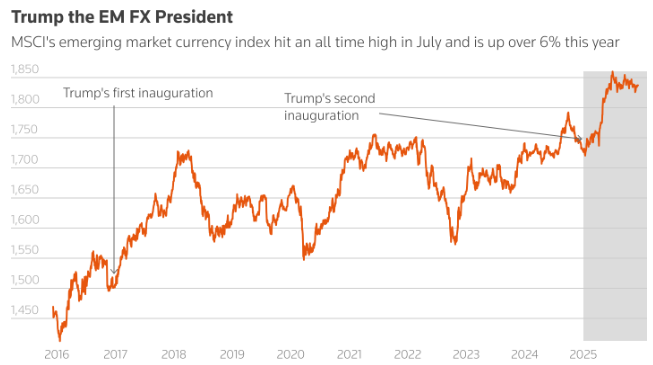
Core Insights - Emerging market currencies are performing strongly due to increased volatility and a weakening dollar, prompting investors to reassess their exposure to the dollar and consider the economic value of developing countries [2][5] - The trend of emerging market currencies is expected to continue into 2026, with significant interest from hedge funds and banks benefiting from foreign exchange trading [1][6] Group 1: Emerging Market Currency Performance - The Hungarian Forint's trading volume has more than doubled since January, with a 20% increase in its exchange rate against the dollar, marking its best performance in 25 years [1] - The MSCI Emerging Markets Currency Index reached a historical high in July, with an expected annual increase of over 6%, the best since 2017 [1] - The Brazilian Real and Mexican Peso are among the best-performing emerging market currencies, supported by robust central banks and high interest rates, with Brazil's rate at 15%, the highest in nearly 20 years [12] Group 2: Impact of Dollar Weakness - The dollar's weakening is part of a broader cycle shift, ending a 14-year bear market for emerging market currencies, as investors move away from reliance on U.S. assets [2][5] - Analysts expect the Federal Reserve to lower interest rates by another two 25 basis points in the coming year, which is crucial for many emerging market currencies and is driving capital inflows [9][12] - The high volatility in the foreign exchange market has created profitable opportunities for hedge funds, with EDL Capital reporting a 28% increase in value this year [5][6] Group 3: Institutional Insights - Major banks have generated nearly $40 billion in revenue from emerging market foreign exchange trading in the first nine months, more than double the revenue from trading ten major currencies [6] - Over half of surveyed top forex traders and hedge fund managers indicated increasing interest in emerging market currencies as the dollar's dominance wanes [9] - The International Monetary Fund has warned of potential risks in the currency market, highlighting that nearly half of global forex trading is dominated by a small number of large banks [5]

新兴市场外汇套利交易明年继续被看好,波动性成唯一隐忧
Di Yi Cai Jing· 2025-12-15 07:51
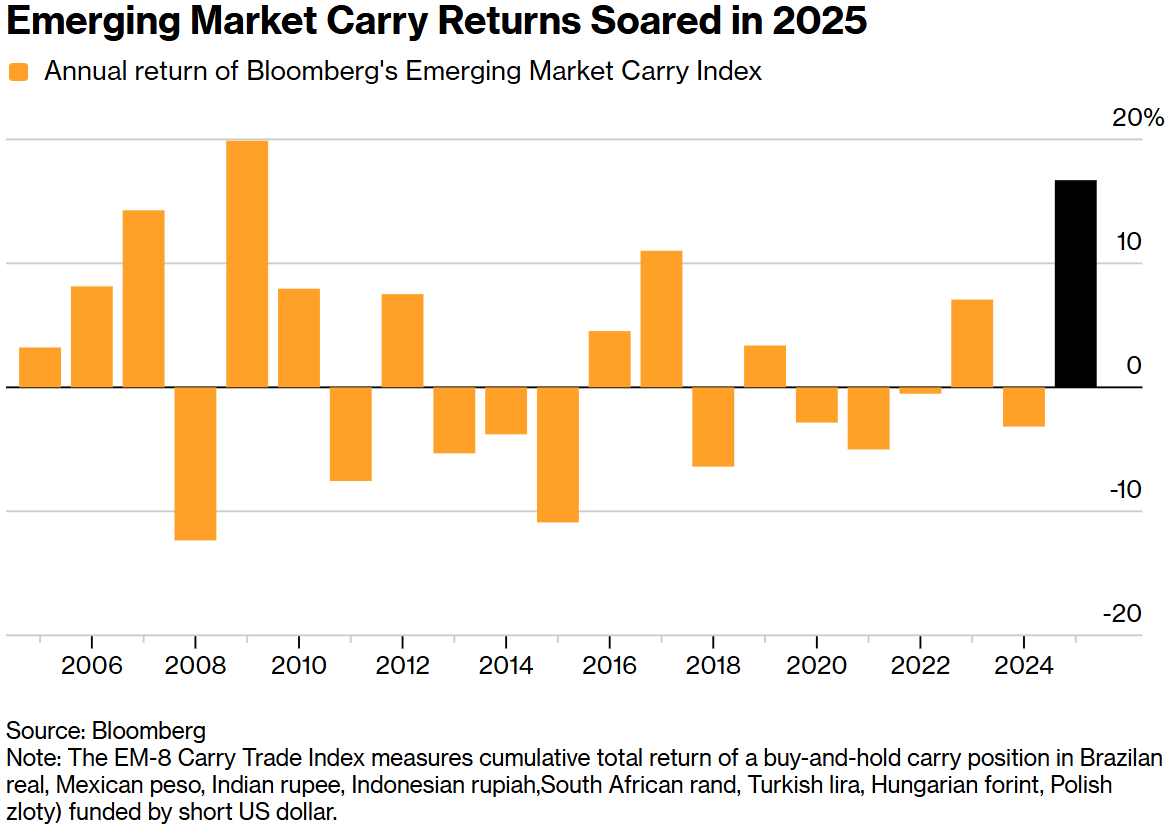
Core Insights - Emerging market carry trades are expected to remain effective through 2026, driven by low borrowing costs from central banks in developed economies and sustained interest rate differentials between developed and emerging markets [1][3]. Group 1: Performance of Emerging Market Carry Trades - The Bloomberg Emerging Market Carry Index has achieved a year-to-date return of 16.71%, the highest since 2009, when it reached 19.89% [3]. - In the previous five years, four years recorded negative returns, with rates of -2.84%, -5.02%, -0.52%, and -3.17% for 2020, 2021, 2022, and 2024 respectively [3]. - High benchmark interest rates in countries like Brazil, Mexico, and South Africa have resulted in three-month implied yields of 13.4%, 7.5%, and 6.6%, significantly outperforming developed economies [3]. Group 2: Market Sentiment and Strategies - The trajectory of the U.S. economy is seen as a key factor for the continued strong performance of emerging market currencies, with expectations of a slowdown encouraging the Federal Reserve to ease monetary policy [4]. - Investment firms like Invesco and Goldman Sachs recommend increasing short positions on the U.S. dollar against currencies such as the Brazilian real and South African rand [4]. - Neuberger Berman highlights that reduced volatility in the foreign exchange market and a weak dollar create favorable conditions for emerging market carry trades [5][6]. Group 3: Volatility Concerns - There is ongoing debate about whether low foreign exchange volatility can be maintained, as adverse currency movements could quickly erase gains [7]. - Current indicators from JPMorgan show emerging market currency volatility is near a five-year low, but concerns remain about potential increases due to factors like U.S. midterm elections and Federal Reserve policy divergences [7]. - Vanguard Group believes that market disruptions from events like Trump's tariff policies are diminishing, suggesting a stable environment for emerging market currencies in 2026 [7].


新兴市场套利狂潮未止!华尔街看好2026年高收益货币前景
智通财经网· 2025-12-14 23:25
Group 1 - Emerging market carry trades are expected to continue thriving in 2026, supported by reduced forex market volatility and a weak US dollar [1] - A key indicator for this strategy has shown a return of approximately 17% this year, marking the highest increase since 2009 [1] - Major asset management firms and banks anticipate that the interest rate gap between developed and emerging markets will persist, with the Federal Reserve and other wealthy nations' central banks likely to maintain low borrowing costs [1] Group 2 - Emerging market stocks, bonds, and currencies have seen significant increases this year, with countries like Brazil and Colombia experiencing currency appreciation of over 13% against the US dollar [3] - The performance of these markets is closely tied to the US economic outlook, with investors hoping for weak growth to encourage further easing of monetary policy by the Federal Reserve [3] - Goldman Sachs has highlighted the attractiveness of shorting the US dollar against currencies like the Brazilian real and South African rand, with a basket of these trades yielding approximately 20% returns this year [3] Group 3 - Investors are assessing whether forex volatility will remain low, as adverse currency movements can quickly erase months of gains [6] - Current market expectations for volatility are low, with a JPMorgan indicator nearing a five-year low, raising concerns among market participants [6] - Despite potential factors that could increase currency volatility, such as US midterm elections and central bank policy divergences, Vanguard Group expects that market disruptions will remain controlled into 2026 [6]
【欧元本周涨超0.6%,瑞郎涨1.1%】周五(12月12日))纽约尾盘,欧元兑美元涨0.04%,报1.1742,本周累计上涨0.86%,12月10日美联储宣布降息以来和12月11日持续走高。本周,英镑兑美元累涨0.31%,报1.3370。美元兑瑞郎累跌1.10%,报0.7959。商品...
Sou Hu Cai Jing· 2025-12-12 21:06
Group 1 - The euro increased by 0.86% this week, closing at 1.1742 against the US dollar, following the Federal Reserve's interest rate cut announcement on December 10 [1] - The British pound rose by 0.31% this week, reaching 1.3370 against the US dollar [1] - The Swiss franc depreciated by 1.10% against the US dollar, closing at 0.7959 [1] Group 2 - The Australian dollar increased by 0.18% against the US dollar, while the New Zealand dollar rose by 0.47% [1] - The Canadian dollar fell by 0.36% against the US dollar [1] - The Swedish krona appreciated by 1.39% against the US dollar, while the Norwegian krone decreased by 0.24% [2] - The Danish krone increased by 0.84% against the US dollar [2] Group 3 - The Polish zloty rose by 0.94% against the US dollar, while the Hungarian forint fell by 0.23% [3]
日元涨超0.2%,瑞郎涨超0.6%
Sou Hu Cai Jing· 2025-12-11 20:35
Core Viewpoint - The article discusses the fluctuations in currency exchange rates, particularly focusing on the performance of the US dollar against various currencies, highlighting both gains and losses in different pairs [1]. Group 1: Currency Performance - The US dollar against the Japanese yen decreased by 0.25%, closing at 155.63 yen, before slightly rising to a high of 156.16 yen and then dropping to a low of 154.95 yen [1]. - The euro appreciated by 0.39% against the US dollar, while the British pound saw a marginal increase of 0.03% [1]. - The US dollar declined by 0.63% against the Swiss franc, indicating a notable shift in this currency pair [1]. Group 2: Commodity Currencies - Among commodity currencies, the Australian dollar fell by 0.20% against the US dollar, and the New Zealand dollar decreased by 0.17% [1]. - The Canadian dollar also experienced a slight decline of 0.10% against the US dollar [1]. Group 3: Scandinavian and Eastern European Currencies - The Swedish krona rose by 0.12% against the US dollar, while the Norwegian krona increased by 0.13% [1]. - The Danish krone appreciated by 0.38% against the US dollar, and the Polish zloty gained 0.37% [1]. - The Hungarian forint saw an increase of 0.28% against the US dollar, reflecting positive movement in these currencies [1].
日元涨约0.5%下探155,英镑涨超1%
Sou Hu Cai Jing· 2025-12-03 20:31
Core Viewpoint - The US dollar experienced a decline against several currencies, particularly the Japanese yen, while the euro and British pound strengthened against the dollar [1] Currency Movements - The US dollar fell by 0.48% against the Japanese yen, closing at 155.13 yen, with a trading range of 155.91 to 155.01 yen throughout the day [1] - The euro appreciated by 0.42% against the US dollar, reaching 1.1673, showing a consistent upward trend [1] - The British pound increased by 1.06% against the US dollar, closing at 1.3352, also reflecting a continuous rise [1] - The US dollar declined by 0.47% against the Swiss franc, ending at 0.7994 [1] Commodity Currencies - The Australian dollar rose by 0.57% against the US dollar [1] - The New Zealand dollar increased by 0.74% against the US dollar [1] - The US dollar decreased by 0.16% against the Canadian dollar [1] Scandinavian and Eastern European Currencies - The Swedish krona appreciated by 0.64% against the US dollar [1] - The Norwegian krone rose by 0.75% against the US dollar [1] - The Danish krone increased by 0.42% against the US dollar [1] - The Polish zloty strengthened by 0.53% against the US dollar [1] - The Hungarian forint rose by 0.37% against the US dollar [1]