大宗商品反弹

Search documents
华泰期货:烧碱上涨,核心驱动因素是什么?
Xin Lang Cai Jing· 2026-01-08 01:47
Group 1 - The core viewpoint of the article is that the price of caustic soda futures has significantly strengthened, with the main contract SH2603 closing up by 4.34% due to various driving factors [7][9]. Group 2 - On the macroeconomic level, the central bank's work meeting has included promoting high-quality economic development and reasonable price recovery as key monetary policy focuses, boosting market macro expectations [9]. - The policy aspect includes a proposed differential electricity pricing policy in Shaanxi province, which plans to increase prices for restricted capacity in caustic soda and other industries by 0.1 yuan/kWh and by 0.3 yuan/kWh for eliminated capacity. This policy affects companies like Shaanxi Beiyuan (1.2 million tons) and Shaanxi Jintai (830,000 tons) [9]. - The cost side indicates that some downstream chlorine-consuming industries are reducing purchases due to weather and price acceptance, with liquid chlorine demand weakening and prices declining, indirectly strengthening the cost support for the chlor-alkali industry [9]. Group 3 - Current caustic soda spot prices are stable but declining, with a loose supply-demand situation unchanged. Inventory in Shandong and Jiangsu continues to accumulate, and there are fewer maintenance shutdowns in January [3][9]. - Downstream purchasing enthusiasm is generally low, with alumina plants operating steadily but unloading efficiency being average, leading to a 32% reduction in alkali procurement prices [3][9]. - In the medium to long term, alumina demand for caustic soda may decline due to industry internal competition policies, and non-alumina demand is weakening as January enters a seasonal off-peak period. Short-term caustic soda prices may fluctuate with macroeconomic sentiment [3][9].


首次突破65美元!白银领衔贵金属开启暴涨模式
Jin Tou Wang· 2025-12-17 03:12
Group 1 - Precious metals, including gold, silver, platinum, and palladium, are experiencing strong upward momentum, with silver prices surpassing $65 per ounce for the first time, reaching a high of $65.63 per ounce, marking a nearly 3.00% increase in a single day [1] - Platinum and palladium contracts also saw significant gains, with platinum rising by 4.00% to 512.80 yuan per gram and palladium increasing by 5.00% to 448.6 yuan per gram [1] - The gold-silver ratio has decreased to around 67.3, while the price spread between platinum and palladium has widened to approximately $240 per ounce [1] Group 2 - The current price surge in silver is supported by both supply and demand factors, with the global silver market experiencing structural shortages for the fifth consecutive year due to limited mining output and increasing demand from renewable energy and electronics sectors [2] - Expectations of loose global monetary policy and declining real yields are reducing the opportunity cost of holding non-yielding assets, attracting institutional investors seeking asset diversification and inflation hedging, creating a rare resonance between industrial and investment demand [2] - Recent U.S. labor data indicates a mixed employment situation, with non-farm payrolls increasing by 64,000 in November, surpassing expectations, but the unemployment rate unexpectedly rose to 4.6%, the highest since September 2021, indicating a relatively weak trend in the labor market [2] Group 3 - The largest gold ETF, SPDR Gold Trust, maintained its holdings at 1,051.69 tons, while the largest silver ETF, iShares Silver Trust, saw a decrease of 42.31 tons in holdings, bringing the current total to 16,018.29 tons [3]
大宗商品强势反弹,尿素震荡为主
Yin He Qi Huo· 2025-07-26 08:33
Group 1: Investment Rating - No investment rating provided in the report. Group 2: Core Views - Last week, commodities rebounded strongly and urea fluctuated; this week, due to low demand, urea prices dropped. The market sentiment has been mediocre since the weekend, with the ex - factory quotes of urea in major regions leading the decline and weak transactions. In Shandong, the ex - factory quotes dropped significantly, while in Henan, they remained stable. Around the delivery area, the ex - factory prices followed the downward trend. [4] - Some urea production facilities are under maintenance, and the daily output has dropped to around 190,000 tons, still at the highest level in the same period. A new Indian tender has been announced. Considering the large price gap between domestic and international markets, the relaxation of export policies may boost the domestic market sentiment to some extent. [4] - The enthusiasm for compound fertilizers in Central and North China is low, and grass - roots inventory preparation is lacking. The operating rate of compound fertilizer plants has slightly increased, but the inventory of urea can be used for about a week, resulting in low procurement sentiment for raw materials. [4] - This week, the inventory of urea production enterprises continued to drop to around 860,000 tons but remained high. The domestic supply is abundant, and overall demand is declining. Although the port inspection policy for exports has been relaxed, its impact on the domestic spot market is limited. [4] - In the short term, domestic demand is in a vacuum period. After the agricultural demand ends and compound fertilizer plants have not started large - scale production, the spot market sentiment is weak. Although the futures price is supported by the continuous strong rebound of domestic commodities, the upside is limited due to the weak fundamentals. It is recommended to short on rallies. [4] Group 3: Summary by Directory 1. Comprehensive Analysis and Trading Strategies - **Trading Strategies**: For single - side trading, short on rallies; for arbitrage, stay on the sidelines; for over - the - counter trading, sell call options on rebounds. [4] 2. Key Data Changes - **Supply - National**: In the 29th week of 2025 (July 17 - 23, 2025), the capacity utilization rate of coal - based urea was 85.78%, a week - on - week decrease of 1.17%; the capacity utilization rate of gas - based urea was 76.50%, a week - on - week increase of 0.13%. [5] - **Supply - Shandong**: The capacity utilization rate of urea in Shandong was 83.78%, a week - on - week increase of 8.08%. [5] - **Demand - Melamine**: In the 30th week of 2025 (July 18 - 24, 2025), the weekly average capacity utilization rate of China's melamine was 65.20%, an increase of 0.96 percentage points from the previous week. [5] - **Demand - Compound Fertilizer**: In the 30th week of 2025 (July 18 - 24, 2025), the capacity utilization rate of compound fertilizers was 33.58%, a week - on - week increase of 1.03 percentage points. [5] - **Demand - Northeast Arrival Volume**: This week (July 18 - 25, 2025), the arrival volume of urea in Northeast China was 15,000 tons, a decrease of 5,000 tons from the previous week, a week - on - week decline of 25.00%. [5] - **Demand - Compound Fertilizer Urea Demand**: As of July 25, 2025, the urea demand of sample compound fertilizer production enterprises in Linyi, Shandong was 820 tons, an increase of 20 tons from the previous week, a week - on - week increase of 2.50%. [5] - **Demand - Pre - orders**: As of July 23, 2025, the pre - order days of Chinese urea enterprises were 5.94 days, a decrease of 0.12 days from the previous period, a week - on - week decrease of 1.98%. [5] - **Inventory - Enterprises**: On July 23, 2025, the total inventory of Chinese urea enterprises was 858,800 tons, a decrease of 36,700 tons from the previous week. The inventory of urea enterprises continued to decline, but the decline rate narrowed. [5] - **Inventory - Ports**: The sample inventory at ports was 543,000 tons, a week - on - week increase of 2,000 tons. [5] - **Valuation**: The price of Jincheng anthracite lump coal rebounded, and the price of Yulin pulverized coal increased. The spot price of urea remained stable overall. The profit of fixed - bed production was 220 yuan/ton, the profit of coal - water slurry production was 360 yuan/ton, and the profit of entrained - flow bed production was 580 yuan/ton. The futures price fluctuated widely, the basis was - 65 yuan/ton, and the 9 - 1 spread was at par. [5]
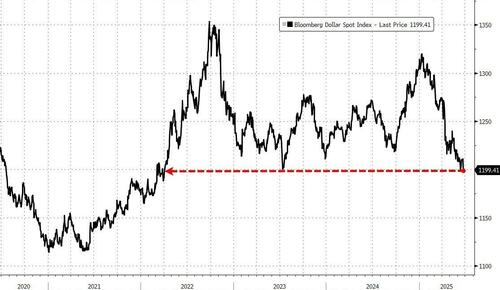
美元破位,商品大涨
Hua Er Jie Jian Wen· 2025-06-27 04:18
Core Viewpoint - The weakening of the US dollar has led to a collective rebound in commodity prices, particularly in precious and base metals, driven by expectations of interest rate cuts by the Federal Reserve [1][3][5]. Group 1: Economic Indicators - The US GDP final value and new home sales data released on Thursday were both weak, increasing expectations for interest rate cuts, with a 27% probability for July and 84% for September [1]. - The dollar index fell to its lowest level since March 2022, breaking below the 98 mark, which triggered a broad rebound in the commodity market [1][3]. Group 2: Commodity Market Reactions - The decline in the dollar has made dollar-denominated commodities more attractive, with gold prices rising above $3,300 per ounce [3]. - Copper prices on the Shanghai Stock Exchange increased by 0.3% to 78,820 RMB per ton, with similar gains observed in the London market for copper and other base metals like aluminum, zinc, and nickel [5]. - Analysts predict that this commodity rebound may just be beginning, with a shift in Federal Reserve policy and further dollar depreciation expected to provide stronger upward momentum for commodities [5]. Group 3: Factors Behind Dollar Weakness - The dollar index's decline is attributed to two main factors: the strong rebound of the euro and the continuous weakness in US macroeconomic data [6][8]. - The euro strengthened due to a ceasefire agreement between Israel and Iran and a historic agreement among NATO members to significantly increase defense spending, injecting new momentum into the European economy [7]. - Weak US economic data, particularly a sharp drop in new home sales, has heightened concerns about an economic slowdown, prompting investors to reassess the Federal Reserve's policy path [8]. Group 4: Precious Metals Outlook - Gold prices have shown resilience, rebounding from the $3,300 per ounce support level, with short-term upside potential limited to around $3,500 per ounce, while downside risks remain contained between $3,100 and $3,200 per ounce [9]. - Silver has outperformed, with a consistent supply deficit of about 8% over the past three years, and prices are expected to rise from the current $39.5 per ounce to between $42.8 and $44.7 per ounce [10]. Group 5: Base Metals Outlook - The weakness of the dollar has provided significant price support for base metals, with copper, aluminum, zinc, and nickel all experiencing price increases [11]. - Goldman Sachs forecasts that copper prices will average $9,890 per ton by late 2025, driven by tariff policies and demand growth, with potential supply tightening further supporting prices [11].