
贵金属开采与交易

Search documents
现货黄金跌1.49%,白银跌1.12%,铜价逆势涨2.05%
Sou Hu Cai Jing· 2026-02-26 15:06
Market Overview - On February 25, 2026, the international precious metals market experienced a significant divergence, with spot gold prices falling by 1.49% to $5149.92 per ounce, while COMEX copper futures surged by 2.05% to $5.9610 per pound [1][3] Gold and Silver Market Dynamics - Prior to the decline, gold prices had stabilized around $5160, but ultimately closed at $5149.92, with COMEX gold futures down 1.12% [3] - The recent price fluctuations are not isolated; gold had recently surpassed the $5000 mark on February 20, 2026, following a dramatic rise of 17.7% from January 19 to 28, 2026 [3] - The volatility was exacerbated by a significant drop on January 30, 2026, where gold plummeted by 9.25% in a single day, marking the largest daily decline in 43 years [3] - Silver prices showed contrasting movements, with COMEX silver futures rising by 0.57% while spot silver fell [3] Federal Reserve Influence - Internal divisions within the Federal Reserve are a key source of market volatility, as evidenced by the January meeting minutes revealing a 9-3 vote on interest rates, highlighting a split between inflation concerns and economic growth risks [4] - The nomination of hawkish Kevin Walsh as Fed Chair disrupted market expectations for aggressive rate cuts, leading to a 0.9% surge in the dollar index, which increased the opportunity cost of holding non-yielding assets like gold [6] Economic Data Impact - U.S. inflation data showed a year-on-year CPI increase of 2.4%, the lowest since May 2025, while core CPI rose by 2.5%, the slowest since March 2021, briefly reigniting hopes for Fed rate cuts [7] - Strong employment data for January, with 130,000 new jobs added, countered these hopes, creating further uncertainty in the market [7] Geopolitical Factors - Geopolitical risks remain a significant variable for the precious metals market, particularly with ongoing negotiations between the U.S. and Iran, which have seen both sides reach a general consensus but still face substantial differences [7] Copper Market Dynamics - The rise in copper prices is driven by industrial demand, particularly from the green transition, with electric vehicles requiring significantly more copper than traditional vehicles [10] - The global demand for copper is expected to increase by approximately 160,000 tons due to the anticipated sales of 32 million new energy vehicles in 2026 [10] - The explosion of AI data centers is also contributing to copper demand, with predictions of a 48% year-on-year increase in copper requirements for these facilities [10] Silver Supply Constraints - The supply of silver is facing rigid constraints, with about 70% of global silver being a byproduct of other metals, and a new export control policy in China expected to reduce global supply by 4,500 to 5,000 tons annually, equating to a 15% decrease [11] - High silver prices are impacting downstream industries, with the cost of silver paste in photovoltaic components rising from below 10% to 30% of production costs, prompting companies to accelerate the development of silver-reducing technologies [13] Central Bank Gold Purchases - Central bank gold purchases have provided unprecedented support to the gold market, with net purchases exceeding 1,100 tons in 2025 and expected to remain high at 755 tons in 2026 [13] - Continuous accumulation of gold reserves by the People's Bank of China over the past 14 months has acted as a stabilizing force during market volatility [13]


贵金属价格涨势能否持续?——贺利氏最近观点
Sou Hu Cai Jing· 2026-01-14 04:49
Market Focus - Precious metal prices are expected to see significant increases in 2025, with platinum and silver reaching new price records in December [2] - The influx of metals into U.S. reserves due to tariff threats has impacted liquidity in other regions, affecting palladium and platinum markets [2] - Platinum and silver were historically undervalued at the beginning of the year, but their prices have significantly narrowed the gap with gold [2] Supply and Demand - A supply shortage in the platinum market is anticipated in 2025, continuing into 2026, while the palladium and rhodium markets are less strained [3] - South African production of platinum group metals has been below normal for a year, with current supply constraints due to holiday closures [3] - ETF holdings for platinum increased by 197,000 ounces in December, but this growth does not match the price surge [3] Technical Analysis - Platinum prices were overbought by the end of December, with an RSI above 90 and prices exceeding the 200-day moving average by 44.4% [4] - Historical data indicates that when prices exceed the 200-day moving average by more than 20%, corrections or bear markets typically follow [4] Geopolitical Factors - Geopolitical tensions have driven gold prices close to historical highs, with significant U.S. actions in Latin America and renewed focus on Greenland's mineral reserves [6] - Despite a pullback after reaching a record high in December, gold prices are projected to rise by 65% in 2025 [6] Export Regulations - China will restrict silver exports starting January 1, 2026, allowing only a limited number of companies to export [7] - In 2025, China exported approximately 4,700 tons of silver, and the new regulations come amid soaring silver prices [7] Trading Activity - The Guangzhou Futures Exchange saw a surge in trading volume for platinum and palladium contracts in December, following significant price increases [8] - Trading limits were adjusted to curb speculative flows, impacting trading volumes while prices continued to rise [8] Automotive Market Impact - Retail sales of passenger vehicles in China declined by 13% in December, although sales of new energy vehicles increased by approximately 5% [9] - The government is supporting new energy vehicle sales through a subsidy program, which may enhance the recovery of platinum group metals, particularly palladium [9]
金银铂钯齐创新高!年末流动性、降息周期与地缘风险合力 贵金属市场上演历史性行情
Zhi Tong Cai Jing· 2025-12-26 07:03
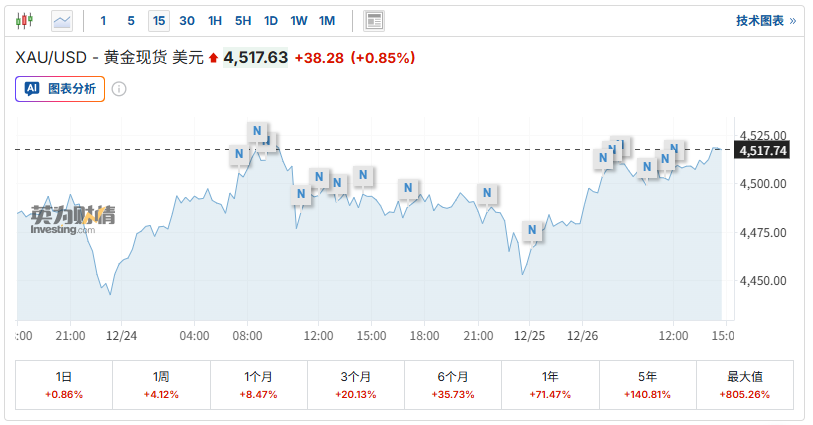
Core Viewpoint - The prices of gold, silver, and platinum have reached historical highs due to speculative buying, tightening market liquidity at year-end, expectations of further interest rate cuts by the Federal Reserve, and escalating geopolitical tensions [1][3]. Group 1: Precious Metals Price Movements - As of the latest report, spot gold increased by 0.85% to $4,517.63 per ounce, previously hitting a record high of $4,531.24 per ounce; February futures for gold rose by 0.97% to $4,546.50 per ounce [1]. - Spot silver surged by 4.16% to $74.8705 per ounce, briefly surpassing the $75 mark [4]. - Platinum prices rose over 8% to $2,451.25 per ounce, marking a new historical high, while palladium increased by 5.55% to $1,822.70 per ounce [5]. Group 2: Market Drivers and Future Outlook - The strong performance of gold this year is attributed to the Federal Reserve's shift to a loose monetary policy, geopolitical uncertainties, robust central bank gold purchases, increased ETF holdings, and ongoing de-dollarization, resulting in the largest annual gain since 1979 [5]. - Silver has seen a remarkable increase of 158% this year, significantly outpacing gold's nearly 72% rise, driven by structural supply-demand gaps, its designation as a critical mineral in the U.S., and strong industrial demand [5]. - Looking ahead to the first half of 2026, gold is projected to potentially reach $5,000 per ounce, while silver could approach $90 per ounce [3]. Group 3: Supply and Demand Dynamics - Platinum and palladium prices have surged due to supply tightness, tariff uncertainties, and a shift in some gold investment demand; platinum has risen approximately 165% this year, while palladium has increased over 90% [7]. - The EU's recent adjustment to its 2035 internal combustion engine ban policy, relaxing CO2 emission reduction targets, has bolstered the demand outlook for platinum, a key material in related technologies [7]. - Strong industrial demand is supporting platinum prices, with U.S. inventory holders replenishing stocks due to concerns over sanction-related risks, helping to maintain high price levels [7].
贵金属狂飙!金银铜铂齐创历史新高,牛市还能走多远?
Guo Ji Jin Rong Bao· 2025-12-24 10:29
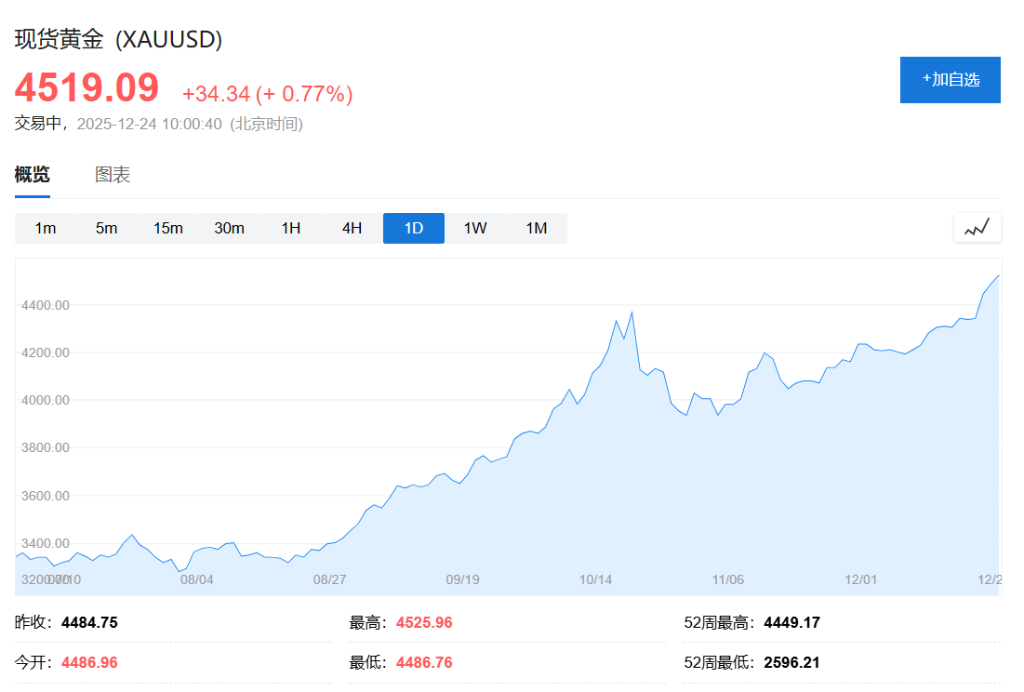
Core Insights - The global precious metals market experienced a significant rally on December 24, with gold, silver, platinum, and copper all reaching historical highs, driven by multiple factors including liquidity expectations, geopolitical risks, and structural supply-demand imbalances [1][3]. Gold Market - London spot gold prices broke through $4,500 per ounce, reaching a new historical record, with a year-to-date increase of approximately $1,880 per ounce, translating to a 64% rise when priced in Chinese yuan [2][4]. - The recent surge in gold prices is attributed to the weak U.S. labor market, as indicated by the November unemployment rate, which supports ongoing monetary easing expectations from the Federal Reserve [4]. - Central banks worldwide have been buying gold in large quantities, providing a solid foundation for the current bull market, with significant inflows into gold ETFs, particularly the SPDR Gold Trust, which saw its holdings increase by over 20% this year [4]. Silver Market - Silver prices have outperformed gold, with London silver reaching $72.255 per ounce and a year-to-date increase exceeding 150% [6]. - The rise in silver prices is driven by both investment and industrial demand, with significant imports in major consumer countries like India, particularly during festive seasons [6]. - The global silver market is experiencing a structural shortage, as demand has consistently outstripped mine production for five consecutive years, exacerbated by the accelerating transition to green energy [6]. Platinum Market - Platinum has emerged as the standout performer among precious metals, with prices surpassing $2,300 per ounce, marking a 150% increase year-to-date, the best annual performance since data collection began in 1987 [7]. - The hydrogen energy sector is creating new demand for platinum, which is used as a catalyst in hydrogen fuel applications, indicating a shift in price dynamics away from traditional precious metal frameworks [7]. - Supply disruptions in major producing countries like South Africa are contributing to a third consecutive year of supply shortages in the platinum market [7]. Copper Market - Copper prices reached a historical high of $12,159.50 per ton, driven by global supply chain tensions and increasing demand from the renewable energy sector [3][8]. - The supply shortage is a critical factor in rising copper prices, with multiple mines facing production interruptions and preemptive stockpiling due to potential tariff policies [8]. - The long-term demand outlook for copper remains optimistic, supported by global energy transition and infrastructure development, although high prices may suppress some consumption and encourage the development of alternative materials [8].
贵金属涨势如虹!黄金4500,铂金2300,白银72,齐创历史新高
Hua Er Jie Jian Wen· 2025-12-24 02:23
Core Viewpoint - Precious metals are experiencing a significant surge in prices, driven by geopolitical risks, ongoing global supply shortages, and strong investment demand, with gold, silver, and platinum reaching historical highs [1][4][10]. Group 1: Gold Market - Spot gold prices have surpassed $4,500 per ounce for the first time, marking an increase of over 66% this year, potentially leading to the best annual performance since 1979 [1][10]. - Central banks have been buying gold in large quantities, providing a solid foundation for the current bull market, with global gold ETF holdings increasing by over 20% this year [10]. - The rise in gold prices is also attributed to concerns over global debt levels and the depreciation of fiat currencies, prompting investors to turn to gold as a hard asset [10]. Group 2: Platinum Market - Platinum prices have surged above $2,300 per ounce, marking the longest consecutive increase since 2017, with a year-to-date rise exceeding 150% [4][11]. - The supply of platinum is facing significant shortages due to disruptions in South Africa, the primary production country, leading to a tight market [11]. - Trade risks, particularly related to potential tariffs from the U.S., are causing traders to store over 600,000 ounces of platinum in U.S. warehouses, significantly above normal levels [11]. Group 3: Silver Market - Silver prices are also on the rise, having recently surpassed $70 per ounce, driven by both investment and industrial demand [7][12]. - Global silver ETF holdings are climbing, and significant imports of silver are being driven by cultural events in major consuming countries like India [12]. - The silver market is experiencing structural shortages, with demand consistently exceeding mine production for five consecutive years [12].
美国通胀降温助推降息预期 金银铂持续高位徘徊
Zhi Tong Cai Jing· 2025-12-19 02:37
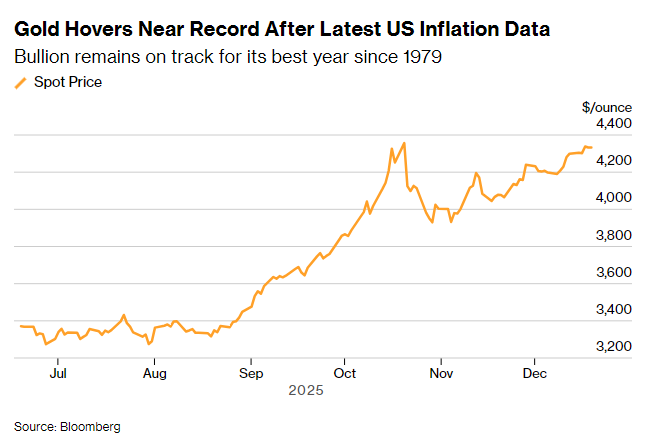
Core Viewpoint - The recent decline in U.S. inflation data has heightened market expectations for interest rate cuts, leading to significant price movements in precious metals such as gold, silver, and platinum, which are nearing historical highs [1][4]. Group 1: Precious Metals Prices - Spot gold prices are hovering around $4,325 per ounce, with a weekly increase of 0.6%, aiming for a second consecutive week of gains, having reached a historical high of $4,381 per ounce in October [1]. - Silver prices are reported at $64.99 per ounce, close to the historical peak of $66.89 per ounce set earlier in the week [1]. - Platinum prices have risen by 1%, approaching a 17-year peak, while palladium has also seen an increase [1]. Group 2: Economic Indicators and Market Reactions - The U.S. core Consumer Price Index (CPI) has seen its year-on-year growth rate drop to the lowest level since early 2021, reinforcing expectations for interest rate cuts [4]. - The recent government shutdown has diminished the reference value of the latest inflation report, creating uncertainty around the Federal Reserve's future monetary policy [4]. - Traders currently estimate a 25% probability of the Federal Reserve cutting rates in January, with calls from President Trump for significant rate reductions next year [4]. Group 3: Geopolitical Factors - Escalating geopolitical tensions, particularly in Venezuela, have increased gold's appeal as a safe-haven asset, supported by U.S. military deployments and sanctions against oil tankers [4]. - The precious metals sector is experiencing a significant bullish trend, with both gold and silver on track for their best annual performance since 1979, driven by central bank purchases and inflows into gold ETFs [4]. Group 4: Supply and Demand Dynamics - A report from Goldman Sachs indicates that declining U.S. interest rates are prompting ETF investors to compete with central banks for limited gold supplies, predicting continued upward pressure on gold prices due to structural high demand from central banks and cyclical support from Fed rate cuts [5]. - Platinum prices have doubled year-to-date, surpassing $1,980 per ounce, with signs of tightening supply in the London platinum market as banks shift inventories to the U.S. to avoid tariff risks [5]. - The launch of platinum futures trading in Guangzhou has led to a rebound in demand from the Chinese market, resulting in strong export performance of platinum to China this year [5].
首次突破65美元!白银领衔贵金属开启暴涨模式
Jin Tou Wang· 2025-12-17 03:12
Group 1 - Precious metals, including gold, silver, platinum, and palladium, are experiencing strong upward momentum, with silver prices surpassing $65 per ounce for the first time, reaching a high of $65.63 per ounce, marking a nearly 3.00% increase in a single day [1] - Platinum and palladium contracts also saw significant gains, with platinum rising by 4.00% to 512.80 yuan per gram and palladium increasing by 5.00% to 448.6 yuan per gram [1] - The gold-silver ratio has decreased to around 67.3, while the price spread between platinum and palladium has widened to approximately $240 per ounce [1] Group 2 - The current price surge in silver is supported by both supply and demand factors, with the global silver market experiencing structural shortages for the fifth consecutive year due to limited mining output and increasing demand from renewable energy and electronics sectors [2] - Expectations of loose global monetary policy and declining real yields are reducing the opportunity cost of holding non-yielding assets, attracting institutional investors seeking asset diversification and inflation hedging, creating a rare resonance between industrial and investment demand [2] - Recent U.S. labor data indicates a mixed employment situation, with non-farm payrolls increasing by 64,000 in November, surpassing expectations, but the unemployment rate unexpectedly rose to 4.6%, the highest since September 2021, indicating a relatively weak trend in the labor market [2] Group 3 - The largest gold ETF, SPDR Gold Trust, maintained its holdings at 1,051.69 tons, while the largest silver ETF, iShares Silver Trust, saw a decrease of 42.31 tons in holdings, bringing the current total to 16,018.29 tons [3]
金银反弹受黄金带动 美联储决议后市场静待新指引
Jin Tou Wang· 2025-10-30 07:16
Core Viewpoint - The recent rise in silver prices is primarily driven by the rebound in gold prices, rather than fundamental factors specific to silver [1][2] Group 1: Market Dynamics - Spot gold rebounded nearly 2% after hitting a three-week low of $3886.46, driven by bargain buying, short covering, and expectations of central banks re-entering the market [1][2] - Traders increased long positions in gold as prices significantly corrected, pushing gold towards the critical $4000 mark [1][2] - Silver prices rose above $48.00 per ounce, with platinum demand also increasing by 1%, indicating a general uptick in the precious metals sector [1] Group 2: Federal Reserve Impact - Traders are adjusting positions ahead of the Federal Reserve's interest rate decision, with a 25 basis point rate cut largely priced in [2] - The market's direction will be influenced by Fed Chair Powell's press conference, particularly if he hints at reducing the scale of quantitative tightening (QT) or adopts a more dovish tone [2] - Both Bank of America and Deutsche Bank suggest that the Fed may end QT this month, which would bolster demand for non-yielding assets like gold and silver [2] Group 3: Technical Analysis - For spot gold, the recent 25 basis point rate cut did not lead to a significant price increase, indicating that many long positions were liquidated [3] - The current outlook for gold remains bearish unless it breaks above the mid-band resistance level [3] - Spot silver has potential upward movement towards the resistance level of $51.07, with a subsequent target of $54.49 if this level is breached [4]