
大宗商品市场波动

Search documents
冠通期货早盘速递-20260303
Guan Tong Qi Huo· 2026-03-03 02:24
Group 1: Hot News - European natural gas market suffered the biggest single - day shock since March 2022 due to a drone attack on Qatar Energy's facility in Ras Laffan, which led to a halt in LNG production. Qatar Energy accounts for about 20% of the global LNG export market [2] - Maersk will suspend the import and export transportation of refrigerated, dangerous/special goods in UAE, Oman, Iraq, Kuwait, Qatar, Bahrain and Saudi Arabia until further notice [2] - On March 2, 2026, Anshan launched a yellow (Ⅲ - level) warning for heavy - pollution weather, and some steel enterprises in Anshan are implementing production cuts of 40% [2] - As of February 27, 2026, the national commercial inventory of soybean oil was 1096,800 tons, a decrease of 41,200 tons from last week. The commercial inventory of palm oil in key regions was 786,700 tons, an increase of 80,300 tons (11.37% week - on - week) and 372,100 tons (89.75% year - on - year) [2] - The Dalian Commodity Exchange announced that due to the complex international situation, commodities such as pure benzene, LPG, ethylene glycol, styrene, polypropylene, and LLDPE have large price fluctuations, and member units are required to strengthen risk management [2] Group 2: Key Focus - Key commodities to focus on are urea, Shanghai copper, Shanghai tin, crude oil, and plastic [3] Group 3: Night - session Performance - The night - session performance of different commodity sectors shows that the non - metallic building materials sector rose 2.02%, the precious metals sector rose 34.51%, the oilseeds and oils sector rose 7.39%, the soft commodities sector rose 2.69%, the non - ferrous metals sector rose 27.24%, the coal - coking and steel - mining sector rose 9.39%, the energy sector rose 2.99%, the chemical sector rose 10.16%, the grain sector rose 1.13%, and the agricultural and sideline products sector rose 2.48% [3] Group 4: Sector Positions - The chart shows the changes in the positions of commodity futures sectors in the past five days [4] Group 5: Performance of Major Asset Classes - In the equity category, the Shanghai Composite Index had a daily increase of 0.47%, a monthly increase of 0.47%, and a year - to - date increase of 5.39%. Other indices like the S&P 500, Hang Seng Index, etc. also had their respective performance [5] - In the fixed - income category, 10 - year, 5 - year, and 2 - year treasury bond futures had different daily, monthly, and year - to - date increases [5] - In the commodity category, the CRB commodity index, WTI crude oil, London spot gold, etc. had their respective performance [5] - In the other category, the US dollar index and CBOE volatility had their performance [5] Group 6: Main Commodity Trends - The report presents the trends of various commodities such as the Baltic Dry Index, CRB spot index, WTI crude oil, London spot gold, London spot silver, LME copper, etc., as well as ratios like the gold - oil ratio and copper - gold ratio [6]
EasyMarkets易信:产出预期稳健 评矿业巨头表现
Xin Lang Cai Jing· 2026-02-19 12:11
Core Viewpoint - Buenaventura (BVN) has demonstrated strong performance in its annual report, with significant price increases in precious metals reflecting robust market support amid high inflation, setting a solid financial foundation for capital expenditures and business expansion in 2026 [1][2]. Production Data - The total gold output for 2025 is projected to be 138,919 ounces, while copper production is expected to reach 52,445 tons [3]. - Although the silver guidance for 2026 is slightly narrowed (estimated between 12,900,000 to 14,500,000 ounces), the anticipated growth in gold production (up to 186,500 ounces) is expected to effectively offset the risks associated with base metal fluctuations [3]. Operational Efficiency - The Orcopampa and Coimolache mines have exceeded expectations, demonstrating the positive impact of technological improvements on production capacity [4]. - The San Gabriel project has faced delays due to external permitting issues, but the introduction of the first gold-silver alloy ingot has sent positive signals to the market [4]. Market Outlook - The long-term support for gold and silver prices due to global risk aversion is expected to enhance Buenaventura's performance guidance for 2026 [4]. - The average gold price achieved in Q4 2025 was $4,214, indicating that if this high level is maintained, the profitability transparency of the mining sector will further improve [4].



黄金巨震、原油冲高、大豆破关,节后市场逻辑将如何演绎?
Sou Hu Cai Jing· 2026-02-13 01:35
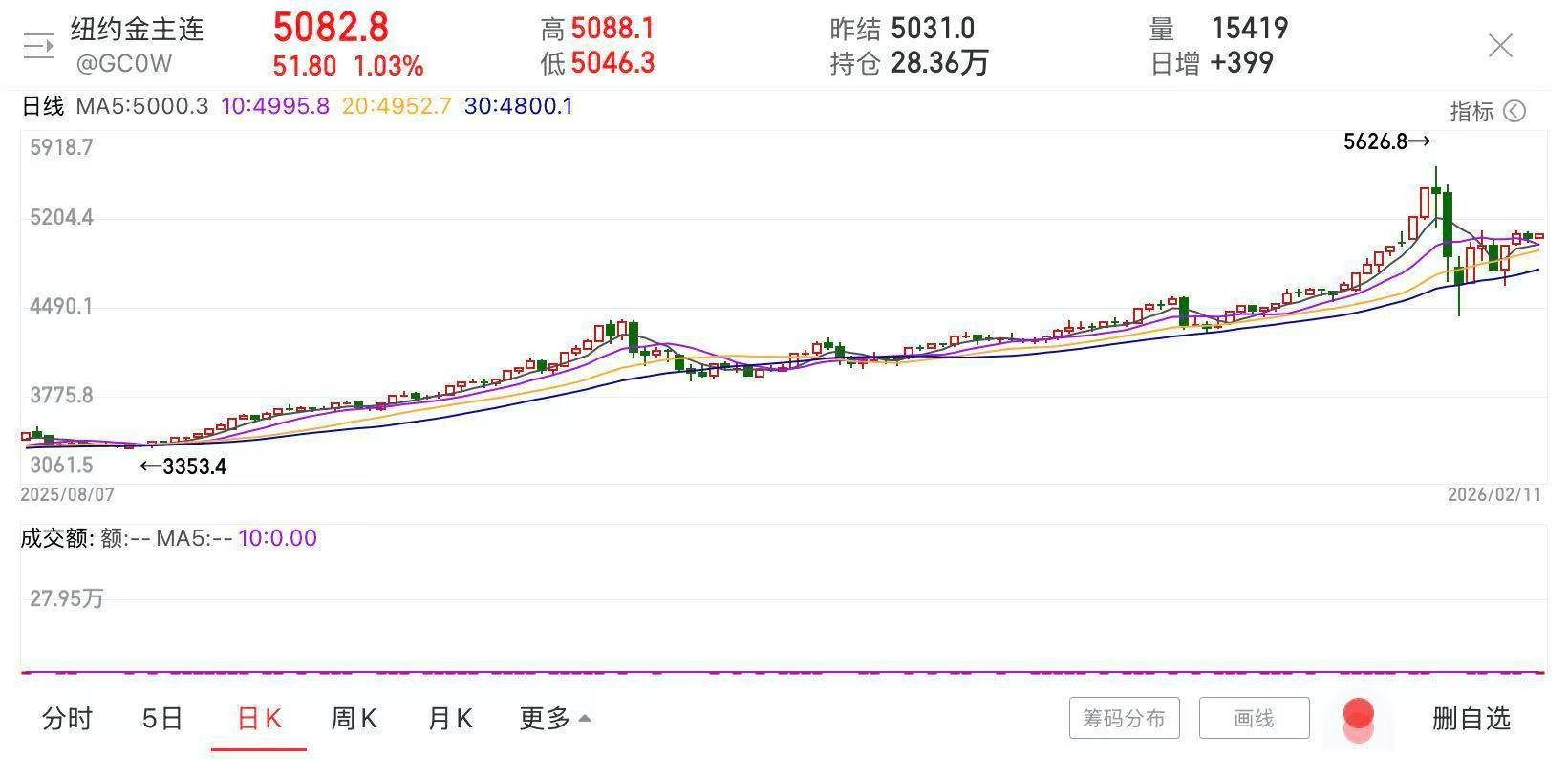
Group 1: Precious Metals - The recent volatility in precious metals, particularly gold and silver, has raised questions about whether the current price adjustments signify a market correction or the end of a bull market [1][2] - Gold prices surged to over $5600 per ounce at the end of January but have since dropped back to around $5000, while silver experienced a significant one-day drop exceeding 25% [1][2] - Factors contributing to the recent decline include increased geopolitical uncertainty, potential shifts in Federal Reserve monetary policy, and profit-taking from previous highs [2] Group 2: Oil Market - Oil prices have recently increased, with West Texas Intermediate crude rising from a low of $55 per barrel to a high of $66 per barrel, reflecting a more than $10 increase [3][6] - Tensions between the U.S. and Iran are a primary driver of oil price fluctuations, as Iran controls a significant portion of global oil reserves and key shipping routes [6] - The outlook for oil prices post-Chinese New Year will depend on geopolitical developments and the resumption of global economic activities, with predictions of a potential supply surplus in 2026 varying among major energy agencies [6][7] Group 3: Agricultural Products - The market reacted positively to President Trump's announcement regarding China's potential purchase of 20 million tons of soybeans, leading to a rise in soybean futures prices above $11 per bushel [8][12] - The increase in soybean prices is supported by improved trade expectations, supply changes in major producing regions, and favorable policy adjustments regarding biodiesel [12] - The soybean market's dynamics will shift post-holiday, focusing on seasonal supply and demand factors, with the consumption pace and recovery in end-user markets being critical for price movements [13]
【真灼港股名家】中国监管机构出手 黄金白银创历史单日跌幅
Sou Hu Cai Jing· 2026-02-01 09:41
Core Viewpoint - The recent surge in commodity prices, particularly gold and silver, has led to significant market volatility, prompting regulatory actions in China to mitigate investment frenzy and market risks [2][3]. Group 1: Price Movements - Gold prices increased from $2,620 in January last year to a historical high of $5,602 in January this year, marking a substantial rise [2]. - Silver prices surged from $28.70 in January last year to a record high of $121 last week, reflecting an extraordinary upward trend [2]. - Copper prices reached a historical high of $13,965 per ton, with a cumulative increase of approximately 12% in January alone [2]. Group 2: Regulatory Actions - On January 30, Chinese regulators suspended trading of five commodity funds to curb the investment frenzy in gold and silver markets [2]. - The only publicly traded silver futures investment tool in mainland China, the Guotou Ruijin Silver Futures Fund, was suspended due to a premium rate exceeding 60% compared to its net asset value [2]. - Regulators warned of stricter measures if the premium did not decrease by February 2 [2]. Group 3: Market Reactions - Following regulatory intervention, the global gold market experienced unprecedented volatility, with over $3 trillion in market value evaporating in a single day [3]. - Gold and silver prices saw significant declines, with gold dropping over 10% and silver falling more than 30% shortly after reaching their historical highs [3]. - Despite the strong selling pressure, many investors believe this pullback does not undermine the larger upward trend and expect a buying opportunity during the adjustment [3]. Group 4: Long-term Outlook - The macroeconomic factors driving the strength of gold, silver, and copper remain intact, suggesting that the recent price drop is merely a position adjustment rather than a market trend reversal [4]. - There are currently no identifiable factors that could trigger a bear market, while uncertainties related to geopolitics, rising G7 debt, diminishing interest in the dollar, central bank demand, and potential inflationary pressures continue to support a bullish outlook [4].

长江有色:30日锡价暴跌 全线抛售看跌浓厚现货谨慎询盘
Xin Lang Cai Jing· 2025-12-30 09:20
Core Viewpoint - The tin market is experiencing significant price declines due to a combination of macroeconomic uncertainties, geopolitical tensions, and changes in supply and demand dynamics [2][3]. Market Performance - The Shanghai tin contract 2602 saw a substantial drop, opening at 334,200 CNY/ton, reaching a high of 336,740 CNY/ton, and a low of 316,730 CNY/ton, ultimately closing at 326,330 CNY/ton, down 16,010 CNY, or 4.68% [1]. - The trading volume for the main contract was 441,256 lots, with open interest decreasing by 6,392 lots from the previous day [1]. Supply Dynamics - Supply is showing signs of recovery, with increased imports from the Democratic Republic of Congo and improved exports from Myanmar and Indonesia, despite ongoing geopolitical risks [3]. - Domestic and international social inventories are accumulating, indicating a loosening of the previously tight supply-demand balance [3]. Demand Dynamics - High tin prices are suppressing downstream profits, leading industries such as solder to adopt low inventory strategies, resulting in weak market transactions [3]. - Traditional consumer electronics are entering a low season, while demand from emerging sectors like AI servers and new energy is not sufficient to offset the overall cyclical decline in demand [3]. Short-term Price Outlook - The cautious macro sentiment is expected to guide the tin market towards further price declines in the short term, as profit-taking by bulls contributes to downward pressure [4].