
锡业

Search documents
寒波骤起金属调 迎春蓄力待春归 —— 今日长江现货锡价走势分析
Xin Lang Cai Jing· 2026-02-13 04:51
Group 1 - The core viewpoint is that the significant drop in tin prices is attributed to a combination of overseas macro risks, seasonal demand weakness, and profit-taking from high prices [1][4]. - Tin prices in the Yangtze River market fell sharply, with a daily decline of 15,750 yuan per ton, representing a 4.0% drop, making it the focus of the metal market [1][2]. - The macroeconomic environment is characterized by overseas market declines and a stabilizing dollar, which has exerted dual pressure on metal assets, particularly tin [1][2]. Group 2 - The current tin market shows a stable supply but weak demand, with domestic smelting enterprises maintaining steady production and raw material supply, while downstream demand is declining due to the upcoming Spring Festival [2][3]. - Leading domestic tin companies have reported significant year-on-year profit growth due to previous high tin prices, and they are maintaining stable production and inventory control during the holiday period [3]. - The operational strategy suggests a cautious approach with a focus on observing market conditions, as short-term tin prices may still face downward pressure [4].


长江有色:宽松潮推升及AI+绿能半导体拐点确立 10日锡价或上涨
Xin Lang Cai Jing· 2026-02-10 03:33
Core Viewpoint - The recent surge in tin prices is attributed to a combination of a weakening US dollar and strong performance in the US stock market, particularly in the AI sector, rather than a fundamental market reversal [1][5]. Group 1: Market Performance - The overnight London tin price rose by 5.64%, closing at $49,815 per ton, an increase of $2,660, with a trading volume of 502 contracts and a reduction in open interest by 63 contracts [1]. - The Shanghai Futures Exchange saw the main contract for tin (2603) close at 385,140 CNY per ton, up 15,450 CNY, reflecting a 4.18% increase [1]. - The LME tin inventory decreased by 55 tons to 7,030 tons as of February 9 [1]. Group 2: Macro Factors - The decline of the US dollar index by 0.84% to 96.814 has lowered the pricing cost of tin and boosted its financial appeal [2]. - The expectation of monetary easing by the Federal Reserve and a drop in the one-year inflation expectation to 3.09% have created a favorable environment for tin demand [2]. - Domestic policies aimed at stabilizing growth and the ongoing development of computing infrastructure are expected to support long-term demand for tin in sectors like semiconductors and photovoltaics [2]. Group 3: Price Predictions - The tin price is expected to open high but may not sustain the overnight surge, likely experiencing high-level fluctuations [3]. - The predicted trading range for the Shanghai tin contract is between 375,000 and 385,000 CNY per ton, with daily fluctuations of 1%-2% [3]. Group 4: Supply and Demand Dynamics - The tin market is characterized by a seasonal slowdown, with supply tightness due to domestic smelter maintenance reducing operating rates from 68% to 45% [4]. - Demand remains subdued, primarily driven by seasonal needs, with no significant replenishment trends observed [4]. - The global refined tin demand is projected to grow by 3.5%-4.5% year-on-year by 2026, with emerging sectors contributing over 90% of the incremental demand [4]. Group 5: Investment Guidance - Investors are advised to maintain light positions and avoid chasing high prices or bottom fishing, focusing on risk aversion [4]. - In the last trading days before the holiday, it is recommended to consider light short positions or remain in cash, with a cautious approach to purchasing [4].
长江有色:供紧缺口及资金做多点燃涨势 9日锡价或上涨
Xin Lang Cai Jing· 2026-02-09 02:48
Core Viewpoint - The recent surge in tin prices is attributed to a combination of macroeconomic factors, supply-demand dynamics, and market sentiment, marking the end of a previous downward trend and indicating a potential for further growth in the sector [5]. Group 1: Supply Constraints - Global tin resource extraction is limited, with a supply ratio of only 14 years, indicating long-term supply constraints [2]. - The production recovery in Myanmar is lagging, with January output below 1,000 tons, and full-scale production expected only in the second half of the year [2]. - Indonesian tin exports are affected by policy approvals, and geopolitical risks in the Democratic Republic of Congo increase the likelihood of supply disruptions [2]. Group 2: Demand Dynamics - Despite the upcoming Chinese New Year holiday, there is a noticeable demand for stocking up on tin from downstream sectors such as solder and photovoltaic materials, driven by low prices [3]. - Emerging sectors like AI servers and electric vehicles are creating rigid demand, supporting the tin market [3]. - Global semiconductor sales are projected to reach a historical high in 2025, further solidifying the demand for tin [3]. Group 3: Inventory Levels - Global visible tin inventories are at historically low levels, with a consumption-to-inventory ratio below 10%, indicating a lack of significant accumulation in both domestic and overseas markets [4]. - This low inventory situation means that even minor fluctuations in demand can lead to substantial price volatility, reinforcing price support [4]. Group 4: Market Outlook - The strong rebound in tin prices signals the end of the previous adjustment phase, driven by macroeconomic conditions, industry dynamics, and market sentiment [5]. - The upcoming period may see a dual boost from domestic growth policies and the resumption of business activities post-holiday, with tin expected to lead the sector due to its scarcity and essential role in emerging fields [5]. - Investors are advised to adopt a balanced strategy for positioning before the holiday and focus on sectors with strong growth potential post-holiday [5]. Group 5: Short-term Forecast - On February 9, tin prices are expected to maintain a strong oscillating pattern, supported by increased risk appetite and last-minute pre-holiday demand [6]. - However, price increases may face limitations due to potential profit-taking by previous investors and limited acceptance of high prices in the spot market [6]. - The ability to break through resistance levels will depend on the sustainability of capital inflows and actual trading activity in the spot market [6].
长江有色:美指反弹施压及地缘风险溢价快速回吐 3日锡价或下跌
Xin Lang Cai Jing· 2026-02-03 03:17
Group 1 - The core viewpoint indicates that the recent sharp decline in tin prices is driven by multiple negative factors, including macroeconomic pressures from the Federal Reserve's hawkish policies and a strong US dollar, which have weakened the attractiveness of dollar-denominated commodities [1][2] - The domestic market is experiencing a significant drop in tin prices, with the main contract on the Shanghai Futures Exchange (SHFE) showing a decrease of 12.38%, reflecting a broader trend of weak demand and high inventory levels [1][2] - The geopolitical situation in the Democratic Republic of the Congo (DRC) has eased, leading to a reduction in speculative trading around tin supply, which has contributed to the recent price drop [1][2] Group 2 - The current market is expected to enter a phase of low-level fluctuations, with the core trading range for the SHFE main contract projected between 375,000 and 390,000 yuan per ton, indicating a search for short-term balance [3] - Key indicators for a market turnaround include potential adjustments in the US dollar index and improvements in spot market transactions, while medium-term recovery will depend on post-holiday restocking demand and actual supply reductions [3] - The market is currently in a critical phase of panic emotion release and reassessment of fundamentals, with long-term trends requiring significant inventory reduction or fundamental changes in monetary policy from the Federal Reserve [3]
当前时点-如何看待金属行情
2026-01-26 15:54
Summary of Key Points from Conference Call Records Industry Overview - **Precious Metals Market**: The precious metals market is currently driven by central bank gold purchases, indicating a long-term cycle independent of general commodity trends. The valuation of precious metals is undergoing a comprehensive recovery, with gold expected to experience upward fluctuations over the next 3-5 years, supported by central bank buying during corrections of around 5% [2][4][5]. Core Insights and Arguments - **Gold Valuation**: The current valuation of gold is recovering, with the market shifting from a short-term cycle to a long-term cycle driven by central bank actions. The valuation is expected to continue improving, with significant support from central bank purchases [2][4]. - **Aluminum Market**: Aluminum prices have room for growth, benefiting from stable global manufacturing PMI and increasing photovoltaic demand, with an expected annual growth rate of 3-5%. The copper-aluminum price ratio is expected to stabilize, with conservative estimates suggesting aluminum prices could reach 30,000 RMB [1][9][12]. - **Supply Constraints**: Global electricity shortages are limiting aluminum supply, particularly in North America, which may face an energy crisis. China's dual carbon policy restricts high-energy aluminum production, further supporting future price increases [10][11][12]. - **Copper Market**: The copper market is benefiting from AI and energy transition trends, with long-term demand growth anticipated. The geopolitical tensions are increasing resource competition, making copper prices more resilient [16][17]. - **Lithium Market**: The lithium carbonate market is entering a price increase cycle due to supply constraints from production halts in Yichun and limited overseas resources. Prices are expected to rise to 150,000 to 200,000 RMB [3][19][20]. Additional Important Insights - **Aluminum Sector**: The aluminum sector is characterized by high dividends and valuation recovery potential. Companies like Tianshan Aluminum and China Hongqiao are seen as undervalued, while companies like Shenhuo and Yun Aluminum have significant profit elasticity [1][14][15]. - **Stock Valuation**: The stock market for precious metals has only partially recovered, with current near-term valuations around 20 times earnings and long-term around 15 times, compared to a historical average of 25 times [4][5]. - **Investment Opportunities**: The focus is shifting towards companies with significant mineral reserves, such as Shandong Gold and Zhaojin Mining, as the market increasingly values long-term reserves over short-term production [5][30]. - **Tin Market**: The tin market is experiencing strong demand, particularly from the semiconductor industry, with supply constraints expected to keep prices elevated. Companies like Tin Industry Co. and Huaxi Nonferrous are highlighted for their potential [24][30]. Conclusion - The overall sentiment in the metals market is optimistic, with various sectors showing potential for growth driven by supply constraints, changing demand dynamics, and supportive government policies. Investors are encouraged to focus on companies with strong fundamentals and significant reserves to capitalize on these trends.
现实基本面供需两弱 沪锡冲高回落【1月26日SHFE市场收盘评论】
Wen Hua Cai Jing· 2026-01-26 11:03
Group 1 - The core viewpoint of the articles indicates that tin prices have experienced significant volatility, with a recent peak increase of over 9%, but closing with a smaller gain of 1.37% at 425,340 yuan/ton. This fluctuation is influenced by the overall valuation levels of non-ferrous metals, driven by rising precious metal prices [1] - The fundamental aspects of tin show a mixed outlook, with optimistic prospects for emerging applications, yet the current supply-demand situation remains weak. Market sentiment is dominating price movements, leading to sharp fluctuations in tin prices [1] - Tin ore imports from Myanmar to China have rebounded significantly from November to December 2025, although they remain at a low level compared to the same period over the past five years. Domestic tin concentrate processing fees have increased, indicating a marginal easing of raw material tightness [1] Group 2 - In terms of end-user demand, the overall market is characterized by rigid demand, with a slow recovery in the consumer electronics sector. Some electronic companies have seen a slight rebound in export orders, but the demand remains weak as evidenced by the decline in daily processing fees for photovoltaic welding strips [2] - Despite current high tin prices suppressing some purchasing intentions, downstream inventories are generally low, leading to a gradual increase in price tolerance. A wave of concentrated restocking behavior was triggered during the recent price correction [2] - Market sentiment is currently exuberant, with domestic inventories declining but still at relatively high levels, while overseas inventories continue to rise. Overall inventory pressure is not significant, but caution is advised regarding potential market cooling and subsequent price corrections [2]
铜冠金源期货商品日报-20260126
Tong Guan Jin Yuan Qi Huo· 2026-01-26 02:05
Report Industry Investment Rating No relevant content provided. Core Viewpoints of the Report - Geopolitical risks are easing but still pose concerns. Gold prices are approaching the $5000 mark. The U.S. economy shows strength, but geopolitical uncertainties and potential changes in the Fed chairperson may affect market sentiment. Different commodities are expected to have various trends based on their respective fundamentals and macro - economic factors [2][4]. - In the domestic market, there is room for reserve requirement ratio and interest rate cuts this year, which will promote the stable development of the capital market. The A - share market is in a stage of volume contraction and differentiation, with a positive medium - term trend [3]. Summary by Related Catalogs Macro - Overseas: The Q3 2025 real GDP annualized quarterly - on - quarterly final value was slightly revised up to 4.4%, the fastest growth rate in two years, supported by strong exports, reduced inventory drag, and consumer resilience. The core PCE inflation remained at 2.9%, still above the Fed's 2% target. The 11 - month PCE price index was in line with market expectations, and the market priced the next interest rate cut in June. Geopolitical tensions have eased temporarily, but long - term concerns remain. The U.S. dollar index fell to 98.3, the 10Y U.S. Treasury yield was basically flat, and gold and silver reached new highs while copper and oil prices declined [2]. - Domestic: There is still room for reserve requirement ratio and interest rate cuts this year. The A - share market closed higher with a slight increase in trading volume. The market is in a stage of volume contraction and differentiation, with a positive medium - term trend [3]. Precious Metals - International precious metal futures prices continued to rise, with COMEX gold futures breaking through $4900 for the first time, closing up 2.09% at $4938.40 per ounce, and COMEX silver futures up 3.86% at $96.22 per ounce. Geopolitical risks and policy uncertainties have increased the demand for hedging, pushing up precious metal prices. The uncertainty of geopolitical risks and concerns about the independence of the Fed are expected to keep gold and silver prices strong [4][5]. Copper - The main contract of Shanghai copper fluctuated narrowly, and LME copper rebounded slightly. The spot market trading was poor, and the inventory increased. The Q3 2025 U.S. GDP growth rate was revised up, and geopolitical risks led to an increase in global risk - aversion sentiment. Rio Tinto's Q4 production increased by 5% year - on - year. It is expected that copper prices will enter a weak oscillation in the short term, but the downside adjustment space may be limited [6][7]. Aluminum - The main contract of Shanghai aluminum closed at 24055 yuan/ton, up 0.59%. The LME closed at $3137.5 per ton, up 0.64%. The U.S. economic data was mixed, and the geopolitical tension in Greenland eased. The inventory of aluminum ingots decreased slightly this week, but the de - stocking is expected to be difficult to continue with the arrival of the off - season. It is expected that aluminum prices will oscillate [8][9]. Alumina - The main contract of alumina futures closed at 2717 yuan/ton, up 1.8%. Overseas and domestic news has led to a rebound in alumina futures prices, but the actual supply impact is limited, and the oversupply pattern remains unchanged. It is expected that the rebound of alumina prices will not last, and it will mainly oscillate at a low level [10]. Cast Aluminum - The main contract of cast aluminum alloy futures closed at 22855 yuan/ton, up 0.62%. The consumption improvement of cast aluminum is limited, the cost decline is limited, and the supply - side start - up is stable at a low level. The supply - demand is weak on both sides, and it is expected to remain oscillating [11]. Zinc - The main contract of Shanghai zinc oscillated horizontally during the day and strengthened at night, and LME zinc closed up. The U.S. economic performance is strong, the inflation meets expectations, and the dollar falls, boosting zinc prices. The inventory decreased slightly this week, and the global zinc ore supply is expected to tighten. It is expected that zinc prices will maintain a high - level oscillation pattern [12][13]. Lead - The main contract of Shanghai lead oscillated narrowly during the day and horizontally at night, and LME lead oscillated. After the decline of lead prices slowed down, the downstream inquiry enthusiasm improved, and some enterprises started pre - holiday stockpiling. Environmental protection control in Shandong and Hebei has restricted the production of some enterprises, and the supply is expected to tighten. It is expected that lead prices will continue to oscillate stably, but the upward driving force is not strong for now [14][15]. Tin - The main contract of Shanghai tin first declined and then rose during the day and strengthened at night, and LME tin oscillated horizontally. Geopolitical concerns have dissipated, and the U.S. economic data is strong, boosting risk appetite. The terminal order demand is sluggish, the downstream purchasing willingness is not strong, and the supply has no new changes. It is expected that tin prices will continue to oscillate at a high level in the short term [16]. Steel and Iron Products - **Screw and Coil**: Steel futures oscillated. Affected by seasonal demand, market trading weakened. The output of five major steel products was stable, the apparent demand declined, and the inventory gradually increased. It is expected that steel prices will mainly oscillate [17]. - **Iron Ore**: Iron ore futures oscillated. The central bank signaled monetary easing, and there is still room for reserve requirement ratio and interest rate cuts. The supply is still at a high level, and the demand is weak in the off - season. The pre - holiday restocking expectation provides some support, and it is expected that the futures price will oscillate [18]. - **Coking Coal and Coke**: Coking coal and coke futures oscillated. The spot market sentiment was weak and stable. The supply of upstream coal mines continued to resume production, and the demand of downstream steel mills was weak. It is expected that the futures price will oscillate weakly [19]. Agricultural Products - **Soybean and Rapeseed Meal**: The soybean meal 05 contract closed up 1.50%, and the rapeseed meal 05 contract closed up 1.21%. Brazil's soybean production, export, and crushing volume are expected to increase. The precipitation in central Brazil may affect the harvest, and the drought in Argentina has led to increased speculation. It is expected that the soybean meal will oscillate and rebound in the short term [20][21]. - **Palm Oil**: The palm oil 05 contract closed up 1.59%. The export of Malaysian palm oil decreased in January, but the U.S. biodiesel policy expectation and the improvement of palm oil export and production contraction support the price. It is expected that palm oil will oscillate strongly in the short term [22].
长江有色:从狂热炒作回归冷静重估 19日锡价或大跌
Xin Lang Cai Jing· 2026-01-19 02:44
Group 1 - The core viewpoint of the articles indicates a significant decline in tin prices due to macroeconomic caution, regulatory measures to curb speculation, and a shift in market sentiment towards actual supply and demand dynamics [1][2] - The London Metal Exchange (LME) tin price dropped by 9.49%, closing at $47,765, with a trading volume of 1,509 contracts and an open interest of 23,747 contracts [1] - The Shanghai Futures Exchange (SHFE) tin futures also experienced a substantial drop, with the main contract opening at 393,700 CNY and falling to 392,550 CNY, marking a decrease of 21,720 CNY [1] Group 2 - Current market conditions show a lack of trading activity in the spot market, with downstream participants adopting a cautious stance [2] - The overall sentiment across the industry chain is one of caution, with expectations that tin prices will continue to exhibit weak fluctuations in the short term due to ongoing macro pressures and a lack of new fundamental drivers [2] - The increase in visible inventory indicates a trend towards looser supply, while demand from end-use electronics remains weak, particularly during the traditional off-season [1][2]
凌晨暴涨!沪锡期价一度突破44万元/吨 行业协会发文
Qi Huo Ri Bao· 2026-01-15 00:22
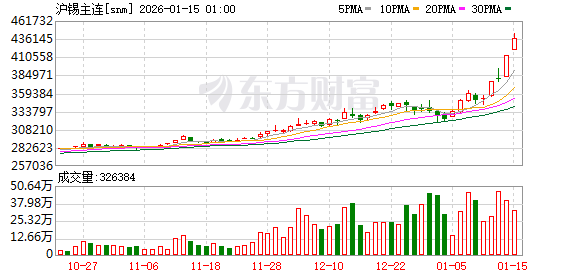
Group 1 - The core viewpoint of the articles highlights the strong upward trend in tin prices driven by macroeconomic sentiment and external market influences, with the Shanghai Futures Exchange tin futures reaching over 400,000 yuan/ton and the London Metal Exchange tin prices peaking at 52,495 USD/ton [2] - Recent optimism in the market is attributed to dual factors: expectations of U.S. fiscal and monetary easing, and a weaker dollar, alongside domestic policy expectations for increased measures in the new five-year plan [2] - The resumption of tin mining in Myanmar is expected to improve supply, but there remains a projected supply gap for the year, while demand from emerging industries such as electric vehicles, photovoltaics, and artificial intelligence is significantly increasing [2] Group 2 - The continuous rise in tin prices reflects long-term supply disruptions centered around the restructuring of Myanmar's Wa State tin industry and the strategic metal premium driven by investments in smart chips and semiconductors [3] - The Shanghai Futures Exchange has issued multiple risk warnings and control measures since December to guide rational market participation amid rising volatility in non-ferrous and precious metal prices [3] - Industry associations have called for a rational approach to maintain market order and stability, urging participants to avoid speculative behaviors and to collaboratively guide prices back to reasonable levels [4] Group 3 - The market currently views tin as a "computing metal," with optimistic demand forecasts, particularly as AI investments are expected to support tin consumption growth through 2026 [4] - However, there are concerns that the acceleration in tin prices may have already priced in long-term demand increases, and the cancellation of export tax rebates for photovoltaic products may only provide a short-term boost to tin consumption [5] - The current market fundamentals have not changed significantly, with stable production from domestic smelters and rising inventories due to weakened consumption, although overall inventory levels remain low [5]
有色金属周度策略-20260112
Fang Zheng Zhong Qi Qi Huo· 2026-01-12 03:28
1. Report Industry Investment Rating The report does not mention the industry investment rating. 2. Core Views of the Report - The non - farm payroll data in the US in December 2025 was lower than expected, with data for October and November revised downwards. The market expects the Fed to cut interest rates by about 50 basis points in 2026. The non - ferrous metals sector started strongly in 2026, and although there was short - term profit - taking, the overall upward trend remained unchanged. The prices of copper, aluminum, tin, nickel, and other metals showed different trends driven by factors such as supply - demand relationships, macroeconomic conditions, and geopolitical factors [3][10][11]. - China's economic data in December 2025 was positive. The official manufacturing PMI returned to the expansion range, and the non - manufacturing PMI was also better than expected. The central bank emphasized increasing counter - cyclical and cross - cyclical adjustments [10]. - The US economic data was mixed. The ISM manufacturing index in December 2025 shrank, but the ISM services index reached a new high in more than a year. The employment data was weak, and the market's expectation of Fed rate cuts remained [10][11]. 3. Summary by Directory 3.1 First Part: Non - ferrous Metals Operation Logic and Investment Recommendations - **Macro - level factors**: In 2026, a relatively loose monetary environment, AI technological development, increased attention to key mineral supply chains, and resource nationalism in resource - rich countries supported the non - ferrous metals sector. However, there was short - term high - volatility due to profit - taking [10]. - **China's economic situation**: In December 2025, China's official manufacturing PMI was 50.1, and the non - manufacturing PMI was 50.2, both better than expected. The central bank planned to increase counter - cyclical and cross - cyclical adjustments [10]. - **US economic situation**: The US ISM manufacturing index in December 2025 shrank, the "small non - farm" ADP employment in December increased by 41,000, lower than expected. The non - farm payroll in December increased by only 50,000, lower than the expected 65,000. The market expected the Fed to cut interest rates by about 50 basis points in 2026 [10][11]. - **Investment recommendations for each metal**: - **Copper**: It was recommended to buy on dips. The short - term upper pressure range was 108,000 - 110,000 yuan/ton, and the lower support range was 98,000 - 99,000 yuan/ton. Consider the reverse - spread opportunity between the 2602 and 2603 copper contracts and buy deep - out - of - the - money long - term call options [3][4]. - **Aluminum and its industrial chain**: For aluminum, a bullish approach was recommended, with the upper pressure range at 24,500 - 25,000 yuan/ton and the lower support range at 22,000 - 22,300 yuan/ton. Buy out - of - the - money put options for protection. For alumina, sell on rallies, with the upper pressure range at 2,900 - 3,000 yuan/ton and the lower support range at 2,000 - 2,200 yuan/ton. Buy out - of - the - money call options for protection. For recycled aluminum alloy, a bullish approach was recommended, with the upper pressure range at 23,500 - 24,000 yuan/ton and the lower support range at 21,000 - 21,500 yuan/ton. Buy out - of - the - money put options for protection [5]. - **Tin**: Temporarily wait and see or take a bullish approach. The upper pressure range was 360,000 - 380,000 yuan/ton, and the lower support range was 310,000 - 320,000 yuan/ton. Buy out - of - the - money put options for protection [6]. - **Zinc**: It was relatively strong and followed the overall sector. The upper pressure was around 24,300 - 24,500 yuan/ton, and the short - term lower support was around 23,600 - 23,800 yuan/ton. Consider the bull - spread option strategy [6]. - **Lead**: It was expected to oscillate and rise. The short - term lower support was around 17,000 - 17,200 yuan/ton, and the upper resistance was around 17,800 - 18,000 yuan/ton. Use a covered - call option strategy [7]. - **Nickel and stainless steel**: Nickel showed high - elasticity and short - term strength. The upper resistance was around 140,000 - 142,000 yuan, and the lower support was around 130,000 - 132,000 yuan. Use options to protect long positions. For stainless steel, a bullish approach on dips was recommended, with the price range at 13,000 - 14,200 yuan [7]. 3.2 Second Part: Non - ferrous Metals Market Review - **Futures price changes**: Copper closed at 101,410 yuan/ton, up 3.23%; aluminum at 24,330 yuan/ton, up 6.99%; tin at 352,540 yuan/ton, up 9.17%; nickel at 139,090 yuan/ton, up 4.70%; stainless steel at 13,860 yuan/ton, up 5.60%; zinc at 23,970 yuan/ton, up 2.99%; alumina at 2,843 yuan/ton, up 2.34%; lead at 17,355 yuan/ton, unchanged; and cast aluminum alloy at 22,985 yuan/ton, up 1.77% [17]. 3.3 Third Part: Non - ferrous Metals Spot Market - **Spot price changes**: Copper spot prices decreased, with the Yangtze River Non - ferrous copper spot price at 100,720 yuan/ton, down 1.88%. Zinc spot prices also decreased, with the Yangtze River Non - ferrous 0 zinc spot price at 24,020 yuan/ton, down 0.66%. Aluminum spot prices were stable, with the Yangtze River Non - ferrous aluminum spot average price at 24,000 yuan/ton, unchanged. Alumina spot prices were stable, with the Antaike national alumina average price at 2,693 yuan/ton, unchanged [23]. 3.4 Fourth Part: Key Data Tracking of Non - ferrous Metals Industry Chain - **Copper**: Included data on exchange copper inventory changes, SMM social copper inventory changes, copper concentrate rough - smelting fees, and the relationship between the US dollar index and copper prices [26]. - **Zinc**: Included data on zinc inventory changes, zinc concentrate processing fees, zinc spot market prices, galvanized sheet production seasonality, and the weekly inventory seasonality of SMM seven - region zinc ingots [28]. - **Aluminum and alumina**: Included data on the relationship between Shanghai aluminum inventory and aluminum prices, LME aluminum inventory and LME aluminum prices, the average price trend of Yangtze River Non - ferrous A00 aluminum ingots, the comparison of China's electrolytic aluminum in - production capacity and total capacity, alumina spot price trends, alumina port inventory changes, and alumina capacity and operating rate trends [32][38]. - **Tin**: Included data on the relationship between Shanghai tin prices and spot premiums, LME tin prices and spot premiums, the relationship between Shanghai tin inventory and LME tin inventory, tin concentrate processing fees, and the seasonal diagram of China's refined tin production [44][47][49]. - **Lead**: Included data on SHFE lead futures inventory, LME lead inventory, LME lead 0 - 3 premiums, lead concentrate processing fees, primary lead operating rate, and SMM lead - acid battery weekly operating rate [56][59][61]. - **Nickel and stainless steel**: Included data on SHFE nickel futures inventory, LME nickel inventory, refined nickel spot premiums, LME nickel 0 - 3 premiums, the average price of nickel - iron, the average price of battery - grade nickel sulfate, stainless steel warehouse receipts, the inventory of 300 - series cold - rolled stainless steel in Wuxi and Foshan, and the profit margin of 304 cold - rolled stainless steel [63][68][70]. 3.5 Fifth Part: Non - ferrous Metals Arbitrage - **Copper**: Recommended a reverse - spread between the 2602 and 2603 copper contracts due to supply constraints and the Fed's rate - cut and balance - sheet - expansion cycle [17]. - Also included data on the changes in the copper Shanghai - London ratio, the premium between Shanghai copper and London copper, and other relevant arbitrage - related data [75]. 3.6 Sixth Part: Non - ferrous Metals Options - **Copper**: Included data on copper option historical volatility, weighted implied volatility, trading volume and open - interest changes, and the ratio of call to put open - interest [95][97]. - **Zinc**: Included data on zinc historical volatility, zinc option weighted implied volatility, trading volume and open - interest changes, and the ratio of call to put open - interest [99]. - **Aluminum**: Included data on aluminum option trading volume and open - interest trends, the ratio of call to put open - interest trends, and Shanghai aluminum volatility trends [100].