
商业航天与卫星

Search documents
太空基建不断加速-持续看好商业航天与卫星产业链
2026-01-29 02:43
Summary of Key Points from Conference Call Industry Overview - The conference call focuses on the commercial aerospace and satellite industry, highlighting rapid advancements and investment opportunities in this sector [1][2]. Core Insights and Arguments - **Rocket Reusability**: Breakthroughs in rocket reusability technology are expected by 2026, which will lower launch costs and enhance competitiveness in commercial aerospace [1][2]. - **Low Earth Orbit (LEO) Satellite Internet**: The development of LEO satellite internet is accelerating, with Starlink achieving near 5G speeds and increasing its user base from 2 million in 2022 to approximately 8-9 million currently [2][4]. - **Global Expansion of LEO Networks**: Companies like Blue Origin and OneWeb are expanding their LEO satellite networks, with OneWeb planning to deploy over 400 satellites [2][3]. - **China's Strategic Moves**: China has applied for frequency resources for 203,000 LEO and medium Earth orbit satellites, indicating a strategic push to secure limited resources in the satellite industry [3][4]. - **Technological Integration**: The integration of commercial aerospace with AI and other emerging technologies is expected to enhance data processing capabilities and improve applications in various sectors [5][6]. Investment Opportunities - **Space Infrastructure**: Investment opportunities include space computing, solar power, 3D printing, and satellite internet, particularly in the context of 6G technology [8][9]. - **LEO Satellites**: There is a significant demand for upgrading TR components and antenna sizes to improve signal quality and bandwidth [9][10]. - **Platform and Service Companies**: Companies providing production testing solutions and satellite asset management services are poised for growth as the industry expands [10][11]. Additional Important Insights - **Technological Innovations**: Key innovations include larger antenna arrays for better connectivity, advanced TR components to counteract Doppler frequency shifts, and upgrades in baseband payloads to meet higher bandwidth demands [12][13][14]. - **Market Dynamics**: The satellite industry is experiencing a shift from mere transmission capabilities to include space computing and solar power, driven by increasing demand and limited supply [7][8]. This summary encapsulates the essential points discussed in the conference call, providing a comprehensive overview of the commercial aerospace and satellite industry's current state and future prospects.
AI光提速电话会议-重视商业航天和卫星大机遇
2026-01-26 02:49
Summary of Conference Call on Commercial Aerospace and Satellite Opportunities Industry Overview - The commercial aerospace industry is primarily driven by enterprises and operates through market-oriented methods, encompassing a supply chain that includes spacecraft research and manufacturing (upstream), launch and satellite operations (midstream), and applications such as communication, navigation, and remote sensing (downstream) [1][2] Key Insights and Arguments - Reusable rocket technology is crucial for cost reduction and efficiency in commercial aerospace. SpaceX's Falcon 9 has successfully recovered 382 times and reused 343 times, significantly lowering launch costs, with a target to reduce costs to below $100 per pound [1][5] - The Chinese version of the "Starlink" plan includes projects like StarNet (with several thousand satellites, 150 launched), Qianfan G60 (over 10,000 planned, with over 1,000 expected this year), and Honghu, which are accelerating development [1][6] - The value distribution in the commercial rocket and satellite supply chain is approximately 25%-30% for upstream, 30%-40% for midstream, and 30%-40% for downstream applications. The total value of 10,000 satellites annually can reach several hundred billion RMB [1][8] Important Developments - Significant advancements in the commercial aerospace and satellite supply chain have occurred since December 2025, including breakthroughs in reusable rocket technology and the IPO application of Blue Arrow Aerospace, which plans to raise 7.5 billion RMB for enhancing reusable rocket capacity [3] - SpaceX plans to build 200GW of solar capacity in the U.S. over the next three years for ground data centers and space AI functions, aiming to deploy approximately 1 million solar AI satellites annually to achieve a 100GW space solar milestone by 2030 [3][4] Competitive Landscape - Leading domestic companies like Blue Arrow Aerospace focus on liquid oxygen-methane engines and rocket development, aiming for a fully integrated supply chain. Internationally, SpaceX's Falcon 9 significantly reduces launch costs through reusable technology, with a goal of complete reusability by 2030 [9] - Other notable companies in the sector include Shunfeng Aviation Technology, which is also advancing similar technologies [9] Investment Directions - Investment directions in the commercial rocket sector include five areas: vehicle structure, propulsion systems, control systems, total assembly integration, and complete machine testing. Companies like Haige Communication, China Mobile, and China Electronics Technology Group have strong competitive advantages in various segments [10][11]
卫星ETF年内普涨15%吸金49亿,商业航天资金分化 华夏航空航天ETF净流出超4亿,华泰柏瑞通用航空ETF同步流出
Xin Lang Cai Jing· 2026-01-09 08:48
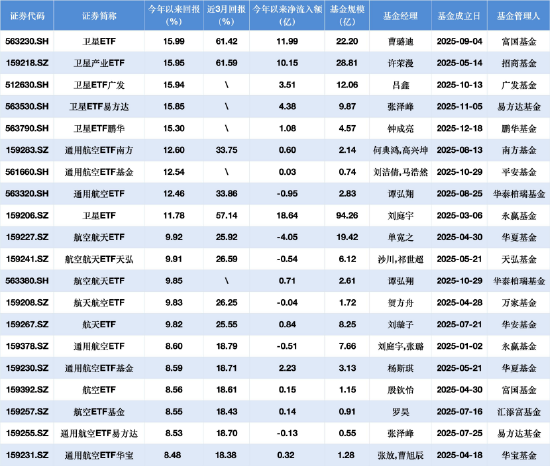
Core Viewpoint - The commercial aerospace and satellite industry is experiencing significant market interest, driven by a combination of policy, technology, and capital, leading to rapid development in this sector [1][5]. Market Performance - As of January 9, the China Securities Satellite Industry Index has increased by 22% year-to-date, while the National Certificate Commercial Satellite Communication Industry Index has risen over 18%, both showing a trend of consecutive daily gains [1][5]. - Several satellite and general aviation-themed ETFs have dominated the top of the ETF performance list, with notable returns: - The satellite ETF from Fortune Fund (563230.SH) has a year-to-date return of 15.99% and a three-month return of 61.42% - The satellite industry ETF from China Merchants Fund (159218.SZ) has a year-to-date return of 15.95% and a three-month return of 61.59% [2][6]. Fund Flows - The satellite ETF from Yongying Fund (159206.SZ) has seen a net inflow of 1.864 billion yuan, nearing a total scale of 9.426 billion yuan. Other satellite ETFs from Fortune and China Merchants have also experienced net inflows exceeding 1 billion yuan [2][7]. - In contrast, some aerospace-themed ETFs have shown signs of profit-taking, with the China Merchants Aerospace ETF (159227.SZ) experiencing a net outflow of 405 million yuan year-to-date [4][8]. Industry Outlook - The year 2026 is anticipated to be a significant year for China's commercial aerospace launches, with expected launch counts surpassing 100. Several private aerospace companies plan to complete key model first flights or recovery validations [4][8]. - Breakthroughs in rocket recovery technology are projected to reduce launch costs by 70% to 90%, facilitating a shift towards a "flight-like" era for satellite launches. Additionally, large-scale networking plans from companies like China Star Network are expected to drive demand across the entire supply chain, including satellite manufacturing, rocket launches, and ground equipment [4][8].


开源证券:8连阳后看本轮春季躁动的变化
智通财经网· 2025-12-27 13:38
Core Viewpoint - The strong inflow of incremental funds has driven the recent market rally, contributing to the Shanghai Composite Index achieving eight consecutive days of gains, and there is a recommendation to actively position for the upcoming spring market rally, focusing on both technology and cyclical sectors [1][2]. Group 1: Market Performance - As of December 26, 2025, the Shanghai Composite Index has achieved eight consecutive days of gains, marking the third occurrence since the "9.24" market rally in 2024 [2]. - The market has shown signs of recovery from previous adjustments, with three major factors influencing the market's positive outlook diminishing [2]. Group 2: Fund Inflows - December saw an unusual net inflow into broad-based ETFs, with a total net inflow of 110.6 billion yuan, primarily driven by the A500 ETF, which accounted for 101.9 billion yuan, or 92.2% of the total [3]. - The net inflow into the A500 ETF is likely to be new capital rather than a reallocation from other ETFs, indicating a strong demand for this specific fund [3]. Group 3: Investment Opportunities - The current macroeconomic environment, characterized by PPI recovery and anti-involution policies, alongside a weak dollar and increased demand for AI hardware, presents investment opportunities in various sectors, including chemicals, new energy materials, and electronic communication products [4]. - The investment strategy should focus on technology and PPI, with attention to new marginal changes, such as the strengthening of domestic demand policies and the potential for growth in commercial aerospace and satellite industries [5]. Group 4: Sector Allocation - Recommended sector allocations include technology sectors such as military, media (gaming), AI applications, and core AI hardware, as well as PPI beneficiaries like photovoltaic, chemicals, steel, and power [5]. - Long-term holdings should consider gold and optimized high-dividend stocks as part of the investment strategy [5].
投资策略周报:牛市眼光看后市,震荡思维买当下-20251221
KAIYUAN SECURITIES· 2025-12-21 11:43
Group 1 - The report emphasizes that the market's repair process is ongoing despite recent fluctuations, with strong sectors like AI hardware and military industries showing new opportunities [1][9][12] - The current market structure indicates that high-growth sectors outperform small caps, which in turn outperform the Shanghai Composite Index, reflecting external liquidity disturbances and the need for a strategic approach to stabilize profit-making effects [1][11][12] Group 2 - Three main factors affecting the market's repair process are identified: the nearing interest rate hike in Japan, concerns about the limited space for future rate cuts by the Federal Reserve, and the weak economic data coupled with a lackluster central economic work conference [2][18][33] - The report suggests that the core drivers of the current bull market remain unchanged, with liquidity still being accommodative and the fundamentals showing moderate recovery, despite external risks impacting the market [13][41] Group 3 - The report recommends focusing on sectors that benefit from technology and PPI improvements, with specific attention to commercial aerospace and satellite industries as strong themes for investment [3][50][58] - The report highlights the importance of the domestic consumption market, particularly in lower-tier cities, as a growing contributor to overall retail growth, indicating a structural shift in consumer behavior [52][54]