
央行购金趋势

Search documents
世界黄金协会美洲区CEO:全球央行连续16年净买入,定价逻辑生变
Mei Ri Jing Ji Xin Wen· 2026-02-23 23:34
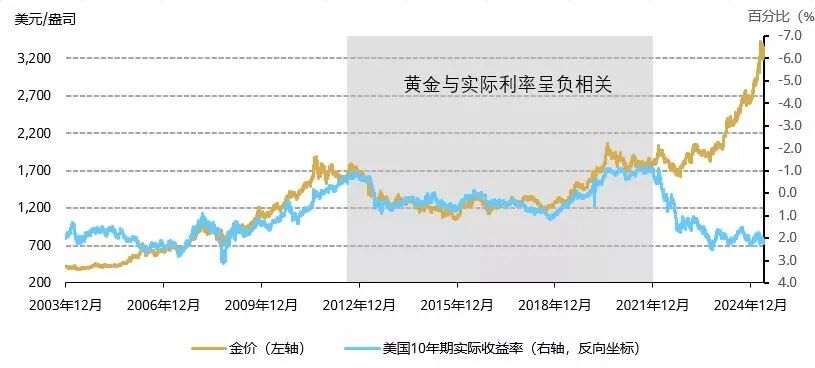
Core Viewpoint - The global gold market is undergoing a structural transformation driven by central bank demand and risk aversion, making gold an essential liquidity buffer in asset allocation [1]. Group 1: Key Drivers of Gold Prices - In 2026, the primary driver for gold valuation is the increased risk and uncertainty in the macroeconomic environment, influenced by geopolitical tensions and financial market pressures [2]. - The demand for gold as a high-quality safe-haven asset has significantly risen due to these factors, alongside a decrease in the opportunity cost of holding gold as the international situation pressures the US dollar [2]. - Despite recent market volatility, gold's stable price performance has attracted substantial cash inflows, creating positive momentum for its growth [2]. Group 2: Relationship with Real Interest Rates - The traditional negative correlation between gold prices and US 10-year real interest rates has weakened, primarily due to other supporting factors like geopolitical risks and strong central bank purchases offsetting the negative impact of rising real rates [3][4]. - The relationship between gold and real interest rates has not disappeared; rather, other macroeconomic forces have become more critical, diminishing the dominance of real yields [4]. Group 3: Central Bank Gold Purchases - Global central banks have maintained a net buying trend for 16 consecutive years, indicating a significant structural change in the gold market [6]. - Although central bank gold purchases slowed in 2025 to 863 tons, this figure remains well above historical averages, reflecting ongoing interest in gold for its crisis performance and inflation-hedging properties [6]. - Emerging market central banks hold about 15% of their foreign exchange reserves in gold, which is half of that of developed markets, suggesting substantial growth potential in future gold demand [7]. Group 4: Gold as a High-Quality Liquid Asset - Gold is increasingly viewed as a major competitor to US Treasuries in the realm of high-quality liquid assets (HQLA), despite not being officially classified as such under Basel III [8]. - During market stress, gold has demonstrated superior liquidity compared to long-term US Treasuries, characterized by deep market depth and stable bid-ask spreads [9]. Group 5: Gold's Role in Diversified Investment Portfolios - In a world of persistent inflation volatility, traditional 60/40 investment portfolios are struggling, and gold is seen as a stabilizing asset that enhances diversification and reduces drawdowns [11]. - Historical analysis indicates that gold improves risk-adjusted returns, particularly in environments where stock-bond correlations rise due to inflation shocks or monetary policy tightening [11]. Group 6: Market Dynamics and Demand Measurement - The surge in over-the-counter (OTC) purchases and unallocated gold accumulation has prompted the World Gold Council to refine its methodologies for capturing this "hidden" demand [12]. - While OTC transactions can significantly influence prices during specific periods, the overall gold market is shaped by a diverse range of participants, including jewelry consumers, technology sectors, and various investors [12].

2026年金价新逻辑 专访世界黄金协会美洲区CEO:全球央行连续16年净买入 一场“结构性变化”正在发生
Mei Ri Jing Ji Xin Wen· 2026-02-19 13:49
Core Insights - The global economic landscape remains volatile in 2026, with gold becoming a focal point for investors due to its perceived value as a safe-haven asset amid rising geopolitical tensions and financial market uncertainties [1]. Group 1: Key Drivers of Gold Market - Gold is undergoing a "structural transformation" driven by central bank purchases and heightened risk aversion, establishing itself as an essential liquidity buffer in asset allocation [1]. - In 2026, the primary driver for gold valuation is the increased risk and uncertainty in the macroeconomic environment, significantly boosting demand for gold as a high-quality safe-haven asset [2]. - The relationship between gold prices and U.S. Treasury yields has weakened, primarily due to other supporting factors like geopolitical risks and strong central bank purchases, which counterbalance the negative impact of rising real interest rates [3][4]. Group 2: Central Bank Purchases - Central banks have maintained a net buying trend for 16 consecutive years, indicating a significant structural change in the gold market, despite a slowdown in purchases in 2025 [6]. - In 2025, central bank gold purchases totaled 863 tons, lower than the historical highs of over 1,000 tons from 2022 to 2024, yet still above historical averages [6]. - Emerging market central banks view gold as a crucial hedge against geopolitical risks, with their gold reserves constituting about 15% of foreign exchange reserves, indicating substantial growth potential [7]. Group 3: Gold as a Liquid Asset - Gold is increasingly viewed as a reliable alternative to U.S. Treasury securities, especially in light of concerns over U.S. fiscal sustainability and debt levels [8]. - During market stress, gold has demonstrated superior liquidity compared to long-term U.S. Treasuries, characterized by deep market depth and stable bid-ask spreads [9]. - Reserve managers are increasingly considering gold as a non-sovereign asset to enhance portfolio resilience and liquidity buffers [10]. Group 4: Investment Strategies - In a world of persistent inflation volatility, traditional 60/40 investment portfolios are struggling, with gold historically improving risk-adjusted returns by enhancing diversification and reducing drawdowns [12]. - The World Gold Council does not provide specific gold price forecasts but outlines hypothetical scenarios in its 2026 gold outlook, indicating that worsening macroeconomic or geopolitical conditions could drive prices higher [13].
2026年金价新逻辑,专访世界黄金协会美洲区CEO:全球央行连续16年净买入,一场“结构性变化”正在发生
Mei Ri Jing Ji Xin Wen· 2026-02-19 10:17
Core Viewpoint - The global gold market is undergoing a structural transformation driven by central bank demand and heightened risk aversion, making gold an essential liquidity buffer in asset allocation [1]. Group 1: Key Drivers of Gold Prices - In 2026, the primary driver for gold valuation is the increased risk and uncertainty in the macroeconomic environment, influenced by geopolitical tensions and localized financial market pressures [2]. - The traditional negative correlation between gold prices and U.S. 10-year Treasury yields has weakened, primarily due to other supporting factors such as geopolitical risks and strong central bank purchases offsetting the negative impact of rising real interest rates [2][3]. - Despite fluctuations, gold's stable price performance has attracted significant cash inflows, creating a positive growth momentum [2]. Group 2: Central Bank Gold Purchases - Global central banks have maintained a net buying trend for 16 consecutive years, indicating a significant structural change in the gold market [6]. - Although central bank gold purchases slowed to 863 tons in 2025, this figure remains above historical averages, reflecting ongoing demand driven by gold's crisis performance and inflation-hedging properties [6]. - Emerging market central banks view gold as a crucial tool for hedging geopolitical risks, with their gold reserves constituting about 15% of foreign exchange reserves, indicating substantial growth potential [6]. Group 3: Gold as a High-Quality Liquid Asset - Gold is increasingly viewed as a reliable, non-sovereign alternative to enhance portfolio resilience and liquidity, especially during market stress periods [7]. - Although gold is not officially classified as a High-Quality Liquid Asset (HQLA) under Basel III, its market performance demonstrates characteristics of such assets, including deep market liquidity and orderly trading during volatility [6][7]. Group 4: Gold's Role in Diversified Investment Portfolios - In a world of persistent inflation volatility, traditional 60/40 investment portfolios are struggling, and gold is seen as a stabilizing component in diversified portfolios [10]. - The Qaurum model indicates that gold typically improves risk-adjusted returns in various macro environments, particularly when stock-bond correlations rise [10]. - The World Gold Council does not predict gold prices but outlines hypothetical scenarios where worsening macroeconomic or geopolitical conditions could drive prices higher [11].

世界黄金协会美洲区CEO解读2026年金价新逻辑:地缘风险成首要因素,全球央行连续16年净买入
Mei Ri Jing Ji Xin Wen· 2026-02-18 06:30
Group 1 - The core viewpoint of the article emphasizes that gold is undergoing a structural transformation driven by central bank demand and risk aversion, making it an essential liquidity buffer in asset allocation [2][16] - In 2026, the primary driver for gold valuation is the rising risk and uncertainty in the geopolitical landscape, which has significantly increased demand for gold as a high-quality safe-haven asset [4][18] - The traditional negative correlation between gold prices and the real yield of 10-year U.S. Treasury bonds has weakened, primarily due to other supporting factors like geopolitical risks and strong central bank purchases [4][19] Group 2 - Central banks have maintained a net buying trend for 16 consecutive years, with 2025's gold purchases at 863 tons, still above historical averages despite a slowdown compared to previous years [7][21] - Emerging market central banks hold about 15% of their foreign exchange reserves in gold, which is half of that of developed markets, indicating significant growth potential for future demand [7][21] - Gold is increasingly viewed as a reliable, non-sovereign alternative to enhance portfolio resilience and liquidity, especially during market stress [8][24] Group 3 - The Qaurum model indicates that gold's strong performance is typically associated with heightened market risks and volatility, suggesting that its optimal allocation in diversified portfolios depends on specific investor goals and risk preferences [12][26] - The article does not provide a specific price forecast for gold but outlines hypothetical scenarios where worsening macroeconomic or geopolitical conditions could drive prices higher [12][27] - The rise of over-the-counter (OTC) transactions and unallocated gold accumulation has increased, complicating the quantification of demand, but the overall market dynamics are influenced by a diverse range of participants [12][27]

盎格鲁黄金获机构上调目标价,股价近期显著上涨
Jing Ji Guan Cha Wang· 2026-02-11 13:16
Core Viewpoint - The market maintains a "buy" rating for AngloGold, raising the target price to $107, supported by predictions of gold prices potentially reaching $6,000 by 2026 due to geopolitical risks and a weakening dollar, which indirectly benefits gold mining stocks [1]. Group 1: Institutional Views - Over the past week, AngloGold's stock price has shown significant volatility, with a range increase of 7.67% and a fluctuation of 11.70%. The stock closed at $98.59 on February 5, rose to $103.95 on February 6, further increased to $107.19 on February 9, and reached a latest closing price of $108.61 on February 10. The total trading volume during this period was approximately $10.4 billion [2]. Group 2: Recent Events - The international gold price experienced a "roller coaster" trend over the past week, rebounding above $5,000 per ounce after a drop from historical highs. Key drivers include geopolitical risks, changes in Federal Reserve policy expectations, and central bank gold purchases. On February 3, gold prices recorded the largest single-day increase since 2009, followed by stabilization that boosted sentiment in gold mining stocks [3].
张尧浠:金银获利了结跳水调整 中长期看涨前景仍不变
Xin Lang Cai Jing· 2025-12-30 10:58
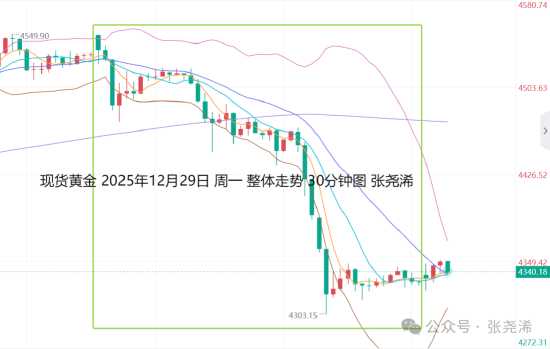
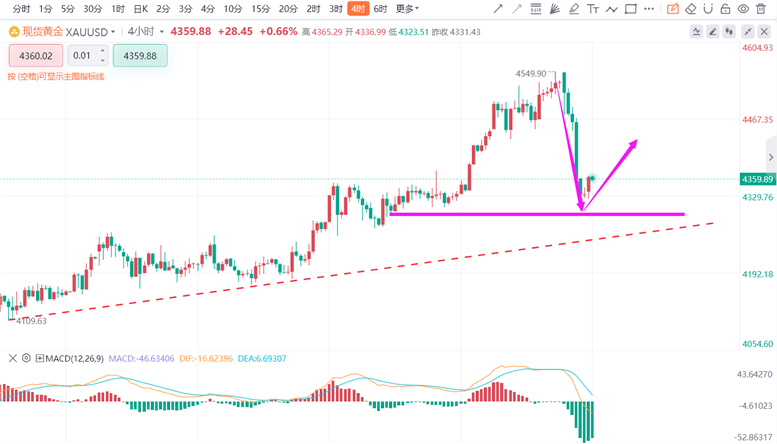
Core Viewpoint - International gold prices experienced a significant drop, falling over $200, as profit-taking occurred after a bullish week, but the overall trend remains upward with technical support from moving averages [1][12]. Group 1: Market Performance - On December 29, gold opened at $4,537.12 per ounce, reached a high of $4,548.58, and then fell to a low of $4,303.73, closing at $4,331.93, marking a daily decline of $202.19 or 4.46% [1][12]. - The daily trading range was $244.85, indicating high volatility during the session [1][12]. Group 2: Future Outlook - The opening on December 30 saw gold prices supported by buying interest at the mid-chart level, with geopolitical tensions providing a positive boost [3][13]. - Despite a bearish outlook from upcoming U.S. economic indicators, the long-term bullish sentiment for gold remains intact due to global economic uncertainties and geopolitical risks [3][14]. - The market is closely watching the Federal Reserve's upcoming policy meeting minutes, which may influence gold prices depending on the tone regarding interest rates [14][16]. Group 3: Technical Analysis - The gold price is currently supported by various moving averages, indicating potential buying opportunities if prices retrace to these levels [9][10]. - The monthly chart shows a potential bearish pattern, suggesting risks of a drop to the $4,000-$3,900 range, but a strong performance in the following month could lead to a bullish outlook towards $5,500-$6,000 [16][19]. Group 4: Influencing Factors - The selection of the next Federal Reserve Chair is seen as a critical factor that could either support or hinder gold prices, with expectations leaning towards a more dovish approach [4][8][17]. - Continued adjustments in central bank reserve structures and persistent inflationary pressures are expected to support gold demand in the long term [16].
张德盛:12.30黄金今日还会涨吗?积存金行情走势分析操作
Sou Hu Cai Jing· 2025-12-30 03:28
Market Overview - International gold prices experienced a significant drop, falling over $200, as investors opted for profit-taking after a week of bullish activity and a surge in silver prices [3] - Despite the recent decline, the overall trend remains bullish, supported by global economic uncertainties, geopolitical risks, and central bank gold purchases [3] Technical Analysis - Gold prices fell from a peak to a low of 4305, indicating a substantial decline, but the market has not broken key support levels, suggesting a potential for recovery [4] - If gold stabilizes above 4400, it may indicate a shift back to a strong bullish trend, with targets set at 4500 [4] Investment Strategy - Investors are advised to consider entering long positions in gold, particularly if prices approach 4330, with initial targets at 4400 and further upside potential at 4500 [4] - For domestic gold contracts, a cautious approach is recommended, with opportunities to enter long positions as the market adjusts after recent declines [4]
Gold price today, Monday, October 6: Gold opens above $3,900 for the first time
Yahoo Finance· 2025-10-06 11:57
Core Insights - Gold futures opened at $3,913.50 per ounce, marking the first time it has opened above $3,900, reflecting a 0.8% increase from the previous close of $3,880.80 [1][4] Price Trends - The current opening price of gold is up 4.2% from the opening price of $3,754.80 one week ago and has increased 9.7% from the opening price of $3,567.80 a month ago [4] - Over the past year, gold prices have surged by 47.3% from the opening price of $2,656 on October 4, 2024 [4] Market Context - Gold's record-high pricing coincides with strong performances in stocks and Bitcoin, with the S&P 500 and Dow Jones Industrial Average reaching new highs and Bitcoin surpassing $125,000 for the first time [2] - Despite the U.S. government shutdown and data reporting pauses, there is a high expectation for an interest rate cut later this month, with a 94.6% probability for a quarter-point reduction [2] Factors Influencing Gold Prices - Gold prices typically rise during periods of economic uncertainty and declining interest rates [3] - Key factors affecting gold prices include geopolitical events, central bank buying trends, inflation, interest rates, and mining production [9][14]
高盛高举看涨大旗:金价超预期上涨的风险更高!
Jin Shi Shu Ju· 2025-10-01 09:43
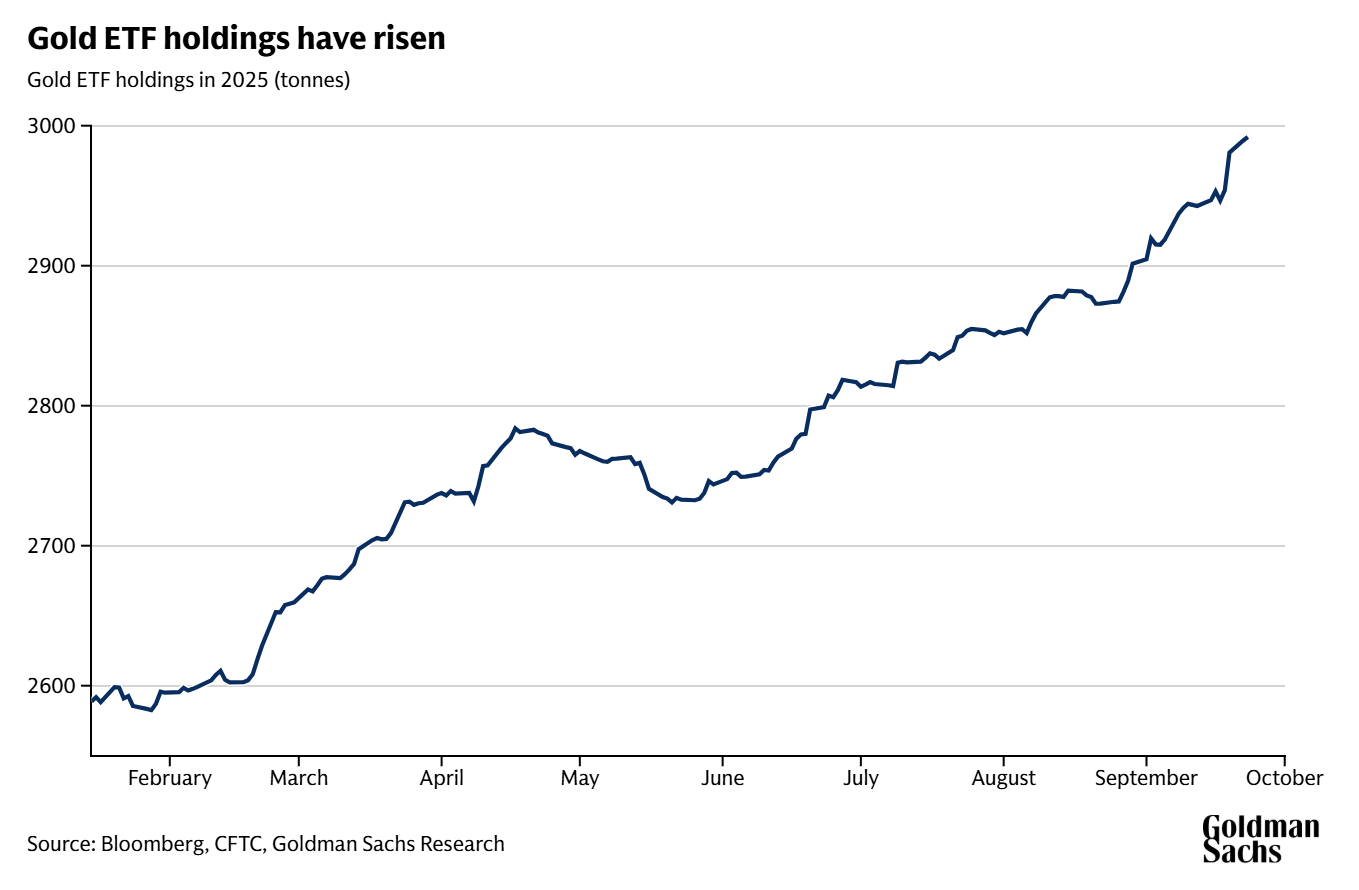
Core Viewpoint - Goldman Sachs reaffirms its prediction that gold prices will reach $4,000 per ounce by mid-2026, driven by strong demand from core buyers, particularly central banks and gold ETFs [2][5]. Group 1: Gold Price Forecast - Gold prices have increased nearly 48% since 2025 and are expected to record double-digit growth for the third consecutive year [2][5]. - The forecast is supported by two main factors: robust structural demand from central banks and the accommodative policies of the Federal Reserve, which will boost gold ETF demand [5]. Group 2: Buyer Categories - Gold buyers are categorized into two groups: "steadfast buyers" and "speculative buyers." Steadfast buyers, including central banks and gold ETFs, tend to buy regardless of price fluctuations, while speculative buyers, such as household investors in emerging markets, enter the market based on perceived price attractiveness [5][6]. - A rule of thumb indicates that for every 100 tons of gold net bought by steadfast buyers, gold prices increase by approximately 1.7% [5]. Group 3: Central Bank Demand - Central banks' gold purchases have slowed in July but are expected to accelerate from September, aligning with seasonal trends [6]. - Since the onset of the Russia-Ukraine conflict in 2022, central banks, particularly in emerging markets, have increased their gold buying pace by about five times, indicating a structural shift in foreign reserve management [6][7]. Group 4: Emerging Market Central Banks - Emerging market central banks have a significantly lower gold allocation compared to developed market central banks, with estimates suggesting that China's gold holdings account for less than 10% of its foreign reserves, while developed economies have around 70% [7]. - A recent survey by the World Gold Council indicates that approximately 95% of central banks expect to increase their gold holdings in the next 12 months, with 43% planning to raise their gold reserves, the highest percentage since the survey began in 2018 [7]. Group 5: Speculative Positions - Large investors, including hedge funds, show a bullish sentiment towards gold in the derivatives market, with net long positions at the highest level since 2014 [8]. - The increase in speculative long positions may pose a risk of short-term price corrections, as historically, speculative holdings tend to revert to the mean [11].
有色金属行业观察:盛达资源采选业务收入增长显著;紫金矿业加码稀贵金属领域
Sou Hu Cai Jing· 2025-08-24 13:18
Group 1: Industry Overview - The non-ferrous metal industry is stabilizing in prices due to rising expectations of interest rate cuts by the Federal Reserve and a recovery in industrial demand during the peak season [1] - Precious metals and industrial metals prices have generally strengthened, with COMEX gold and silver rising by 1.05% and 2.26% respectively, while LME aluminum and copper prices have also seen slight increases [1] - Companies are enhancing their competitiveness through capacity expansion and strategic positioning, with a particular focus on Shengda Resources and Zijin Mining [1] Group 2: Shengda Resources - Shengda Resources reported a 44.24% year-on-year increase in revenue from its non-ferrous metal mining and selection business, reaching 640 million yuan [2] - The company's core mines exhibit high profitability, with a gross margin of 62.64%, showcasing both resource endowment and operational advantages [2] - Shengda has identified approximately 12,000 tons of silver and 34 tons of gold through its seven controlled mining subsidiaries, with ongoing efforts to integrate mining rights at its main mine [2] - The company is progressing with its capacity expansion plans, with new mines expected to gradually release production capacity, supported by the rising metal prices [2] Group 3: Zijin Mining - Zijin Mining has established Fujian Zijin Precious Metals Co., Ltd. with a registered capital of 5 billion yuan, extending its business into precious metal smelting and resource extraction [3] - This move aims to enhance the company's industrial chain and synergize with its existing copper and gold operations, improving comprehensive resource development capabilities [3] - Recent large transactions indicate institutional investors' recognition of Zijin Mining's long-term value, with a total of 43 large transactions amounting to 727 million yuan in the past three months [3] - The strategic actions and capital movements of Zijin Mining are positioned to capitalize on the favorable industry cycle, supported by macroeconomic policies and demand recovery [3]

